Think of a couple from Seattle standing outside their Delhi hotel at 6 AM with two large suitcases, a printed train ticket to Agra and a slightly nervous feeling about the station crowd. Their friends in the next room have booked a car with a driver and will leave an hour later, with breakfast still warm in their stomachs. Both couples will reach the Taj Mahal the same morning, yet their days will feel completely different. That small scene sums up the real question behind the best way to travel around India: there is no single right answer, only the right answer for each stretch of your route. India is huge, distances are long, and the three main options each win in different situations.
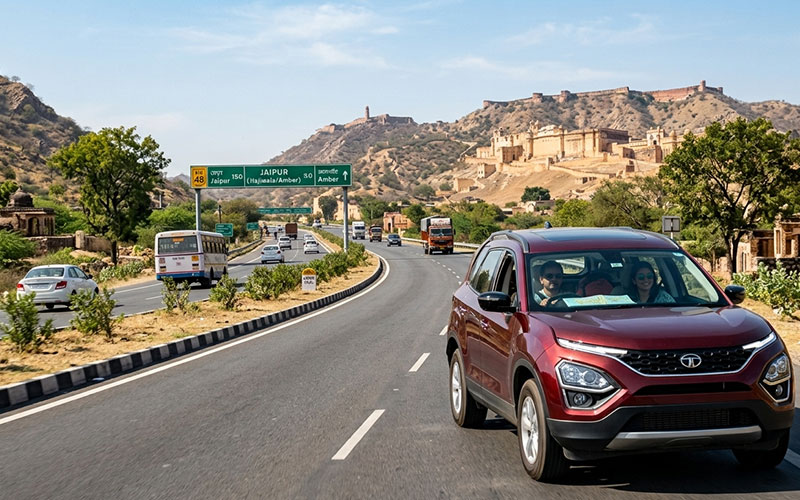
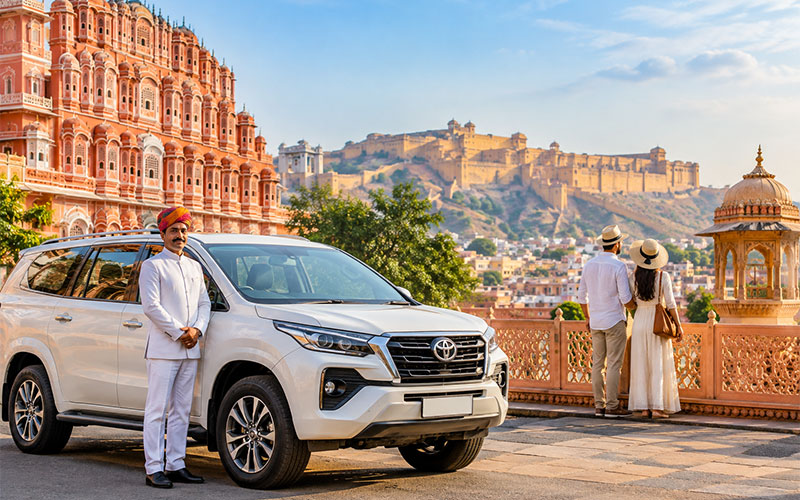
A private car with driver wins on flexibility and door-to-door comfort. You leave when you want, stop for photos at a stepwell or a roadside tea stall, and your luggage stays locked in the boot all day. The driver handles tolls, parking, fuel, state permits and the chaos of city traffic, which is the part most first-time visitors underestimate. The downside is time on long stretches: anything above 400 km becomes a full day in the vehicle. Cost is also higher for a solo traveller, though for a family of four or six the per-person rate often drops below the price of good train seats plus taxis at each end.
Trains in India win on certain fast corridors and on overnight journeys. The Gatimaan Express and Vande Bharat Express between Delhi and Agra are quicker than any car, and an overnight first-class sleeper between Delhi and Varanasi saves a hotel night. Trains also give you a slice of everyday Indian life that many guests remember fondly. The catch is the effort at either end: reaching the station early, finding the right platform, carrying bags up stairs and over footbridges, and then arranging a taxi at the other end. Tickets on popular routes also sell out weeks ahead, which surprises many visitors.
Domestic flights in India win on very long distances. Delhi to Varanasi, Delhi to Kochi, Mumbai to Udaipur or Jaipur to Goa are all jumps where flying saves a full day or more. Fares are reasonable if booked a few weeks ahead, and the major airlines are punctual by regional standards. However, the flight time is only part of the story. Add the drive to the airport, the recommended two-hour arrival window, security queues, baggage collection and the transfer to your hotel, and a 75-minute flight easily becomes a five-hour door-to-door day.
At Heritage India Private Tours, our founder Magan Singh has spent more than 27 years driving guests across Rajasthan and North India, and the pattern he sees again and again is simple. Guests who mix all three modes sensibly end up the happiest. They fly the long jumps, take a fast train where it clearly beats the road, and keep a car and driver for the scenic heartland of Rajasthan and the hill roads of Kerala. The sections below break that down with real routes, real fares and a sample two-week cost comparison, so you can decide which mode suits each leg of your own route.
One more factor deserves attention before the numbers: energy. A long rail day with luggage, or an early flight with a 4 AM wake-up call, takes a toll on the next day of sightseeing. A car day is slower but gentler, and you arrive at the hotel with the bags already handled. When guests compare options, we always suggest weighing time, cost, comfort and travel flexibility in India together rather than looking at the ticket price alone.
Discover India Your Way, with Every Journey Thoughtfully Planned
From the iconic Golden Triangle to Rajasthan's royal cities and beyond, experience India with the freedom of private travel. Enjoy a comfortable vehicle.
The Delhi to Agra train vs car comparison is the classic example. The Gatimaan Express leaves Hazrat Nizamuddin station at about 8:10 AM and reaches Agra Cantonment in roughly one hour and 45 minutes. The Vande Bharat Express from New Delhi covers the same distance in a similar time. By car, the 230 km run via the Yamuna Expressway takes about three and a half hours from central Delhi, and up to four and a half hours if you leave during the morning rush. On paper the train wins clearly. In practice, you must reach the Delhi station around 45 minutes early, which means leaving your hotel well before 7 AM, and then hire a taxi or guide at Agra Cantonment to reach the Taj Mahal.
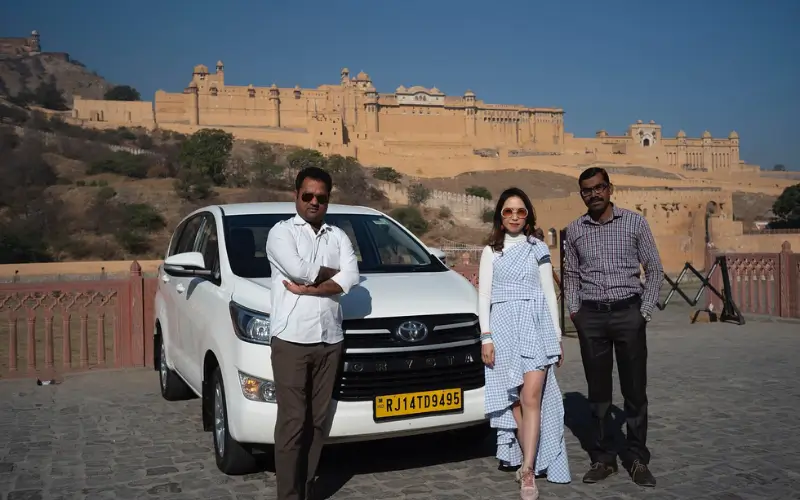
The car option, meanwhile, lets you leave at 6 AM, reach the Taj Mahal by about 9:30 AM, and then continue the same afternoon to Fatehpur Sikri and onward to Jaipur without returning to Delhi. That one-way flow is why most of our Golden Triangle by car guests skip the train entirely. If you are doing a same-day Agra trip from Delhi and returning at night, the train is a strong choice. If you are moving on to Jaipur, the car makes far more sense.
For Delhi to Jaipur, the distance is about 280 km. By car it takes four and a half to five and a half hours depending on Delhi traffic and the stretch near Gurugram. The Shatabdi Express from New Delhi takes roughly four and a half hours, and the newer Vande Bharat service from Delhi Cantonment takes about four hours. Flights exist, with about one hour in the air, but once airport time is added, flying rarely saves anything on this route. The train is comfortable and affordable here, but the car again wins if you want to stop at Neemrana Fort or the Abhaneri stepwell on the way.
Jaipur to Udaipur is where the car usually wins outright. The road distance is about 395 km and takes six and a half to seven and a half hours with a lunch stop. Day trains take around seven hours and run at limited times, and direct flights are few or connect through Delhi or Mumbai. By car you can break the drive at Chittorgarh Fort, one of the largest forts in India, or take the longer route via Pushkar and the Ranakpur temple. This is classic Rajasthan driving, and it is the kind of route where Magan Singh and our drivers know every good lunch halt and clean washroom stop.
Delhi to Varanasi is the opposite case. The road distance is about 820 km, which means 13 to 15 hours of driving, so we never recommend it by car. A direct flight takes about one hour and 25 minutes, and fares typically run INR 5,500 to 10,000 (about USD 66 to 120) one way in economy. The overnight train alternative, such as the Shiv Ganga Express from New Delhi, takes around 12 to 13 hours. A first-class AC berth costs roughly INR 4,000 to 4,800 (about USD 48 to 58), and second-class AC roughly INR 2,500 to 2,900. The overnight train saves a hotel night, but you arrive early in the morning and may sleep lightly with the rocking carriage.
Kochi to Munnar shows why road travel is unavoidable in some regions. There is no railway line or airport serving Munnar, so the 125 km climb into the tea hills is done only by road. It takes four to four and a half hours with photo stops at waterfalls and spice gardens. Onward from Munnar to Thekkady and then to the Alleppey backwaters is also road-only. For a South India loop, a car with driver in Kerala is the standard way to travel, usually starting from Kochi airport after a domestic flight from Delhi or Mumbai.
Indian Railways runs one of the largest networks in the world, and choosing the right class makes a big difference. For overnight journeys, First AC (1AC) is the top class on most trains. It has lockable cabins of two or four berths, bedding provided, and far fewer passengers per carriage. On the Delhi to Varanasi overnight run, expect INR 4,000 to 4,800 per person. It is not luxury in the hotel sense, but it is private and relatively quiet. Washrooms are shared with the carriage and are cleaned during the journey, though standards vary.
Second AC (2AC) is the most popular class for foreign travellers on overnight routes. It has open bays of four berths with curtains, plus two side berths along the corridor, and bedding is included. Fares on Delhi to Varanasi run about INR 2,500 to 2,900. It is perfectly safe and comfortable, though less private than First AC. Third AC (3AC) is cheaper again, with six berths per bay and more people, and we suggest it only for travellers on a strict budget who are comfortable with crowds.
On day trains such as the Shatabdi and Vande Bharat, the choice is between Chair Car and Executive Chair Car. Executive class has wider reclining seats arranged two plus two, more legroom and better meal service. On Delhi to Agra by Gatimaan Express, Executive Chair Car costs roughly INR 1,600 to 1,900 (about USD 19 to 23), and standard Chair Car about INR 800 to 950. On Delhi to Jaipur by Vande Bharat, Executive class runs around INR 1,900 to 2,300, and Chair Car around INR 1,000 to 1,250. Meals and tea are usually included in the fare on these premium day trains.
For foreign travellers, IRCTC booking for foreigners is the trickiest part of rail travel. The official IRCTC website and app allow foreign nationals to register using an international mobile number and email address. Verification is done through the email and sometimes through a one-time password, and the process can take a day or two to settle. Payment with an international card works through the payment gateway on the website, but some foreign cards are declined, so it helps to keep a second card ready. Booking normally opens 60 days before the date of travel, and popular trains on the Golden Triangle can sell out within days in peak season.
There is also a small foreign tourist quota on many main trains, which holds a limited number of seats for passport holders. It can be booked online through IRCTC once your account is verified, or at the International Tourist Bureau on the first floor of New Delhi railway station with your passport and visa. Waitlisted tickets are a common source of confusion. A waitlisted ticket bought online is cancelled automatically if it does not confirm, and you cannot board with it. Many travellers prefer to let their tour operator or a reliable agent book train seats, paying a small service charge for the peace of mind.
At stations, allow 30 to 45 minutes before departure, keep a printed or screenshot copy of the ticket along with your passport, and check the platform number on the display boards because it can change. Porters in red shirts will carry bags for roughly INR 100 to 200 per item, and it is wise to agree the price first. Our drivers regularly drop guests at New Delhi, Hazrat Nizamuddin or Jaipur Junction and pick them up at the other end, which removes most of the stress from train travel in India.
Experience India Beyond the Ordinary Tourist Journey
Explore India's extraordinary destinations without the limitations of fixed group tours. Travel privately, enjoy flexible sightseeing and discover the country with experienced local support and comfort throughout your journey.
India has a large and competitive domestic air market, led by three main carriers. IndiGo is the largest, with the widest network and frequent departures on almost every route that matters to visitors. Air India, which has absorbed Vistara, offers economy, premium economy and business class on many routes. Akasa Air is the newer carrier, with a smaller but growing network and a reputation for good punctuality. All three run modern aircraft, and the flying experience is comparable to budget and mid-range carriers in Europe or Australia.
Domestic flight fares in India vary widely with timing. As a rough guide on the high side, Delhi to Varanasi runs INR 5,500 to 10,000 (about USD 66 to 120) one way in economy, Delhi to Udaipur INR 5,500 to 9,500, Delhi to Kochi INR 7,500 to 13,000 (about USD 90 to 156), and Jaipur to Mumbai INR 5,500 to 9,500. Booking three to six weeks ahead usually lands you in the middle of those ranges, while last-minute and holiday-weekend fares can jump above them. Air India business class on trunk routes may cost INR 22,000 to 40,000. Fares usually include taxes but not seat selection, meals or extra baggage.
Domestic baggage allowance in India is the detail that catches most international visitors. Your long-haul ticket may allow 23 kg or even two bags of 23 kg each, but the standard domestic economy allowance on IndiGo, Akasa and Air India's basic fares is usually 15 kg checked baggage plus 7 kg cabin baggage. Excess baggage is charged per kilogram, typically INR 650 to 800 per kg if prepaid online, and higher at the airport counter. A guest carrying a 23 kg suitcase on a domestic leg can easily pay INR 5,000 or more in excess fees. If your domestic flight is on the same ticket as your international flight, the international allowance sometimes applies, so check your booking carefully.
Security rules at Indian airports are strict. Only passengers with a ticket and identity document can enter the terminal, so the person dropping you off cannot come inside. Power banks must be in cabin baggage, not checked bags, and lighters are restricted. Arrive at least two hours before domestic departures at big airports like Delhi and Mumbai, and 90 minutes at smaller ones like Udaipur or Varanasi. Web check-in usually opens 48 hours before departure and is free for standard seats.
When should you fly? We suggest flying any leg above about 600 km of road distance, or any leg that would need more than nine hours of driving. That covers Delhi to Varanasi, Delhi to Kochi, Delhi to Leh, Jaipur to Goa or Mumbai, and Udaipur to Mumbai. Below that distance, the airport time often cancels out the flight time, and you lose the chance to see the countryside. A flight plus driver combination is common: we drop you at Jaipur or Udaipur airport, and another driver from our network meets you at the arrival gate in Kochi or Varanasi with a name board.
Flight delays are most common in December and January, when fog in North India can hold departures from Delhi, Agra and Varanasi for several hours in the early morning. If your route includes a winter flight that connects with an international departure, leave a full buffer day. Morning flights after 10 AM tend to be more reliable in the fog season than dawn departures, and that alone can save a lot of frustration on a tight itinerary.
The smartest routes mix all three modes. A typical guest arriving in Delhi for two weeks might take a car and driver around the Golden Triangle and into Rajasthan, fly from Udaipur back to Delhi or straight to Varanasi, and either fly or take an overnight first-class train for the last leg. The car covers the scenic heartland where flexibility matters most, the plane covers the long jumps, and the train adds a short, memorable rail experience where it genuinely saves time. This mix of car, train and flight in India is what most of our repeat clients ask for.
Luggage handling decides how pleasant each mode feels. With a car, your bags stay in the vehicle from the airport to the last hotel, and the driver helps load and unload at every stop. On trains, you carry your own bags or pay porters, and large suitcases do not fit easily under the berths, so soft bags of medium size are best. On flights, the 15 kg checked limit is the main constraint. Many guests leave one large bag with the driver for the Rajasthan leg and fly to Varanasi with a smaller overnight bag, collecting the big bag again when they return to Delhi. That simple trick avoids excess baggage charges entirely.
Now the numbers. Take a two-week route for two adults: Delhi, Agra, Jaipur, Pushkar, Jodhpur, Udaipur, then Varanasi, and back to Delhi. With a private driver for the full route, a sedan such as a Maruti Suzuki Ciaz costs roughly INR 13 to 16 per km with a minimum of 250 km a day, while a Toyota Innova Crysta runs about INR 19 to 24 per km. For the Rajasthan and Golden Triangle portion of ten days and roughly 2,300 km, expect INR 65,000 to 85,000 (about USD 780 to 1,020) in a sedan, or INR 90,000 to 120,000 (about USD 1,080 to 1,440) in an Innova Crysta, including fuel, tolls, parking, state permits and driver allowance. Add flights from Udaipur to Varanasi and Varanasi to Delhi at INR 22,000 to 36,000 for two, plus local transfers.
The train-only approach for the same route is cheaper on tickets but heavier on effort. Executive and 2AC fares across all legs might total INR 28,000 to 38,000 for two, plus station taxis, auto rickshaws and local day cars in each city at INR 2,500 to 4,500 a day, which adds INR 30,000 to 50,000 across two weeks. The total lands near INR 60,000 to 90,000, close to the sedan cost, but with far more time spent at stations and less freedom to stop along the way. The flight-heavy approach, flying Delhi to Jaipur, Jaipur to Udaipur via Delhi, and so on, costs more again, often INR 85,000 to 130,000 for two in fares plus local transport, and wastes many half days at airports.
Our honest suggestion is the mixed route: a car and driver for the Rajasthan and Golden Triangle stretch, one or two flights for the long jumps, and an optional fast train between Delhi and Agra if you have a spare day in Delhi. That combination usually gives the best balance of cost, time and comfort, and it removes the stress of handling luggage on crowded platforms. A Toyota Innova Hycross or Tempo Traveller makes sense for larger families, and a BMW 5 Series or Mercedes-Benz S Class is available for guests who want a premium touch.
To get a quote, send your dates, number of travellers and rough route to us on WhatsApp at +91 9799397401 or through the enquiry form on heritageindiaprivatetours.com. We reply with vehicle options, a day-by-day itinerary and a clear list of what is included and excluded. We can also help with train tickets, flight suggestions and hotel bookings, so every leg connects neatly. With more than 16,000 travellers served and a 5.0 rating on Tripadvisor from 448 reviews, our team knows how to make each part of the route run smoothly.
It depends on the route. Fast trains like Gatimaan Express beat the car between Delhi and Agra if you return the same day. For Rajasthan routes such as Jaipur to Udaipur, a car with driver is better because you can stop at Chittorgarh or Ranakpur, keep luggage in the vehicle and avoid station transfers at both ends.
The Gatimaan Express and Vande Bharat Express take about one hour and 45 minutes station to station. By car via the Yamuna Expressway, the 230 km drive takes about three and a half to four and a half hours. Add station arrival time and transfers, and the door-to-door gap narrows to roughly one hour.
Yes. Foreign nationals can register on the IRCTC website using an international mobile number and email, then pay with an international card. Some cards are declined, so keep a backup. Booking opens 60 days ahead. You can also book the foreign tourist quota at the International Tourist Bureau at New Delhi station with your passport.
For overnight trips, First AC gives lockable two or four berth cabins and is the most private option, while Second AC with curtained berths is comfortable and popular. For daytime trains like Shatabdi and Vande Bharat, Executive Chair Car offers wider seats, better meals and more legroom for a modest extra charge over Chair Car.
Most domestic economy fares on IndiGo, Akasa Air and basic Air India fares allow 15 kg checked baggage and 7 kg cabin baggage. Excess baggage costs roughly INR 650 to 800 per kg if prepaid online, more at the airport. Power banks must travel in cabin bags. Check whether your domestic leg sits on an international ticket.
A direct flight takes about one hour and 25 minutes and costs INR 5,500 to 10,000 one way. The overnight train takes 12 to 13 hours, with First AC at INR 4,000 to 4,800. Fly if time is short or you sleep badly on trains. Take the train if you want to save a hotel night.
No. Munnar has no railway station or airport, so the 125 km trip from Kochi is by road only and takes about four to four and a half hours. Most travellers book a car with driver from Kochi airport and continue by road to Thekkady and the Alleppey backwaters.
A sedan such as Maruti Suzuki Ciaz costs roughly INR 13 to 16 per km with a 250 km daily minimum, and a Toyota Innova Crysta about INR 19 to 24 per km. Quotes usually include fuel, tolls, parking, state permits and driver allowance. Guide fees, monument tickets and tips are normally extra.
Train travel in AC classes is generally safe for foreigners. Keep valuables close, use a small lock for bags on overnight trains, and do not accept food from strangers. Use official porters in red shirts and agree prices first. Having a driver drop you at the platform and meet you at arrival removes most of the stress.
Send your dates, number of guests, arrival city and rough route to Heritage India Private Tours on WhatsApp at +91 9799397401 or through the website enquiry form. You will receive a day-by-day itinerary, vehicle options and a clear inclusion list. A small advance confirms the booking, with the balance usually paid during the tour.