Delhi - Jaipur - Jodhpur - Jaisalmer - Thar Desert Camp - Jodhpur - Udaipur - Delhi
Two very different kinds of royal comfort meet on this luxury India tour with desert glamping and palace stays. Most nights are spent in real palaces, the kind where former rulers still keep private wings and where breakfast arrives on silver under painted ceilings. Then, for two nights in the middle of the trip, the walls fall away and you sleep in a luxury tent on the edge of the Thar dunes, with a four-poster bed, a stone-floored bathroom and a lantern-lit dinner on the sand. The contrast is the point. Jaipur and Jodhpur show the grandeur of Rajput courts, Jaisalmer brings the golden sandstone fort and the open desert, and Udaipur closes the journey with a lake palace stay before a short flight back to Delhi.
The trip runs through Rajasthan with a private car and driver from start to finish, which matters on a route with long desert roads. Your chauffeur keeps a steady pace, stops wherever there is something worth photographing, and carries your luggage between palace and camp. Our usual palace choices include Jai Mahal Palace or Rambagh Palace in Jaipur, Umaid Bhawan Palace in Jodhpur, Suryagarh in Jaisalmer and the Taj Lake Palace in Udaipur, each subject to availability. The camp is a small, privately run glamping site beyond the village of Damodra, away from the busy dune areas, where a camel ride, a jeep drive into the Desert National Park and a Manganiyar music evening are all part of the stay. October to March is the best window, with warm days and cool, clear nights under canvas.
Tour Highlights
 Package Includes:
 Package Excludes:
Reply within 24hrs
Palaces and dunes are still a few days away, but the comfort begins at the airport. Our chauffeur meets you at the arrivals exit of Indira Gandhi International Airport with your name on a card, wheels the luggage to a spacious air-conditioned vehicle, and drives you to a five-star hotel in New Delhi, our usual choice being The Leela Palace or the Taj Mahal Hotel on Mansingh Road, subject to availability. The drive takes about an hour. A member of our Jaipur team, who has come up to Delhi to welcome you, meets you at the hotel with your travel documents and a short note on what to pack for the desert camp.
Days in the Thar are warm, but nights in December and January can drop close to freezing, so a fleece and a warm hat are worth packing, even though the tents have heaters and hot water bottles. A light scarf is handy against wind-blown sand. If you land in the afternoon, a gentle drive past India Gate at dusk is a pleasant introduction, or you can stay in and recover with a massage at the hotel spa. Dinner tonight is at your leisure, and the hotel's Indian restaurant is a reliable first taste of north Indian cooking, from butter chicken to black lentil dal. Overnight stay in Delhi.
After breakfast your chauffeur drives you south on the Delhi–Jaipur highway, a smooth road with a midway coffee stop at a clean highway café near Behror. As the city falls behind, the scenery turns to mustard fields, brick kilns and the first rocky ridges of the Aravalli hills. You reach Jaipur in time for lunch and check in at your first palace. Our usual choice is Rambagh Palace, once the home of Maharaja Sawai Man Singh II and his wife Gayatri Devi, or the smaller Jai Mahal Palace with its Mughal-style gardens, both subject to availability. Peacocks wander across the lawns while you settle in.
The afternoon is for the palace itself. Rambagh began as a garden house for a royal handmaiden in the 1830s and grew into a royal residence and, later, one of India's first palace hotels. Take tea on the verandah, walk the twenty-seven acres of gardens, or book a treatment at the Jiva spa. As evening falls, a drink at the Polo Bar, decorated with trophies from the days when the Jaipur polo team was the best in the world, sets the scene for dinner at Suvarna Mahal, the former royal banquet hall with gilded ceilings and crystal chandeliers. Overnight stay in Jaipur.
Your local guide joins you after breakfast for a day built around Jaipur's royal story. Start high above the city at Jaigarh Fort, the military citadel of the Kachhwaha rulers, which guarded the treasury and the palace of Amber below. Its prize is the Jaivana, a wheeled cannon cast in the fort's own foundry in 1720 and said to be the largest of its kind in the world. From the ramparts you look straight down on Amber's palace walls and Maota Lake. On the way down, stop at the Anokhi Museum of Hand Printing, housed in a restored haveli in Amber, where a craftsman shows how wooden blocks stamp patterns onto cotton.
In the afternoon, visit the City Palace, where the royal family still lives in the seven-storey Chandra Mahal. With a special-access tour, subject to availability, you can see private rooms such as the blue Chhavi Niwas and the Shobha Niwas, lined with mirrors and gold leaf. Downstairs, the Mubarak Mahal displays royal costumes, including robes of Sawai Madho Singh I, who was said to be over two metres tall. End the day at the Sisodia Rani garden on the Agra road, laid out in terraces with fountains and murals of Krishna, which is calm in the late afternoon light. Overnight stay in Jaipur.
Today the route turns west toward the desert. The highway passes through Ajmer district, and your chauffeur can stop for a cup of tea in the small town of Beawar, famous for its til patti, a crisp sesame and jaggery sweet. The land becomes drier as you go, with thorn trees, flocks of goats, and women in bright red and orange skirts carrying water pots. You reach Jodhpur by mid-afternoon and drive up the hill to Umaid Bhawan Palace, our usual choice in the city, subject to availability. Built between 1929 and 1943 as a famine relief project, it is one of the largest private residences in the world.
The palace was designed in art deco style by the British architect Henry Lanchester, and its central dome rises over a rotunda with a whispering gallery. One wing remains home to the former Maharaja of Jodhpur, another is a museum, and the rest is the hotel. Spend the afternoon by the underground pool with its zodiac mosaic tiles, then watch the sun set over the city from the palace terrace, with Mehrangarh glowing on its rock across the valley. Dinner can be served on the lawns by candlelight, a fitting start to the Jodhpur section of the trip. Overnight stay in Jodhpur.
After a leisurely breakfast, your guide accompanies you to Mehrangarh Fort, rising on sheer cliffs above the old town. Inside, the museum galleries show the royal life of the Rathores, including the Daulat Khana treasury, cradles for royal babies and a collection of turbans in every style of Rajasthan. Before leaving the fort, walk down to the Chokelao Bagh, an eighteenth-century Rajput garden restored on the slope below the ramparts, where flowerbeds follow the original eighteenth-century layout. For those with energy and a head for heights, a zipline course runs across lakes and walls on the northern side of the fort.
In the afternoon, descend into the old city to the Toorji ka Jhalra, a stepwell built in the 1740s by a queen of Maharaja Abhay Singh. Recently cleaned, its carved steps drop deep into green water, and the cafés around it are good for a lime soda. A short drive takes you to Mandore Gardens, the old capital of Marwar before Jodhpur was founded in 1459, where red sandstone cenotaphs of the early rulers stand among banyan trees. Return to the palace for an evening drink in the Trophy Bar, followed by dinner at Risala, the palace restaurant decorated with portraits of the Jodhpur Lancers. Overnight stay in Jodhpur.
The drive to Jaisalmer is a straight run into the heart of the Thar, past sand-coloured villages and herds of camels grazing on the khejri trees. Midway, the town of Pokaran is worth a short stop for its sandstone fort of the Champawat Rathores, now partly a heritage hotel and museum. Your chauffeur knows the clean places for lunch and the right time to leave so you arrive in good light. As you approach Jaisalmer, the land becomes almost flat and golden, with wind turbines turning on the horizon and the fort appearing far off like a mirage on its low hill.
Our usual palace choice here is Suryagarh, a newly built fortress hotel on the edge of town in the traditional sandstone style, subject to availability. Its courtyards, carved jharokhas and torch-lit corridors give it the feel of a desert palace, and it has a spa and indoor pool for the end of a long drive. In the evening, the hotel often hosts a performance by Manganiyar musicians, hereditary singers who played for the Bhati rulers and still sing their ballads to the sound of the kamaicha, a bowed instrument made of mango wood and goat skin. Dinner is served in a lantern-lit courtyard. Overnight stay in Jaisalmer.
Your guide meets you early, before the heat and the crowds, for a walk into Jaisalmer Fort, one of the few living forts in the world, where around three thousand people still live inside its walls. Founded by Rawal Jaisal in 1156, it rises from the Trikuta hill in yellow sandstone that turns gold in the afternoon sun. Inside, the Raj Mahal palace has a museum of royal relics and views over the old town. The cluster of Jain temples, built between the twelfth and sixteenth centuries, is open to visitors in the morning, and the carving inside the Chandraprabhu and Parshvanath temples is as fine as lace.
Below the fort, the lanes lead to the havelis built by merchants who grew rich on the caravan trade. Salim Singh ki Haveli, built for a prime minister of the state, has a top storey that flares outward with a row of peacock-shaped brackets and thirty-eight balconies. Nearby stands the Tazia Tower at Badal Palace, a five-storey pagoda-like structure built by Muslim craftsmen as a gift to the Maharawal. In the afternoon, rest at the hotel, then take a walk among the royal cenotaphs at Vyas Chhatri at sunset, when the domes stand out against an orange sky. Overnight stay in Jaisalmer.
The palace gives way to canvas today. After a late breakfast, your chauffeur drives west from Jaisalmer with stops along the way. At Amar Sagar, a seventeenth-century lake palace and Jain temple sit beside a seasonal reservoir. A little further on, Lodurva was the capital of the Bhati rulers before Jaisalmer, and its rebuilt Jain temple has a beautiful carved gateway arch and a sacred tree called the Kalpataru, made of metal. Then the road runs through scrub and small villages until the dunes begin. Your luxury desert glamping camp lies near Damodra, away from the noisier camps where most tour buses go.
Each tent is set on a raised platform, with a king-size bed, rugs, wooden furniture, a writing desk and an attached bathroom with hot shower and flush toilet. In the late afternoon, camels arrive at the camp to take you up the nearest dunes for sunset, with a chaiwala waiting at the top with hot tea. As the sun drops, the sand turns rose and then grey, and the first stars appear. Back at camp, dinner is served by lanterns on the dunes: dal baati churma, ker sangri made from desert beans and berries, and bajra roti from the clay oven. Overnight stay in the Thar Desert Camp.
Rise early for tea at the tent, then a jeep drive into the Desert National Park, a protected area of more than three thousand square kilometres that shelters some of the last great Indian bustards, a large and endangered bird. A naturalist from the camp guides you through areas of grassland and low dunes where chinkara gazelles, desert foxes and spiny-tailed lizards are commonly seen, along with raptors such as the tawny eagle and laggar falcon. Sudasari is the main area for wildlife, and morning is the best time before the heat rises. Return to camp for a full breakfast in the shade.
The afternoon brings a slower pace. A walk to a nearby village, with a guide from the camp, introduces the families who live in round mud houses with thatched roofs, keep goats and camels, and collect rainwater in underground tanks called tankas. The women may show you their mirror embroidery, and the children are often eager to practise English. Back at camp, the evening ends around a bonfire with Kalbeliya dancers and the sound of the algoza, a double flute. The desert sky is very dark here, so stay up late to see the Milky Way stretched overhead. Overnight stay in the Thar Desert Camp.
Wake to a quiet dawn on the dunes and enjoy breakfast outside before leaving the camp mid-morning. The drive back east to Jodhpur passes through the same desert country, but in reverse it feels different, with the sand slowly giving way to farmland and the city appearing on its hill in the afternoon. This overnight stop breaks the long journey to Udaipur into two comfortable days and avoids a tiring evening on hill roads. Tonight our usual choice is a smaller palace hotel such as Ajit Bhawan, built for the younger brother of Maharaja Umaid Singh, or the RAAS boutique hotel below Mehrangarh, subject to availability.
If you stay at RAAS, the rooftop terrace offers perhaps the closest view of Mehrangarh from any hotel in the city, with the fort lit up at night directly above you. If Ajit Bhawan is your base, its vintage car collection is often on show in the courtyard, and the family can arrange a short ride. Late afternoon is free for the Sardar Market around the clock tower, where shops sell spices, bandhani scarves and leather juttis, or simply for a slow cup of masala chai in the hotel garden. Dinner tonight is at the hotel. Overnight stay in Jodhpur.
The road south from Jodhpur climbs gradually into the Aravalli hills, and the desert gives way to green valleys, rivers and mango groves. Around the halfway point lies Ranakpur, home to the Chaumukha Jain temple, built in the fifteenth century from pale marble. The temple has 1,444 carved pillars, and it is often said that no two are the same. Your guide explains the four-faced design and shows you the carving of the serpent Parshvanath, with its many coils wrapped together. Non-Jain visitors may enter from midday; shoes, leather items and shorts are not allowed inside. Lunch is served at a resort nearby.
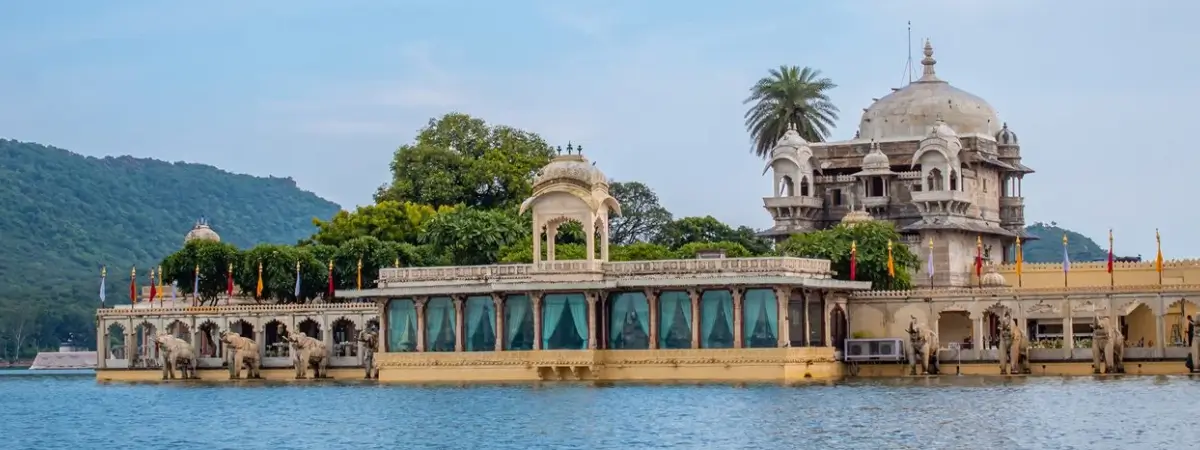
The last two hours of driving wind through hill country to Udaipur, the City of Lakes. Here your final palace awaits, and our usual choice is the Taj Lake Palace, the white marble palace that seems to float on Lake Pichola, built in the 1740s by Maharana Jagat Singh II as a summer pleasure palace, subject to availability. Guests arrive by the hotel's private boat from its jetty in the city. In the evening, a private cruise on Lake Pichola carries you past the ghats, the City Palace and Jag Mandir as the sun goes down, with champagne on board. Overnight stay in Udaipur.
After breakfast on the terrace, a boat takes you across to the city for your guided visit. The City Palace of Udaipur, built over four centuries by the Maharanas of Mewar, holds the Crystal Gallery in the Fateh Prakash Palace, with crystal furniture ordered from England by Maharana Sajjan Singh in 1877, including a crystal bed. Your guide also leads you through the Amar Vilas courtyard garden and the Bhim Vilas with its paintings of the life of Krishna. Next, walk to the Jagdish Temple, a seventeenth-century Vishnu temple, then visit the Bagore ki Haveli for its mirror rooms and puppet collection.
In the afternoon, drive to Fateh Sagar Lake and take a boat to Nehru Park in the middle, or visit the Saheliyon ki Bari garden with its lotus pools and marble elephants. For a last royal view, drive up to the Sajjangarh Monsoon Palace on a hilltop above the city, where the sunset lights up the lakes and the Aravalli ridges in shades of gold. Tonight is your farewell dinner at Neel Kamal, the Lake Palace's Indian restaurant, which serves dishes from the old royal kitchens of Mewar, including laal maas, a fiery mutton curry, and the milder safed maas. Overnight stay in Udaipur.
Your last morning in Rajasthan begins slowly, with breakfast on the palace terrace and the lake catching the early light. There is time for a final swim or spa visit before the hotel boat carries you back to the jetty, where your chauffeur is waiting with the car. The drive to Maharana Pratap Airport takes about forty minutes. Our airport representative helps you check in for the domestic flight to Delhi, which takes about an hour and a half. If your bags have grown heavier with textiles, miniature paintings and silver, we can help arrange extra baggage allowance in advance.
On arrival in Delhi, a chauffeur meets you at the domestic terminal. If your international flight leaves late at night, a day room at an Aerocity hotel can be arranged so you can rest and freshen up, and there may be time for a short stop at Dilli Haat for last-minute crafts. Your chauffeur then drives you to the international terminal of Indira Gandhi International Airport and helps with your luggage. From royal suites in Jaipur and Jodhpur to a tent on the Thar dunes and a palace on a lake, the journey ends here, and Heritage India Private Tours wishes you a safe flight home.
Hear what our happy guests say about their India adventures! From private drivers to guided tours, we make every journey smooth, safe & unforgettable.
 rating score: 5.0 of 5, based on 448 reviews

Complete our inquiry form

Customize your itinerary

Confirm when you're satisfied
1-to-1 Service | Reply within 24hrs | Expert's Advice