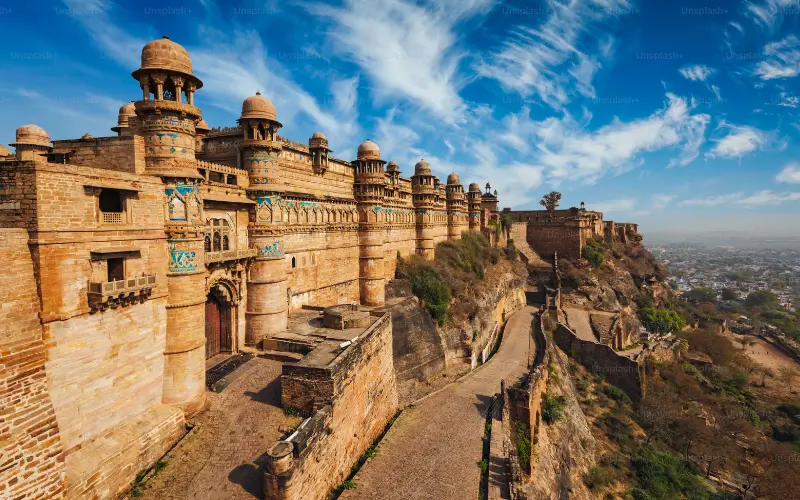
The road west from Jodhpur begins in a city of blue houses and ends in a city of gold. In between lie nearly 300 kilometres of the Thar Desert: open scrubland, villages of round mud huts, herds of camels grazing on thorny bushes, and long, empty stretches where the horizon seems to shimmer in the afternoon heat. Around the last bend before Jaisalmer, the fort appears on its hill, honey-coloured walls glowing in the sun, looking much as it must have to the camel caravans that once traded silk and spices along this route.
Driving from Jodhpur to Jaisalmer by private car is one of the classic drives of Rajasthan, and it leads to one of the most memorable nights of any India trip: an evening in a desert camp among the sand dunes. This guide covers the distance, driving time and fares, the stops worth making on the way, how to choose a desert camp, and practical tips for camel rides, jeep safaris and keeping warm on a cold desert night.
The direct route from Jodhpur to Jaisalmer follows National Highway 125 through Balesar and Pokhran, a distance of about 285 kilometres. In a private car, the drive takes five to five and a half hours, including a tea break. A slightly longer northern route through Osian and Phalodi covers about 330 kilometres and takes six to six and a half hours, but adds two worthwhile stops along the way.
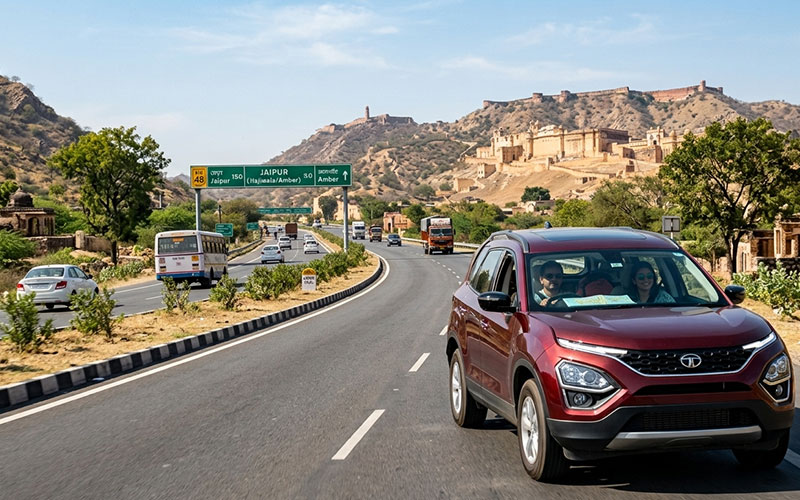
The road is in good condition for most of its length, with a smooth two-lane highway and wide shoulders. Traffic is light compared with eastern Rajasthan, but trucks, camel carts and livestock appear regularly. Fuel stations are fewer than in the east, so drivers usually fill up in Jodhpur or Pokhran. There are few large restaurants on the way, so carrying water and snacks is wise.
| Trip Type | Sedan (INR) | Innova Crysta (INR) | Tempo Traveller (INR) |
| One-way drop, Jodhpur to Jaisalmer | 6,500 – 8,000 | 8,500 – 10,500 | 12,000 – 15,000 |
| Return trip with one night in Jaisalmer | 9,500 – 11,500 | 12,500 – 15,000 | 18,000 – 22,000 |
| Return with two nights (incl. dunes transfer) | 13,500 – 16,000 | 18,000 – 21,500 | 25,000 – 30,000 |
| Jaisalmer to Sam dunes and back | 1,500 – 2,200 | 2,000 – 3,000 | 3,000 – 4,000 |
The Jodhpur to Jaisalmer taxi fare for a one-way drop includes the cost of the car returning empty, which is why it is relatively high for a single day. On a longer Rajasthan tour, this drive is simply part of the package, charged at the normal daily rate of around INR 4,500 to INR 5,500 for a sedan or INR 6,000 to INR 7,200 for an Innova.
Tolls are low on this road, usually INR 100 to INR 250 one way for a car. Parking at Jaisalmer Fort and the dunes costs INR 50 to INR 200 per stop. If your desert camp is near the Sam or Khuri dunes, the camp is 40 to 50 kilometres from Jaisalmer town, and your driver will take you there and back.
Some travellers consider the train. Overnight trains between Jodhpur and Jaisalmer take five to six hours and are cheap, but they arrive early in the morning or late at night, and you still need transport at both ends. For anyone with luggage or a desert camp booking, the private car is the far more practical choice.
When booking, confirm that the price includes the dunes transfer if you are staying at a desert camp, as some operators charge this separately. Also check where your driver will stay. Most desert camps offer driver accommodation, but at a few camps the driver sleeps in Jaisalmer town and returns the next morning.
Departure time matters. Leaving Jodhpur by 8 AM lets you reach Jaisalmer by early afternoon, with time to check in and rest before heading to the dunes for sunset. If your night is in a desert camp, ask your driver to aim for arrival at the camp by 3:30 to 4 PM in winter, when sunset falls around 5:45 PM.
The direct road through Pokhran is fast, but a little detour turns a long drive into one of the most interesting days on a Rajasthan tour.
Osian, about 65 kilometres north-west of Jodhpur, is an ancient trading town with a remarkable cluster of Hindu and Jain temples dating from the 8th to the 12th centuries. The finely carved Mahavira Jain temple and the hilltop temple dedicated to a mother goddess are the highlights. Entry to the temples is free, though modest dress is required, shoes must be removed, and leather items such as belts and wallets are not allowed inside the Jain temple. Allow one hour. Osian also has sand dunes on its outskirts, and some travellers spend a night in a desert camp here instead of near Jaisalmer.
From Osian, the road continues to Phalodi and the village of Khichan, about 140 kilometres from Jodhpur. Between September and March, thousands of demoiselle cranes migrate here from Central Asia and Mongolia. Villagers have fed them for generations, and every morning between 7 AM and 9 AM, the birds gather in a feeding enclosure in the village. The sight of thousands of grey cranes landing together is a rare treat for bird lovers. There is no ticket, but a small donation for grain is appreciated. Reaching Khichan by 9 AM means leaving Jodhpur by 6:30 AM.
Pokhran, roughly halfway on the direct route, has a 14th-century fort that now serves partly as a heritage hotel and museum. Entry costs about INR 100 to INR 200. Pokhran is also known as the site of India's nuclear tests, though there is nothing to see of that history. It is a convenient place for a tea break and lunch at the fort's restaurant.
Ramdevra, 12 kilometres from Pokhran, is home to a shrine dedicated to the folk saint Ramdev, revered by both Hindus and Muslims. During the annual fair in August or September, it draws huge crowds of pilgrims, but at other times it is quiet and easy to visit.
A short stop at a roadside village gives a glimpse of desert life. Families live in round mud houses with thatched roofs, and women in bright skirts carry water pots from village wells. Ask your driver to introduce you rather than stopping on your own, and always ask before taking photos of people.
If you take the northern route through Osian and Khichan, the total driving day stretches to seven or eight hours with stops. This is best done with an early start and an evening arrival in Jaisalmer town rather than a desert camp on the same evening.
A night in the desert is the highlight of many Rajasthan trips, but camps vary enormously in comfort, location and price. Choosing well makes all the difference.
There are three main dune areas around Jaisalmer. The Sam sand dunes, about 42 kilometres west of town, are the largest and most famous, with high rolling dunes and dozens of camps. They are lively, especially in December and January, with music, camel rides and crowds of domestic tourists. The Khuri dunes, about 45 kilometres south-west, are smaller but quieter, with a more rural village setting. Kanoi and Damodara, closer to Sam, offer a handful of more exclusive camps with fewer visitors.
| Camp Category | Price per Tent per Night (INR) | What You Get |
| Standard tented camp | 5,000 – 8,000 | Basic tent, shared or simple attached bathroom, dinner and breakfast |
| Deluxe camp | 8,000 – 14,000 | Larger tent, attached bathroom with hot water, cultural show, all meals |
| Premium camp | 15,000 – 25,000 | Spacious tent with proper beds, heaters, quieter location, better food |
| Luxury camp (e.g. The Serai, Suryagarh-run camps) | 30,000 – 75,000 | Private tents with plunge pools or verandas, fine dining, personal service |
Most camps include dinner, breakfast and an evening programme of Rajasthani folk music and dance around a bonfire. Many also include a short camel ride at the dunes. Ask whether the camp has attached bathrooms with running hot water, especially in winter, and whether the tents have heaters.
Location within the dune area matters. Many Sam camps sit in a long row along the road, a few hundred metres from the dunes, with loudspeakers playing until late. Quieter camps further from the main strip, or in the Khuri and Kanoi areas, offer the silence and stars that most travellers hope for. If peace matters to you, ask for a camp away from the main tourist strip.
Prices rise sharply between 20 December and 5 January, often by 40 to 70 percent, and many camps sell out weeks ahead. The Jaisalmer Desert Festival, held each February, also fills camps quickly.
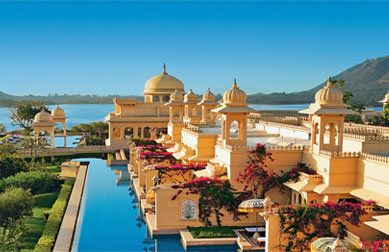
For travellers who prefer a solid room to a tent, several heritage hotels in Jaisalmer town, such as Suryagarh and the Gorbandh Palace, offer evening trips to the dunes with dinner, followed by a comfortable night back in town. Suryagarh, a modern fortress-style hotel on the edge of the desert, costs INR 25,000 to INR 60,000 per night and arranges private dune dinners with candles and musicians, which many couples choose for an anniversary or honeymoon.
Food at desert camps is usually a set Rajasthani dinner with lentils, vegetable curries, flatbreads cooked on an open fire, rice and a sweet dish. Better camps offer a choice of continental dishes and a separate children's menu. If you have dietary needs, such as vegan or gluten-free food, tell your tour company in advance so the camp can prepare for you. Alcohol is usually available at deluxe and luxury camps, though at a premium, with a beer costing INR 400 to INR 700.
Check-in at most camps is around 2 PM to 3 PM, and check-out around 10 AM. Many guests watch the sunrise from the dunes, have breakfast, and then return to Jaisalmer for a day at the fort. This works well because the fort is best enjoyed in the softer light of the morning.
Safety at camps is generally good, but keep valuables with you or in a locked bag, as tents cannot be secured like hotel rooms. Carry a small torch for walking between tents and bathrooms after dark, as paths are often lit only by low lamps.
The classic desert activity is a camel ride at sunset. At Sam, short rides of 30 to 45 minutes to the top of the dunes cost INR 600 to INR 1,200 per camel, and many camps include this in the stay. For a longer ride into quieter dunes, a two to three hour camel trek with a local camel driver costs INR 1,500 to INR 3,000 per person. Overnight camel safaris, sleeping under the stars on the dunes with a simple dinner cooked over a fire, cost INR 3,500 to INR 6,000 per person.
Jeep safaris across the dunes are popular with families and thrill seekers. A 30 to 45 minute dune drive costs INR 2,500 to INR 4,000 per jeep, shared by up to five people. The jeeps climb and slide down steep dunes, which is exciting but bumpy, so it is not ideal for anyone with back problems or for pregnant travellers. Quad bikes cost INR 1,000 to INR 2,000 for 15 to 20 minutes.
Timing is everything in the desert. In winter, sunset falls around 5:45 PM, so aim to be at the dunes by 4:30 PM. Sunrise is around 7:15 AM. In October and March, both are about 30 to 45 minutes different.
Desert nights in December and January are colder than most visitors expect. Daytime temperatures reach 22 to 25°C, but nights can drop to 3 to 7°C. Pack a warm jacket, a hat and socks for the evening, and check that your camp provides heaters and thick blankets. In October, November, February and March, nights are milder at 10 to 16°C.
The desert is dry and dusty. Carry lip balm, moisturiser, sunglasses and a scarf to cover your face during jeep rides. Protect cameras and phones from fine sand with a zip bag.
Respect local customs. Camel drivers and camp staff often come from nearby villages, and tipping them INR 100 to INR 300 after a ride or performance is appreciated. Ask before photographing women and children in villages, and do not give money to children who ask, as this encourages begging.
Heritage India Private Tours arranges Jodhpur to Jaisalmer drives as part of Rajasthan tours, with experienced desert drivers and carefully chosen camps in quiet locations. We can add stops at Osian and Khichan, arrange private camel treks and help you choose between camps at every budget.
About 285 kilometres by the direct route through Pokhran, or around 330 kilometres via Osian and Phalodi.
Five to five and a half hours on the direct route, or six to eight hours with stops at Osian and Khichan.
A one-way sedan costs about INR 6,500 to INR 8,000, and an Innova Crysta about INR 8,500 to INR 10,500.
Sam has larger dunes and more activity, while Khuri is quieter and more rural. For peace and stars, Khuri or a camp away from the main Sam strip is better.
Standard camps cost INR 5,000 to INR 8,000 per tent per night with meals, deluxe camps INR 8,000 to INR 14,000, and luxury camps up to INR 75,000.
In December and January, nights can fall to 3 to 7°C. Pack warm clothing and check that your tent has a heater.
A short sunset ride costs INR 600 to INR 1,200 per camel. Longer treks cost INR 1,500 to INR 3,000 per person.
Generally yes, but it is bumpy and not suitable for people with back problems or for pregnant travellers.
Between September and March, with the best viewing during morning feeding between 7 AM and 9 AM.
Most camps provide driver accommodation. At some camps, the driver stays in Jaisalmer and returns the next morning.