Bengaluru - Mysuru - Coorg - Hassan - Hampi - Chennai - Mahabalipuram - Pondicherry - Thanjavur - Madurai - Munnar - Thekkady - Alleppey - Kochi
Five dynasties built most of what travellers come to see in the south, and this twenty-day route visits the finest work of each in the order history left it. Hoysala sculptors carved soapstone into lace at Belur and Halebidu; the Vijayanagara kings raised a capital among the boulders of Hampi; Pallava stonecutters shaped whole temples from single rocks at Mahabalipuram; the Cholas built the great tower at Thanjavur; and the Nayaks of Madurai covered the Meenakshi temple in painted gods. Between those chapters come the Mysuru palace, the coffee hills of Coorg, the French streets of Pondicherry, the tea slopes of Munnar, the spice gardens of Thekkady and a night on an Alleppey houseboat. For first-time visitors who want the whole picture, this is our most complete South India private tour.
The route covers roughly 2,600 kilometres across Karnataka, Tamil Nadu, Puducherry and Kerala, so we have arranged it carefully. Drives are kept below five hours wherever possible, with one longer day from Hassan to Hampi broken by a stop at the Chitradurga fort, and a domestic flight from Hubballi to Chennai replaces a punishing two-day crossing of the Deccan. A private car and driver carries you throughout, with your English-speaking chauffeur handing over to a Tamil Nadu and Kerala colleague only where state permits make it sensible. In every major stop, a licensed local guide explains the temples, inscriptions and courts in plain language, so that by the time you reach the Kerala coast, the many kings, gods and styles of the South India temple tour fit together in a story you can follow.
Tour Highlights
 Package Includes:
 Package Excludes:
Reply within 24hrs
Welcome to Karnataka. When you clear immigration at Kempegowda International Airport, our representative will be holding a sign with your name just beyond the exit gate. Your chauffeur loads the luggage, offers a bottle of cold water, and sets off on the hour-long drive into the city along a highway lined with new tech campuses, an early hint of the modern side of Bengaluru, often called India's Silicon Valley. Your hotel is in the central business district, close to MG Road and Cubbon Park, so that the evening can include a short walk if you feel like stretching your legs after the flight.
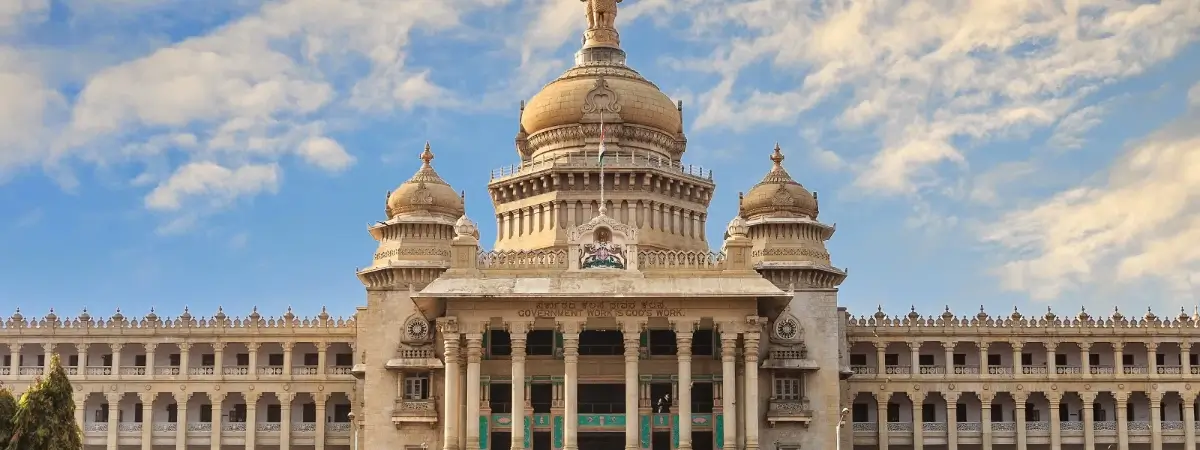
If you arrive in the afternoon, a gentle introduction is the government's Vidhana Soudha, the granite seat of the state legislature, which is lit up on Sunday evenings and public holidays. Seen from Cubbon Park, its neo-Dravidian domes and columns show how the newly independent state chose to express itself in stone. Dinner tonight could be at one of the city's old Udupi-style restaurants, where a crisp masala dosa with coconut chutney costs very little and is cooked with real care. Your tour specialist will call to confirm the next morning's timings and answer any questions about the twenty days ahead.
Overnight stay in Bengaluru.
After breakfast, the road south takes you to Srirangapatna, an island in the Kaveri river that served as the capital of Hyder Ali and his son Tipu Sultan in the late eighteenth century. With your guide, you walk around the remains of the fort, see the dungeon where British officers were held, and stop at the obelisk marking the spot where Tipu fell during the final siege of 1799. Nearby, Daria Daulat Bagh, his summer palace, is a low teak pavilion whose walls are covered in painted scenes of the Battle of Pollilur, in which his forces defeated the East India Company. The palace museum is closed on Fridays.
Before leaving the island, you visit the Gumbaz, the domed mausoleum where Tipu, his father and his mother are buried, set in a quiet garden with cypress trees. The Ranganathaswamy temple, one of the oldest on the island, is just a few minutes away. You reach Mysuru by mid-afternoon and check in. In the evening, your chauffeur can drive you to the Brindavan Gardens below the Krishnaraja Sagar dam, where terraced fountains are switched on after dark, or you can save your energy for an early start tomorrow. The fountain show usually runs for about an hour after dark, and the garden is busiest at weekends.
Overnight stay in Mysuru.
Your Mysuru city tour begins early on Chamundi Hill, the steep wooded rise south of the city where the goddess Chamundeshwari, guardian of the Wodeyar dynasty, is worshipped in a temple with a tall seven-storey gateway. On the way down, you stop at the giant Nandi, a five-metre statue of Shiva's bull carved from a single black boulder in the seventeenth century and hung with stone bells and garlands. From there, your guide takes you into the Mysuru Palace as the gates open, when the Durbar Hall and its painted columns can be seen without the crowds, and then on foot into Devaraja Market, where pyramids of kumkum powder in red, orange and yellow stand beside heaps of jasmine, betel leaves and bananas of a dozen varieties.
After an early lunch, the road climbs west towards the Western Ghats. At Bylakuppe, one of the largest Tibetan settlements outside Tibet, refugees have farmed and run monasteries since the early 1960s. The Namdroling Monastery, known locally as the Golden Temple, houses three gilded statues of the Buddha, Padmasambhava and Amitayus, each nearly twenty metres tall, and in the late afternoon you may hear young monks chanting in the prayer hall. You reach Coorg, or Kodagu, by early evening and check in to a hotel on a working coffee estate outside Madikeri. Ask the kitchen for a Kodava dinner of akki roti, bamboo shoot curry and Coorg-style chicken.
Overnight stay in Coorg.
Leaving Coorg after breakfast, you drive north through Somwarpet and Sakleshpur, a coffee and cardamom district of misty hills. Just outside Sakleshpur, a short climb brings you to the Manjarabad Fort, a star-shaped fortress built by Tipu Sultan around 1792 on a hilltop with a view over the forested Western Ghats. Its eight-pointed outline is best seen from the walls, and on a clear day you can see the Arabian Sea coast far to the west. The route then descends into the plains of Hassan district, an area that was the heartland of the Hoysala kingdom between the eleventh and fourteenth centuries.
In the afternoon, you reach Belur, where the Chennakeshava temple was commissioned in 1117 by King Vishnuvardhana to celebrate a victory over the Cholas. It took more than a century to finish, and the result is one of the most detailed buildings in India. With your guide, you study the madanikas, carved bracket figures of dancers, huntresses and women at their mirrors, which lean from the pillars beneath the eaves. Inside, the lathe-turned columns are so finely polished that they seem to have been made of metal. The temple was listed by UNESCO in recent years along with Halebidu and Somnathpur.
Overnight stay in Hassan.
Morning brings you to Halebidu, about thirty kilometres from Hassan, which was the Hoysala capital, Dwarasamudra, until it was sacked by the armies of the Delhi Sultanate in the fourteenth century. The Hoysaleswara temple here was never completed, yet its outer walls carry thousands of sculptures arranged in horizontal bands: elephants at the base for strength, then lions for courage, horses for speed, scrolls of foliage, and above them a long frieze of scenes from the Ramayana and Mahabharata. Your guide will help you pick out Ravana shaking Mount Kailash and Krishna lifting the Govardhan hill. A small site museum holds sculptures found nearby.
After lunch, the drive south of about fifty kilometres brings you to Shravanabelagola, one of the most important Jain pilgrimage sites in India. Here, the statue of Gommateshwara, or Bahubali, stands about eighteen metres high at the top of Vindhyagiri hill, carved from a single granite rock around 983 AD. Reaching it means climbing roughly 620 steps cut into the bare rock, barefoot, so we suggest the late afternoon when the stone has cooled. Socks are allowed. Every twelve years, the statue is anointed with milk, saffron and flowers in the Mahamastakabhisheka festival. Return to Hassan for the evening.
Overnight stay in Hassan.
Today is the longest drive of the tour, so we set off early after a packed breakfast. The road crosses the dry Deccan plateau, a landscape of sunflower and millet fields, granite outcrops and windmills. Around the halfway point, you stop at Chitradurga, where a fort of seven concentric walls winds over a cluster of huge boulders. It was held by the Nayaka chiefs and later by Hyder Ali. Your chauffeur knows the story of Onake Obavva, the woman who is said to have defended a gap in the walls with a wooden pestle while her husband was at lunch; the small opening still bears her name.
After a simple lunch in town, the drive continues north to Hosapete and then the short final stretch to Hampi. As you approach, the landscape changes dramatically into a sea of rounded orange boulders, stacked and balanced as if by giants, with banana plantations and paddy fields along the Tungabhadra river. Your hotel is close to the ruins, and the evening is free to rest. If you still have energy, the riverside near the Virupaksha temple is calm at dusk, when pilgrims light lamps and the temple elephant, when present, returns from her bath. Pack a light bag for the night so that the larger suitcases can stay in the car.
Overnight stay in Hampi.
Hampi, a UNESCO World Heritage Site, was Vijayanagara, the capital of a South Indian empire that ruled from the fourteenth to sixteenth centuries and amazed Persian and Portuguese visitors with its wealth. It was sacked after the Battle of Talikota in 1565, and the ruins now cover about twenty-six square kilometres. With your guide, you begin in the Royal Centre, where the stepped Mahanavami Dibba platform carries carvings of hunting parties, dancers and foreign traders. Nearby are the Queen's Bath, the elegant stepped tank called Pushkarani, and the Hazara Rama temple, whose walls show processions of horses, elephants and soldiers.
Inside the Zenana enclosure, the two-storey Lotus Mahal combines Hindu and Islamic styles with cusped arches, and next to it are the eleven domed Elephant Stables. In the afternoon, you head to the Vittala temple complex, where the famous stone chariot stands in the courtyard and the pillars of the main hall were once said to produce musical notes when tapped, although this is no longer allowed in order to protect them. Electric vehicles carry visitors along the final stretch of road. On the way back, the King's Balance, where rulers were weighed against gold and grain given to priests, makes an interesting stop.
Overnight stay in Hampi.
The second day in Hampi starts at the Virupaksha temple, still in active worship, where the tall eastern gateway towers over the old bazaar street. Inside, a small hole in a wall of the inner chamber projects an inverted image of the gateway, a pinhole camera effect, and your guide will show you where to look. You then walk the length of Hampi Bazaar, once lined with pavilions where merchants sold horses, jewels and silk, and follow the riverside path past the Kodandarama temple and small shrines carved into the rocks. Wear comfortable shoes with a good grip, as the rocks near the river can be smooth and steep in places.
After lunch, cross the Tungabhadra in a round coracle to Anegundi, the older village said to be Kishkindha, the monkey kingdom of the Ramayana. Its quiet lanes, old houses and a community craft centre where women weave banana-fibre bags make a pleasing contrast with the ruins. Fit travellers can climb the 570 steps to the Anjanadri temple, believed to be the birthplace of Hanuman, for a sweeping view. The day ends on Hemakuta Hill, where small early temples and boulders turn orange in the setting sun, and the gateway of Virupaksha rises above the plain. Your guide will also explain how the Tungabhadra was used by pilgrims for centuries.
Overnight stay in Hampi.
After an early breakfast, your Karnataka chauffeur drives you to Hubballi airport, about three and a half hours west across the plateau. On the way, if time permits, you can stop at Lakkundi, a village with Chalukyan temples and a stepwell, where the stone is carved in a style older than Hoysala work. At the airport, you say goodbye to your chauffeur and board a domestic flight to Chennai, about an hour and a half in the air, taking you from the Deccan plateau down to the Coromandel coast in a fraction of the time it would take by road.
Your new chauffeur for Tamil Nadu and Kerala meets you in Chennai arrivals and drives you to your hotel. If you arrive in time, the late afternoon is the right moment for Marina Beach, one of the longest urban beaches in the world, where families gather in the evening to buy roasted corn, sundal and bajji from stalls on the sand. Swimming is not recommended because of strong currents, but a walk along the promenade is pleasant as the heat lifts. Dinner tonight might be a Chettinad meal, with pepper chicken and kuzhi paniyaram, at a restaurant your chauffeur recommends.
Overnight stay in Chennai.
Your Chennai city tour begins in Mylapore, one of the oldest neighbourhoods, at the Kapaleeshwarar temple, dedicated to Shiva, with a richly painted gateway and a large water tank where festival boats float. A few streets away, the San Thome Basilica stands over what is believed to be the tomb of St Thomas the Apostle, who is said to have been martyred nearby in the first century. You then drive past the University of Madras and other red-brick Indo-Saracenic buildings along the Marina to reach Fort St George, built by the East India Company in 1644. St Mary's Church inside is the oldest Anglican church east of Suez, and the fort museum, closed on Fridays, displays East India Company coins and uniforms.
After lunch, you leave the city on the East Coast Road. Halfway along is DakshinaChitra, a heritage village where traditional houses from Tamil Nadu, Kerala, Karnataka and Andhra Pradesh have been rebuilt, with craftspeople at work; it is closed on Tuesdays. You arrive in Mahabalipuram in the late afternoon and check in to a beachside hotel. Before dinner, take an evening stroll along the sand, where the Shore Temple stands floodlit at the edge of the waves, seen at its most atmospheric after the crowds have left. Leave valuables in the hotel safe before you walk along the sand, as the beach can be crowded in the evening.
Overnight stay in Mahabalipuram.
The seventh-century Pallava monuments of Mahabalipuram, a UNESCO site, mark the beginning of stone temple building in South India. With your guide, you start early at the Shore Temple, built in the early eighth century by King Narasimhavarman II, whose granite towers have stood on the coast through centuries of salt spray. Next, you visit the Pancha Rathas, five monolithic shrines named after the Pandava brothers and their wife Draupadi, each carved in a different architectural style, as if the sculptors were testing ideas. A stone elephant, lion and bull stand among them. Most guests find that two hours here are enough to see the main monuments without rushing.
Then comes Arjuna's Penance, one of the largest open-air rock reliefs in the world, a granite wall carved with more than a hundred figures of gods, animals, sages and nymphs gathered around a natural cleft that once carried water. Nearby, Krishna's Butter Ball, a huge boulder balanced on a slope, is a favourite for photographs. After lunch, drive south on the East Coast Road to Pondicherry, a former French colony that remained under French rule until 1954. Check in to a heritage hotel in the French Quarter, and spend the evening walking along the seafront promenade, closed to traffic after dusk.
Overnight stay in Pondicherry.
The morning begins with a walk through the French Quarter, known as the White Town, where mustard-yellow and white colonial villas with bougainvillea and green shutters line streets such as Rue Romain Rolland and Rue Suffren. Your guide points out the French Consulate, the Lycée Français and the Église de Notre Dame des Anges, whose interior was painted to look like marble. In the Tamil Quarter, just across the old canal, the houses change to verandas with carved wooden pillars and open courtyards. The Sri Aurobindo Ashram, founded in 1926, is open to visitors for silent contemplation at the flower-covered tomb of Sri Aurobindo and the Mother.
In the afternoon, you drive about twelve kilometres to Auroville, an international township founded in 1968 as an experiment in shared living, now home to people from more than fifty countries. The visitor centre explains its ideals, and a short walk leads to a viewing point for the Matrimandir, a giant golden sphere covered with gilded discs that stands in the middle of the community. Entry inside requires advance registration and is not always possible. Before returning, you can browse the Auroville boutiques for handmade paper, incense and organic food. Dinner tonight is at a French or Creole restaurant in the White Town.
Overnight stay in Pondicherry.
This day's drive follows the Chola heartland. About seventy kilometres south of Pondicherry, you stop at Chidambaram, home to the Thillai Nataraja temple, where Shiva is worshipped as the cosmic dancer. The golden-roofed inner shrine, the Chit Sabha, and the gateways carved with all 108 poses of classical Bharatanatyam dance are what make this temple special. The priests here belong to a hereditary community called the Dikshitars, recognisable by their distinctive hair knots. Your guide will explain the meaning of the empty space worshipped alongside the dancing image, known as the Chidambara Rahasyam. Dress modestly, with shoulders and knees covered, as the temple is in full daily worship.
The next stop, Gangaikonda Cholapuram, was the capital built by Rajendra Chola I in the eleventh century to celebrate his army's march to the Ganges. Its Brihadisvara temple, a UNESCO site, has a curved tower slightly smaller than its counterpart at Thanjavur, and is often quieter, so it is a good place to appreciate Chola sculpture without crowds. Look out for the panel showing Shiva garlanding the saint Chandesha. You reach Thanjavur in the late afternoon, in time to see the Brihadeeswarar temple at sunset, when its granite tower glows gold against the sky. Drives through the rice belt of the Kaveri delta are flat and green, with plenty of village life to watch from the car.
Overnight stay in Thanjavur.
Return to the Brihadeeswarar temple in the cool of the morning with your guide. Built by Rajaraja Chola I and completed in 1010, it was the largest temple in India in its day, and its tower rises about sixty-six metres, topped by a capstone said to weigh around eighty tonnes. The huge monolithic Nandi in the courtyard and the Chola-era frescoes, partly covered by later Nayak paintings, are worth close attention. You then visit the Thanjavur Royal Palace, built by the Nayaks and Marathas, and its Saraswati Mahal Library, which holds rare palm-leaf manuscripts and a collection of Chola bronzes in the art gallery.
Leaving Thanjavur, you drive to Tiruchirappalli and visit Srirangam, the Ranganathaswamy temple on an island in the Kaveri, one of the largest functioning temple complexes in the world, with seven concentric walls and twenty-one gateways. Inside, the Hall of a Thousand Pillars and the horse-pillared Sesharaya mandapa are outstanding. Non-Hindus may not enter the inner shrine, but there is much to see. From Trichy, a fast highway takes you to Madurai. In the evening, your guide takes you to the Meenakshi temple for the palliyarai ceremony, when Shiva's image is carried by palanquin to Meenakshi's chamber for the night.
Overnight stay in Madurai.
Morning is the best time to see the Meenakshi Amman temple in detail, before the heat and crowds build. The temple has fourteen gateway towers, the tallest over fifty metres, each covered with thousands of brightly painted figures of gods, demons and animals. Inside, your guide leads you to the Golden Lotus Tank, where poets of the ancient Tamil Sangam academy are said to have tested their works, and to the Hall of a Thousand Pillars, which now holds a small art museum. Note that mobile phones and cameras are not allowed inside, and lockers are available at the entrance; your guide will handle this.
After lunch, visit the Thirumalai Nayak Palace, built in 1636 by the king who also expanded the Meenakshi temple. Its vast courtyard, ringed by thick white columns, and the domed audience hall show an Indo-Islamic influence unusual in Tamil Nadu. Later, the Gandhi Memorial Museum, housed in the seventeenth-century palace of Rani Mangammal, displays the blood-stained cloth Mahatma Gandhi was wearing when he was shot, and explains why he adopted the simple dhoti in this very city. End the day at Puthu Mandapam, a pillared hall full of tailors and brass sellers. Your guide will also suggest a good place nearby for a jigarthanda, Madurai's chilled drink of milk, almond gum and ice cream.
Overnight stay in Madurai.
This morning, you leave the plains of Tamil Nadu and climb into the Western Ghats. The route passes Theni, an area of grape vineyards and coconut groves, and then the Bodinayakanur ghat road, a series of hairpin bends that rises steeply from the hot plains to the cool tea country of Kerala. As you cross the state border at Bodimettu, the landscape changes quickly: suddenly the hills are covered with neatly clipped tea bushes, with silver oak trees for shade and small clusters of workers' houses painted in pastel colours. Your chauffeur will stop at viewpoints along the way. Carry a light jacket, as the temperature drops sharply as you gain height.
You arrive in Munnar by early afternoon and check in to a hillside resort with views over the valleys. Munnar, at about 1,600 metres, was developed by Scottish planters in the late nineteenth century, and the town still has a Church of South India built in 1910 and several old estate bungalows. In the late afternoon, take a gentle walk through the tea gardens close to the resort, where you can see workers picking the top two leaves and a bud by hand. As the evening cools, the mist rolls in from the valleys, and the resort may light a fire for guests.
Overnight stay in Munnar.
The morning starts at Eravikulam National Park, home to the largest population of the Nilgiri tahr, a mountain goat found only in the Western Ghats. Forest department buses take you from the entrance to Rajamala, where the tahr graze close to the road and seem completely unbothered by visitors. The park is usually closed from February to March for the calving season. Every twelve years, the hills here are covered in blue neelakurinji flowers, and even in other years the grasslands and rolling shola forests make a beautiful backdrop for an easy walk. Arrive early, as the queues for the buses grow longer through the morning, especially at weekends and during school holidays.
After lunch, visit the Tata Tea Museum at the Nallathanni estate, where a short film and a working factory explain how tea is withered, rolled, fermented and dried, using old machinery imported from Britain, with a tasting at the end. Note that the museum is closed on Mondays. Later, you drive to Mattupetty, about thirteen kilometres away, to see the dam and the lake, where pedal boats are available, and Echo Point, where children love to test the echo off the hills. On the way back, buy a packet of fresh tea and homemade chocolates from a shop in town. Tea is sold here at estate prices.
Overnight stay in Munnar.
The drive south to Thekkady winds through cardamom hills, an area where the spice grows under tall forest trees on slopes that stay wet for much of the year. After about three and a half hours, you reach Kumily, the small town on the edge of Periyar Tiger Reserve, and check in. Right after lunch, a guided visit to a spice farm shows how cardamom, black pepper, cinnamon, clove, nutmeg, vanilla and coffee are grown and harvested. The farmer will let you crush leaves and taste seeds straight from the plant, and the small shop at the end sells fresh spices at fair prices.
In the late afternoon, take a short bamboo rafting or nature walk inside the reserve with a forest department guide, or, if you prefer something less active, the boat ride on Periyar Lake, where you might see sambar deer, wild boar, otters and elephants drinking at the shore. Boats run at set times, and tickets are limited, so we will book for you in advance. In the evening, watch a performance of Kalaripayattu, Kerala's ancient martial art, at a theatre in town, where performers leap, spin and fight with swords and sticks in a small earthen arena.
Overnight stay in Thekkady.
The descent from the hills to the coast brings a final change of scenery: rubber estates, pineapple fields and then the flat, water-filled landscape of Kuttanad. You arrive in Alleppey around midday and board your private houseboat, a modern version of the old kettuvallam rice boats, with a bedroom, bathroom, open lounge deck and a crew of three, including a cook. Lunch, evening tea, dinner and the next morning's breakfast are served on board, and the menu features Kerala dishes like karimeen fry, prawn curry, thoran and red rice. Your crew will greet you with fresh tender coconut water as you step on board.
All afternoon, the houseboat cruises slowly along palm-lined canals and across Punnamada Lake, the site of the famous Nehru Trophy snake boat race held each August. You pass small churches, temples and schools, ducks being herded by farmers, women washing pots at the water's edge, and men fishing with simple nets from tiny canoes. As evening falls, the boat moors near a village, and you can take a short walk along the dykes between paddy fields with the crew. A quiet dinner on deck rounds off a long and rewarding journey through four southern states.
Overnight stay in Alleppey.
After breakfast on the deck, the houseboat returns to the jetty, where your chauffeur is waiting. The drive north to Kochi takes about an hour and a half, and on arrival you have time for a short Kochi city tour before your flight. With a local guide, you visit the Santa Cruz Cathedral Basilica, a Gothic-style church with painted ceilings, then walk through the old warehouses of Bazaar Road in Mattancherry, where ginger, pepper and turmeric are still traded. A short stop at a Kathakali centre shows how the dancers apply their elaborate green and red make-up, a process that can take two hours.
Depending on the time of your flight, a final lunch of appam and stew or a fish moilee is served at a restaurant in Fort Kochi. Your chauffeur then drives you to Kochi International Airport, about an hour from Fort Kochi, in time for your onward journey. Over these twenty days, you will have seen the work of Hoysala sculptors, Vijayanagara kings, Pallava stonecutters, Chola temple builders and Nayak painters, along with the coffee, tea and spice hills and the backwaters of Kerala, and we hope this tour has given you a clear and lasting picture of the south. Thank you for travelling with Heritage India Private Tours.
Hear what our happy guests say about their India adventures! From private drivers to guided tours, we make every journey smooth, safe & unforgettable.
 rating score: 5.0 of 5, based on 448 reviews

Complete our inquiry form

Customize your itinerary

Confirm when you're satisfied
1-to-1 Service | Reply within 24hrs | Expert's Advice