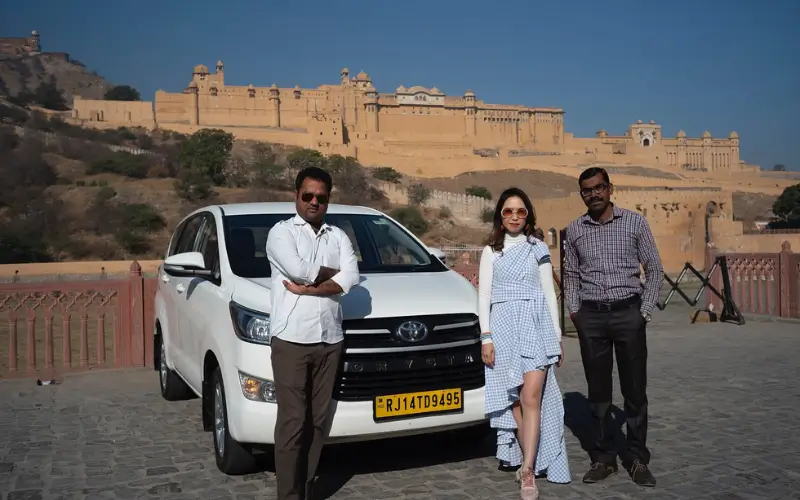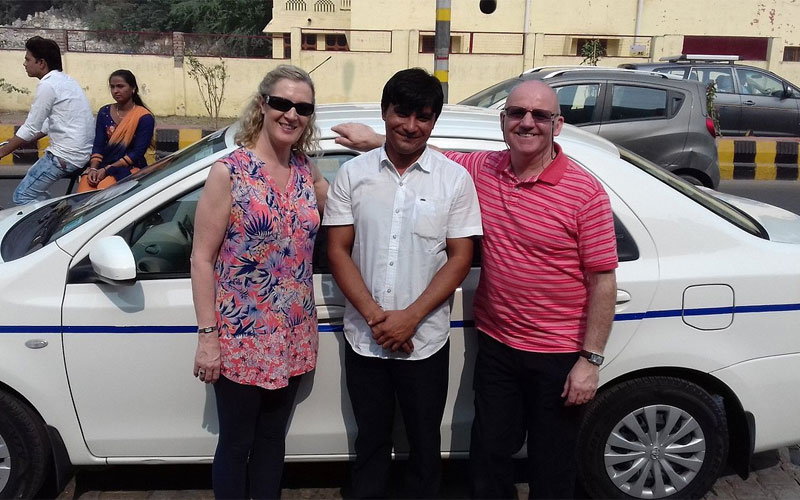
When David and Karen from Toronto first priced a Golden Triangle tour, they found packages online ranging from USD 299 to USD 4,500 per person. Both were described as "private six-day tours" of Delhi, Agra and Jaipur. The cheaper one used three-star city hotels, left out monument tickets and included three long shopping stops. The expensive one placed them at the Oberoi Amarvilas with a direct view of the Taj Mahal, with a senior guide in every city. Neither price was wrong. They simply described very different trips.
The Golden Triangle tour cost depends on four things: the car and driver, the hotels, the guides and monument entry fees, and meals. Once you know what each part costs, it becomes easy to see whether a package price is fair and where your money is going. This guide breaks down every element with realistic, higher-side prices, then puts them together into complete per person budgets for different travel styles.
The car is the backbone of any Golden Triangle private tour. A typical six-day circuit starts in Delhi, drives to Agra, continues to Jaipur via Fatehpur Sikri, and returns to Delhi or drops you at Jaipur airport. The actual driving distance is about 1,000 to 1,100 kilometres, but most operators bill a minimum of 250 kilometres per day, so a six-day tour is charged for around 1,500 kilometres.
| Vehicle | 5 Days (INR) | 6 Days (INR) | 7 Days (INR) |
| Sedan (Dzire / Etios) | 23,000 – 28,000 | 27,000 – 33,000 | 31,000 – 38,000 |
| Maruti Ciaz | 25,000 – 30,000 | 29,000 – 35,000 | 33,000 – 40,000 |
| Toyota Innova Crysta | 32,000 – 38,000 | 38,000 – 45,000 | 44,000 – 52,000 |
| Tempo Traveller | 44,000 – 52,000 | 52,000 – 62,000 | 60,000 – 72,000 |
These prices include fuel, driver allowance, tolls, state permits and parking. For two travellers, the cost of a sedan works out to roughly USD 150 to USD 190 per person for six days. An Innova adds about USD 60 to USD 70 per person, but gives far more space for luggage and a smoother ride on the Agra to Jaipur highway.
The route itself has some fixed costs. Tolls on the Yamuna Expressway from Delhi to Agra run about INR 450 to INR 550 one way. The road from Agra to Jaipur adds around INR 300 to INR 450, and Jaipur to Delhi about INR 600 to INR 800. Together with permits for Uttar Pradesh and Rajasthan, these add INR 3,000 to INR 5,000 to the tour, which is why some low quotes look cheaper than they really are.
A one-way tour that ends in Jaipur, with a flight onward to Udaipur, Mumbai or Varanasi, usually costs about the same as a round trip, because the car still has to return to Delhi. Some operators charge a return fee of INR 4,000 to INR 6,000. If you are continuing into Rajasthan or extending to Ranthambore, the same car can simply carry on, which is often the simpler choice.
Airport transfers are normally included in a package. If they are not, a Delhi airport pickup for a sedan costs INR 1,800 to INR 2,500, and a late-night arrival may add INR 300 to INR 500.
When you compare quotes, ask for the exact car model, the registration year and confirmation that tolls, permits and driver allowance are included. Also ask whether the driver will stay with you for the full tour, or whether a different driver will meet you in each city, as some cheaper operators change cars at Agra or Jaipur to cut costs.
Keeping one driver for the whole circuit has real value. He learns your pace, knows your luggage, remembers that one of you prefers the front seat, and can adjust timings each morning without calling the office. That continuity is one of the quiet reasons private tours feel so much more relaxed than shared coach tours on the same route.
Your Golden Triangle Journey, Tailored to Perfection
Experience Delhi's timeless heritage, the Taj Mahal's unforgettable beauty and Jaipur's royal elegance with a private tour designed around your budget and travel style.
Hotels usually make up the largest share of the Golden Triangle package price, often 40 to 55 percent of the total. Choosing your hotel level is therefore the biggest decision you will make about cost. Prices below are for a double room per night with breakfast, in peak season from October to March, and sit on the higher side.
| Hotel Category | Delhi (INR) | Agra (INR) | Jaipur (INR) |
| Good 3-star | 4,500 – 7,000 | 4,000 – 6,000 | 4,000 – 6,500 |
| 4-star / boutique heritage | 8,000 – 13,000 | 7,000 – 11,000 | 7,500 – 14,000 |
| 5-star (ITC, Taj, Trident) | 15,000 – 30,000 | 14,000 – 25,000 | 15,000 – 28,000 |
| Luxury (Oberoi, Leela Palace, Taj palaces) | 30,000 – 60,000 | 50,000 – 100,000 | 45,000 – 120,000 |
In Delhi, location matters more than stars. Hotels in central areas such as Connaught Place, Lodhi Road and Aerocity save time in traffic. Aerocity is convenient for late arrivals and early departures, while central Delhi suits sightseeing days. Five-star properties such as The Leela Palace, Taj Mahal Hotel and ITC Maurya sit at the top of the range.
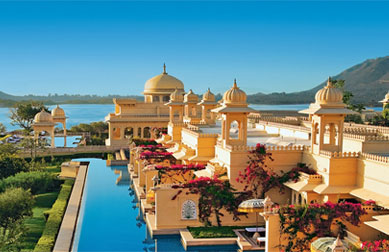
In Agra, most travellers stay just one night, so many choose a better hotel here than anywhere else. The Oberoi Amarvilas, around 600 metres from the Taj Mahal with views from every room, is the most famous choice and costs INR 50,000 to INR 100,000 per night in peak season. The ITC Mughal and Taj Hotel and Convention Centre are excellent five-star options at a lower price. Good four-star hotels near the Taj East Gate cost INR 7,000 to INR 11,000.
Jaipur offers the widest choice of heritage stays. Former palaces and noble mansions converted into hotels, such as Alsisar Mahal, Shahpura House and Narain Niwas Palace, offer royal character at four-star prices. At the top end, the Rambagh Palace and Oberoi Rajvilas are among the finest hotels in Asia, with rooms from INR 45,000 to INR 120,000 per night.
For a six-day tour with five nights, two travellers sharing a room can expect total hotel costs of roughly INR 25,000 to INR 35,000 for good three-star hotels, INR 40,000 to INR 60,000 for four-star and heritage hotels, INR 75,000 to INR 140,000 for five-star, and INR 200,000 or more for the luxury palace collection.
Peak dates push these prices up further. Between 20 December and 5 January, rates rise 30 to 60 percent, and many luxury hotels add compulsory gala dinner charges for Christmas Eve and New Year's Eve. Booking two to three months ahead gives the best choice of rooms.
One practical tip helps here. Ask for a hotel with an early breakfast in Agra if you want sunrise at the Taj Mahal, since the gates open about 30 minutes before sunrise and the best light lasts less than an hour. Many good Agra hotels pack a breakfast box for guests leaving at 6 AM, which saves time and lets you return for a proper meal afterwards.
Licensed local guides bring the monuments to life, explaining the history of Mughal emperors and Rajput kings in a way that a guidebook cannot. In the Golden Triangle, guides are hired city by city, and they usually meet you at your hotel or at the monument entrance. Rates for English-speaking, government-licensed guides are on the higher side below.
Delhi guides charge INR 2,000 to INR 3,000 for a full day. Agra guides cost INR 1,500 to INR 2,500 for a half day covering the Taj Mahal and Agra Fort. Jaipur guides charge INR 1,500 to INR 2,000 for a half day and INR 2,500 to INR 3,500 for a full day. Guides speaking French, Spanish, German or Italian cost 20 to 30 percent more and should be booked well in advance. Across the full tour, guides add about INR 7,000 to INR 10,000 for the group, not per person.
Monument entry fees for foreign visitors are set by the Archaeological Survey of India and state governments, and they are considerably higher than Indian rates.
| Monument | Foreign Visitor Fee (INR) | Opening Hours |
| Taj Mahal (incl. main mausoleum) | 1,300 | Sunrise to sunset, closed Fridays |
| Agra Fort | 650 | Sunrise to sunset |
| Fatehpur Sikri | 610 | Sunrise to sunset |
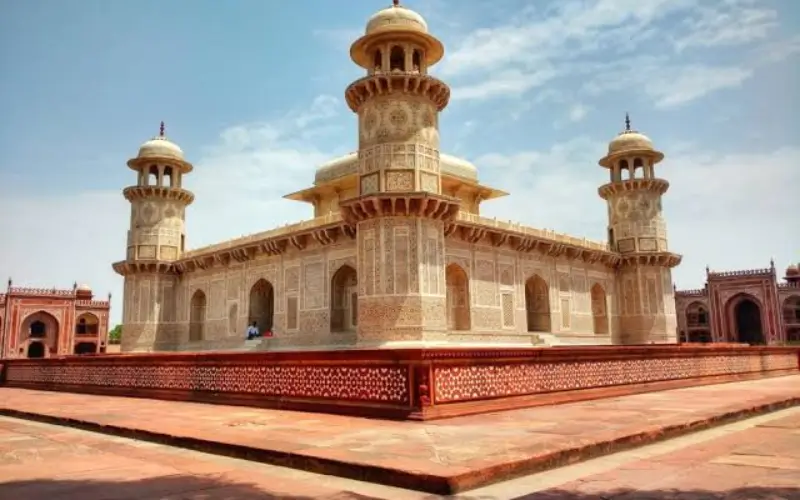
| Itimad-ud-Daulah (Baby Taj) | 310 | Sunrise to sunset |
| Red Fort, Delhi | 600 | 9:30 AM – 4:30 PM, closed Mondays |
| Qutub Minar | 600 | 7 AM – 5 PM |
| Humayun's Tomb | 600 | Sunrise to sunset |
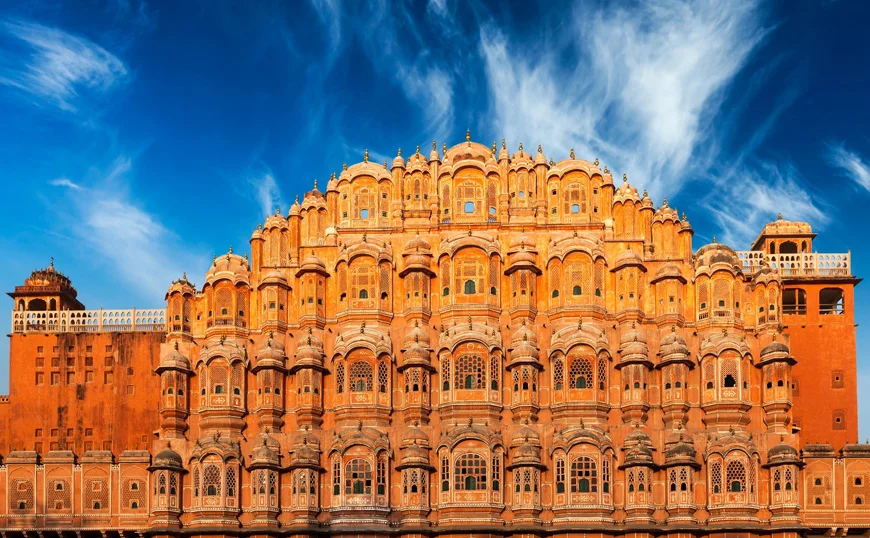
| Jaipur Composite Ticket (Amber, Hawa Mahal, Jantar Mantar, Albert Hall, Nahargarh) | 1,000 | Valid for 2 days |
| City Palace, Jaipur | 700 – 1,000 | 9:30 AM – 5 PM |
For a typical six-day tour covering the main sights, monument entry fees come to about INR 6,000 to INR 7,000 per person. Card payments and online tickets are accepted at most sites, and online booking for the Taj Mahal saves time at the ticket counter. Children under 15 enter most ASI monuments free.
A few extra costs appear on the ground. Battery shuttles from the Taj Mahal parking area to the gates cost a few dozen rupees per person. The jeep ride up to Amber Fort costs about INR 1,000 to INR 1,200 per jeep for the round trip. A cycle-cart ride through the lanes of Old Delhi costs INR 500 to INR 1,000 for two people. Audio guides at some monuments cost INR 150 to INR 300.
Some travellers try to save by skipping guides. In Jaipur this can work if you read up beforehand, but at the Taj Mahal and Fatehpur Sikri, a good guide makes a real difference, both for the stories and for finding the best photo angles away from the crowds. A guide also handles ticket queues, security checks and shoe covers, which saves a surprising amount of time on busy mornings when thousands of visitors arrive at the same gate.
Keep small notes of INR 100 and INR 200 for shoe covers, lockers, washrooms and tips at monuments, as many small counters do not accept cards.
Discover the Golden Triangle in Exceptional Style
Make your journey through Delhi, Agra and Jaipur truly special with private sightseeing, refined accommodation options and the freedom to explore at your own pace.
Putting every element together gives a realistic total. The table below shows the cost per person for a six-day, five-night Golden Triangle tour, with two travellers sharing a room and a private car. It includes the car and driver, hotels with breakfast, guides in each city, monument entry fees, and a modest allowance for lunches and dinners.
| Travel Style | Per Person (INR) | Per Person (USD) |
| Comfortable 3-star | 55,000 – 70,000 | 625 – 795 |
| 4-star and heritage | 78,000 – 100,000 | 885 – 1,135 |
| 5-star | 120,000 – 165,000 | 1,365 – 1,875 |
| Luxury palaces (Oberoi, Taj palaces) | 240,000 – 380,000 | 2,725 – 4,320 |
Meals are a flexible part of the budget. Breakfast is usually included with hotels. Lunch at a good restaurant costs INR 800 to INR 1,500 per person, and dinner at a five-star hotel restaurant costs INR 2,500 to INR 5,000 per person with drinks. A modest daily meal allowance of INR 2,000 to INR 3,000 per person covers most travellers comfortably.
Solo travellers pay more per person, because the car and the hotel room are not shared. Expect a solo traveller to pay roughly 60 to 75 percent of what a couple pays in total. Groups of four to six travelling in an Innova or Tempo Traveller pay less per person, since the vehicle cost is divided further.
The cheapest way to reduce the total cost is to stay in four-star or heritage hotels while keeping a good car and guides. The most rewarding upgrade is usually one special night, such as the Oberoi Amarvilas in Agra or a palace in Jaipur, rather than luxury at every stop.
Watch carefully for packages that look much cheaper than the ranges above. They often exclude monument fees, use hotels far from the city centre, change cars between cities, or include compulsory shopping stops. A transparent quote lists each element clearly, so you can see exactly what you are paying for.
It also helps to set aside a separate amount for personal spending, which most packages never include. Shopping in Jaipur for textiles, block prints and silver jewellery can easily reach INR 10,000 to INR 30,000 for keen buyers, while tips for drivers and guides across six days usually total INR 4,000 to INR 6,000 per couple.
Heritage India Private Tours prepares every Golden Triangle package with a clear breakdown of car, hotels, guides and entry fees, so nothing is hidden.
A six-day private tour costs roughly USD 625 to USD 800 per person with three-star hotels, USD 885 to USD 1,135 with four-star and heritage hotels, and USD 1,365 to USD 1,875 with five-star hotels, based on two people sharing.
Hotels offer the biggest savings. Choosing four-star or heritage hotels instead of five-star properties can reduce the total by 30 to 40 percent.
About INR 1,300 including entry to the main mausoleum. The Taj Mahal is closed on Fridays.
Not always. Many packages exclude them, which can add INR 6,000 to INR 7,000 per person. Always check before booking.
Five to seven days is ideal. Six days gives a comfortable pace with a full day in Delhi, an overnight in Agra and two nights in Jaipur.
Yes, especially at the Taj Mahal and Fatehpur Sikri. Guides cost INR 1,500 to INR 3,500 per day and add depth to every visit.
A sedan costs about INR 27,000 to INR 33,000 and an Innova Crysta about INR 38,000 to INR 45,000, including tolls, permits and driver allowance.
Yes. Hotel rates rise 30 to 60 percent between 20 December and 5 January, and car rates rise 15 to 25 percent.
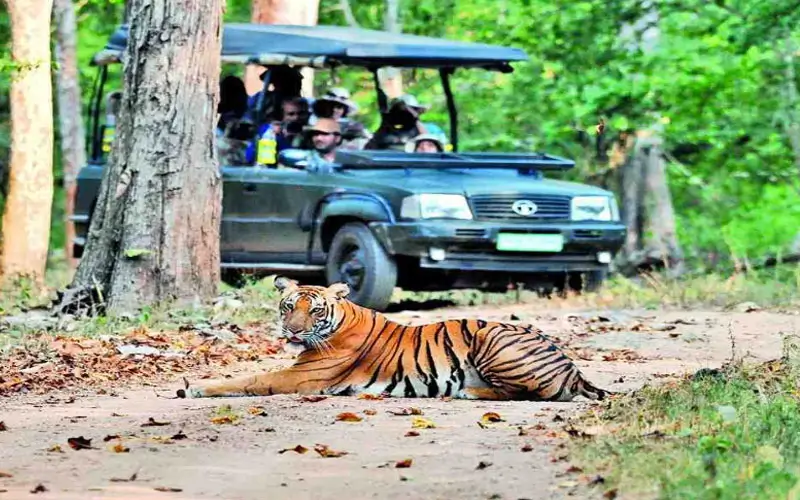
Yes. Ranthambore adds two nights and around USD 300 to USD 700 per person depending on the lodge. Varanasi adds a flight and two nights.
Yes. A solo traveller pays for the full car and a single room, so the per person cost is roughly 60 to 75 percent of a couple's total.