Delhi - Agra - Jaipur - Khajuraho - Varanasi - Mumbai
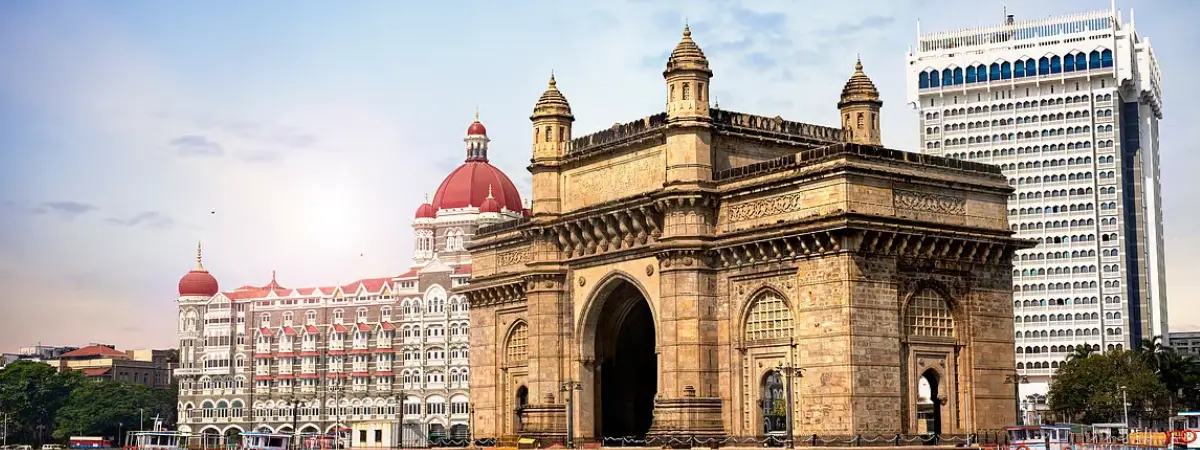
Thirteen World Heritage Sites, two thousand years of building and a single question link the days of this Luxury India Art Architecture and UNESCO Heritage Tour: how did each age of Indian history express itself in stone? You will trace the answer from the Mauryan stupa at Sarnath to the sculpted Chandela temples of Khajuraho, from the Persian garden tombs of the Mughals to the astronomical instruments of an eighteenth-century Rajput king, and finally to the Victorian Gothic railway terminus and Art Deco seafront of Mumbai. Guides on this tour are art historians, archaeologists or senior heritage specialists, and each site visit is arranged for the hour when light and crowds are kindest to the architecture.
Comfort is handled quietly in the background. Every road leg is covered by a private car and driver, while the long distances between Jaipur, Khajuraho, Varanasi and Mumbai are covered by domestic flights. Hotels are chosen partly for their own design value, and our usual choices include The Leela Palace in Delhi, The Oberoi Rajvilas in Jaipur and Taj Nadesar Palace in Varanasi, subject to availability. Alongside the monuments, the itinerary makes room for the living arts that grew from them: a marble inlay workshop in Agra, block printers and blue potters in Jaipur, and silk weavers in the lanes of Varanasi. This is an India UNESCO heritage tour for travellers who want depth over a checklist.
Tour Highlights
 Package Includes:
 Package Excludes:
Reply within 24hrs
Your arrival at Indira Gandhi International Airport marks the start of sixteen days of art and architecture, and a representative from Heritage India Private Tours is waiting in the arrivals hall holding a name card. Terminal 3, where most international flights land, is itself a fair introduction to modern India, with its long walls of copper hand gestures, or mudras, sculpted above the immigration counters. The chauffeur stows your bags and heads for The Leela Palace in Chanakyapuri, our usual choice and subject to availability, about thirty-five minutes away in normal traffic, along the broad avenues of the diplomatic quarter.
The hotel itself was designed to echo the scale of Lutyens' Delhi, with domed ceilings, inlaid marble floors and a rooftop pool looking towards the leafy diplomatic enclave. After check-in, your representative goes through a reading list for the tour, a set of site maps and the names of the specialists who will guide you in each city. Nothing else is booked today, giving the body clock time to adjust. If you are awake in the evening, Le Cirque on the top floor or Jamavar, the hotel's Indian restaurant, offer refined dinners without leaving the building. Overnight stay in Delhi.
The day opens at Humayun's Tomb, the first of Delhi's three UNESCO sites and, in the view of many architectural historians, the true ancestor of the Taj Mahal. Your guide explains how the Persian architect Mirak Mirza Ghiyas introduced the double dome, the charbagh garden divided by water channels and the use of red sandstone framed by white marble. The Aga Khan Trust for Culture restored the tomb and its gardens with traditional lime plaster and hand-cut tiles, and next door, Sunder Nursery shows the same team's work on a cluster of smaller Mughal tombs set among lawns and a bonsai garden.
After lunch at Sunder Nursery's café, drive south to Mehrauli and the Qutub Minar, a seventy-three metre victory tower begun in the late twelfth century. Your guide draws attention to the bands of Arabic calligraphy and the carved balconies, then leads you into the Quwwat-ul-Islam mosque, where columns taken from earlier Hindu and Jain temples still bear their bells and lotus carvings. The Alai Darwaza gateway, with its pointed horseshoe arches and lattice screens, is a small masterpiece of early Indo-Islamic design. Return to the hotel in the late afternoon, with a free evening before dinner. Overnight stay in Delhi.
Delhi's third UNESCO site is the Red Fort, which is closed on Mondays, so this day is scheduled to avoid it. Your guide enters through the Lahori Gate and leads you along the Chatta Chowk, a covered bazaar inspired by those Shah Jahan saw in Peshawar. The Diwan-i-Aam, the hall of public audience, holds the inlaid marble throne canopy where the emperor received petitions, while the Diwan-i-Khas, the private audience hall, carries the famous Persian couplet saying that if there is paradise on earth, it is here. The water channel called Nahr-i-Bihisht once ran through every pavilion to cool them.
After lunch, the National Museum on Janpath brings the subject of the coming weeks into focus. Your guide highlights the Harappan dancing girl in bronze, the Gandhara Buddhas, a Chola Nataraja and the Mughal miniature galleries, each linked to a site you will soon see in person. Later, a short drive to the Kiran Nadar Museum of Art in Saket shows how twentieth-century painters such as M.F. Husain, S.H. Raza and Amrita Sher-Gil reinterpreted India's long artistic tradition. The museum is closed on Mondays. Dinner tonight is at Indian Accent in The Lodhi, known for modern takes on regional dishes. Overnight stay in Delhi.
Leave Delhi after breakfast and follow the Yamuna Expressway south to Agra, a smooth drive of about three and a half hours with a refreshment stop at a highway food court. Our usual choice in Agra is ITC Mughal, subject to availability, whose low red sandstone buildings and Mughal gardens were designed to recall the architecture of the city's monuments. After check-in and lunch, your architectural guide takes you across the Yamuna to Itimad-ud-Daulah, the tomb Empress Nur Jahan built for her father and the first Mughal building faced entirely in white marble, completed several years before work on the Taj began.
Itimad-ud-Daulah is small enough to study up close, and its walls are covered with pietra dura inlay of semi-precious stones in floral and geometric patterns, from cypress trees to wine flasks. Your guide shows how this technique prepared the way for the decoration of the Taj Mahal. Before sunset, move on to Mehtab Bagh, the Mughal garden facing the mausoleum across the Yamuna, which archaeologists believe was laid out as part of the Taj Mahal's original design. From here, the mausoleum's reflection can sometimes be seen in the octagonal pool, and the view helps explain the precise symmetry of the whole layout, river and all. Overnight stay in Agra.
Because the Taj shuts every Friday and admits visitors from just before dawn, this day is always fixed for a Saturday-to-Thursday slot. You arrive at the East Gate in the soft light of dawn with an architectural historian, who explains the geometry that makes the monument feel effortless: the minarets lean slightly outward, the calligraphy around the main arch grows larger towards the top to appear uniform from below, and the garden is divided into sixteen beds by raised walkways. Inside the mausoleum, the lattice marble screen around the cenotaphs is one of the finest pieces of carving in India.
After breakfast at the hotel, visit Agra Fort, where your guide focuses on the palace buildings that span three emperors, from Akbar's red sandstone Jahangiri Mahal through to the marble chambers Shah Jahan added in the 1630s. In the afternoon, a visit to a family workshop of marble inlay artisans, many of whom trace their craft to the builders of the Taj, shows how agate, carnelian and lapis lazuli are cut, shaped and fitted into marble using simple tools. The precision is astonishing, and you can buy directly from the makers if you choose, with certificates and secure shipping arranged by the workshop. Overnight stay in Agra.
Leave Agra early for the forty-kilometre drive to Fatehpur Sikri, the red sandstone city Emperor Akbar built in the 1570s and abandoned within fifteen years, probably because of water shortages. Your guide pays particular attention to the Panch Mahal, a five-storey open pavilion of columns that grows smaller towards the top, and the Diwan-i-Khas, where a single carved pillar supports a central platform from which Akbar is said to have held debates with scholars of many faiths. At the Jama Masjid, the white marble tomb of Sheikh Salim Chishti displays some of the finest lattice screens of the Mughal period.
The drive continues west into Rajasthan, and a detour of about forty-five minutes brings you to Abhaneri, home to Chand Baori, a stepwell dug over a thousand years ago. Thirteen storeys of steps descend in perfect zigzags to the water below, creating a pattern that architects and photographers find irresistible. Next door, the ruined Harshat Mata temple still shows fine carvings of musicians and dancers. Arrive in Jaipur by late afternoon after a long but rewarding day and settle into The Oberoi Rajvilas, our usual choice and subject to availability, set amid gardens, orchards and a restored eighteenth-century Shiva temple. Overnight stay in Jaipur.
Jaipur holds three UNESCO listings, and today you see all of them. Amber Fort, one of the six Hill Forts of Rajasthan inscribed together, rises above Maota Lake on the old road from Delhi. Your guide explains how Raja Man Singh, a general in Akbar's army, combined Rajput defence with Mughal ideas of garden and palace. The Diwan-i-Aam's double row of columns, the carved and painted Ganesh Pol, and the Jas Mandir with its glass inlay and alabaster panels show this fusion clearly. Arrive early, when the light falls across the ramparts and before the tour groups fill the courtyards and the heat builds.
In the afternoon, the walled city welcomes you with its famous terracotta-pink façades, part of Jaipur's third UNESCO-listed feature, a city laid out on a strict grid by the architect Vidyadhar Bhattacharya. Your guide takes you into Jantar Mantar, the open-air observatory built by Maharaja Sawai Jai Singh II, where giant instruments of stone and brass measure time, track stars and predict eclipses. The Samrat Yantra, a sundial nearly twenty-seven metres high, can read the hour to within a couple of seconds when the sun is out. Close the day at the City Palace's Pritam Niwas Chowk, with its four painted gateways. Overnight stay in Jaipur.
This morning focuses on how Jaipur's craftsmen keep traditional arts alive. Visit a blue pottery workshop near Amer Road, where artisans shape quartz paste rather than clay and paint it with cobalt designs before firing. Continue to Sanganer, about sixteen kilometres south of the city, where block printers carve teak blocks and print fabrics by hand using natural indigo and madder dyes. You will watch the printers line up each block precisely along the cloth, a skill that can take years to master. The workshops welcome visitors, and the textiles are sold directly by the families who make them, so the money stays in the workshop.
After lunch, the subject turns to modern architecture. Jawahar Kala Kendra, designed by the architect Charles Correa, is laid out on a nine-square grid based on the ancient Vastu Shastra layout of the old city, with each square representing a planet. Your guide shows you its open-air amphitheatre, painted domes and the way Correa reinterpreted the stepwells and courtyards of Rajasthan. Late in the afternoon, Panna Meena ka Kund, a small stepwell near Amber, offers an intimate contrast to Chand Baori. Finish with dinner at Bar Palladio, whose blue interiors were inspired by Italian and Mughal design. Overnight stay in Jaipur.
Khajuraho lies deep in Madhya Pradesh, far from main roads, and the easiest way to reach it from Jaipur is by domestic flight, usually connecting through Delhi. Your chauffeur takes you to Jaipur airport in the morning, and the connecting flights bring you to Khajuraho's small airport by early afternoon. A new chauffeur meets you there for the short ten-minute drive to the hotel. Our usual choice is The Lalit Temple View, subject to availability, chosen for its location within walking distance of the Western Group of temples and for gardens shaded by old mango trees, and many rooms look straight at the temple spires.
After a late lunch and a rest, your archaeologist guide introduces the Chandela dynasty, which built around eighty-five temples here between the tenth and twelfth centuries, of which roughly twenty-five survive. A preview walk around the outer walls of the Western Group in the soft evening light reveals the elaborate sculpture you will study in detail tomorrow. In the evening, the sound and light show held in the temple gardens tells the story of the Chandela kings in English, with the temples floodlit against the night sky. Dinner is at the hotel, where the kitchen prepares Bundelkhandi dishes on request. Overnight stay in Khajuraho.
The Western Group is the heart of the UNESCO-listed Khajuraho temples, and you enter as soon as the gates open, when the sandstone glows in the early light. Your guide begins with the Lakshmana Temple, the earliest of the great temples, whose base shows long friezes of hunting, war and courtly life. Next comes the Kandariya Mahadeva, the largest and most refined, its shikhara built up of eighty-four smaller towers rising like a mountain range. The famous sculptures of celestial maidens, musicians and couples cover the walls in astonishing detail, and your guide explains their meaning within Hindu temple design and the wider symbolism of the sacred mountain.
After lunch, drive a short distance to the Eastern Group, where Jain temples such as the Parshvanath and Adinath show a quieter style with exceptionally fine carving. The Ghantai Temple, with its pillars of carved bells and chains, survives only partly but is beautiful. Continue to the Southern Group, where the Duladeo Temple, one of the last built by the Chandelas, shows how the sculptural style became more ornate. Return to the hotel by late afternoon, and in the evening visit the Adivart Tribal and Folk Art Museum to see the masks, bell-metal and painted crafts of Madhya Pradesh. Overnight stay in Khajuraho.
Your chauffeur drives you to Khajuraho airport for the short flight to Varanasi, which takes around an hour when it operates. Where the direct flight is not scheduled, we arrange a connection through Delhi instead. At Babatpur airport a fresh chauffeur meets you for the hour-long run into the city, passing mustard fields and brick kilns. Our usual choice here is Taj Nadesar Palace, subject to availability, a nineteenth-century palace hotel in forty acres of mango orchards, with horse-drawn carriages to carry guests through the gardens. Lunch is served on the verandah, followed by a rest in your room before the evening ahead.
In the late afternoon, your guide leads you through the narrow lanes towards Dashashwamedh Ghat, the city's main bathing ghat, where priests perform the Ganga aarti every evening. You watch from a private boat moored offshore, which gives a clearer and calmer view than the crowded steps. A line of young priests raise many-tiered brass lamps and circle them through the smoke in perfect time, while conch shells, bells and chanting fill the air and floating marigold lamps drift past on the current. The ritual lasts about forty-five minutes. Afterwards, walk back through the lanes with your guide, stopping for a cup of Banarasi lassi served in a clay pot. Overnight stay in Varanasi.
Before sunrise, a rowing boat takes you along the curve of the Ganges, past more than eighty ghats where pilgrims bathe, priests chant and laundry is beaten on stone slabs. Your guide points out the architecture along the river: the Man Mandir Ghat palace, built by Raja Man Singh of Amber, with its rooftop observatory designed by Jai Singh II, the same ruler whose Jantar Mantar you saw in Jaipur. At Manikarnika Ghat, the cremation pyres burn day and night, and your guide explains the Hindu beliefs surrounding death in Varanasi. Photography is not permitted at the cremation ghats, and your guide will tell you when to lower the camera.
After breakfast, drive about thirty minutes to Sarnath, where the Buddha delivered his first sermon. The Dhamek Stupa, a solid brick and stone mound decorated with carved Gupta-period floral bands, marks the spot. Your guide then takes you to the Sarnath Archaeological Museum, closed on Fridays, which holds the polished sandstone Lion Capital of Ashoka, now India's national emblem, as well as a serene seated Buddha in the teaching gesture, among the finest Gupta sculptures. Return to the hotel in the afternoon, with time to relax in the gardens before dinner, perhaps with a carriage ride around the orchards. Overnight stay in Varanasi.
Banarasi silk is one of the great textile traditions of India, and this morning you visit the weavers' quarter of Madanpura or Peeli Kothi with your guide. In small rooms, families work on handlooms using punched cards to create the patterns of zari brocade, with threads of gold and silver woven into silk. A single sari may take weeks to finish. Watching the shuttles move back and forth gives you a new appreciation of the saris in the city's shops, and you can buy directly from the weavers. Your guide explains how to tell genuine handloom silk from cheaper powerloom copies, a useful skill in a city full of silk shops, and how the motifs of jaal, butidar and shikargah patterns are named and used.
In the afternoon, drive to the campus of Banaras Hindu University, where Bharat Kala Bhavan holds one of the finest collections of Indian art outside a national museum. Highlights include a remarkable group of Mughal and Pahari miniature paintings, Gupta terracottas and Banarasi textiles. The museum is closed on Sundays and university holidays, so your guide will confirm the timings. Return through the old city, stopping at the Bharat Mata Temple, which contains a relief map of undivided India carved in marble rather than an idol. Supper might be a Banarasi vegetarian thali in the palace dining room. Overnight stay in Varanasi.
Leave Varanasi on a late-morning direct flight to Mumbai, which takes a little over two hours. On arrival, your chauffeur drives you to South Mumbai, where our usual choice is the Trident at Nariman Point, subject to availability, with views over Marine Drive and the bay. After check-in and a short rest, your architectural guide begins with the most extraordinary railway station in the world, Chhatrapati Shivaji Maharaj Terminus, a UNESCO site designed by Frederick William Stevens and completed in 1888. Its Gothic towers and domes are decorated with carvings of peacocks, gargoyles, lions and tigers by students of the Sir J.J. School of Art.
From the station, your guide walks you to the nearby Municipal Corporation Building, which faces the terminus across the road with a matching Gothic façade, and points out details invisible from a car window, such as stained glass, iron balustrades and carved stone capitals. Finish with a look at Bombay Gymkhana, the cricket club founded in 1875 in the open grounds of the Azad Maidan, before returning to the hotel. Dinner can be at Masque, a modern Indian tasting menu restaurant in a converted mill in Mahalaxmi, or at the hotel's own Frangipani restaurant, which overlooks the bay. Overnight stay in Mumbai.
Mumbai has three UNESCO sites, and today you see the remaining two. In the morning, a private launch crosses the harbour from the Gateway of India to Elephanta Island in about fifty minutes. The caves are closed on Mondays. In the main cave, carved in the sixth century, your guide studies the sculpted panels flanking the giant Trimurti: Ardhanarishvara, the half-male, half-female form of Shiva; Gangadhara, showing Shiva receiving the river Ganga in his hair; and the wedding of Shiva and Parvati. The grand pillared hall, with its square columns and cushion capitals, offers a lesson in rock-cut architecture, since every column was carved from the living rock.
After lunch, your guide leads a walking tour of the Oval Maidan, the open ground at the centre of the Victorian Gothic and Art Deco Ensembles of Mumbai, inscribed by UNESCO in 2018. Along the eastern edge line up the High Court, the Rajabai tower and the university's Convocation Hall, while across the grass rises a row of Art Deco apartment buildings from the 1930s, with curved balconies, sunburst motifs and pastel colours. Continue along Marine Drive to see the second-largest collection of Art Deco buildings in the world. A farewell dinner is arranged at Ziya. Overnight stay in Mumbai.
Your final day is shaped around your flight time. If you have a free morning, your chauffeur can take you to the Dr. Bhau Daji Lad Museum in Byculla, the city's oldest museum, set in a Palladian building with a beautifully restored Victorian interior of gilded columns and Minton tiles. It is closed on Wednesdays. Alternatively, the galleries of Kala Ghoda offer a final look at contemporary Indian art, and the Chemould Prescott Road gallery near Fort is one of the oldest commercial art spaces in the country. A late checkout is requested where possible, and luggage can be stored with the concierge.
At the agreed hour, your chauffeur and representative meet you in the hotel lobby and take you out to the international airport at Sahar, roughly an hour's drive. The airport's Terminal 2, with its coffered roof and the Jaya He museum displaying more than five thousand artworks along the departure corridors, is a fitting last stop for a tour devoted to Indian art. Your representative helps with check-in and luggage. Over sixteen days you will have seen thirteen World Heritage Sites and a long list of working craft studios, and we hope the memories stay with you long after you are home. Our team will be glad to hear your impressions afterwards.
Hear what our happy guests say about their India adventures! From private drivers to guided tours, we make every journey smooth, safe & unforgettable.
 rating score: 5.0 of 5, based on 448 reviews

Complete our inquiry form

Customize your itinerary

Confirm when you're satisfied
1-to-1 Service | Reply within 24hrs | Expert's Advice