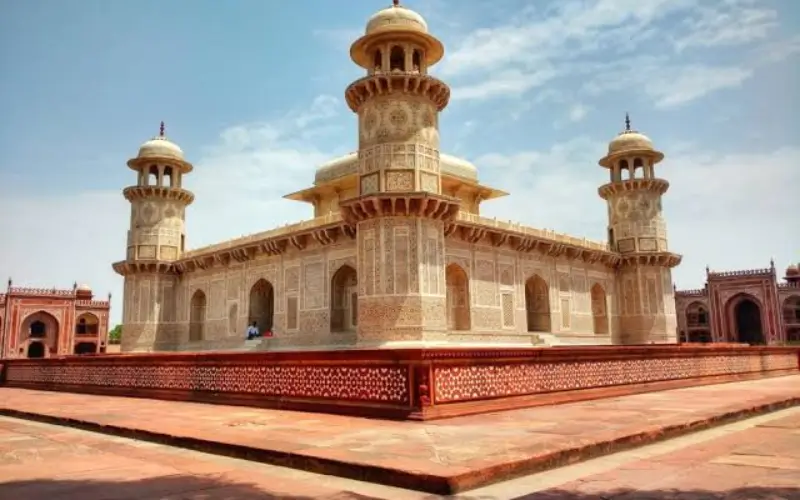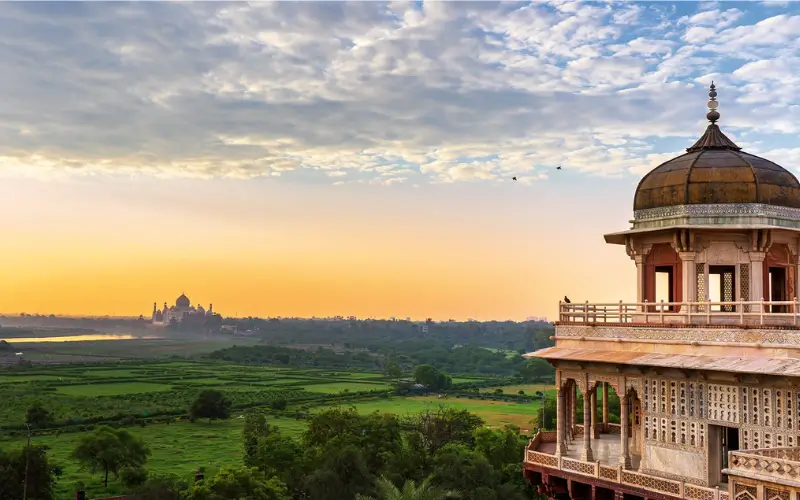
Most travellers leave Agra with their minds still full of the Taj Mahal. An hour later, the car turns off the highway and climbs a low ridge, and suddenly a whole abandoned city of red sandstone appears: palaces, courtyards, a towering gateway and a white marble tomb glowing in the middle of a vast mosque. This is Fatehpur Sikri, the capital that Emperor Akbar built in the 16th century and left behind after only about fourteen years. Three hours further on, past mustard fields and village ponds, a narrow lane leads to a deep stepwell with thousands of steps falling in perfect geometric patterns to a pool of green water far below.
The drive from Agra to Jaipur by car is one of the most rewarding days on the Golden Triangle, but only if it is timed well. Leave too late, and you will rush through Fatehpur Sikri, skip Abhaneri and arrive in Jaipur after dark. This guide covers fares, distances, entry tickets and opening hours, and the best order of stops, so the day feels like part of the holiday rather than a long transfer.
The direct distance from Agra to Jaipur is about 240 kilometres via National Highway 21, passing Bharatpur and Dausa. Adding the short detour to Fatehpur Sikri adds very little, as it lies just off the same road about 40 kilometres from Agra. The Abhaneri stepwell sits about 10 kilometres off the highway, around 95 kilometres before Jaipur, and adds 20 to 30 minutes of extra driving. The total for the day is usually 260 to 280 kilometres.
|
Trip Type |
Sedan (INR) |
Innova Crysta (INR) |
Tempo Traveller (INR) |
|---|---|---|---|
|
One-way drop, Agra to Jaipur (with stops) |
7,000 – 8,500 |
9,500 – 11,500 |
13,500 – 16,500 |
|
As part of a Golden Triangle tour (per day) |
4,500 – 5,500 |
6,000 – 7,000 |
8,500 – 10,000 |
|
Agra to Jaipur via Ranthambore (2 days) |
11,500 – 14,000 |
15,500 – 18,500 |
22,000 – 26,500 |
The Agra to Jaipur taxi fare for a one-way drop includes the cost of the car returning empty, which is why it is higher than a single day within a longer tour. If you are already on a Golden Triangle tour with the same car and driver, this day is simply part of the package and is charged at the normal daily rate.
Tolls on the route are moderate, around INR 300 to INR 450 for a car, plus state permit charges when a Delhi or Uttar Pradesh car enters Rajasthan. Parking at Fatehpur Sikri costs about INR 100 to INR 200, and the parking lot at Abhaneri is small and usually free or very cheap.
The road itself is mostly a good four-lane highway, though the section near Bharatpur and some village stretches around Dausa can be slower. Trucks are common, especially at night, so a daytime drive is safer and more pleasant.
Some travellers wonder whether to take the train instead. Trains between Agra and Jaipur take four to five hours, but they do not stop near Fatehpur Sikri or Abhaneri, and you still need taxis at both ends. For anyone who wants to see the monuments on the way, the private car is the only practical choice.
When you book, confirm that the price includes tolls, the Rajasthan permit, parking and driver allowance. Also confirm the hotel pickup time in Agra the evening before, as an early start makes the whole day easier.
For families or groups, an Innova Crysta or Innova Hycross gives more space for luggage and a calmer ride on the rougher stretches. Two travellers with medium bags will be comfortable in a sedan such as a Maruti Ciaz. If you are carrying shopping from Agra, such as marble inlay pieces or rugs, a larger car with a full boot is worth the upgrade.
Drivers who know the route well will suggest leaving Agra around 8 AM, which places you at Fatehpur Sikri just as it fills with the first wave of visitors, but well before the midday crowds and heat. That single decision shapes the whole day.
Fatehpur Sikri is a UNESCO World Heritage Site and one of the best-preserved Mughal cities anywhere. It was built by Emperor Akbar in the late 16th century to honour the Sufi saint Salim Chishti, who had predicted the birth of his son. The city was abandoned soon after, possibly because of water shortages, and its palaces have survived almost intact.
The site is divided into two parts. The royal complex holds the palaces, the Hall of Public Audience, the Hall of Private Audience with its famous carved central pillar, the five-storey palace with open pavilions, and the courtyards where Akbar played a life-size board game with servants as pieces. The religious complex, next door, holds the great mosque, the white marble tomb of Salim Chishti and the immense Gate of Magnificence, one of the tallest gateways in the world.
The royal complex opens from sunrise to sunset, and the entry fee for foreign visitors is about INR 610. The mosque and tomb area is a working religious site with free entry, though you must remove your shoes and cover your shoulders and knees. Shoe attendants at the entrance expect a small tip of INR 20 to INR 50.
Allow about two hours for a good visit. A licensed guide from Agra can join you for the day, or you can hire one at the entrance. A guide for Fatehpur Sikri costs INR 1,000 to INR 1,500 for the visit, and makes a real difference in making sense of Akbar's experiments with religion, architecture and court life. Be cautious of unofficial guides who approach visitors in the parking area, and ask to see a government licence card before hiring anyone.
At the entrance to the religious complex, you will meet many vendors and some persistent touts. It is best to decline politely and keep moving. Inside the tomb of Salim Chishti, visitors tie threads to the marble screens as they make wishes, a custom you are welcome to join.
The parking area for Fatehpur Sikri is about a kilometre from the main gate, and a shuttle bus takes visitors up the hill for a small fee. Wear comfortable shoes, as there is a lot of walking on uneven stone, and carry water, especially in March and April, when temperatures rise quickly.
There are simple restaurants near the parking area, but most travellers prefer to eat later on the road. If you are hungry, a light snack here keeps you going until a proper lunch near Bharatpur or Dausa.
Leaving Fatehpur Sikri by about 11 AM leaves plenty of time for Abhaneri and an afternoon arrival in Jaipur. If you love history and want to spend longer, it is better to drop Abhaneri than to rush the Mughal city, which deserves an unhurried visit.
The Abhaneri stepwell is one of the most dramatic sights in Rajasthan, yet many travellers have never heard of it. Built in the 8th or 9th century, it is one of the deepest and largest stepwells in India, about 30 metres deep with around 3,500 narrow steps arranged in a perfectly symmetrical pattern across 13 levels. Stepwells like this one stored rainwater for the dry months and also served as cool gathering places during the hot season.
Abhaneri village sits about 10 kilometres off the highway, roughly 95 kilometres before Jaipur. The stepwell opens from sunrise to sunset. Entry has been free for many years, though a small ticket may now be charged for foreign visitors at certain times. Visitors are no longer allowed to walk down the steps, so you view it from the surrounding galleries. A visit takes 30 to 45 minutes.
Next to the stepwell stands the Harshat temple, an early medieval temple dedicated to a goddess of joy, with finely carved stone panels. Many of the original carvings rest in the stepwell's galleries, so walking around both gives a good picture of the site's history.
A few other stops can be added depending on your interests and time. Bharatpur, about 55 kilometres from Agra, is home to Keoladeo National Park, one of Asia's finest bird sanctuaries and a UNESCO World Heritage Site. Between November and February, it hosts migratory birds from Central Asia and Siberia, including painted storks, pelicans and many species of ducks. Entry for foreign visitors is about INR 500, and a two-hour visit by bicycle cart with a naturalist guide costs around INR 1,000 to INR 1,500. Adding Keoladeo makes the day long, so it suits early risers or those staying overnight in Bharatpur.
Lunch is usually taken around Bharatpur, Mahwa or Sikandra on the Jaipur highway, where several highway restaurants serve North Indian and Rajasthani food with clean washrooms. A meal for two costs INR 800 to INR 1,500. Some travellers prefer to wait for a late lunch at a heritage hotel in Jaipur instead.
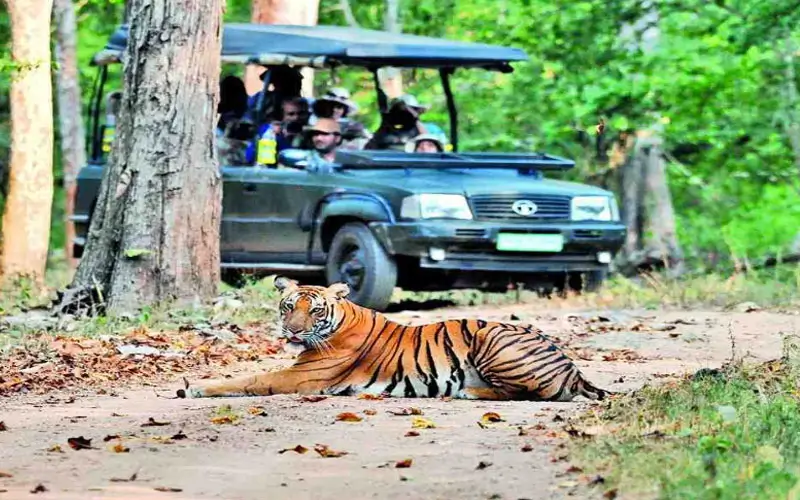
If you are heading to Ranthambore instead of Jaipur, the route branches south at Bharatpur or Dausa towards Sawai Madhopur. In that case, Abhaneri does not fit as easily, and you would usually visit it later on the Ranthambore to Jaipur leg.
For travellers with a special interest in rural life, a short stop in a village near Abhaneri can be arranged with the driver. Villages here still have old wells, clay homes and farming families who are often happy to greet visitors. A small gift for children, such as pencils or notebooks, is better than money.
The secret to a good Agra to Jaipur day is the start time. Leave your Agra hotel by 8 AM, and the day falls into place naturally. Reach Fatehpur Sikri around 9 AM and spend two hours there. Leave by 11 AM, stop for lunch around 1 PM, and reach Abhaneri by about 2:30 PM. After 45 minutes at the stepwell, continue to Jaipur, arriving around 5 PM, which leaves time to check in, rest and enjoy an evening walk or dinner.
If you want to see the Taj Mahal at sunrise on the same morning, the timing changes. Visit the Taj from about 6:30 AM to 8:30 AM, return to the hotel for breakfast and check-out, and leave Agra by 10 AM. In this case, it is better to choose either Fatehpur Sikri or Abhaneri, rather than both, to avoid arriving in Jaipur after dark.
Arriving in Jaipur in the evening means facing city traffic on the Agra Road and around the old city between 5:30 PM and 8 PM. Your driver will know the best roads, but allow 30 to 45 minutes from the city edge to central hotels. Hotels near the airport or on Tonk Road are quicker to reach from this direction.
Winter days are short. In December and January, the sun sets around 5:45 PM, and dusk comes quickly. Rural highways become harder to drive after dark because of dim truck lights, tractors and animals on the road. This is the strongest reason to keep the day on schedule and resist adding too many stops.
Summer brings the opposite problem. From April onward, temperatures can rise above 40°C by noon, and walking around Fatehpur Sikri in the midday sun is exhausting. In hot months, start at 7 AM and keep the walking parts of the day to the morning.
A small kit makes the drive more comfortable: water, snacks, sunscreen, a scarf to cover shoulders at the mosque, small cash notes for shoe attendants and washrooms, and a fully charged phone for photos.
Heritage India Private Tours arranges the Agra to Jaipur drive as part of every Golden Triangle and Rajasthan tour, with experienced drivers who know exactly when to leave, where to stop and how to reach Jaipur before dark. Licensed guides for Fatehpur Sikri can be added on request. Share your dates through the enquiry form or on WhatsApp at +91-9799397401 for a complete quote.
About 240 kilometres directly, or 260 to 280 kilometres including stops at Fatehpur Sikri and Abhaneri.
About four and a half to five hours without stops. With Fatehpur Sikri and Abhaneri, the full day takes eight to nine hours.
A one-way sedan with stops costs about INR 7,000 to INR 8,500, and an Innova Crysta about INR 9,500 to INR 11,500, including tolls and permits.
About INR 610 for the royal complex. The mosque and tomb area is free but requires modest clothing and removing shoes.
Yes. It adds only 30 to 45 minutes of driving and visiting time and is one of the most striking sights in Rajasthan.
No. Walking down the steps is no longer permitted. Visitors view the stepwell from the surrounding galleries.
Around 8 AM to see both Fatehpur Sikri and Abhaneri comfortably and reach Jaipur by 5 PM.
Yes, but choose either Fatehpur Sikri or Abhaneri on the way, so you still reach Jaipur before dark.
Yes. Highway restaurants around Bharatpur, Mahwa and Sikandra on the Jaipur road serve fresh food with clean washrooms.
For bird lovers visiting between November and February, yes. It adds two to three hours, so an overnight stop in Bharatpur is the comfortable choice.