Delhi - Agra - Jaipur - Pushkar - Jodhpur - Udaipur - Mumbai
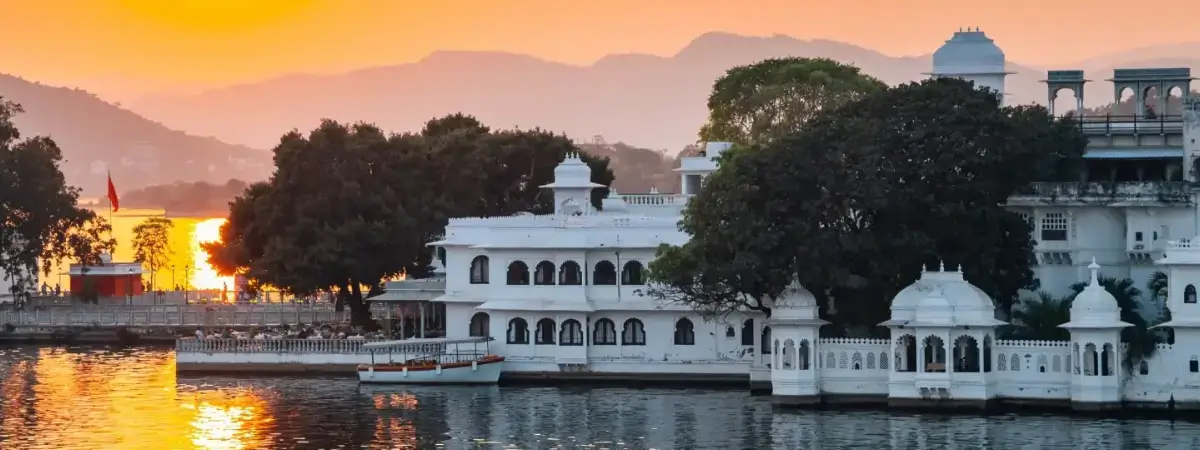
Rushing through India tends to leave guests with a camera roll full of forts and very little memory of how any of them felt. Our Luxury India Slow Travel Tour with Exclusive Heritage Stays turns that around by giving you eighteen days for seven places, so no stop is shorter than two nights and the longer ones run to three. You sleep in buildings that carry their own history: a 1930s hotel on Janpath, a restored haveli inside the walls of Jaipur, a lakeside palace in Pushkar, a townhouse under the cliffs of Mehrangarh and a palace wing on Lake Pichola. Mornings start late when you want them to, sightseeing is kept to one main visit a day, and the afternoons are left for the pool, a long lunch or a wander with no fixed return time.
A private car and driver carries you overland from Delhi through Agra and the Rajasthan heartland, which suits a slow pace far better than a group coach with a timetable. Your English-speaking chauffeur stays with you all the way to Udaipur, stopping wherever a village well, a roadside chai stall or a field of mustard catches your eye. In each city a local guide joins for the main visit, and we brief them to talk to you rather than recite dates. From Udaipur a short domestic flight takes you to Mumbai, where two nights in the heritage wing of the Taj Mahal Palace close the trip by the Arabian Sea. This slow travel India tour is well suited to returning visitors, couples, and anyone who would rather know five rooms of a palace well than walk past fifty of them.
Tour Highlights
 Package Includes:
 Package Excludes:
Reply within 24hrs
After the long flight, nobody expects you to do anything today, and we have built the first evening around rest. Our representative meets you in the arrivals hall at Indira Gandhi International Airport holding a name board, helps with the luggage trolley, and walks you to the car where your chauffeur is waiting with chilled water and a cold towel. The drive to central Delhi takes forty-five minutes to an hour depending on traffic, passing the diplomatic enclave of Chanakyapuri with its tree-lined roads and embassy gates. We hand over a printed folder with your full itinerary, local mobile numbers, and the names of every guide you will meet along the route.
Your first two nights are at The Imperial on Janpath, our usual choice for this tour, a hotel opened in 1931 when Lutyens' New Delhi was still being finished. The corridors are hung with one of the largest private collections of colonial-era prints and lithographs in the country, and the palm-lined driveway feels a world away from the traffic outside. Early check-in can be arranged for a night flight, subject to availability. If you are awake and hungry, the 1911 bar serves a good gin and tonic, and the Spice Route restaurant is worth booking for later in the week. Overnight stay in Delhi.
A late breakfast is the right start, so your guide meets you at ten and the car heads south to Mehrauli, the oldest continuously inhabited part of Delhi. The Qutub Minar comes first, a fluted red sandstone tower raised from 1199 onward, with the rust-free iron pillar standing in the courtyard of the Quwwat-ul-Islam mosque beside it. Rather than leaving straight after, you walk into the Mehrauli Archaeological Park next door, where more than a hundred scattered structures sit among babul trees: the stepwell of Rajon ki Baoli, the tomb of Balban, and the small domed Jamali Kamali mosque with its painted ceiling.
Lunch is back at the hotel or at a quiet café in the Lodhi Colony neighbourhood, followed by an afternoon left free for the pool or a rest. Around five, the car takes you to Humayun's Tomb for the soft late light on the red sandstone and white marble, then a short walk across the road into Nizamuddin Basti. On Thursday evenings, and often on other days too, qawwals sing at the dargah of the Sufi saint Nizamuddin Auliya after sunset prayers; your guide finds you a place to sit on the marble floor. Remember to carry a scarf or cap for your head inside. Overnight stay in Delhi.
The Yamuna Expressway makes the run to Agra smooth and predictable, so there is no need for an early start. Your chauffeur collects you after breakfast, around half past ten, and the drive takes about four hours including a coffee stop at one of the food plazas along the way. The road crosses the flat farmland of western Uttar Pradesh, with sugarcane in winter and fields of wheat turning gold by March. Arriving in Agra in the early afternoon, you check in to The Grand Imperial, our usual choice here, a restored building from the late 1800s with high ceilings, arched verandahs and a courtyard pool.
Rather than going straight to the Taj Mahal, the afternoon is given to Itimad-ud-Daulah, the tomb that Nur Jahan built for her father on the east bank of the Yamuna. It is small, quiet, and covered in pietra dura inlay of cypress trees, wine cups and fruit bowls that predates the Taj by two decades, which is why many call it the draft before the masterpiece. From there it is a short drive to Mehtab Bagh, the Mughal garden directly across the river, where you watch the Taj Mahal turn pink and then grey as the sun drops behind it. Overnight stay in Agra.
The Taj Mahal opens thirty minutes before sunrise, and that first hour is the best reason to stay two nights in Agra. Your guide meets you in the hotel lobby with tickets already arranged, and a battery car takes you from the parking zone to the east gate. Inside, you have the time to sit on the marble bench in the Charbagh garden, walk around the plinth to the riverside terrace, and look closely at the calligraphy around the main arch, which grows larger near the top so that it reads evenly from the ground. Please note that the Taj Mahal is closed every Friday, and our itinerary is always arranged around that day.
After a late breakfast back at the hotel, the middle of the day is yours. Many guests sleep for an hour after the early start, then visit Agra Fort in the afternoon, where the Musamman Burj is the octagonal tower in which Shah Jahan spent his final years looking across at his wife's tomb. If you prefer something different, your guide can take you to a marble inlay workshop run by families descended from the original Taj craftsmen, where you watch a single flower being cut from carnelian and lapis lazuli. There is no pressure to buy anything, and the demonstration is worth seeing for its own sake. Overnight stay in Agra.
Leaving Agra after breakfast, the car reaches Fatehpur Sikri in under an hour, and we suggest giving it a proper two hours rather than the usual rushed stop. Akbar built this red sandstone capital in the 1570s and left it about fifteen years later, most likely because the water supply failed. Your guide walks you through the Diwan-i-Khas with its single carved pillar, the five-storey Panch Mahal, and the courtyard of the Jama Masjid, where the white marble tomb of Salim Chishti has lattice screens so fine they look like lace. Families still tie red threads on the screens when praying for a child.
The rest of the road runs west across the state border into Rajasthan, through Bharatpur and Dausa, and reaches Jaipur by mid-afternoon. Your home for the next three nights is Samode Haveli, our usual choice, a 200-year-old nobleman's mansion inside the walled city, with painted dining rooms, a mirrored suite and a swimming pool in a quiet courtyard garden. Being within the old walls means you can walk out of the gate into the evening life of Gangori Bazaar without needing the car. The haveli kitchen serves a Rajasthani thali on the terrace if you want an easy first dinner. Overnight stay in Jaipur.
Amber Fort sits eleven kilometres north of the city, and arriving soon after the gates open at eight lets you see the courtyards before the coaches roll in around ten. Your guide takes you up through the Suraj Pol gate into the Jaleb Chowk, then through the Ganesh Pol, whose painted façade is one of the finest in Rajasthan. The Sheesh Mahal hall of mirrors is the famous room, but take time too in the zenana courtyard at the top, where the queens' apartments open on to a shared corridor so that the Raja could visit any wife without the others knowing.
Instead of hurrying back to the city, the late morning drifts down the hill to Panna Meena ka Kund, a sixteenth-century stepwell whose criss-cross stairways make some of the best photographs near Jaipur. Amber village behind it is a cluster of old temples, including the Jagat Shiromani, built by a queen in memory of her son, and you can walk its lanes with very few other visitors. Lunch is a simple affair at a café near the Jal Mahal on the way back. The afternoon is left open at Samode Haveli, a good time for the pool or a massage in the spa. Overnight stay in Jaipur.
This morning stays inside the walled city, within walking distance of the haveli. At the City Palace, the royal family still lives in the seven-storey Chandra Mahal, and the Pritam Niwas Chowk courtyard has four painted doorways for the four seasons, the peacock gate being the one everyone photographs. Next door, Jantar Mantar holds Sawai Jai Singh's eighteenth-century stone instruments, among them the Samrat Yantra sundial, which tells local time to within about two seconds. Your guide explains how the instruments were actually used, which brings the strange shapes to life far better than any plaque. Mornings here are cooler and the courtyards far quieter than after lunch.
From the observatory, a short walk brings you to the front of the Hawa Mahal on Sireh Deori Bazaar; for the best view, climb to the rooftop café opposite and look at its 953 small windows over a cup of masala chai. The afternoon is completely free. Some guests shop for block-printed cotton at Anokhi on Prithviraj Road or for silver jewellery in Johari Bazaar, while others prefer an afternoon in the haveli library with a book. Your chauffeur is on call if you want to go anywhere, and the hotel can arrange a cooking demonstration of laal maas in the evening. Overnight stay in Jaipur.
A short and easy drive today, heading south-west on the Ajmer highway after a leisurely breakfast. The road climbs gently into the Aravalli hills, and just before Pushkar you cross the Nag Pahar ridge, which separates the holy town from the city of Ajmer. If you wish, the car can stop in Ajmer for an hour at the dargah of Khwaja Moinuddin Chishti, one of the most visited Sufi shrines in South Asia, where the huge cauldrons in the courtyard are still used to cook food for pilgrims at festival times. Shoes are left with the car, and your guide keeps the visit short and calm.
Pushkar is a small town built around a lake, with fifty-two ghats leading down to the water and around four hundred temples. You stay two nights at the Pushkar Palace, our usual choice, a former royal residence standing right on the lake edge, so the morning bells and evening chants come straight to your window. After check-in and lunch, your guide walks you to the Brahma Temple, one of very few temples dedicated to the creator god anywhere in India, and then down to Gau Ghat for the sunset aarti, where lamps are swung over the water to the sound of conch shells. Overnight stay in Pushkar.
Pushkar rows much of the rose crop that goes into rose water, gulkand jam and the garlands sold at temples across Rajasthan. Early this morning, while it is still cool, your guide takes you to a family farm on the edge of town to watch the pickers at work and then into a small processing unit where petals are distilled in copper pots. You taste gulkand on bread, rose sherbet and a cup of chai, and you are welcome to buy a bottle of rose water for a fraction of what it costs at home. The farm visit is relaxed and personal, and the family is always happy to answer questions.
Later in the morning, a ropeway lifts you to the Savitri Temple on Ratnagiri hill, dedicated to Brahma's first wife, with a view over the lake, the town and the sand dunes beyond. The afternoon is unhurried. You can sit in the palace garden, browse the main bazaar for hand-stitched leather journals and cotton clothing, or have a lassi at one of the rooftop cafés above the ghats. Please be aware that alcohol and meat are not served in Pushkar because of its religious status, and the hotel kitchen prepares excellent vegetarian Rajasthani food instead, with dal, kadhi and malpua on most menus. Overnight stay in Pushkar.
The road to Jodhpur runs west through the town of Merta, where the poet-saint Mirabai was born, and a stop at the Meera Bai temple is a pleasant way to break the drive. The landscape grows drier as you go, with khejri trees, camel carts and herds of goats moving along the road edge. Your chauffeur knows a highway dhaba near Merta that serves crisp kachori and sweet milky tea, the kind of place you would never stop at without someone local to recommend it. Stops like this are part of the slow rhythm of the tour, and you will remember them as warmly as any palace.
You reach Jodhpur in the early afternoon and check in to RAAS Jodhpur, our usual choice, a set of eighteenth-century buildings restored into a boutique hotel at the foot of Mehrangarh. From the pool and many of the rooms, the fort fills the whole view, lit gold at night. After resting, take an evening stroll into the old city with your guide, through the Navchokiya neighbourhood where the houses are painted a deep blue, and finish at the stepwell of Toorji ka Jhalra, a few minutes' walk from the hotel and restored a few years ago after decades under rubble. Overnight stay in Jodhpur.
Mehrangarh opens at nine, and from RAAS you can either take the car up the hill or walk a steep path through the blue lanes in about twenty minutes. The fort is privately run by the Mehrangarh Museum Trust and is in excellent condition; its galleries hold palanquins, howdahs, painted cradles and a large collection of turbans. Inside the palace, the Phool Mahal is gilded from floor to ceiling, while the Moti Mahal has a ceiling inlaid with mirror and glass. Near the Loha Pol gate, look for the handprints of the queens who committed sati, still covered with red powder.
After lunch at the Mehran Terrace café inside the fort, the car drops you at Jaswant Thada, the white marble memorial built in 1899 for Maharaja Jaswant Singh II, where thin sheets of marble glow when the afternoon sun shines through them. The rest of the day is free. If you want a short walk late in the day, the Rao Jodha Desert Rock Park below the fort walls has paths through native shrubs and grasses growing on volcanic rock, and it is often almost empty. Dinner can be on the RAAS terrace, looking straight up at the lit walls. Overnight stay in Jodhpur.
The Bishnoi community follows a set of twenty-nine principles, one of which forbids cutting green trees or harming animals, and their villages south of Jodhpur are among the few places in the desert where blackbuck and chinkara graze close to houses. An open jeep takes you out this morning with a local guide to visit a potter in Kakani, a dhurrie weaver in Salawas, and a Bishnoi family who will show you the opium ceremony of welcome, made with water filtered through cloth. The visit ends with lunch prepared in a village home, usually bajra roti, ker sangri and buttermilk.
Back in the city, rest through the heat of the afternoon, and then take the car eight kilometres north to Mandore, the old capital before Jodhpur was founded. The gardens contain red sandstone cenotaphs of the Marwar rulers, built in the style of temples rather than tombs, as well as the Hall of Heroes with its painted figures cut from a single rock face. Langur monkeys play among the trees in the late light. For your last evening, your guide can book a table at the Indique rooftop at Pal Haveli, overlooking the clock tower and the lights of Sardar Market. Overnight stay in Jodhpur.
This is the longest road day of the tour, so we leave at nine and break it in the middle. The route climbs through the Aravalli hills, with the fields giving way to dry forest and small hamlets of thatched houses. At Ranakpur, the Chaumukha Jain temple from the fifteenth century stands in a quiet valley, built entirely of pale marble and supported by 1,444 pillars, each carved in a different way. The temple opens to non-Jain visitors from midday until five, and leather items, including belts and wallets, must be left in the car. Women are asked to cover shoulders and knees, and an audio guide is offered at the entrance.
After lunch at a small resort near the temple, the last stretch winds through the hills for two more hours before descending into Udaipur. You stay three nights at Shiv Niwas Palace, our usual choice, a crescent-shaped wing of the City Palace still owned by the Mewar royal family, with heritage rooms that look down to Lake Pichola. Arriving in the late afternoon, there is time for a drink in the Paantya courtyard restaurant as the lake turns silver and the lights come on at the Lake Palace in the middle of the water, a view you will come back to every evening. Overnight stay in Udaipur.
Staying inside the City Palace complex means today begins with a short walk to the museum entrance. Your guide takes you through the Mor Chowk with its peacocks made of coloured glass, the Krishna Vilas with its miniature paintings of royal festivals, and the Zenana Mahal, now a gallery of silver carriages and palanquins. The views from the upper balconies across the lake to the Aravalli hills are among the best in Rajasthan. The Crystal Gallery, holding a set of glass furniture ordered from England in 1877 and never used, is worth the separate ticket. Your guide sets an easy pace, with plenty of benches and shade along the way.
After lunch, walk downhill to the Jagdish Temple, an Indo-Aryan temple from 1651 with an image of Vishnu carved from a single black stone, and then back through the old lanes of Gangaur Ghat. In the late afternoon, a private boat takes you across Lake Pichola to the island of Jag Mandir, where Prince Khurram, the future Shah Jahan, sheltered during a rebellion against his father. You can sit in the island café as the sun goes down behind the hills and the City Palace glows across the water. The boat brings you back to the palace jetty after dark. Overnight stay in Udaipur.
Today keeps a light touch. After breakfast, the car takes you to Saheliyon ki Bari, the garden of the maidens laid out in the eighteenth century, with lotus pools, marble elephants and fountains that still run on water pressure from the Fateh Sagar Lake above, with no pumps involved. Afterwards, drive along the bank of Fateh Sagar to the Sajjangarh Monsoon Palace viewpoint if the day is clear, or go straight to a studio in the old city for a two-hour miniature painting lesson with a local artist, using squirrel-hair brushes and stone colours. You take home your own small painting of an elephant or a bird, framed by the artist if you wish.
The afternoon is yours for a long lunch, a swim, or a spa treatment at the palace. At seven, walk to Bagore ki Haveli at Gangaur Ghat for the Dharohar folk dance programme, an hour of Rajasthani dance that ends with a performer balancing a tower of clay pots on her head while dancing on the edge of a brass plate. It is cheerful and well done rather than a tourist show. A farewell dinner at Ambrai, on the opposite shore with a view of the palace lit up at night, rounds off your time in Rajasthan. Overnight stay in Udaipur.
Your chauffeur, who has been with you since Delhi, drives you to Maharana Pratap Airport this morning, a twenty-five-minute run from the city. This is the moment many guests find hard, as a good driver becomes a friend over two weeks. The flight to Mumbai takes about an hour and twenty minutes, and our Mumbai representative meets you on arrival with a new car and driver. The drive into south Mumbai crosses the Bandra–Worli Sea Link, a cable-stayed bridge over the bay, and gives you your first look at the city's skyline, with fishing boats moored below the Worli fishing village.
You check in for two nights at the Taj Mahal Palace, our usual choice, opened in 1903 and facing the Gateway of India across the harbour. Request a room in the Palace Wing, the original building, where the grand staircase rises beneath a painted dome. After settling in, walk across the road to the Gateway, built to commemorate the 1911 royal visit, and along the waterfront to watch the ferries return from Elephanta. In the evening, the Sea Lounge on the first floor serves tea and snacks with a view of the boats, as it has done for generations of Bombay families. Overnight stay in Mumbai.
A local guide joins you after breakfast for a morning in the Fort district, the core of colonial Bombay. You begin at Chhatrapati Shivaji Maharaj Terminus, the Victorian Gothic railway station that still handles millions of commuters every day, and continue past the High Court and the Rajabai Clock Tower of Mumbai University to the art galleries and cafés of Kala Ghoda. The Chhatrapati Shivaji Maharaj Vastu Sangrahalaya museum, formerly the Prince of Wales Museum, holds miniature paintings, Gandhara sculpture and a fine collection of Indian textiles. The guide keeps the walking short and uses the car between stops, so the morning never feels tiring.
After lunch at a Parsi café such as Britannia & Co. in Ballard Estate, where berry pulao has been on the menu since 1923 and which closes on Sundays, the afternoon takes you to Malabar Hill and the Banganga Tank, a freshwater pool surrounded by temples and old houses that feels like a small village inside the city. Visit the Hanging Gardens for a view over Marine Drive, then drive down to the promenade itself at sunset, when the curve of streetlights known as the Queen's Necklace starts to glow. Your driver waits nearby, so you can stay as long as you like. Overnight stay in Mumbai.
Your last morning is free until it is time to leave for the airport, so have a slow breakfast, take a final swim, or walk to Colaba Causeway for any last-minute shopping. The hotel can usually hold your bags if your flight is late at night, and if you need a room until the evening, we can arrange late check-out on request, subject to availability. Your driver will be in the lobby at the agreed time, and we always allow at least three hours before an international departure because of Mumbai's unpredictable traffic. Our Mumbai team stays in touch by phone until you have checked in.
The drive to Chhatrapati Shivaji Maharaj International Airport takes about an hour from Colaba, longer during the evening rush. Your chauffeur helps with the luggage up to the terminal entrance, where only passengers with tickets are allowed inside. We hope that eighteen days at this gentle pace have left you with clear memories of places rather than a blur of names: the qawwali singers at Nizamuddin, the rose farms of Pushkar, the blue lanes under Mehrangarh and the quiet water of Pichola. Magan Singh and the team in Jaipur would be glad to hear from you after you get home.
Hear what our happy guests say about their India adventures! From private drivers to guided tours, we make every journey smooth, safe & unforgettable.
 rating score: 5.0 of 5, based on 448 reviews

Complete our inquiry form

Customize your itinerary

Confirm when you're satisfied
1-to-1 Service | Reply within 24hrs | Expert's Advice