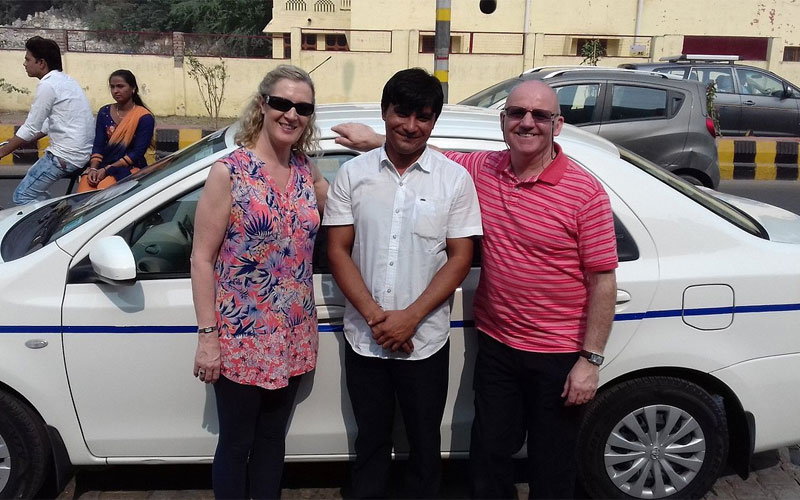
Not long ago, the road from Delhi to Agra meant five to six hours of crawling through towns, trucks and level crossings on the old national highway. Today, the six-lane Yamuna Expressway has changed everything. On a clear morning, a private car leaves South Delhi at 6 AM and rolls into Agra by 9:30, with time for a relaxed breakfast stop on the way. For most travellers, this drive is their first taste of the Indian countryside: mustard fields in winter, brick kilns on the horizon, and villages where farmers cycle to work with milk cans tied to their bicycles.
There are trains and buses between the two cities, but Delhi to Agra by private car remains the most flexible way to travel, especially for families, older travellers and anyone carrying luggage onward into Rajasthan. This guide covers fares for one-way and return trips, the route and travel time, worthwhile stops on the way, and whether a day trip or an overnight stay suits you better.
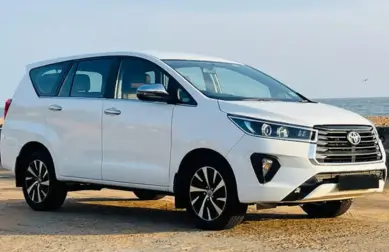
Fares depend on the vehicle, whether the trip is one way or return, and whether the car stays with you overnight. Tolls on the Yamuna Expressway are significant, so always check whether they are included. The figures below show realistic Delhi to Agra taxi fare ranges on the higher side, including fuel, tolls, the Uttar Pradesh state permit and driver charges.
| Trip Type | Sedan (INR) | Innova Crysta (INR) | Tempo Traveller (INR) |
| One-way drop, Delhi to Agra | 5,500 – 7,000 | 7,500 – 9,500 | 11,000 – 14,000 |
| Same-day return, Delhi – Agra – Delhi | 7,500 – 9,000 | 10,000 – 12,000 | 14,500 – 18,000 |
| Two-day return with overnight in Agra | 9,500 – 11,500 | 13,000 – 15,500 | 19,000 – 23,000 |
| Delhi to Agra, continuing to Jaipur (2 days) | 11,000 – 13,500 | 15,000 – 18,000 | 22,000 – 27,000 |
A one-way drop costs more than half of a return trip, because the car must drive back to Delhi empty. If you are continuing to Jaipur or Rajasthan, keeping the same car is usually better value than booking a one-way drop and a fresh car from Agra.
The toll on the Yamuna Expressway is about INR 450 to INR 550 one way for a car, and roughly 60 percent more for a Tempo Traveller. Additional city tolls in Noida or Greater Noida add a small amount. A Delhi-registered tourist car also pays an Uttar Pradesh state permit, about INR 400 to INR 800 for a sedan, depending on validity.
Parking in Agra is managed carefully around the Taj Mahal. Cars cannot enter the zone within 500 metres of the monument, so drivers park at designated lots near the East or West Gate, and visitors take electric shuttles or walk the final stretch. Parking costs INR 100 to INR 300 depending on the lot.
Pickup location makes a difference. Hotels in Aerocity or Gurugram add 30 to 50 minutes to the start of the drive compared with South Delhi or Noida. Some operators charge INR 500 to INR 1,000 more for pickups from Gurugram.
Late-night or very early starts may carry a small extra charge of INR 300 to INR 500, especially for sunrise visits that require leaving Delhi around 3 AM.
For a Delhi to Agra cab booked through a reliable company, the price should include all of the above. A quote that seems very low often leaves out tolls, the state permit or parking, which together can add INR 1,500 to INR 2,000. Ask for an all-inclusive figure and the exact car model before booking.
For comparison, the Gatimaan Express train from Delhi's Hazrat Nizamuddin station to Agra Cantonment takes about one hour and forty minutes, and executive class tickets cost roughly INR 2,000 to INR 2,600 per person each way. For two travellers, a return trip by train plus local taxis in Agra often costs close to a private car, but without door-to-door convenience or the freedom to stop on the way.
Discover the Taj Mahal in Comfort with a Private Delhi–Agra Transfer
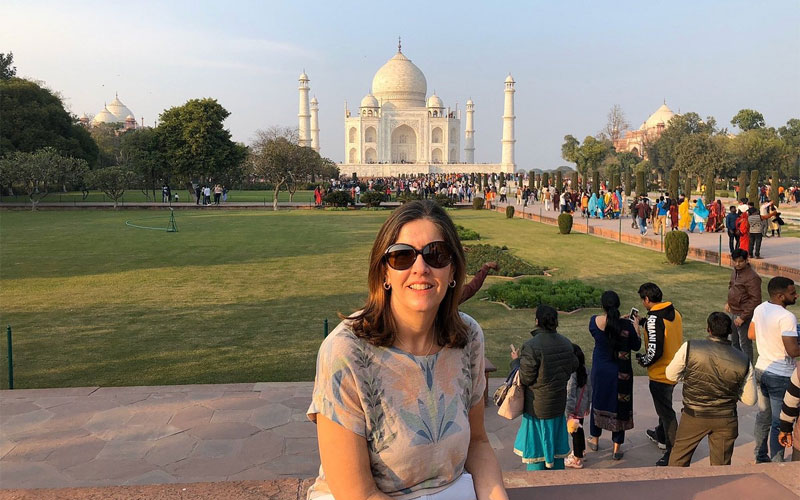
Travel from Delhi to Agra in a comfortable private, air-conditioned car and enjoy a smoother journey to India's iconic Taj Mahal.
The fastest route from Delhi to Agra runs south-east through Noida to the start of the Yamuna Expressway near Greater Noida, then follows the expressway for 165 kilometres to the outskirts of Agra. Total distance from central Delhi is about 230 kilometres.
Travel time depends heavily on when you leave Delhi. Starting at 6 AM, the drive usually takes three to three and a half hours. Leaving at 9 AM can add an hour because of city traffic in Delhi and Noida. Returning in the evening can also be slow, particularly near the Delhi border between 6 PM and 9 PM, when commuter traffic peaks.
The Yamuna Expressway itself is a smooth, access-controlled highway with three lanes in each direction. The speed limit for cars is 100 kilometres per hour, and it is monitored by cameras. Trucks keep largely to the left lane, and the road is well lit near toll plazas but dark between them at night.
Food plazas sit roughly every 50 kilometres along the expressway, with the most popular ones near Jewar and Mathura. They offer clean washrooms, coffee chains, Indian snacks and fast food. A coffee and snack for two costs INR 400 to INR 800. Breakfast at a food plaza is a common first stop for travellers leaving Delhi early.
Winter fog is the biggest challenge on this route. From mid-December to mid-January, dense morning fog can cut visibility to a few metres, and the authorities sometimes reduce speed limits to 75 kilometres per hour or less. During these weeks, a 6 AM start may take four to five hours, and a sunrise visit to the Taj Mahal is often hidden in mist. Experienced drivers slow down, keep fog lights on and avoid overtaking in poor visibility.
An alternative route via the old National Highway 19 through Faridabad, Palwal and Mathura is slower, at four and a half to five and a half hours. It is useful only if you want to stop at Vrindavan, or if the expressway is closed for some reason.
Arrival in Agra itself involves 20 to 30 minutes of city traffic before reaching hotels near the Taj Mahal. If your first stop is the Taj, your driver will head directly to the East Gate or West Gate parking area. The East Gate usually has shorter queues, while the West Gate is closer to the old city and Agra Fort.
On the return drive, try to leave Agra by 4 PM. This brings you to the Delhi border before the heaviest evening traffic and keeps most of the expressway drive in daylight, which is safer and far more pleasant.
Most travellers drive straight from Delhi to Agra, but a few stops along the way add interest without making the day too long.
Sikandra, on the edge of Agra, is the tomb of Emperor Akbar. It sits in a large garden with deer and peacocks, and its gateway, with its four white minarets, is one of the finest pieces of Mughal architecture. Entry for foreign visitors is about INR 310, and the site opens from sunrise to sunset. A visit takes 45 minutes to an hour, and it is quieter than most monuments in Agra. Sikandra is a perfect stop if you arrive in the afternoon and want something to see before checking into your hotel.
Mathura, about 50 kilometres before Agra, is one of the holiest cities for Hindus and is believed to be the birthplace of Lord Krishna. The temple complex marking the birthplace is busy with pilgrims and has strict security, so phones and bags must be left outside. A visit takes about an hour.
Vrindavan, 15 kilometres from Mathura, is famous for its many temples associated with Krishna. The ISKCON temple is popular with international visitors and welcomes guests from 4:30 AM to 1 PM and 4:30 PM to 8:30 PM. The town is especially atmospheric during Holi, when it becomes one of the centres of the colour festival. Adding Mathura and Vrindavan to the drive adds three to four hours.
For nature lovers, the Keoladeo National Park at Bharatpur lies about 55 kilometres west of Agra, on the road to Jaipur rather than Delhi. It is one of the finest bird sanctuaries in Asia and is best visited between November and February. It usually fits better into an Agra to Jaipur drive.
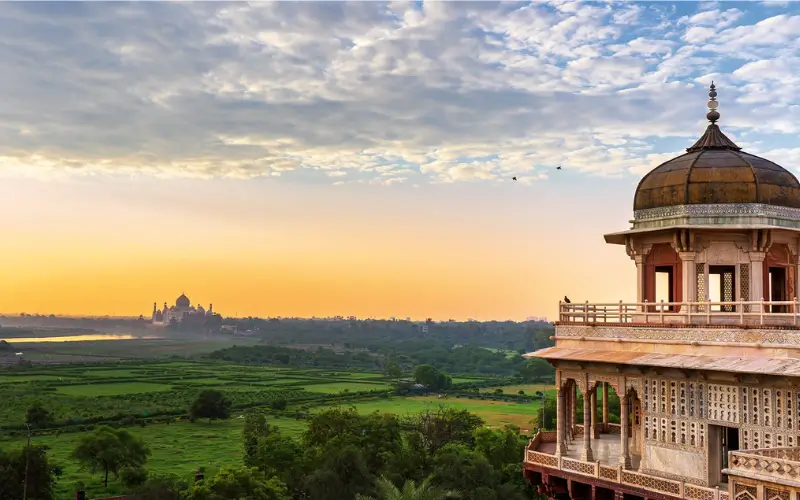
Within Agra, Mehtab Bagh, a garden on the far bank of the Yamuna River opposite the Taj Mahal, offers the best sunset views of the monument. Entry for foreign visitors is about INR 300, and the garden closes at sunset. It is a lovely end to an arrival day and is open on Fridays, when the Taj Mahal itself is closed.
Itimad-ud-Daulah, often called the Baby Taj, is a delicate marble tomb on the east bank of the Yamuna, built before the Taj Mahal. Its inlay work is considered by many to be finer than that of the Taj itself. Entry is about INR 310 for foreign visitors, and a visit takes 45 minutes.
Your Taj Mahal Experience Begins with the Right Journey
Discover the timeless beauty of the Taj Mahal without the stress of coordinating multiple transport options.
The question most travellers ask is whether they should see Agra as a same-day Taj Mahal trip from Delhi or stay overnight. Both work, but they suit different people.
A day trip makes sense if you are short on time, staying in Delhi for several nights, or travelling on a tighter budget. You leave Delhi early, spend four to five hours in Agra covering the Taj Mahal and Agra Fort, have lunch, and drive back in the afternoon. The total day runs 12 to 14 hours, with six to seven hours in the car. It is tiring, especially for older travellers or young children, but it is entirely doable, and many visitors do exactly this.
An overnight stay makes the visit much more relaxed. You can drive to Agra in the morning, visit Agra Fort and Itimad-ud-Daulah in the afternoon, watch the sunset from Mehtab Bagh, and then see the Taj Mahal at sunrise the next morning, when the light is soft and the crowds are smaller. The Taj opens about 30 minutes before sunrise, and the first two hours are the best time of day for photographs.
An overnight stay also lets you continue directly to Jaipur on the second day via Fatehpur Sikri, which avoids driving back to Delhi. This is how most Golden Triangle tours are arranged, and it saves three to four hours of driving compared with returning to Delhi and then heading to Jaipur separately.
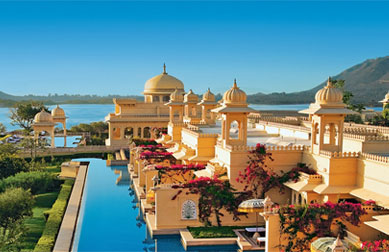
Cost is another factor. The overnight option adds a hotel night, which ranges from INR 4,000 to INR 6,000 for a good three-star hotel to INR 50,000 or more at the Oberoi Amarvilas. The car cost rises by about INR 2,000 to INR 3,500 for the extra day.
Remember that the Taj Mahal is closed on Fridays for prayers. If your trip falls on a Friday, the day trip will not include the Taj, so arrange the visit for another day. On full-moon nights and the two nights either side, the Taj also opens for limited night viewing in small time slots, which must be booked a day ahead at the Archaeological Survey of India office in Agra.
Heritage India Private Tours arranges Delhi to Agra trips as same-day return tours, overnight stays and full Golden Triangle circuits, with English-speaking drivers and all tolls and permits included in the price.
No. It is closed on Fridays. Mehtab Bagh, across the river, stays open and offers good views of the monument.
About three to three and a half hours on the Yamuna Expressway with an early start. Leaving later or returning during evening rush hour can add an hour.
A one-way sedan costs about INR 5,500 to INR 7,000, and a same-day return costs INR 7,500 to INR 9,000, including tolls and permits.
Roughly INR 450 to INR 550 one way for a car, and more for larger vehicles such as Tempo Travellers.
Yes, it is a modern, access-controlled highway. Fog in December and January is the main risk, so drivers slow down and early starts may take longer.
Yes. Adding both towns takes three to four extra hours, so it suits an overnight trip rather than a same-day return.
At designated lots near the East or West Gate. Electric shuttles or a short walk take you to the entrance.
Yes, if time is short. It is a long day of 12 to 14 hours, so an overnight stay is more comfortable for families and older travellers.
Fast trains are quick, but a private car offers door-to-door travel, luggage space and flexible stops, and is often similar in cost for two or more travellers.
Yes. Keeping the same car for Agra to Jaipur via Fatehpur Sikri is usually better value than a one-way drop and a new booking.