Picture a family reunion of fourteen people flying in from Toronto, Leicester and Sydney, all landing at Delhi airport within six hours of each other. Two grandparents need easy steps and legroom, three teenagers want to sit together at the back, and between them the group has twenty-two suitcases and a folding wheelchair. Booking three separate cars would split the group, triple the driver costs and turn every photo stop into a headcount exercise. A single private minibus hire with driver solves all of that, and it is the most common request we receive from groups of nine or more at Heritage India Private Tours in Jaipur.
The workhorse of Indian group travel is the Tempo Traveller, made by Force Motors and sold in several body lengths. The 9-seater is a compact version with three rows of two-by-one seating, ideal for a group of seven or eight who want spare seats for bags. The 12-seater is the most booked size, with four passenger rows, a wide aisle and enough rear space for roughly ten medium suitcases. The 16-seater and 18-seater are longer wheelbase versions that suit school groups, church groups and larger family parties; with a full load of eighteen adults, though, luggage space becomes tight and a roof carrier is essential. Our own fleet covers the Tempo Traveller 9 to 18 seater range, and we always recommend booking one size above your headcount if every guest has a large suitcase.
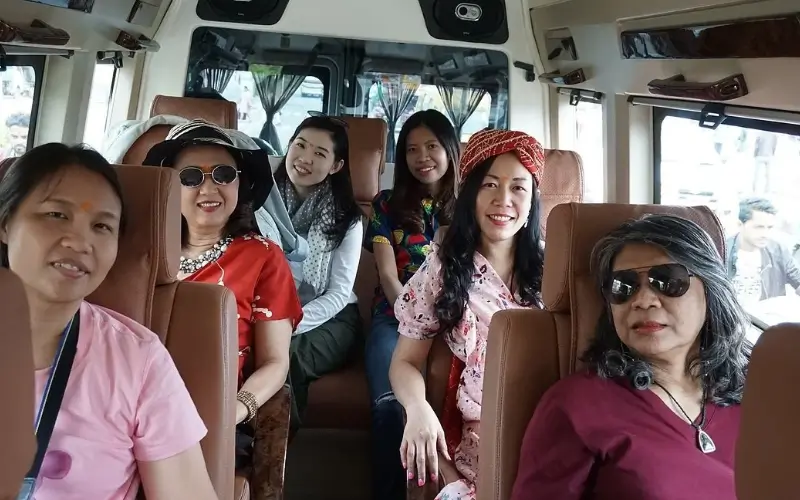
The Force Urbania is the newer, more premium option, available in 10, 13 and 15 seat layouts. It has a monocoque body similar to a European van, a smoother ride, larger tinted windows, individual roof AC vents for every seat, USB charging points and a lower step for boarding. For guests in their seventies or groups on a luxury itinerary, the Urbania is noticeably more comfortable on long highway days such as Delhi to Jaipur or Jaipur to Udaipur. It costs more per kilometre than a standard Tempo Traveller, but most groups feel the difference by the end of the first day.
For groups of 20 to 27 people, the right choice is a minicoach or small bus, usually built on a Force Traveller long body, Tata Winger extended or an Eicher or SML Isuzu chassis. These have two-by-one or two-by-two seating, a central door, an under-floor or rear luggage area and a single large AC unit. A 27-seat minicoach is still small enough to reach most heritage hotels and monuments, whereas a full 35 or 45 seat coach often has to park far away and run shuttles. Above 27 guests we generally suggest two smaller vehicles rather than one large coach, because flexibility on Indian roads matters more than having everyone in one cabin.
Comfort features vary between vehicles of the same model, so it is worth asking specific questions. Pushback seats with reclining backs and armrests are standard in good Tempo Travellers and all Urbanias, but some budget operators still use fixed bench seats. A roof luggage carrier with a waterproof cover is fitted on most 12 to 18 seaters; confirm that the cover is included, because dust and occasional rain are real issues in Rajasthan. Ask whether the AC is a roof-ducted system with vents for every row, since older vans with a single front unit struggle to cool the rear seats in April, May and June. Good vehicles also carry a first aid kit, a fire extinguisher, a music system with a microphone for guides, reading lights and curtains.
The pricing model for a minibus rental with driver in India is almost always based on kilometres travelled, with a daily minimum. On outstation trips the standard minimum is 250 km per day, meaning that even on a day when you only drive 80 km around Jaipur, you are billed for 250 km. Over a long trip this evens out, because highway days such as Delhi to Jaipur (about 280 km) or Jaipur to Udaipur (about 400 km) exceed the minimum. Within a single city, operators instead offer an eight-hour, eighty-kilometre package, with extra hours and extra kilometres charged separately.
Here are realistic per-kilometre rates, quoted on the higher side so that you are more likely to find a pleasant surprise than an unpleasant one. A 9-seater Tempo Traveller usually costs INR 26 to 30 per km (about USD 0.31 to 0.36). The 12-seater is INR 28 to 34 per km (USD 0.34 to 0.41). The 16 and 18 seaters run INR 34 to 40 per km (USD 0.41 to 0.48). A Force Urbania in 10 to 15 seat configuration is typically INR 40 to 50 per km (USD 0.48 to 0.60). A 20 to 27 seat minicoach costs INR 50 to 65 per km (USD 0.60 to 0.78). For a full city day in Jaipur, Delhi or Agra, budget INR 6,500 to 8,500 for a 12-seater and INR 9,500 to 12,500 for an Urbania.
On top of the kilometre rate you will see a driver allowance, sometimes called a night charge. This covers the driver's meals and is usually INR 500 to 800 per day (USD 6 to 10) for Tempo Travellers and Urbanias, and INR 700 to 1,000 for minicoach drivers. Most heritage and luxury hotels in Rajasthan provide free or low-cost drivers' dormitories, so accommodation is rarely billed separately, but if you are staying at a remote camp or a small boutique property without driver rooms, an extra INR 1,000 to 1,500 per night may apply. If the vehicle runs after 10 PM or before 6 AM, an additional late-night charge of INR 300 to 500 is common.
Interstate permits and taxes are the part of the bill that confuses many first-time visitors. A commercial vehicle registered in Rajasthan that enters Uttar Pradesh for Agra, or Delhi for the capital, must pay a state entry tax, and the reverse applies for vehicles from Delhi entering Rajasthan. For a 12-seater these taxes can add INR 2,500 to 5,500 per state crossing depending on the validity period, and they are higher for minicoaches. Toll charges on the expressways are also significant: the Delhi to Jaipur route costs roughly INR 900 to 1,400 in tolls for a minibus, and the Yamuna Expressway between Agra and Delhi adds a further INR 900 to 1,200. Parking at monuments usually ranges from INR 100 to 400 per stop.
When you compare quotes, check whether they are all-inclusive or base-only. A cheap-looking quote of INR 22 per km can become more expensive than an honest INR 32 per km quote once tolls, state taxes, parking, driver allowance and the garage-to-garage kilometres are added. We prefer to quote a fixed package price for the whole itinerary, listing what is included and what is not, so that a group treasurer can collect money from everyone upfront. Monument entry fees, guide fees, meals and tips for the driver are always excluded, and a tip of INR 500 to 1,000 per day from the whole group is a fair and appreciated gesture.
Different groups use a group tour minibus in India in very different ways, and the right vehicle depends as much on the type of group as on the headcount. A family reunion of three generations, for example, needs low steps, frequent restroom stops and a gentle pace, so an Urbania or a well-maintained 12-seater with spare seats is ideal. These groups often want to stop at roadside restaurants for tea, at stepwells and at small craft villages, and a driver who is patient with long breaks makes a huge difference. We suggest a maximum of five to six hours of driving per day for families with elderly members.
Wedding party transport is a speciality of its own. Guests travelling to a destination wedding in Jaipur, Udaipur or Jodhpur often arrive in waves over two days, then need daily transfers between hotels, the venue and sightseeing spots. A fleet of two or three Tempo Travellers, each assigned to a hotel cluster, is usually more efficient than one big coach. The drivers keep a printed guest list, display signage at the airport, and stay on call late into the night for return trips after the evening events. For wedding groups we normally quote a per-day rate per vehicle rather than a per-kilometre rate, because the distances are short but the hours are long.
School and college groups have different priorities: safety, strict timings, a responsible adult on board and clear communication with parents back home. For student trips we use vehicles with seat belts on every seat, GPS tracking, speed governors set to 80 km per hour and a driver who has worked with student groups before. Teachers usually want a 16 or 18 seater so that one adult can sit at the front and one at the back. A typical study tour covers Delhi, Agra and Jaipur with a visit to the Jantar Mantar observatory, which fits neatly into a science or history curriculum.
Church groups and faith tours from the USA, UK and Australia often travel in groups of fifteen to twenty-five, visiting cathedrals in Delhi and Agra, mission schools and charities alongside the main monuments. These groups appreciate a microphone system for a group leader to speak during drives, a predictable Sunday morning schedule and vehicles large enough to carry donated supplies. A 20 to 27 seat minicoach is usually the best fit, and we can arrange English-speaking guides who are comfortable with mixed-faith groups.
Photography clubs are perhaps the most demanding group type, and also the most rewarding to drive. They need sunrise departures, often leaving at 5 AM for the golden hour at Amber Fort or the Taj Mahal, then long midday rests and late sunset sessions at Nahargarh or the lakes of Udaipur. They also carry a lot of fragile gear, so we recommend a 12-seater for eight photographers, leaving the rear rows free for camera bags and tripods. The driver will often double as a local fixer, knowing which rooftop cafes allow tripods and where to park near the old city gates before the crowds arrive.
Numbers on paper make more sense when you see them applied to a real route. Consider a typical Golden Triangle group tour by Tempo Traveller for twelve guests over six days: arrival in Delhi, one day of Delhi sightseeing, a drive to Agra via the Yamuna Expressway, a day at the Taj Mahal and Agra Fort, a drive to Jaipur via Fatehpur Sikri and the Abhaneri stepwell, a full day in Jaipur and a final return to Delhi airport. Total distance is usually between 1,050 and 1,200 km including city running, which is below the six-day minimum of 1,500 km at 250 km per day, so billing is on the minimum of 1,500 km.
For a 12-seater Tempo Traveller at INR 32 per km, the vehicle cost is about INR 48,000. Add driver allowance of INR 700 per day for six days (INR 4,200), tolls of roughly INR 4,500 to 5,500, interstate taxes for Delhi, Uttar Pradesh and Rajasthan of INR 7,000 to 11,000 and parking of about INR 2,500. That brings the total to roughly INR 66,000 to 72,000 (about USD 790 to 865), or around INR 5,500 to 6,000 per person for the entire transport. In a Force Urbania at INR 45 per km, the same trip comes to about INR 88,000 to 96,000 (USD 1,055 to 1,150). Splitting either amount across twelve people often makes it cheaper per head than two separate sedans.
Now consider a ten-day Rajasthan minibus tour for sixteen guests from Jaipur, covering Jaipur, Pushkar, Jodhpur, Jaisalmer, Udaipur and back to Jaipur or onward to Delhi. This route runs about 2,300 to 2,600 km, comfortably above the ten-day minimum of 2,500 km in most cases. At INR 38 per km for a 16-seater, the vehicle cost is roughly INR 95,000 to 99,000. Add driver allowance of INR 800 per day (INR 8,000), tolls of INR 5,000 to 7,000 and parking of INR 3,500, and the total is around INR 1,12,000 to 1,20,000 (USD 1,340 to 1,440), or about INR 7,000 to 7,500 per person. If the trip ends in Delhi rather than Jaipur, budget an extra INR 4,000 to 6,000 for Delhi entry tax.
For a 25-person group on the same Rajasthan circuit in a minicoach at INR 60 per km, expect roughly INR 1,65,000 to 1,85,000 (USD 1,980 to 2,220) including all extras. That works out at under INR 7,500 per head, which is one of the best-value ways to travel through Rajasthan as a large group. Remember that these are transport figures only. Hotel rooms, monument tickets such as the Taj Mahal foreigner fee of INR 1,100 plus INR 200 for the main mausoleum, Amber Fort at INR 500 for foreigners and local guides at INR 1,500 to 3,000 per city per group are separate.
Season affects all of these figures. Between October and March, especially around Christmas, New Year and the wedding weeks of November and February, demand for 12 to 18 seaters in Jaipur and Delhi is very high, and rates can rise by ten to twenty per cent. Booking at least six to eight weeks ahead in these months secures both the vehicle and an experienced driver. From April to September, rates are often a little lower, but you should insist on a vehicle with strong roof-ducted AC because daytime temperatures in Rajasthan regularly cross 40 degrees Celsius.
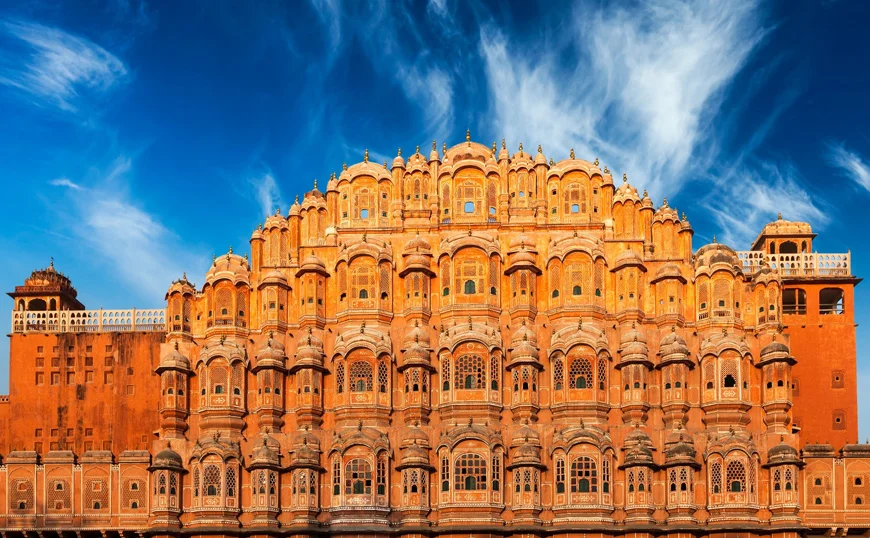
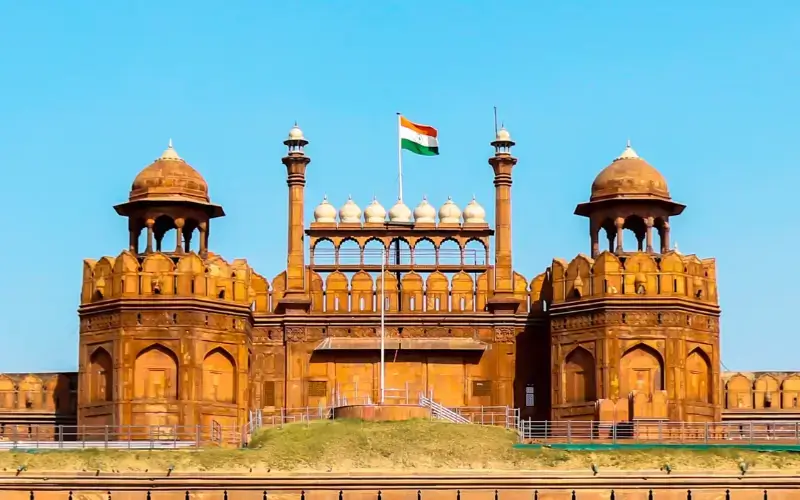
Even the best Tempo Traveller with driver cannot go everywhere a car can, and it is wise to know the limits before you finalise an itinerary. The old walled cities of Jaipur, Jodhpur, Jaisalmer, Udaipur and Old Delhi have narrow lanes, low balconies and tight turns. In Jaipur, a 12-seater can drive along the main market roads near Hawa Mahal and Johari Bazaar but cannot enter the inner lanes; in Jodhpur, the blue-city lanes below Mehrangarh Fort are strictly for walking or auto-rickshaws. In Old Delhi, minibuses park near the Red Fort and guests switch to cycle rickshaws for Chandni Chowk. Udaipur's lakeside lanes near the City Palace are similar, and most lakeside hotels require a short walk or a small shuttle car for the final stretch.
Hill roads add a different kind of limit. Routes to Mount Abu, Kumbhalgarh and Nahargarh Fort are paved and fine for 12 to 18 seaters, but a 27-seat minicoach may struggle on tight hairpins. In the Himalayan states, many roads to Shimla, Manali, Mussoorie and Leh Ladakh have specific rules for commercial vehicles from other states, and some routes, such as Rohtang Pass, require separate permits with daily caps. For mountain itineraries we usually recommend locally registered Tempo Travellers driven by hill-experienced drivers, rather than taking a plains vehicle all the way up.
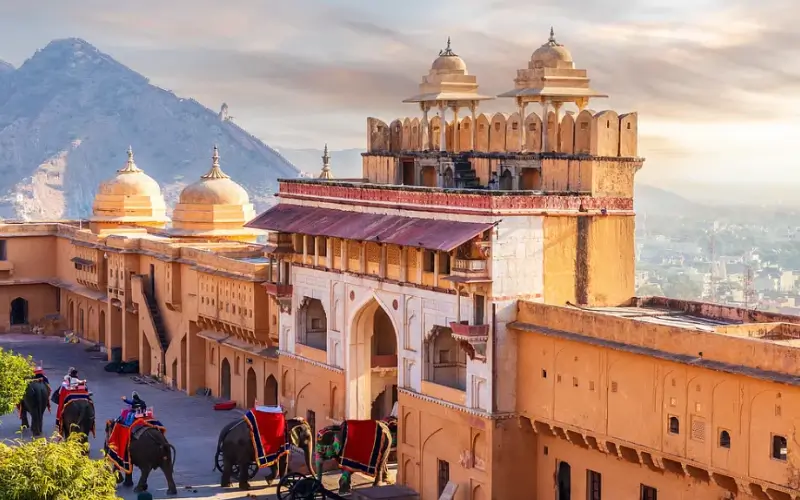
Some monuments have their own vehicle rules. At the Taj Mahal, diesel vehicles stop at the parking area and guests take an electric shuttle or golf cart to the gate for a small fee. At Amber Fort in Jaipur, minibuses park at the lower lot and guests either walk up or take jeeps to the upper courtyard. At Fatehpur Sikri, a short shuttle bus connects the parking to the monument entrance. Your driver will know these patterns and will time drop-offs to keep walking short for elderly guests.
Before you send a minibus booking enquiry, gather a few details so that the quote you receive is accurate. Note the exact number of adults and children, the number and size of suitcases, the arrival and departure flights or trains, the full day-by-day route and any special needs such as a wheelchair, child seats or a vehicle with an extra-low step. Ask for the vehicle's registration year, AC type, whether pushback seats and a covered roof carrier are included, and whether the quote covers tolls, interstate taxes, parking and driver allowance. Ask also for photographs of the actual vehicle and the driver's name and phone number at least a day before arrival.
On payment and cancellation, most reputable operators ask for an advance of twenty to thirty per cent to confirm the vehicle, with the balance paid to the driver in cash or by bank transfer during the trip. Cancellations more than fifteen days before arrival are usually refunded in full or with a small processing fee, while late cancellations may lose the advance. At Heritage India Private Tours, founder Magan Singh personally checks each group vehicle before a long trip, drawing on more than twenty-seven years of driving in Rajasthan and North India. To get a fixed, transparent quote for your group, send your route and headcount on WhatsApp at +91 9799397401 or through the enquiry form on our website, and we will reply with vehicle options and an all-inclusive price.
For twelve adults with large suitcases, book a 16-seater Tempo Traveller or a 15-seat Force Urbania rather than a 12-seater. The spare seats absorb cabin bags, jackets and shopping, and the longer body gives more rear luggage space. If your group travels light with carry-on bags only, a 12-seater with a covered roof carrier works well and costs less per kilometre.
On the higher side, a 9-seater costs INR 26 to 30 per km, a 12-seater INR 28 to 34 per km and a 16 or 18 seater INR 34 to 40 per km. Outstation trips carry a minimum of 250 km per day. Tolls, interstate taxes, parking and driver allowance are usually extra unless the quote clearly says all-inclusive.
For long highway days, elderly guests or premium itineraries, yes. The Urbania has a smoother ride, individual roof AC vents, larger windows, USB charging and a lower boarding step. It costs roughly INR 40 to 50 per km versus INR 28 to 34 for a 12-seater, but comfort over eight hours of driving is noticeably better.
Driver allowance covers the driver's meals and daily expenses on the road. Expect INR 500 to 800 per day for a Tempo Traveller or Urbania and INR 700 to 1,000 for a minicoach. Most heritage hotels provide driver rooms, so accommodation is rarely extra. Late-night duty after 10 PM may add INR 300 to 500.
Commercial vehicles pay entry tax when crossing state borders, for example from Rajasthan into Uttar Pradesh or Delhi. For a 12-seater this is typically INR 2,500 to 5,500 per state, more for larger vehicles. Some quotes include these taxes and some do not, so always ask whether interstate permits are covered before you confirm the booking.
A minibus can use the main roads around Jaipur's walled city, such as the stretch near Hawa Mahal, but not the narrow inner lanes. In Jodhpur, the blue-city lanes are walking only. Your driver will park at the nearest suitable point and guests walk, or take auto-rickshaws or cycle rickshaws for short stretches inside the old quarters.
For travel between October and March, book six to eight weeks ahead, and even earlier around Christmas, New Year and the peak wedding weeks of November and February. Summer and monsoon bookings can often be arranged two to three weeks ahead. Early booking secures both a newer vehicle and an experienced driver who knows your route.
Tipping is customary and appreciated. A fair amount for a group is INR 500 to 1,000 per day in total, given at the end of the trip in an envelope. If the driver handled long hours, early starts for photography or extra help with elderly guests and luggage, many groups add a little more as thanks.
Yes, for student groups we provide vehicles with seat belts on every seat, GPS tracking, a first aid kit, a fire extinguisher and a speed governor set to 80 km per hour. Drivers experienced with school trips are assigned, and teachers receive the driver's details and vehicle number in advance to share with parents.
Send your headcount, luggage count, travel dates and route on WhatsApp at +91 9799397401, by email to heritageindiapvttour@gmail.com or through the website enquiry form. We reply with suitable vehicle options, photographs and an all-inclusive price. A twenty to thirty per cent advance confirms the booking, with the balance payable during the trip.