Delhi - Agra - Jaipur - Jodhpur - Udaipur - Delhi
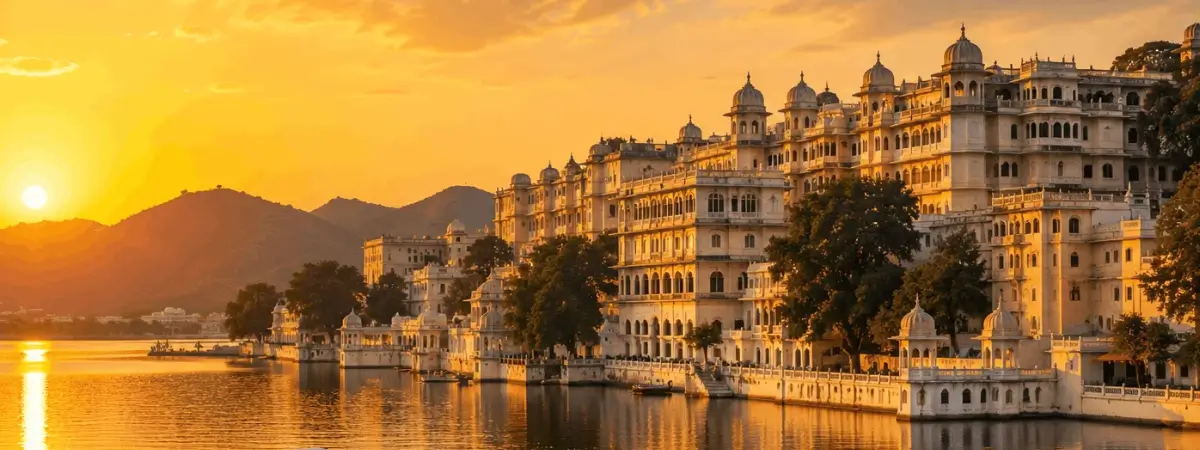
Rajasthan's princely capitals each wear a different colour, and over eleven days you see three of them after the Mughal marvels of Delhi and Agra. Our Golden Triangle Tour with Jodhpur and Udaipur is a heritage journey for travellers who enjoy slow mornings in palace hotels, long conversations with guides and evenings on a terrace above a lake. Pink Jaipur offers bazaars and hill forts, blue Jodhpur sits beneath the great cliff fortress of Mehrangarh, and white Udaipur rises from the still waters of Lake Pichola. Between Jodhpur and Udaipur, the road passes through the Aravalli hills to Ranakpur, where a fifteenth-century Jain temple of pale marble stands on 1,444 carved pillars, no two of them alike.
Every road section is covered by private car and driver, with the same English-speaking chauffeur from Delhi to Udaipur, and a domestic flight from Udaipur back to Delhi saves a twelve-hour drive at the end. We suggest heritage stays wherever possible: a restored haveli in Jaipur, a fort-view property in Jodhpur and a lake-facing hotel in Udaipur, chosen to match your budget. The Udaipur city tour includes the City Palace, Jagdish Temple, Saheliyon ki Bari and a private sunset boat on Lake Pichola stopping at Jag Mandir island. You will also find quiet hours in your schedule, because a long trip needs space for a swim, a massage or a book on a shaded balcony.
Tour Highlights
 Package Includes:
 Package Excludes:
Reply within 24hrs
A Heritage India Private Tours representative meets you after customs at Delhi airport, holding a sign with your name. With luggage loaded into the air-conditioned car, you meet your English-speaking chauffeur, who will remain with you all the way to Udaipur, more than a thousand kilometres away. During the hour-long drive to the hotel, your representative explains the route, hands over a printed folder with hotel and guide details, and notes any preferences for meals, pace or shopping. Hotels for the whole tour have already been confirmed, and our Jaipur office keeps in touch by phone and messaging throughout the trip, so you can reach a real person at any hour.
The rest of the day is free. If you feel like stretching your legs after a long flight, visit Safdarjung Tomb in the late afternoon. Built in the mid-eighteenth century for a Mughal prime minister, it is among the last great garden tombs of the empire and is usually very quiet, with a few couples sitting in the lawns and parrots calling from the trees. The domed chambers, red and buff sandstone and marble panels give you a gentle introduction to the Mughal style you will see in full splendour in Agra. In the evening, try a quiet dinner at the hotel and go to bed early. Overnight stay in Delhi.
Your Delhi city tour opens with an Old Delhi heritage walk led by a local guide. Begin at Jama Masjid and walk through Kinari Bazaar, where tinsel, turbans and wedding garlands spill from tiny shopfronts, then into Naughara, a lane of nine Jain-owned havelis with carved doorways painted in pastel colours. Your guide takes you inside a restored haveli courtyard where a family has lived for generations, explaining how such houses were arranged around light and air. The Red Fort is closed on Mondays; on other days, a short stop at its Lahori Gate completes the morning, followed by a lunch of kebabs or a light vegetarian meal at a well-known eatery.
After lunch, the car heads to New Delhi. Pass the Rashtrapati Bhavan and India Gate along Kartavya Path, then visit Humayun's Tomb, the garden mausoleum that inspired the Taj Mahal. The neighbouring Isa Khan's Tomb, an octagonal structure built earlier in the sixteenth century, sits inside a small fortified garden and is often missed by visitors. Before returning to the hotel, the car can stop at Hauz Khas Village, where the ruins of a medieval madrasa overlook a lake and the lanes are full of design shops and cafes. A good spot for an evening coffee before dinner, the area is lively but relaxed. Overnight stay in Delhi.
Leave Delhi after breakfast on the Yamuna Expressway, and reach Agra in time for lunch at your hotel. In the afternoon, visit Itimad-ud-Daulah, the so-called Baby Taj, built by Empress Nur Jahan for her father, a Persian noble who rose to become chief minister of the empire. The marble walls are covered in inlaid patterns of wine cups, cypress trees and flower vases, and the latticed screens cast delicate shadows across the floor. Then cross back over the river to Agra Fort, where the halls of Akbar, Jahangir and Shah Jahan sit inside a massive red sandstone wall. Your guide explains how the fort grew over three generations.
Late in the afternoon, head to the riverbank for a slow walk at Mehtab Bagh, the garden laid out across the Yamuna from the Taj Mahal. The view from here is direct and uncluttered, and as the sun sets the dome turns from cream to pale rose. Your guide may tell you about the legend of a black Taj said to have been intended for this spot, and why historians doubt it. Dinner tonight can be at a rooftop restaurant with a view toward the monument; try a classic Mughlai meal with nihari, chicken korma and sheermal bread, or a vegetarian thali with paneer and dal. Overnight stay in Agra.
Rise early for the Taj Mahal sunrise visit. The monument opens about thirty minutes before sunrise and is closed every Friday, which we always build around. Walk through the main gate as the light grows, and see the dome appear in soft morning colour. Inside, your guide shows you the delicate pierced marble screen around the cenotaphs and the precious stones set into the walls, many of which glow under a torch. Spend time on the riverside terrace behind the tomb, where the Yamuna flows slowly past and the mosque and guest house flank the main building in red sandstone. Return to the hotel for a leisurely breakfast and check-out.
On the way to Jaipur, stop at Fatehpur Sikri, the abandoned capital of Emperor Akbar. Walk through the Diwan-i-Khas, the Jodha Bai Palace with its blue glazed roof tiles, and the Birbal Bhawan, named after one of the emperor's nine gems of court. In the mosque complex, the Buland Darwaza rises high above the town, and the white marble tomb of Sheikh Salim Chishti sits in the courtyard. Continue to Jaipur through farmland and small towns, arriving in the late afternoon. Check in at your heritage hotel, perhaps a restored haveli or a former nobleman's palace, and relax in its courtyard with a cup of masala chai. Overnight stay in Jaipur.
Your Jaipur city tour begins at Amber Fort, the palace of the Kachhwaha Rajputs on a ridge above Maota Lake. A jeep takes you up to the main courtyard, and your guide leads you through the Diwan-i-Aam, the Sheesh Mahal and the zenana palace of Man Singh I. Then drive further up to Jaigarh Fort, where the giant Jaivana cannon sits on the ramparts and an old water reservoir once held enough to last the garrison through long sieges. On the way back down, stop at the Jal Mahal viewpoint, and take a short break at a local stepwell in Amer village for a quieter look at Rajput water engineering.
In the afternoon, visit the City Palace and its museums, where royal costumes and weapons are displayed in former palace halls. Next door, Jantar Mantar holds stone instruments that once tracked the stars and the sun with great precision. Stop at Hawa Mahal for photographs, then walk through Johari Bazaar, known for gems and silver jewellery, and Tripolia Bazaar for brass and lac bangles. Towards sunset, visit the Albert Hall Museum, whose Indo-Saracenic facade is floodlit at night. Later, enjoy dinner at a heritage haveli, where a musician plays the ravanhatta, a folk string instrument of Rajasthan. Overnight stay in Jaipur.
After an early breakfast, check out and set off for Jodhpur, the old capital of Marwar. The highway runs southwest through Ajmer district, and the change in landscape is clear as farmland gives way to dry scrub, low hills and camel herds grazing near the road. Your chauffeur will stop at a clean highway restaurant for lunch; a plate of dal and roti, a bowl of curd and sweet chai make an easy meal. If you prefer, we can break the drive with a short stop at a roadside village where women draw water from a well and a local tea stall serves freshly fried mirchi vada and kachori.
You reach Jodhpur in the mid-afternoon and check in at a fort-view hotel. As the light softens, take a short walk through Navchokiya, one of the oldest blue neighbourhoods of the city, where houses painted in shades of indigo line narrow lanes below the fort walls. Your guide introduces you to the quarter's history, the stepwells such as Toorji ka Jhalra, now restored with cafes around it, and the old merchant homes. As the sun sets, the cliff fortress above you glows red and gold. Dinner can be on a rooftop with a direct view of the floodlit fort, a fine first evening in the Blue City. Overnight stay in Jodhpur.
Your Jodhpur city tour starts early at Mehrangarh Fort, built by Rao Jodha on a high rocky ridge. Pass through seven gates, including Jaya Pol and Loha Pol, where the handprints of royal widows remain carved into the wall. The museum inside the fort holds one of the finest royal collections in Rajasthan: gilded palanquins, elephant howdahs, painted miniatures and an armoury of jewelled swords. The Moti Mahal, Phool Mahal and Takhat Vilas show how the palaces grew more decorative over the centuries. From the ramparts, the blue city stretches to the horizon, with the domes of Umaid Bhawan Palace rising on a distant hill.
After the fort, take a walk on the trail of Rao Jodha Desert Rock Park, a restored area of native desert plants on the volcanic rock below the fort, with fine views of the walls above. Then visit Jaswant Thada, a white marble memorial with thin translucent panels and a small lake beside it. In the afternoon, wander through Sardar Market around the clock tower for spices, textiles and silver. End the day with a visit to the Umaid Bhawan Palace museum, part of one of the largest private residences in the world, still home to the royal family. Dinner might include laal maas or ker sangri with bajra roti. Overnight stay in Jodhpur.
Leave Jodhpur after breakfast for a scenic drive through the Aravalli hills to Udaipur, with a long stop at Ranakpur. The Ranakpur Jain temple is open to non-Jain visitors from midday, so the timing of your departure is arranged around that. Dedicated to Adinath, the first Jain Tirthankara, the temple is built of pale marble and stands on 1,444 carved pillars, each one different. Your guide explains the Jain beliefs of non-violence, and the carving of the serpent canopy above a small figure of Parshvanath is a highlight. Leather items, including belts and wallets, must be left outside, and shoulders and knees should be covered.
After lunch at a hotel near the temple, continue through the hills to Udaipur, a drive of about two and a half hours on winding roads with views over forested valleys and small hamlets. Arrive in Udaipur in the late afternoon and check in at your lakeside hotel. If the light permits, take a slow walk to Gangaur Ghat on the eastern shore of Lake Pichola, where the stone steps lead down to the water and pigeons gather on the old gateway. In the evening, enjoy a quiet dinner overlooking the lake, with the palace walls lit up across the water. Overnight stay in Udaipur.
The Udaipur city tour begins at the City Palace, a complex of eleven palaces built over several centuries by the Maharanas of Mewar. Walk through the Mor Chowk with its glass peacocks, the Badi Mahal with its hanging garden on a hilltop, and the Zenana Mahal, now a gallery of royal artefacts. The views from its balconies over Lake Pichola are among the finest in India. Nearby, Jagdish Temple, a seventeenth-century Indo-Aryan shrine dedicated to Lord Vishnu, has finely carved walls of dancers, elephants and horsemen. Then visit Saheliyon ki Bari, the Garden of the Maidens, with its marble pavilions, lotus pools and fountains.
In the late afternoon, board a private boat on Lake Pichola for a sunset ride. The boat glides past the Lake Palace hotel, the bathing ghats and the long white facade of the City Palace, before stopping at Jag Mandir, the island palace where a young Shah Jahan once found refuge from his father. Walk among its stone elephants and courtyard gardens, then sail back as the sky turns gold. In the evening, attend the Dharohar folk dance show at Bagore ki Haveli, where dancers balance pots on their heads in the Bhavai dance and puppeteers perform. Dinner can be at a lakeside restaurant. Overnight stay in Udaipur.
Spend today on a day trip into the Aravalli hills to Kumbhalgarh Fort, built by Rana Kumbha in the fifteenth century and the birthplace of Maharana Pratap, Mewar's great warrior king. The fort's outer wall runs for about thirty-six kilometres, broad enough for several horsemen to ride side by side, and is often called the second longest continuous wall in the world. Inside are more than three hundred temples, both Hindu and Jain. Climb to Badal Mahal, the Palace of Clouds, at the highest point for a view over the forested hills and, on a clear day, the sand of the Thar Desert toward Marwar.
On the way back, if time allows, stop at a village to see a Persian wheel turned by bullocks to lift water for the fields, and drink a glass of fresh buttermilk at a roadside stall. Return to Udaipur in the late afternoon and spend the evening at leisure. You could book a cooking demonstration in a local home to learn dishes such as dal baati, or browse the miniature painting studios near Jagdish Temple, where artists paint with squirrel-hair brushes. Your farewell dinner can be on a rooftop with a view of the City Palace and the lake, a fitting end to your Rajasthan journey. Overnight stay in Udaipur.
Enjoy a slow breakfast with a view of the lake, perhaps followed by a final walk along the ghats or a short visit to the Vintage Car Museum at the Garden Hotel, which displays the Maharanas' Rolls-Royces and Cadillacs. After check-out, your chauffeur drives you to Maharana Pratap Airport, about forty minutes from the city, for your domestic flight to Delhi. This is the moment to say goodbye to the driver who has carried you across the length of Rajasthan; most guests by now consider him a friend. The flight to Delhi takes about one hour and twenty minutes, saving a long day on the road.
On arrival in Delhi, our representative meets you at the domestic terminal and escorts you to the international terminal for your onward flight, or to a hotel near the airport if your departure is late at night. A day-use room can be arranged on request. As you settle into your seat for the journey home, you take with you memories of three royal cities, two great Mughal capitals and the people who made them come alive: guides, drivers, artisans, cooks and boatmen. Our team will follow up by email after your return, and we are always pleased to hear about your trip and to welcome you back.
Hear what our happy guests say about their India adventures! From private drivers to guided tours, we make every journey smooth, safe & unforgettable.
 rating score: 5.0 of 5, based on 448 reviews

Complete our inquiry form

Customize your itinerary

Confirm when you're satisfied
1-to-1 Service | Reply within 24hrs | Expert's Advice