Delhi - Agra - Jaipur - Varanasi - Bodh Gaya
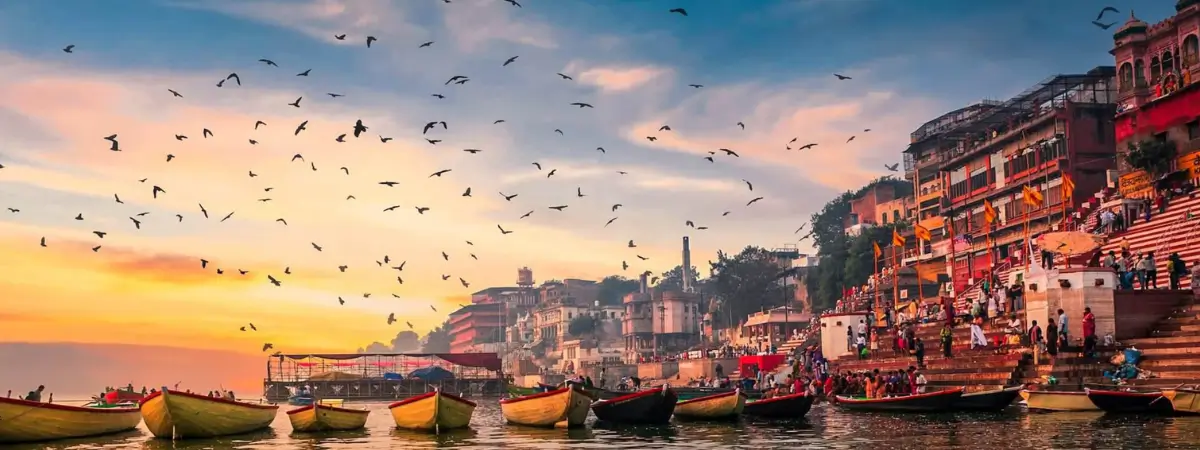
Two of the oldest sacred landscapes in Asia sit at the end of our Golden Triangle Tour with Varanasi and Bodh Gaya, a 10-day private itinerary that links Mughal and Rajput India with the riverbanks of the Ganges and the place where the Buddha attained enlightenment. The first half follows the familiar triangle: Delhi's mosques and Sufi shrines, the Taj Mahal at first light in Agra and the forts and palaces of Jaipur. Then a domestic flight carries you east to Varanasi, where pilgrims bathe at dawn and lamps are offered to the river every evening. The final stretch crosses into Bihar to Bodh Gaya, quiet and green, with monasteries built by Buddhist communities from Thailand, Japan, Bhutan and Tibet.
The tour suits travellers interested in faith, philosophy and daily ritual, and it is paced gently enough for senior guests. Every road transfer is made in a private car and driver, and in each city a local English-speaking guide explains the meaning behind what you see rather than simply listing dates. Long distances are handled sensibly: Jaipur to Varanasi by direct flight, and Bodh Gaya back to Delhi by air from Gaya, so you spend more time on the ghats and less in traffic. The Varanasi tour includes a sunrise boat ride, the evening Ganga aarti at Dashashwamedh Ghat and a half-day at Sarnath, where the Buddha preached his first sermon. Hotels are comfortable, quiet and close to the main sites, with breakfast every morning.
Tour Highlights
 Package Includes:
 Package Excludes:
Reply within 24hrs
Our representative greets you as you clear customs and immigration at Indira Gandhi International Airport in Delhi. With a printed name board and a garland of marigolds, you are easy to spot even in the busiest arrival hall. Your chauffeur, who will drive you through the Golden Triangle portion of the tour, loads your bags into an air-conditioned car and takes you to your hotel, a journey of around 45 minutes. During the drive, the representative hands over a folder with your full itinerary, domestic flight tickets, hotel vouchers and a list of contact numbers available around the clock, so help is always one call away.
he rest of the day is free to recover from the long flight. If you arrive early and feel rested, a gentle evening visit to Gurudwara Bangla Sahib near Connaught Place sets the spiritual tone of the tour. The white marble Sikh temple with its golden domes welcomes visitors of all faiths; heads must be covered and shoes removed, and scarves are provided at the entrance. Volunteers serve a free vegetarian meal, called langar, in the community kitchen to thousands of people every day, and guests are welcome to sit and eat on the floor alongside pilgrims. Your driver waits outside and returns you to the hotel afterwards. Overnight stay in Delhi.
After breakfast your guide meets you for a Delhi city tour shaped around the city's many faiths. You begin at Jama Masjid in Old Delhi, built by Shah Jahan, where the vast courtyard can hold twenty-five thousand worshippers at Friday prayers. A short walk leads into the lanes around Chandni Chowk, past the Jain Digambar temple with its bird hospital and the Sis Ganj Gurudwara, which marks the site where the ninth Sikh Guru was martyred. You then drive past the Red Fort, closed on Mondays, before continuing to Raj Ghat, the simple black marble memorial where Mahatma Gandhi was cremated.
After lunch the tour moves to the south of the city. Humayun's Tomb, with its red sandstone and white marble dome, is the garden tomb that later inspired the Taj Mahal, and its restored gardens are calm in the afternoon. At the Qutub Minar complex you see the oldest mosque in Delhi, built using carved pillars from earlier Hindu and Jain temples. Before sunset your guide leads you into the narrow lanes of Nizamuddin Basti to the dargah of the Sufi saint Hazrat Nizamuddin Auliya. On Thursday evenings especially, singers perform devotional qawwali in the courtyard, an atmosphere few visitors forget. Overnight stay in Delhi.
Leave Delhi after breakfast on the Yamuna Expressway, which runs straight and fast through the farmland of western Uttar Pradesh. The drive to Agra takes about four hours with a short tea break, and your driver will point out the brick kilns and mustard fields along the way. After check-in and a short rest, your guide takes you to Agra Fort, a walled city of red sandstone where the Mughal emperors held court. Look for the Jahangiri Mahal, built in a blend of Hindu and Islamic styles, and the Musamman Burj, the octagonal tower where Shah Jahan spent his final years gazing at the Taj Mahal.
In the afternoon visit the tomb of Itimad-ud-Daulah, often called the Baby Taj, on the east bank of the Yamuna. Built by Empress Nur Jahan for her father, it was the first Mughal building to use marble inlay on such a scale, and its quiet garden is rarely crowded. Your guide can then arrange a short stop at a marble inlay workshop, where artisans who trace their craft to the families who decorated the Taj Mahal still cut semi-precious stones by hand. Please remember that the Taj Mahal is closed to visitors every Friday, so tomorrow's sunrise visit is timed around that. Overnight stay in Agra.
Rise before dawn for the highlight of Agra. Your guide collects you at the hotel and walks with you through the gates of the Taj Mahal just as the sky starts to lighten. Shah Jahan built the tomb for his wife Mumtaz Mahal, and in the early light the white marble seems almost weightless above the Yamuna. Inside the cenotaph chamber, the octagonal marble screen is carved so finely that light passes through it. Take time to sit on the benches near the reflecting pool, where the crowds are thinner in the first hour. Return to the hotel for breakfast and check out by mid-morning.
On the way to Jaipur you stop at Fatehpur Sikri, about an hour from Agra. Akbar built this city in honour of the Sufi saint Salim Chishti, who had foretold the birth of his son, and pilgrims still tie red threads to the marble screens of the saint's tomb, praying for wishes to be granted. Your guide walks you through the Jodha Bai palace, the Panch Mahal and the Diwan-i-Khas before you continue west through Bharatpur and Dausa. You arrive in Jaipur by late afternoon. A quiet dinner at your hotel is ideal after the early start. Overnight stay in Jaipur.
The Jaipur city tour begins with Amber Fort, set on a hillside above Maota Lake. A short jeep ride brings you to the main courtyard, and your guide explains how the Kachwaha rulers built the Sila Devi temple at the entrance, where a goddess image brought from Bengal is still worshipped every morning. Inside, the Sheesh Mahal's mirror-studded ceiling and the Sukh Niwas, cooled by water channels, show how comfortable royal life could be. On the return drive, stop for photographs at Jal Mahal and the royal cenotaphs at Gaitore, where the maharajas of Jaipur are commemorated in carved marble chhatris.
After lunch you visit the City Palace and the Jantar Mantar observatory, where giant stone instruments built by Maharaja Sawai Jai Singh II still measure time and the positions of the stars. Your guide then takes you outside the old city to Galta Ji, a temple complex tucked into a narrow gorge, with natural spring-fed pools where pilgrims bathe and troops of macaques roam the walkways. The sunset view from the Surya Mandir above the gorge looks back across the whole city. On the way back, you can stop at Hawa Mahal for a photograph of its pink facade. Overnight stay in Jaipur.
After breakfast your chauffeur drives you to Jaipur International Airport for the direct flight to Varanasi, which takes about an hour and a half. This is where you say goodbye to your driver from the Golden Triangle part of the tour. On arrival at Lal Bahadur Shastri Airport, a new chauffeur and guide meet you for the 25 km drive into the city. Varanasi's old quarter is a maze of lanes too narrow for cars, so hotels are chosen for easy access to the ghats, and luggage is carried by porters for the final stretch where needed. The city feels very different from Rajasthan, older and more intense, so the rest of the afternoon is kept free.
In the late afternoon your guide takes you by cycle-rickshaw or on foot through the lanes towards Dashashwamedh Ghat. Here, every evening at dusk, young priests in saffron robes perform the Ganga aarti, waving tall brass lamps, ringing bells and burning incense to honour the river. You can watch from the steps or from a boat moored just offshore, which gives a clearer view of the whole ceremony. Afterwards, release a small leaf boat filled with marigolds and a lit candle onto the water, a simple offering made by thousands of pilgrims every night. Dinner can be at a vegetarian restaurant near Godowlia. Overnight stay in Varanasi.
Wake early for the most memorable hour in Varanasi. Before sunrise, your guide walks you down to the river for a boat ride along the ghats, from Assi Ghat in the south to Manikarnika Ghat, the main cremation ground, where fires burn day and night. As the sun rises over the far bank, pilgrims bathe, chant and offer water to the sun, wrestlers train at the akharas and washermen beat clothes on stone slabs. Photography is welcome on most ghats, but your guide will advise you to put cameras away near the cremation areas out of respect for grieving families.
After breakfast you drive 10 km to Sarnath, where the Buddha gave his first sermon after his enlightenment. The great brick Dhamek Stupa marks the spot, and Buddhist pilgrims from Sri Lanka, Myanmar and Tibet circle it in prayer. The Sarnath Archaeological Museum, closed on Fridays, houses the original Ashokan lion capital, now the national emblem of India. Later return to Varanasi for a walk through the old city lanes to the Kashi Vishwanath Temple corridor and a stop at a silk weavers' workshop for Banarasi saris. Try a cup of thick lassi or kachori sabzi from a street stall. Overnight stay in Varanasi.
After breakfast you leave Varanasi and head east along the Grand Trunk Road towards Bihar. The drive to Bodh Gaya takes about six hours with stops for tea and lunch at a clean highway restaurant. The scenery shifts to rice paddies, palm trees and villages built of mud brick, giving a glimpse of rural life in eastern India that few tours show. You cross the Son River on a long bridge near Dehri, and your driver can stop for photographs where it is safe. It is a long but relaxed day on the road, with time to rest between the busier days on either side.
You reach Bodh Gaya in the afternoon and check in at a quiet hotel close to the Mahabodhi Temple. In the evening, walk with your guide to the temple for a first visit as monks gather for the evening chanting. The temple grounds are lit by hundreds of butter lamps, and pilgrims from across Asia sit in meditation under the Bodhi Tree, a descendant of the tree under which Siddhartha Gautama sat when he attained enlightenment. The atmosphere is peaceful and welcoming to visitors of every faith. Dinner at the hotel or at a nearby Tibetan cafe serving momos and thukpa. Overnight stay in Bodh Gaya.
Return to the Mahabodhi Temple in the early morning when the air is cool and the grounds quiet. Your guide explains the Vajrasana, the diamond throne of enlightenment, and the seven sacred spots around the temple where the Buddha spent the weeks after his awakening, including the Lotus Pond and the Animesh Lochan Chaitya. Afterwards, visit some of the monasteries built by different Buddhist countries, including the Thai temple with its curved golden roof and the Japanese Daijokyo temple near the 80-foot Great Buddha Statue, carved in sandstone and granite. The Royal Bhutan monastery, with its painted clay panels, is another favourite stop.
After breakfast drive about 80 km to Rajgir, where the Buddha spent several rainy seasons. A ropeway climbs to the Vishwa Shanti Stupa, and a path leads to the Griddhakuta, or Vulture's Peak, where he delivered many important teachings. From Rajgir it is a short drive to the ruins of Nalanda, a great monastic university from the fifth century that attracted scholars from China, Korea and Tibet. Walk through the remains of lecture halls, dormitories and temples, now a UNESCO World Heritage Site. You return to Bodh Gaya in the evening for a final quiet dinner. Overnight stay in Bodh Gaya.
After breakfast and perhaps a final early walk around the Mahabodhi Temple, check out of your hotel. Your chauffeur drives you to Gaya Airport, about 12 km from Bodh Gaya, for the flight to Delhi. Direct flights from Gaya operate mainly in the winter pilgrimage season; at other times we route you through Patna or Varanasi, and the exact routing is confirmed when you book. The flight to Delhi takes around two hours. Our team checks timings and connections carefully so that you have a comfortable gap before your international flight home, and your driver will help with bags at the terminal entrance.
On arrival in Delhi, our representative meets you at the domestic terminal and assists with your transfer to the international terminal for your onward flight, or to an airport hotel if your departure is later that night. If there is time, a short visit to Dilli Haat for handicrafts from every Indian state makes a pleasant last stop. Thank you for travelling with Heritage India Private Tours. We hope your Golden Triangle Tour with Varanasi and Bodh Gaya has given you a deeper sense of India's spiritual life, from Mughal tombs to the river ghats and the Bodhi Tree. Please send us your photographs and feedback once you are home.
Hear what our happy guests say about their India adventures! From private drivers to guided tours, we make every journey smooth, safe & unforgettable.
 rating score: 5.0 of 5, based on 448 reviews

Complete our inquiry form

Customize your itinerary

Confirm when you're satisfied
1-to-1 Service | Reply within 24hrs | Expert's Advice