Delhi - Agra - Ranthambore - Jaipur - Udaipur
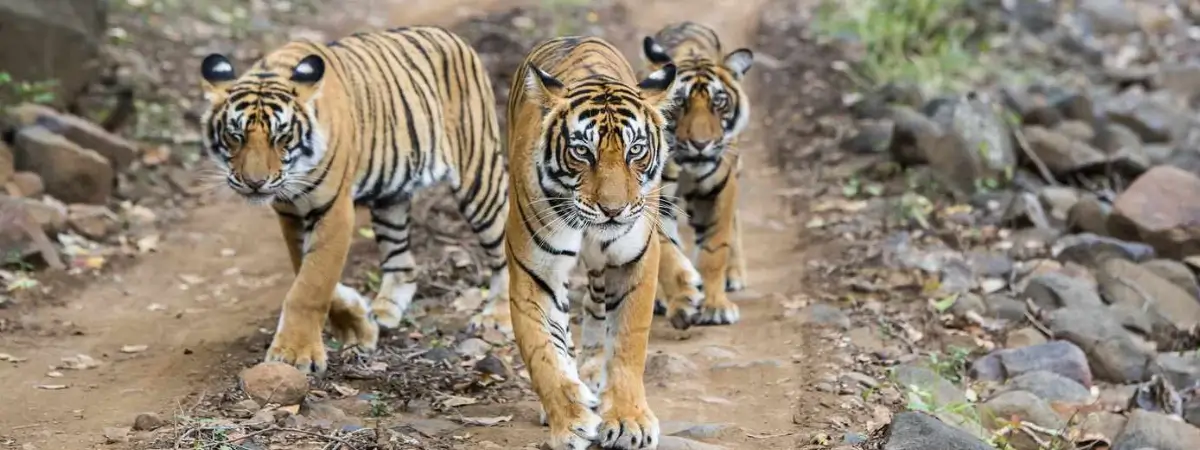
Tigers, lakes and Mughal marble share one route on our Golden Triangle Tour with Ranthambore and Udaipur, an 11-day private itinerary for travellers who want more than the standard three-city loop. You begin in Delhi with its Mughal tombs and old bazaars, watch the Taj Mahal change colour at sunrise in Agra, and then head south-west into the dry deciduous forest of Ranthambore National Park for three jeep or canter safaris. From there the road climbs to Jaipur, the pink-washed capital of the Kachwaha rulers, before a final stretch takes you to Udaipur and its palaces reflected in Lake Pichola. Every transfer is covered by a private car and driver, so you set the pace, stop for photographs whenever the light is right and never wait for a group.
The route has been arranged with wildlife and photography in mind. Ranthambore sits roughly midway between Agra and Jaipur, which means no wasted backtracking and a full two nights near the park gates. Safari slots are pre-booked through the forest department portal, and we try to secure different zones on each drive to improve your chances of a sighting. In the cities, local English-speaking guides lead the Delhi, Agra and Jaipur city tours, while Udaipur gets three nights so the pace slows down at the end. Hotels range from heritage havelis to quiet jungle lodges, chosen for comfort, location and good breakfasts. The tour ends with a short domestic flight from Udaipur to Delhi, saving a full day on the road before your flight home.
Tour Highlights
 Package Includes:
 Package Excludes:
Reply within 24hrs
Your tour starts the moment you walk out of the arrivals hall at Indira Gandhi International Airport. A representative from Heritage India Private Tours waits with a name board, helps with your luggage and introduces you to the chauffeur who will look after you on the road. The drive to your hotel usually takes 40 to 60 minutes depending on the hour and the traffic around Dhaula Kuan. On the way your driver will hand over a welcome folder with your printed itinerary, safari confirmations, emergency numbers and a local SIM card guide, so everything you need for the coming eleven days is in one place before you even check in.
After a long-haul flight, most guests prefer a quiet first evening. Hotel check-in in India is normally at 2 pm, and we request early access where possible for morning arrivals. If you land in daylight and feel fresh, a short walk around Lodhi Garden is a pleasant way to stretch your legs among fifteenth-century tombs, joggers and parrots. Your driver can also take you for an easy dinner at a restaurant in Khan Market, where kebabs, dal makhani and fresh tandoori breads are a gentle introduction to North Indian food. Keep cameras charged tonight, because tomorrow's light in Old Delhi is worth catching early. Overnight stay in Delhi.
The Delhi city tour begins in the old walled city of Shahjahanabad. Your guide meets you at the hotel and drives to the Red Fort, closed on Mondays, where the Lahori Gate, Diwan-i-Am and the marble pavilions along the river side tell the story of the Mughal court. From there you walk to Jama Masjid, the largest mosque in India, and climb the southern minaret if it is open for a view over the rooftops. A cycle-rickshaw ride through Chandni Chowk follows, weaving past wedding card shops, spice sellers on Khari Baoli and the famous paranthe wali gali, where stuffed flatbreads are fried in ghee.
After lunch the city changes character as you move into the wide avenues of New Delhi designed by Edwin Lutyens. You drive past India Gate, the Kartavya Path and the Rashtrapati Bhavan, then stop at Humayun's Tomb, the red sandstone garden tomb that inspired the Taj Mahal. Photographers love the late afternoon here, when warm light hits the double dome and the charbagh water channels. The day closes at the Qutub Minar complex, with its 73-metre fluted tower and the rust-free iron pillar standing in the courtyard of the Quwwat-ul-Islam mosque. Your driver returns you to the hotel by early evening. Overnight stay in Delhi.
After breakfast you leave Delhi on the Yamuna Expressway, a smooth six-lane road that cuts the drive to Agra to around four hours, including a coffee stop. Your chauffeur keeps a cool box of drinking water in the car, and the clean expressway rest areas make the journey easy. On arrival you check in and rest for a while before the afternoon visit. Your guide then leads you through Agra Fort, the red sandstone citadel built by Akbar and later refined by Shah Jahan, where the Khas Mahal, Musamman Burj and Diwan-i-Khas look across the river towards the Taj Mahal.
In the late afternoon you cross the river to Mehtab Bagh, the moonlight garden laid out by Babur, which faces the Taj Mahal from the opposite bank. This is one of the best spots in Agra for wide-angle shots of the monument without crowds, and at sunset the marble often glows pink and gold. The garden is quiet and flat, so it suits all ages. If you have energy for dinner out, your driver can suggest a place near Fatehabad Road for Mughlai dishes such as murg musallam, or for Agra's famous petha sweets made from ash gourd. Remember that the Taj Mahal is closed on Fridays. Overnight stay in Agra.
Set your alarm early, because the gates of the Taj Mahal open about thirty minutes before sunrise. With your guide you enter through the eastern gate, where the queues are shorter, and walk through the red sandstone Darwaza-i-Rauza to the first full view of the white tomb. In the soft morning light the inlay work of carnelian, jasper and lapis on the cenotaph screens is easier to appreciate, and the reflecting pools are often still. After about two hours you return to the hotel for breakfast, check out and load the car for the long drive south-west towards the forests of Ranthambore.
The first stop is Fatehpur Sikri, about 40 km from Agra, the abandoned capital Akbar built in red sandstone. Your guide shows you the Panch Mahal, the Diwan-i-Khas with its carved central pillar and the Buland Darwaza of the Jama Masjid, where the white marble tomb of Salim Chishti has lattice screens as fine as lace. The road then passes Bharatpur and Dausa, and the countryside turns to mustard fields, small villages and rocky hills. You reach Sawai Madhopur in the late afternoon and check into a jungle lodge near the park. Dinner is usually served around a bonfire in winter. Overnight stay in Ranthambore.
Today belongs to the forest. A wake-up call comes before dawn, and your safari vehicle, either a six-seat open jeep or a twenty-seat canter, collects you from the lodge between 6 and 7 am depending on the season. Ranthambore National Park is divided into zones, and a forest naturalist rides with you to read pugmarks, alarm calls from spotted deer and the behaviour of langur monkeys. Ranthambore is known for tigers that are relatively relaxed around vehicles, and the old lakes of Padam Talao, Rajbagh and Malik Talao are favourite spots for sightings. Sambar deer, marsh crocodiles, wild boar and painted storks are common along the way.
You return to the lodge around 10 am for a late breakfast and a rest through the hottest part of the day. The afternoon safari usually starts around 2 to 2.30 pm and runs until sunset, often in a different zone so you see another part of the reserve. Photographers should carry a long lens of 200 to 400 mm, a scarf to keep dust off the camera and a warm jacket for winter mornings, which can be surprisingly cold in an open jeep. Please note that the core zones normally close for the monsoon from July to September. In the evening the lodge naturalist often gives a short talk on tiger conservation. Overnight stay in Ranthambore.
One more dawn drive gives you a final chance at a tiger sighting, or perhaps a leopard on the rocky edges of the reserve. Zones 1 to 5 tend to have the most consistent tiger movement, and we try to book a fresh zone for this last drive. If you prefer a slower morning, you can skip the safari and instead visit Ranthambore Fort, a UNESCO-listed hill fort inside the reserve, where pilgrims climb to the Trinetra Ganesh Temple and langurs sit along the old walls. After breakfast you check out and take a short stop at the Dastkar craft centre, which supports local village women.
The drive to Jaipur takes about three and a half hours through Tonk district, with low hills and roadside stalls selling guavas and sugarcane juice. You arrive in Jaipur by mid-afternoon and check into your hotel. In the evening your driver can take you to Bapu Bazaar and Nehru Bazaar for printed cotton, mojari shoes and lac bangles, or to the rooftop of a heritage hotel near the walled city for a quiet dinner. Rajasthani dishes such as laal maas, ker sangri and dal baati churma are worth trying at least once. The pink walls of the old city glow beautifully after sunset. Overnight stay in Jaipur.
The Jaipur city tour starts early to beat the heat and crowds at Amber Fort, 11 km north of the city. You can ride up in a jeep to the Suraj Pol gate, then walk through the Diwan-i-Am, Ganesh Pol and the Sheesh Mahal, the hall of mirrors where a single candle once lit the entire ceiling. The view from the ramparts takes in Maota Lake below and the walls of Jaigarh Fort snaking along the ridge above. On the way back you stop for photographs at Jal Mahal, the palace that appears to float in Man Sagar Lake, best seen before the late-morning haze.
In the afternoon your guide leads you through the City Palace, still home to the former royal family, with its Mubarak Mahal textile gallery and the Pritam Niwas Chowk courtyard with four painted peacock doorways. Next door is Jantar Mantar, a collection of giant stone astronomical instruments including the Samrat Yantra sundial, accurate to about two seconds. You end with the classic view of Hawa Mahal from the cafes across the street, where the morning sun lights its 953 small windows best. If time allows, a visit to a block-printing workshop in Sanganer shows how traditional textiles are still made by hand. Overnight stay in Jaipur.
Today's drive is the longest on the tour, but the four-lane highway via Ajmer, Bhilwara and Chittorgarh keeps it comfortable. Your driver leaves after an early breakfast and stops regularly for tea and stretching. The landscape changes slowly from flat farmland to the rugged Aravalli hills of Mewar. If you leave early enough and the group is keen, a two-hour detour into Chittorgarh Fort is possible, with the Vijay Stambha tower of victory, Rani Padmini's palace and the Kirti Stambha. Many guests consider it one of the most moving forts in Rajasthan, and it breaks the long journey nicely with a proper walk and fresh air.
You reach Udaipur in the late afternoon. Hotels around Lake Pichola and Lal Ghat are close to the old city, and many have rooftop terraces facing the water and the City Palace. After check-in, take a short walk to Gangaur Ghat, where women still wash clothes on the steps and pigeons crowd the old archway at sunset. For dinner, the lakeside restaurants of Hanuman Ghat serve both Rajasthani thalis and continental dishes with views of the lit palace across the lake. The pace from here onward is deliberately slower, giving you time to rest after the safari days. Overnight stay in Udaipur.
The Udaipur city tour begins at the City Palace, the largest palace complex in Rajasthan, built over four centuries by the Mewar rulers. Your guide leads you through the Mor Chowk with its glass mosaic peacocks, the Zenana Mahal, and the Krishna Vilas painting gallery, while balconies frame views over Lake Pichola. Nearby, the Jagdish Temple, an Indo-Aryan temple dedicated to Vishnu, has carved elephants and musicians along its base. Later you stroll through Saheliyon ki Bari, the garden of the maidens, with lotus pools and marble elephants spraying fountains. Lunch can be taken at a cafe near the palace gate, where a cold glass of lassi is welcome on warm days, before a short rest at the hotel.
In the late afternoon you board a boat from the City Palace jetty for a sunset ride on Lake Pichola. The boat circles Jag Niwas, now the Taj Lake Palace hotel, and stops at Jag Mandir island, where Shah Jahan is said to have taken refuge as a young prince. Photographers will enjoy the view of the palace facade turning gold as the sun drops behind the hills. In the evening you can attend the Dharohar folk dance show at Bagore ki Haveli near Gangaur Ghat, with puppetry and the famous pot-balancing dance. Dinner can be at a rooftop restaurant facing the lake. Overnight stay in Udaipur.
A full-day excursion today takes you into the Aravalli hills north of Udaipur. The drive to Kumbhalgarh Fort takes about two and a half hours on winding country roads past farms and shepherds. Built by Rana Kumbha in the fifteenth century, the fort has walls stretching over 36 km, often called the second longest wall in the world. Inside are more than 300 temples and the Badal Mahal at the top, which gives sweeping views across the forested hills into the Marwar plains. The fort is also the birthplace of Maharana Pratap, a hero of Mewar, and the climb to the top is steady, so comfortable shoes help.
From Kumbhalgarh you continue about 50 km to Ranakpur, home to one of the finest Jain temples in India. Dedicated to Adinath, the temple has 1,444 carved marble pillars, no two of them alike, and the delicate ceilings are a challenge for any photographer. Non-Jain visitors may enter from noon, and leather items must be left outside. A simple vegetarian lunch nearby is a good option before the return drive to Udaipur, which takes about two and a half hours. You reach your hotel in the early evening, in time for a last dinner by the lake. Overnight stay in Udaipur.
Enjoy a relaxed final morning in Udaipur. If you are an early riser, a walk along the lakeside at Ambrai Ghat gives a peaceful view of the City Palace before the day warms up, and the boats are still tied up along the shore. After breakfast you check out, and your chauffeur drives you to Maharana Pratap Airport at Dabok, about 25 km from the city. Depending on your connection, the domestic flight to Delhi takes around one hour and fifteen minutes. Our team will have confirmed the flight timing and baggage allowance for you in advance, and your driver will make sure you reach the airport with time to spare.
On arrival in Delhi, our representative meets you and assists with the transfer to the international terminal, or to a hotel near the airport if your flight home leaves later at night. Many guests use this time for last-minute shopping at Dilli Haat or a quiet lunch at a nearby hotel. Before you leave, please share your feedback with us. As a small Jaipur-based team founded by Magan Singh, we value every comment and photograph you send. Your Golden Triangle Tour with Ranthambore and Udaipur ends here, with memories of tigers, palaces and quiet lakes to take home, and we hope to welcome you back to Rajasthan again.
Hear what our happy guests say about their India adventures! From private drivers to guided tours, we make every journey smooth, safe & unforgettable.
 rating score: 5.0 of 5, based on 448 reviews

Complete our inquiry form

Customize your itinerary

Confirm when you're satisfied
1-to-1 Service | Reply within 24hrs | Expert's Advice