Bengaluru - Mysuru - Kabini - Coorg - Hassan - Hampi - Badami - Bengaluru
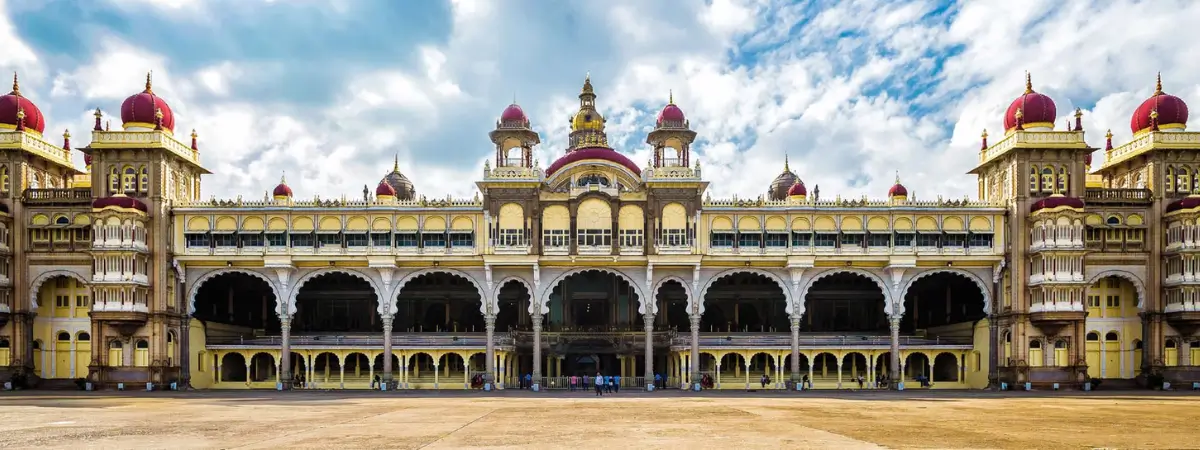
Karnataka holds more World Heritage carving per kilometre than almost anywhere in India, and it also shelters the largest wild elephant population in Asia, so a single road trip here can swing from a sixth-century cave shrine to a jeep track with leopard pugmarks. Our Karnataka heritage and wildlife private tour takes advantage of both. You start in Bengaluru, cross the island fortress of Srirangapatna to reach Mysuru, then spend two nights on the backwaters of the Kabini river, the southern edge of Nagarhole National Park. After a night in the coffee hills of Coorg, the route turns north into Hoysala country around Hassan, then onward to the boulder-strewn capital of Vijayanagara at Hampi, and finally to the red sandstone gorge of Badami with its Chalukyan cave temples.
A single private car and driver carries you from Bengaluru airport to Badami, so luggage stays in the same vehicle throughout and the chauffeur gets to know your pace. Safaris at Kabini are run by the forest department in open jeeps and canter vehicles, with a motorboat ride on the reservoir where elephants gather on the shoreline in the dry months. Heritage sites are covered with archaeologists or long-serving local guides who read inscriptions and know which panel shows which myth. To avoid a nine-hour drive back to the capital at the end, the trip finishes with a short flight from Hubli to Bengaluru, included in the price. This Karnataka tour package with private chauffeur suits curious travellers who like early mornings, binoculars and a good stone carving in equal measure.
Tour Highlights
 Package Includes:
 Package Excludes:
Reply within 24hrs
Our representative meets you at Kempegowda International Airport, and your chauffeur, who will drive you for the next twelve days, introduces himself at the car. The drive into the city takes about an hour. If your flight lands in the morning or around lunchtime, you have time for a gentle afternoon in the old southern quarter of Bengaluru, which the city's founder Kempe Gowda laid out in the sixteenth century. Tipu Sultan's summer palace, a two-storey structure built almost entirely in teak with painted arches and balconies, stands beside the remains of the mud fort where the British army fought Tipu's soldiers in 1791.
From there, your driver continues to Basavanagudi, where the Bull Temple houses a 4.5-metre Nandi carved out of a single grey-black granite rock and polished by centuries of coconut oil. On the hill behind it, Kempe Gowda built a watchtower that marked one corner of the city's limits. Early evening is a good time for filter coffee and a crisp masala dosa at Vidyarthi Bhavan on Gandhi Bazaar, a no-frills eatery open since the 1940s that still serves on steel plates. Our usual choice of hotel is a comfortable four-star property in the city centre, with an early night before the drive south.
Overnight stay in Bengaluru.
After breakfast you leave on the expressway toward Mysuru. About 15 km before the city, the road crosses into Srirangapatna, an island formed by two arms of the Cauvery and the capital of Hyder Ali and Tipu Sultan. Your guide meets you at Daria Daulat Bagh, Tipu's summer palace, whose walls are painted floor to ceiling with scenes of the Battle of Pollilur, where his army defeated the East India Company. The palace is closed on Fridays. Next you visit the Gumbaz, a domed mausoleum with ebony doors inlaid with ivory, where Tipu lies beside his father and mother, and the spot by the ramparts where he fell in 1799.
The Sri Ranganathaswamy temple on the island gives the town its name, and inside lies a large reclining Vishnu in the Hoysala style. Your car then reaches Mysuru by early afternoon. The local guide takes you through the Mysore Palace with a focus on its armoury of royal weapons and the Gombe Thotti doll pavilion, which displays the dolls used in the Dasara festival. The palace is lit with nearly 100,000 bulbs on Sunday evenings and public holidays. Later, walk through the old Mandi Mohalla quarter and stop at a family bakery for hot Mysore bonda, a fried lentil snack.
Overnight stay in Mysuru.
This morning is set aside for Somanathapura, 35 km east of Mysuru, where the Keshava temple of 1268 is the most complete example of Hoysala carving outside the Belur and Halebidu circuit, and a perfect introduction before you reach them later in the tour. The temple stands on a star-shaped platform inside a walled courtyard with 64 cells, and its outer walls carry six bands of friezes: elephants at the base for strength, then horses for speed, scrolls of foliage, and finally episodes from the Ramayana and Mahabharata. Your guide explains how the soapstone was carved soft and then hardened in the open air, allowing the fine detail to survive.
Back in Mysuru for a late lunch, try a Mysore masala dosa with its red chutney at Mylari, a small cafe beloved by locals since the 1930s. In the afternoon you visit the Jaganmohan Palace art gallery, which holds paintings by Raja Ravi Varma and a collection of musical instruments and clocks, followed by St Philomena's Cathedral with its neo-Gothic twin spires modelled on Cologne Cathedral. Before sunset, the driver can take you to the Karanji Lake aviary walk, where pelicans and painted storks nest in the trees. Tonight is a good moment to pack a smaller day bag for the jungle.
Overnight stay in Mysuru.
A quiet road through farming villages and coconut groves takes you south-west from Mysuru to the Kabini river, which separates Nagarhole National Park from Bandipur. Our usual choice is the Kabini River Lodge, run by the state's Jungle Lodges and Resorts in the former hunting lodge of the Maharaja of Mysore, or the Evolve Back Kuruba Safari Lodge, subject to availability. Lunch is served soon after arrival, and the naturalist briefs you on safety, safari rules and what the forest has been showing in recent days. Neutral clothing in greens, browns and khaki helps, while white and bright colours are best avoided.
The afternoon safari departs around 3 pm and returns before 6 pm, when the forest gates close. Open jeeps follow set routes along forest tracks through teak, rosewood and bamboo, and the guide reads alarm calls from spotted deer and langurs to guess where a predator may be moving. Kabini is famous for its tigers, leopards, wild dogs called dholes and the occasional black panther, a melanistic leopard that has made the area well known among wildlife photographers. Gaur, sambar and elephant herds are seen on most drives. In the evening, the lodge screens a short wildlife film before a buffet dinner by the river.
Overnight stay in Kabini.
Wake-up tea arrives at around 5:45 am, and the morning jeep safari leaves at 6:30 am, returning by about 9:30 am. Early hours are cooler and the light is soft, so animals are more active, and tigers often walk the dirt roads at this time. Your naturalist carries a field guide and checks the latest sighting reports with other drivers. Birders will enjoy the crested serpent eagle, Malabar pied hornbill and the bright scarlet minivet in the canopy. After breakfast you have the rest of the morning to rest, read or walk the lodge grounds, where monkeys and peacocks wander between the cottages.
In the late afternoon, instead of a second jeep drive, you board a motorboat on the Kabini reservoir. In the dry months from March to June, the receding water exposes grassland on the shore, and elephant herds of thirty or more gather there to feed and bathe, one of the largest such gatherings in Asia. Marsh crocodiles bask on the rocks, ospreys and river terns fly overhead, and otters are sometimes seen fishing near the banks. As the sun sets, the boat returns to the jetty, and the evening ends with a campfire and conversation about the day's sightings.
Overnight stay in Kabini.
Breakfast is followed by a drive north-west through the edges of Nagarhole and the town of Gonikoppal, where coffee and pepper estates take over from the forest. You reach Madikeri, the small capital of Kodagu district, in time for lunch, and your chauffeur stops at Madikeri Fort, rebuilt in stone by Tipu Sultan and later used by the British as an administrative centre. Inside its walls stand a small museum in an old church and two life-size stone elephants. After lunch, which can be a Kodava meal of pork curry with rice rotis, you continue towards Bhagamandala, 40 km away.
At Bhagamandala, the Cauvery meets the Kannike and the underground Sujyoti river at a confluence called Triveni Sangama, and the Bhagandeshwara temple nearby has sloping copper roofs in the Kerala style. A further 8 km uphill takes you to Talacauvery, the source of the Cauvery, where a small tank collects water from a spring on the Brahmagiri hills. Steps behind the shrine climb to a viewpoint where the Western Ghats roll away in every direction. Your hotel tonight is a homestay or estate resort on a working coffee plantation, and dinner is cooked by the owner's family.
Overnight stay in Coorg.
You leave Coorg after breakfast through Kushalnagar and the plains of the Hemavathi river. A short detour leads to Shravanabelagola, one of the most important Jain pilgrimage sites in India, where the statue of Gommateshwara, or Bahubali, stands 18 metres high on top of Vindhyagiri hill. Carved from a single granite block around 981, the figure shows the prince standing in meditation for so long that creepers climb his legs and anthills rise at his feet. The climb involves around 620 rock-cut steps, which must be done barefoot, so start early before the stone heats up; socks are allowed and doolies, or porter chairs, can be hired.
Every twelve years, the statue is bathed from scaffolding with milk, saffron, sandalwood paste and flowers during the Mahamastakabhisheka festival. Opposite Vindhyagiri, the smaller Chandragiri hill holds Jain temples and inscriptions linked to Chandragupta Maurya, who is said to have ended his life here as a monk. After a simple vegetarian lunch in town, your car continues 50 km to Hassan, the base for the Hoysala temples. The hotel is a comfortable three or four-star property, and the evening is free to rest after the climb, perhaps with a foot massage or a quiet walk around the Hassan town tank before dinner.
Overnight stay in Hassan.
Today is devoted to two of the finest temples in South India, both part of the UNESCO-listed Sacred Ensembles of the Hoysalas. At Belur, 38 km from Hassan, the Chennakeshava temple was commissioned by King Vishnuvardhana in 1117 to mark a victory over the Cholas, and it took over a century to finish. Your guide points out the bracket figures called madanikas, celestial dancers carved on the outer pillars, especially the Darpana Sundari admiring herself in a mirror. Inside, the Narasimha pillar was once said to rotate on its base, and its carvings are so fine that a flashlight shows tiny figures in each panel.
After lunch you drive 16 km to Halebidu, the old Hoysala capital of Dwarasamudra, sacked twice by the Delhi Sultanate in the fourteenth century. The Hoysaleswara temple has twin shrines dedicated to Shiva, each with a large Nandi pavilion facing it, and its outer walls carry more than 240 figures of gods and goddesses above friezes of elephants, lions and horsemen. The nearby Jain bastis, with their polished black stone pillars, are often quiet and worth the short walk. Late in the afternoon, return to Hassan, and ask your driver about the Hassan coffee shops for a local filter brew.
Overnight stay in Hassan.
This is the longest drive of the tour, so you leave early, around 7 am, with packed breakfast available on request. Highways across the Deccan plateau are well surfaced, and the landscape turns drier as you head north, with sunflower and maize fields, windmills and granite outcrops. Halfway, your chauffeur stops at Chitradurga Fort, a seven-walled hill fortress spread across boulder-strewn hills. Your guide tells the story of Onake Obavva, a local woman who defended a gap in the walls against Hyder Ali's soldiers using only a pestle, and you see the narrow crevice called Onake Kindi that bears her name.
After lunch in Chitradurga, the drive continues through Hosapete, a sugar and iron ore town, to Hampi, which lies about 13 km away on the banks of the Tungabhadra. The scenery becomes dramatic as you approach, with huge boulders balanced on each other and banana plantations below. Our usual choice is the Evolve Back Hampi, built in the style of a Vijayanagara palace, or a simpler heritage resort near Kamalapur, subject to availability. Tonight, rest after the long drive, or walk to the Hampi Bazaar area at dusk to see the Virupaksha gopuram lit against the sky.
Overnight stay in Hampi.
Your Hampi guide begins at Virupaksha temple, a working shrine in use since before the Vijayanagara empire, where the temple elephant Lakshmi used to bless visitors with her trunk. A small chamber inside throws an inverted image of the main gopuram onto a wall through a pinhole, an early version of a camera obscura. From there you climb Hemakuta hill for views over the temples and boulders, then visit the Sasivekalu and Kadalekalu Ganesha statues, the giant monolithic Lakshmi Narasimha with its broken arms, and the Badavilinga, a 3-metre Shiva linga standing in water that flows through an ancient irrigation channel built by the Vijayanagara engineers.
After lunch at a local cafe, the afternoon covers the Royal Enclosure, where the Mahanavami Dibba platform, a three-tiered stone structure with carved panels of hunting and dancing, was used by the kings to watch the Dasara festival. Nearby you see the stepped tank, uncovered by archaeologists in the 1980s, and the Queen's Bath with its arched balconies. In the Zenana Enclosure stand the Lotus Mahal and the long Elephant Stables with eleven domed chambers. Finish at the Hazara Rama temple, whose walls show the Ramayana in continuous bands of relief. Sunset is best from Hemakuta hill again or from Malyavanta hill.
Overnight stay in Hampi.
Arrive at the Vittala temple early, ideally when it opens at 8:30 am, to see the stone chariot in front of the main hall before the crowds. The chariot, now on the back of the Indian fifty-rupee note, was once topped with a brick tower and had wheels that could turn. Inside the maha-mandapa, the famous musical pillars produce notes when tapped, though touching them is now prohibited to protect the stone. Your guide shows you the King's Balance nearby, where rulers were weighed against gold and grain for charity, and then leads you along the riverside path to the ruins of Achyutaraya temple and its long market street.
In the afternoon, your car takes you to Talarighat, where a round woven coracle carries you across the Tungabhadra to the village of Anegundi, older than Hampi itself and linked in local belief to the monkey kingdom of Kishkindha from the Ramayana. Visit the Anjanadri hill, which some believe is the birthplace of Hanuman, where 575 steps lead to a small white temple at the top. Anegundi also hosts a women's craft cooperative that weaves banana fibre into baskets and bags. On the way back, stop at the Hampi Archaeological Museum at Kamalapur, which is closed on Fridays.
Overnight stay in Hampi.
Leaving Hampi after breakfast, you drive north-west across the Tungabhadra and through farming country to Aihole, which archaeologists call the cradle of Indian temple architecture. Over a hundred temples are spread around the village, and the Durga temple is the highlight, with an apsidal layout shaped like a Buddhist chaitya hall and a covered gallery running all the way around it. The Lad Khan temple, named after a later resident, is one of the earliest temples in the area. The Ravanaphadi cave has carvings of dancing Shiva and the river goddesses Ganga and Yamuna, with crisp details. It is a peaceful place, rarely crowded.
From Aihole, it is 14 km to Pattadakal, a UNESCO World Heritage Site on the banks of the Malaprabha river, where the Chalukya kings were crowned. Here, temples in northern and southern styles stand side by side, which makes it an ideal place to compare them. The Virupaksha temple, built by Queen Lokamahadevi to celebrate her husband's victory over the Pallavas, is the largest and most detailed, and the Papanatha temple combines both styles in one building. The drive continues 22 km to Badami, where you check into a simple but comfortable hotel near the town.
Overnight stay in Badami.
Be at the Badami cave temples soon after the gates open in the morning, before the sandstone steps warm up. Four caves are cut into the red sandstone cliff above Agastya Lake: the first is dedicated to Shiva and shows him dancing with eighteen arms, the second and third to Vishnu, and the fourth to the Jain Tirthankaras. Cave 3, the largest, carries an inscription dated to 578 and keeps fragments of ceiling paintings as well as a fine Vishnu seated on the serpent Shesha. Monkeys are common on the steps, so keep food out of sight. Across the lake, the Bhutanatha temples sit on the water's edge.
After an early lunch, your chauffeur drives you to Hubli airport, about two and a half hours away, for the afternoon flight to Bengaluru, included in the package. This is where you say goodbye to the driver who has carried you through the forests, hills and ruins of Karnataka. The flight takes a little over an hour. On arrival at Bengaluru, our representative meets you and helps you connect to your international departure, or transfers you to an airport hotel if your flight leaves the following day. Founder Magan Singh and the team thank you for travelling with Heritage India Private Tours, and we hope to welcome you again soon.
Hear what our happy guests say about their India adventures! From private drivers to guided tours, we make every journey smooth, safe & unforgettable.
 rating score: 5.0 of 5, based on 448 reviews

Complete our inquiry form

Customize your itinerary

Confirm when you're satisfied
1-to-1 Service | Reply within 24hrs | Expert's Advice