Delhi - Agra - Bhandarej - Jaipur - Samode - Jaipur - Delhi
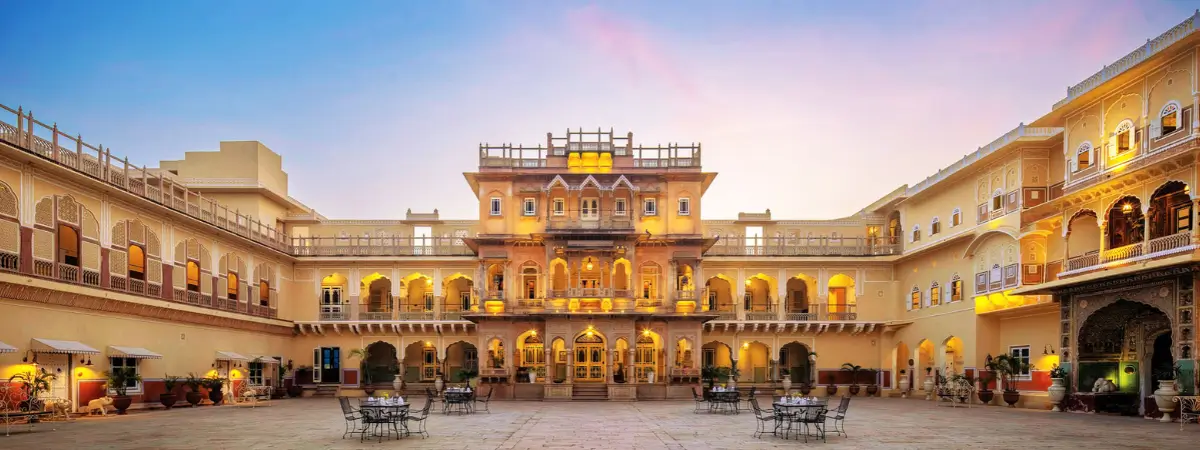
Behind a carved wooden door in a Chandni Chowk lane, a courtyard opens to the sky, and that is where your first night begins on this Golden Triangle tour with heritage haveli stays. A haveli is a traditional Indian mansion built around one or more open courtyards, with painted walls, jharokha balconies and rooftop terraces where families once slept on summer nights. Over eight days, you sleep in restored havelis in Old Delhi and Jaipur, spend one night near the Taj Mahal, and visit the painted mansions, stepwells and palace villages that give this region its character. A private car and driver links every stop, and local guides who know the history of these family homes walk you through their courtyards and lanes.
Hotel chains offer comfort, but havelis offer a sense of place. You wake to pigeons on the parapet and the call of the chai seller in the lane below, eat breakfast under fresco-painted arches, and often meet the families whose ancestors built the house. In Old Delhi, that means a carefully restored Mughal-era mansion such as Haveli Dharampura, a few minutes' walk from Jama Masjid. In Jaipur, it means a nineteenth-century noble residence with mirrored rooms and a pool in the garden, such as Alsisar Haveli or Samode Haveli. Rooms vary in shape and size, as old houses do, and some have steep stairs, so we match rooms to each guest. This is the Golden Triangle seen from inside its historic homes.
Tour Highlights
 Package Includes:
 Package Excludes:
Reply within 24hrs
Our representative meets you inside the arrivals hall at Delhi airport and accompanies you to your private car for the drive into the old walled city, about an hour away. Because motor vehicles cannot enter the narrowest lanes of Chandni Chowk, your car stops at the nearest point and a porter, or a cycle rickshaw if the lane allows, brings your luggage the last few hundred metres to the haveli door. It is a memorable arrival: the noise of the bazaar fades as you step into a cool stone courtyard, and staff welcome you with rose sherbet and a garland of jasmine. Within minutes, the long flight feels far behind you.
Take time to rest after the flight in your room, many of which open onto balconies over the inner courtyard. Late afternoon, climb to the rooftop, where the domes and minarets of Jama Masjid rise only a short distance away and the evening call to prayer drifts across the rooftops. Dinner is served in the haveli's own dining room, usually a menu of old Delhi dishes such as nihari, mutton korma and sheermal, a saffron-scented bread. Your guide stops by to introduce himself and describe tomorrow's walk through the lanes of the old city, including which stretches are best seen early before the shops open. Overnight stay in Delhi.
Morning is spent on foot with a guide who specialises in Shahjahanabad, the city built by Shah Jahan in the 1640s. Walk to Kinari Bazaar, where tinsel and wedding trimmings hang from every shopfront, then turn into Naughara, a short cul-de-sac of nine painted haveli fronts in pastel colours, and continue to Chunnamal Haveli, once the home of a wealthy cloth merchant. In Gali Qasim Jan, stop at Mirza Ghalib's Haveli, the small house of the great Urdu poet, now a modest museum. Pause for parathas at Paranthe Wali Gali, fried in pure ghee and served with pickles and potato curry.
After lunch, your private car and driver takes you out of the old city to New Delhi for a change of scene. Visit Humayun's Tomb, where the garden layout and double dome inspired the Taj Mahal, then Safdarjung's Tomb, one of the last great Mughal garden tombs and usually quiet. Drive past India Gate and the government buildings designed by Edwin Lutyens and Herbert Baker. The Red Fort, visible from your haveli quarter, is closed on Mondays, so on other days your guide can include a short visit to its Diwan-i-Khas and the Mumtaz Mahal museum before dinner. Overnight stay in Delhi.
After breakfast in the courtyard, leave Old Delhi and drive to Agra on the Yamuna Expressway, a journey of about four hours. Agra has no restored haveli hotels of the same character as Delhi or Jaipur, so tonight's stay is in a heritage-style hotel close to the eastern gate of the Taj Mahal, chosen so you can walk out at sunrise tomorrow. After check-in and lunch, your guide takes you to Agra Fort, where you can trace the evolution from Akbar's sandstone Jahangiri Mahal, with its carved brackets and courtyards, to Shah Jahan's white marble Khas Mahal and the river-facing Musamman Burj.
Late afternoon, walk into the old quarter around Kinari Bazaar and Johri Bazaar in Agra, where crumbling merchant havelis with carved balconies still line the lanes, and families sell silver and fabric from ground-floor shops as they have for generations. Your guide can point out the old Mughal-era caravanserai gateways and the small temples tucked between shops. For dinner, try Agra's local specialities, including bedai and jalebi from a well-known shop, or a quiet meal at the hotel. Go to bed early, since tomorrow begins before dawn, and ask reception for a packed tea to take with you. Overnight stay in Agra.
Your guide meets you at the hotel in the dark, and a short walk or battery-cart ride brings you to the eastern gate of the Taj Mahal just before it opens. The monument is closed on Fridays, so your dates are arranged around that. Pass through the Great Gate and watch the marble turn pale pink in the first light, with mist often hanging over the Yamuna. Your guide explains how the inlay of carnelian, jasper and lapis lazuli was cut and set, and points out the identical red sandstone mosque and guest house on either side of the tomb, built so the whole complex stays perfectly balanced.
After breakfast, check out and head west towards Jaipur. Around 60 km before the city, near Dausa, stop at Bhandarej, a village with a large step-terraced stepwell built in the eighteenth century, rarely visited by tourists and quite peaceful. Continue to Jaipur and check into a nineteenth-century noble haveli inside or just outside the walled city, with painted walls, mirrored rooms and a pool in the garden. The family that owns it may join you for a cup of tea and talk about the house's history. Dinner is served on the terrace by lantern light, often with dishes from the family's own recipes. Overnight stay in Jaipur.
Begin with a morning walk through the walled city of Jaipur, laid out in 1727 by Maharaja Sawai Jai Singh II on a grid of broad bazaars and narrow residential lanes. Your guide leads you through Tripolia Bazaar, where brass and steel utensils are sold, and into Chaura Rasta, lined with booksellers and small temples. Step through the gates of old merchant havelis whose courtyards are now shared by several families, and stop for a pyaaz kachori and a clay cup of lassi at Lassiwala on MI Road, a shop that has been serving lassi from the same spot for decades. The kachori is crisp, spicy and best eaten hot.
Afternoon takes you up to Amber Fort, where the Sheesh Mahal and the marble Jai Mandir show the finest rooms of the old Kachwaha rulers. Below the fort, walk the quiet lanes of Amber village, where several old havelis have been restored, and visit Panna Meena ka Kund, a stepwell with geometric staircases on all four sides. Your guide takes it slowly here. Watch the sun go down over Maota Lake before returning to your haveli. The evening is free for a quiet dinner in the courtyard, where a local musician sometimes plays the ravanhatta, a folk string instrument of Rajasthan. Overnight stay in Jaipur.
After breakfast, drive north-west into the Aravalli hills to Samode, a small village dominated by Samode Palace, the former residence of noble families of the Jaipur court, now a heritage hotel. Day visitors usually book lunch at the palace, which gives access to its famous Durbar Hall and Sheesh Mahal, decorated with intricate painted murals and mirror mosaics that are among the finest in Rajasthan. Your guide also takes you for a walk through the village, where artisans make lac bangles and families still live in old haveli homes with painted doorways. The pace here is slow, and children often follow visitors around asking for photographs.
Return to Jaipur in the afternoon and check into your second haveli, a noble residence of a different character, set in a walled garden with shaded verandahs and antique furniture. Moving between two properties lets you compare how Rajput nobles built and decorated their homes. Before dinner, take a short drive to Nahargarh Fort for a view over the city at sunset, or relax in the courtyard with a cup of masala chai. Dinner tonight is Rajasthani home cooking: laal maas, ker sangri, bajra roti and a sweet dish of ghevar or moong dal halwa, depending on the season. Overnight stay in Jaipur.
Morning visits the City Palace, still partly the home of the former royal family, where the Chandra Mahal, the Mubarak Mahal and the Pritam Niwas Chowk show how royal residences grew from the same courtyard layout used in the city's havelis. Next door, Jantar Mantar's stone instruments still measure time and planetary positions, and your guide shows how the great sundial works. Your guide then takes you to a rooftop café facing Hawa Mahal, whose 953 small jharokha windows were designed so that royal women could watch processions without being seen, a feature you will have noticed in your own haveli.
The afternoon is for crafts that have long decorated haveli interiors. Visit a workshop where artists paint frescoes using the traditional araish technique, a polished lime plaster that gives Jaipur's palace walls their soft shine, and a small studio making blue pottery from quartz rather than clay. Shoppers will find fine textiles in the old bazaars, and your guide can introduce you to fair-priced dealers. In the evening, enjoy a farewell dinner in the haveli courtyard, lit by oil lamps, with a performance of Rajasthani folk music arranged by your hosts, a warm way to end the trip. Overnight stay in Jaipur.
After a final breakfast in the haveli, say goodbye to the family and staff who looked after you, and begin the drive to Delhi, which takes five to six hours along the national highway. Your chauffeur stops for coffee and lunch at reliable roadside restaurants, and the timing is fixed around your international flight. If your flight leaves very late, we can book a day room near the airport, or you can opt for an hour-long domestic flight from Jaipur to Delhi, which we can arrange on request. Any fragile purchases, such as blue pottery, are packed carefully before departure.
At Indira Gandhi International Airport, your chauffeur unloads your luggage at the departure terminal and says goodbye after a week on the road together. Our Jaipur office is available by phone and WhatsApp until you leave. Guests on this route often say that sleeping in old family homes changed how they saw India: the monuments became part of a living city, not just sights on a list. If you would like to extend your haveli stays, the painted towns of Shekhawati, such as Mandawa and Nawalgarh, lie a few hours north of Jaipur and can easily be added next time.
Hear what our happy guests say about their India adventures! From private drivers to guided tours, we make every journey smooth, safe & unforgettable.
 rating score: 5.0 of 5, based on 448 reviews

Complete our inquiry form

Customize your itinerary

Confirm when you're satisfied

1-to-1 Service | Reply within 24hrs | Expert's Advice