Delhi - Agra - Jaipur - Jodhpur - Jaisalmer
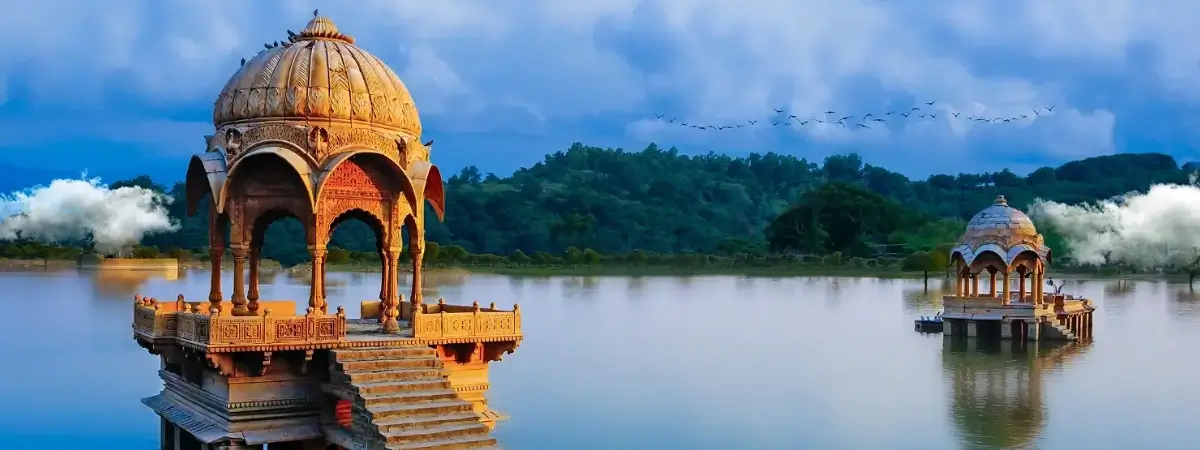
Sand dunes, golden sandstone and starlit desert nights are what set our Golden Triangle Tour with Jaisalmer Desert Safari apart from a standard week in North India. Over twelve days you cover the classic triangle of Delhi, Agra and Jaipur, then keep driving west into the Thar Desert, where Rajasthan feels wilder and the towns are built in shades of blue and gold. Jodhpur's Mehrangarh Fort rises straight out of a rock above the blue houses of the old city, and Jaisalmer's living fort still houses families, shops and temples inside its walls. The high point is an evening camel ride on the Sam sand dunes, followed by folk music, a campfire dinner and a night under canvas in the desert.
Travel is by private car and driver throughout, with the same chauffeur from Delhi into the desert and back, so you build up an easy rapport with someone who knows every dhaba and roadside chai stop along the way. Local English-speaking guides lead the Jaipur, Jodhpur and Jaisalmer city tours, adding stories of the Rathore and Bhati clans that shaped the western desert. Distances are long in Rajasthan, so we break the drive with stops at the Abhaneri stepwell, the Osian temples and village halts rather than racing between cities. Instead of a two-day drive back to Delhi, the tour ends with a short domestic flight from Jodhpur. It suits active couples, families with older children and photographers who enjoy wide desert skies and warm evening light.
Tour Highlights
 Package Includes:
 Package Excludes:
Reply within 24hrs
A warm welcome awaits you at Indira Gandhi International Airport, where a member of our team stands outside the arrivals hall with your name on a board. After a quick introduction, you meet the chauffeur who will drive you all the way across Rajasthan over the next ten days. He loads your bags into the air-conditioned car and takes you to your hotel in about 45 minutes. Along the way you receive a welcome pack with the printed itinerary, desert camp and flight details, and our 24-hour phone numbers. Feel free to ask any questions about the route or your driver's daily timings.
Since international flights often land late at night or early in the morning, the first day is kept free for rest. If you arrive in good time and want a short outing, your driver can take you to Connaught Place, the white colonnaded circle built by the British, for a coffee at one of the old cafes and a look at the shops in the inner circle. Alternatively, an early dinner at your hotel and a good night's sleep are the best preparation for the busy days ahead. Drink plenty of bottled water, as the dry northern air can be dehydrating after a long flight. Overnight stay in Delhi.
Your Delhi city tour starts in the heart of Old Delhi, where history and daily commerce collide in the narrowest of lanes. Your guide leads you on foot through Khari Baoli, the largest spice market in Asia, where sacks of dried chillies, turmeric and cardamom line the corridors and porters carry loads on their heads. From the rooftop of the Gadodia Market, you look out over the old city towards the domes of Fatehpuri Masjid. Continue to Jama Masjid and drive past the Red Fort, which closes on Mondays, before stopping at a sweet shop in Chandni Chowk for jalebi fried fresh in large iron pans. Wear comfortable shoes, as much of the morning is on foot.
In the afternoon you move to New Delhi's wide boulevards and gardens. Humayun's Tomb, built by the emperor's widow in the sixteenth century, is a peaceful place to walk, with its symmetrical gardens and the small blue-domed Barber's Tomb in the corner. Drive past the President's House and India Gate, then end the day at the Qutub Minar, a soaring tower of red and buff sandstone decorated with bands of Quranic verses. If you have time in the evening, the Dilli Haat crafts market is a relaxed place for handicrafts from every state and regional snacks such as momos and dosa. Overnight stay in Delhi.
After breakfast check out and drive to Agra on the Yamuna Expressway, a smooth journey of around four hours with one tea stop at a clean rest area. On arrival you check into your hotel and freshen up before heading out with your guide to Agra Fort. The fort's massive red sandstone walls hide a series of graceful palaces, including the Diwan-i-Am, where the emperor heard public petitions, and the marble Moti Masjid. From the octagonal Musamman Burj, where Shah Jahan was imprisoned by his son Aurangzeb, there is a fine distant view of the Taj Mahal along the curve of the Yamuna River, framed by carved marble arches.
Later in the afternoon walk through Kinari Bazaar, the old market near Jama Masjid in Agra, where shops sell everything from wedding saris to brass utensils. Agra is also known for its leather goods and marble inlay, and your guide can point you towards reliable workshops if you wish to buy souvenirs. For dinner, try a traditional Mughlai meal with butter chicken, biryani and soft naan, followed by a piece of the famous Agra petha. Note that the Taj Mahal is closed on Fridays, so we will arrange the itinerary so your sunrise visit tomorrow falls on another day of the week. Overnight stay in Agra.
Wake early for a sunrise visit to the Taj Mahal, which opens its gates around thirty minutes before dawn. Your guide meets you at the hotel and walks you through the security check at the eastern gate. Seeing the white marble tomb slowly brighten in the morning light is the moment most travellers remember longest. Walk around the platform to see the Quranic calligraphy around the main arch, which grows larger towards the top so it looks uniform from the ground, and visit the red sandstone mosque on the western side. Return to your hotel for breakfast and check out by mid-morning.
On the way to Jaipur, take a detour to Abhaneri, a small village about 95 km before Jaipur, to see the Chand Baori stepwell. Built more than a thousand years ago, it descends thirteen storeys in a perfect pattern of 3,500 narrow steps, and is one of the deepest stepwells in India. Next to it stands the Harshat Mata temple with fine stone carvings. Continue to Jaipur and check into your hotel by late afternoon. In the evening, drive up to Nahargarh Fort on the ridge for sunset views over the Pink City as the lights come on below. Overnight stay in Jaipur.
The Jaipur city tour begins at Amber Fort, the former capital of the Kachwaha Rajputs, perched on a ridge above Maota Lake. Climb through the Suraj Pol gate into the Jaleb Chowk courtyard, then visit the Diwan-i-Am, the elaborately decorated Ganesh Pol gateway and the Sheesh Mahal, whose walls and ceiling are covered with tiny convex mirrors. On the way down the hill stop at the Panna Meena ka Kund, a symmetrical stepwell where the criss-cross staircases make a favourite photograph in soft morning light. Then pause at Jal Mahal on the shore of Man Sagar Lake for a quick picture, ideally before the tour buses arrive.
In the afternoon visit the City Palace, where the Mubarak Mahal displays royal costumes and the Diwan-i-Khas holds two enormous silver urns, listed as the largest single silver objects in the world. Next door, the Jantar Mantar observatory has nineteen stone instruments built for tracking stars and the movement of the sun. Walk to the Hawa Mahal, the Palace of Winds, built so the royal women could watch street processions unseen. End the day with shopping in Johari Bazaar for jewellery and Bapu Bazaar for textiles and leather slippers. For dinner, try a Rajasthani thali with gatte ki sabzi and bajra roti. Overnight stay in Jaipur.
Leave Jaipur after breakfast and drive west towards Jodhpur via Ajmer and Beawar. The landscape changes noticeably as you go, from green farmland to dry scrub and then to the open semi-desert of the Marwar region, dotted with khejri trees. Along the way your driver can stop at a roadside dhaba for hot tea and fresh pakoras, and you may see camels pulling carts or shepherds moving flocks of goats along the road. If you would like a short break, a stop at the Pushkar Lake ghats adds about an hour to the journey. Most travellers reach Jodhpur by mid-afternoon after a comfortable day of driving, with the fort visible from miles away.
After checking into your hotel, take a gentle walk in the evening to the Ghanta Ghar, the clock tower built in the nineteenth century, and the busy Sardar Market around it, a short ride from most hotels. Stalls sell spices, tie-dyed bandhani fabric, silver jewellery and colourful mojari shoes, and the atmosphere is lively but friendly. Try a glass of the famous makhaniya lassi from one of the old shops near the clock tower, rich and topped with saffron and cream. For dinner, a rooftop restaurant facing Mehrangarh Fort gives wonderful views as the floodlit walls glow softly above the blue houses. Overnight stay in Jodhpur.
The Jodhpur city tour starts with Mehrangarh Fort, one of the largest forts in India, built on a sheer rocky hill 125 metres above the city. Enter through the Jai Pol and Loha Pol gates, where small handprints mark the memory of royal widows who committed sati. Inside, the museum displays a superb collection of royal palanquins, elephant howdahs, miniature paintings and arms. The Phool Mahal and the Sheesh Mahal are richly decorated, and from the ramparts you can see the old city spread out below, painted in shades of blue that gave Jodhpur the name Blue City. Allow at least three hours here.
After the fort, visit Jaswant Thada, a white marble cenotaph built in memory of Maharaja Jaswant Singh II, surrounded by small gardens and a lake. The thin marble sheets glow in the sunlight, and the terrace looks straight back at the fort. Later, drive to Umaid Bhawan Palace, one of the last great palaces built in India, part of which is now a museum and part a luxury hotel. In the late afternoon, walk with your guide through the narrow blue lanes of Navchokiya and Brahmpuri below the fort, where you can chat with residents and photograph the painted doorways, temples and steps. Overnight stay in Jodhpur.
After breakfast set out for Jaisalmer, deep in the Thar Desert. About 65 km from Jodhpur, stop at Osian, an ancient trading town known for its cluster of Hindu and Jain temples dating from the eighth to the eleventh centuries. The Sachiya Mata temple, on a small hill, and the Mahavira Jain temple, with its finely carved pillars and ceilings, are the main highlights. The surrounding dunes are low and the village quiet, a good first glimpse of desert life. Continue past the solar fields and windmills near Phalodi and the small town of Pokaran, known for its old red sandstone fort.
You reach Jaisalmer in the afternoon and check into your hotel, often a converted haveli. The town is built almost entirely from yellow sandstone, which glows a soft gold as the sun sets, giving it the name Golden City. In the evening drive up to the Vyas Chhatri, a cluster of sandstone cenotaphs on a low hill outside the town, where the sunset view of Jaisalmer Fort is one of the finest in Rajasthan. Local musicians sometimes play the kamaicha and sing desert folk songs here at dusk. Return to your hotel for dinner and an early night after the long drive. Overnight stay in Jaisalmer.
Start the day early at Gadisar Lake, a man-made reservoir built in the fourteenth century to provide water to the town. At sunrise the carved stone gateway and the small temples on the water's edge are reflected in the still lake, and catfish crowd the steps waiting to be fed. Early light is best here for photographs. Then begin the Jaisalmer city tour at Jaisalmer Fort, built in 1156 by Rawal Jaisal. About a quarter of the town's population still lives within its walls, so as you walk you pass homes, small shops, cafes and guesthouses tucked into the old buildings.
Inside the fort visit the seven-storey Raj Mahal palace and the group of Jain temples, carved in yellow sandstone with an incredible level of detail. In the afternoon walk through the old town to see the havelis built by wealthy merchants. Patwon ki Haveli is a cluster of five mansions with intricate stone latticework and balconies, while Salim Singh ki Haveli has a distinctive peacock-shaped roof. Nathmal ki Haveli was carved by two brothers, each working on one half, and if you look carefully the two sides are not quite identical. Spend the evening shopping for embroidered textiles and mirror work. Overnight stay in Jaisalmer.
Spend a relaxed morning in Jaisalmer, perhaps visiting the small Desert Culture Centre and Museum or simply wandering the fort lanes at your own pace, stopping for a coffee on a rooftop cafe inside the walls. After lunch, drive west to the abandoned village of Kuldhara, where the Paliwal Brahmin community left their homes almost two hundred years ago in a single night, according to local legend. The roofless stone houses, temple and lanes are eerie and interesting, and your guide shares the stories told about why the village was abandoned. Nearby, the Khaba Fort ruins sit on a hilltop with views across the empty desert, and a small museum holds fossils found in the area.
Continue to the Sam sand dunes, about 45 km from Jaisalmer, for the much-anticipated Jaisalmer desert safari. A camel ride takes you across the rippled dunes to watch the sun sink below the horizon in the deep orange light, one of the true highlights of any trip to Rajasthan. As darkness falls, you head to your desert camp, where Kalbelia dancers and Manganiyar musicians perform around a campfire. Dinner is a traditional Rajasthani meal served under the open sky. Later, step outside the tent to see a sky filled with stars, free from any city lights. Overnight stay in Sam desert camp.
Wake early for a quiet walk on the dunes at sunrise, when the sand is cool and the desert is completely silent apart from the call of birds. If you would like, a short jeep ride over the dunes can be arranged before breakfast for a bit of excitement, at extra cost. After a hearty breakfast at the camp, say goodbye to the desert crew and drive back east towards Jodhpur. The road passes through small desert villages, where women in bright ghagras carry water pots and children wave from the doorways of round mud huts with thatched roofs. Your driver stops wherever you would like a photograph.
You reach Jodhpur in the afternoon and check into your hotel. The rest of the day is at leisure, giving you time to rest after the camp night or to pick up any last purchases. If you missed anything on your earlier visit, the Toorji ka Jhalra stepwell near the clock tower is worth seeing, restored and surrounded by cafes and boutiques. In the evening, enjoy a farewell dinner at a heritage hotel, perhaps trying laal maas, the fiery red mutton curry of Rajasthan, or a lighter vegetarian thali with ker sangri, mirchi vada and sweet ghevar. Overnight stay in Jodhpur.
After a leisurely breakfast, check out of your hotel. Your chauffeur, who has driven you more than two thousand kilometres across North India, takes you to Jodhpur Airport, about 5 km from the city centre, for your domestic flight to Delhi. Most guests use this moment to thank their driver properly after so many days on the road together, and many keep in touch long afterwards. The flight takes about one hour and fifteen minutes. We confirm the flight timing in advance to make sure you have enough time for your international connection, usually choosing a midday departure so the morning stays unhurried.
On arrival in Delhi, our representative meets you at the domestic terminal and helps with the transfer to the international terminal or to a hotel near the airport if your international flight leaves late at night. If you have a few spare hours, a visit to the National Museum or a last lunch at a South Delhi restaurant can round off the trip nicely. Thank you for choosing Heritage India Private Tours for your Golden Triangle Tour with Jaisalmer Desert Safari. We hope the memory of the dunes at sunset and the forts of Rajasthan stays with you for a long time.
Hear what our happy guests say about their India adventures! From private drivers to guided tours, we make every journey smooth, safe & unforgettable.
 rating score: 5.0 of 5, based on 448 reviews

Complete our inquiry form

Customize your itinerary

Confirm when you're satisfied
1-to-1 Service | Reply within 24hrs | Expert's Advice