Bengaluru - Chikmagalur - Coorg - Wayanad - Ooty - Munnar - Thekkady - Kochi - Kumarakom
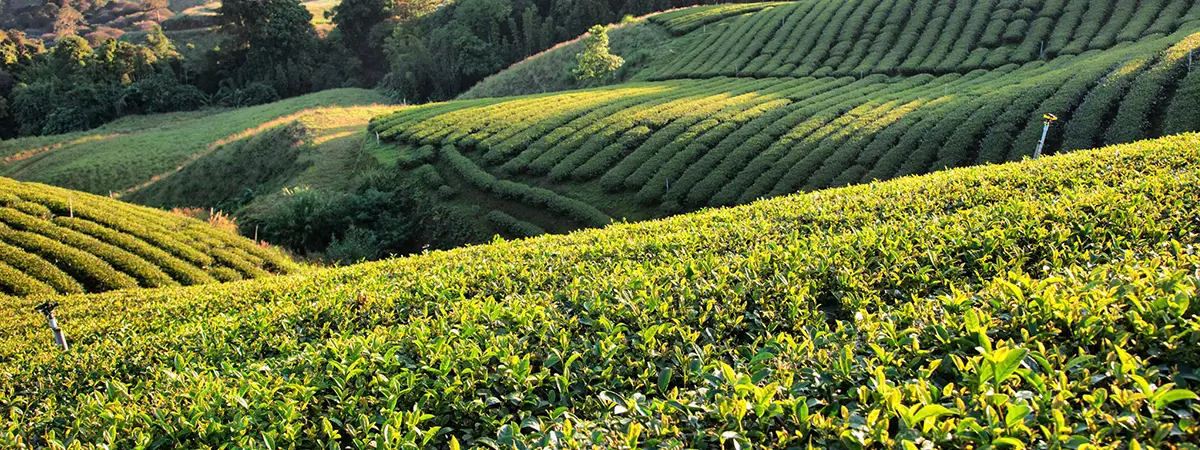
Seven coffee beans, carried home from Yemen by a Sufi pilgrim called Baba Budan, set the course for this South India Coffee Tea and Spice Plantation Tour, because the hills where he is said to have planted them in Chikmagalur still grow some of the finest arabica in the country. Across twenty-one days you follow the crops that shaped the Western Ghats: coffee under silver oak shade in Karnataka, pepper vines climbing those same trees in Coorg and Wayanad, the clipped tea terraces of the Nilgiris and Munnar, and the cardamom forests around Thekkady. The route finishes where these goods once left India, in the old spice warehouses of Mattancherry in Kochi, followed by a final night afloat on Vembanad Lake. Every road section runs with a private car and driver, and the pace leaves real time on each estate rather than a hurried photograph at the gate.
Much of the learning happens on foot and at the table. Estate managers walk you through pulping sheds and drying yards in Chikmagalur, a Kodava family serves pork curry and steamed rice dumplings at their home in Coorg, and a tea maker in Coonoor shows how withered leaf becomes the brisk Nilgiri cup. Between estates come the sights that make the long hill drives worthwhile: Hoysala carving at Belur, the Tibetan monastery at Bylakuppe, prehistoric engravings inside Edakkal Caves, the Nilgiri Mountain Railway down to Coonoor and Nilgiri tahr grazing in Eravikulam National Park. Most nights are spent in estate bungalows and homestays where breakfast comes with coffee or tea grown a short walk away. October to March suits this route best, when coffee cherries ripen, pepper is ready for picking and the tea gardens sit clear of monsoon cloud.
Tour Highlights
 Package Includes:
 Package Excludes:
Reply within 24hrs
Your flight lands at Kempegowda International Airport, roughly 40 km north of the city, where our representative waits outside the arrivals hall with a name board. The drive into central Bengaluru takes about an hour, a little longer if you land during the evening rush on Ballari Road, so the pickup is timed to your flight rather than to a fixed slot. On the way your chauffeur, who stays with you through the whole Karnataka and Nilgiri section, talks you through the road ahead and the rhythm of the coming three weeks. After check-in at your hotel, the remainder of the day is free to rest, change money, buy a local SIM card or simply sleep off the time difference.
If you have energy later in the day, a short outing makes a gentle start. Bengaluru grew up as the market town for beans grown in the Karnataka hills, and its small standing cafes, known as darshinis, still serve strong filter coffee in a steel tumbler set inside a wide bowl called a davara. The server pours it back and forth between the two until a thick froth forms, and locals drink it standing at a counter in a couple of minutes. Your chauffeur can drop you at one close to your hotel or at the India Coffee House on Church Street, a cooperative run by its own workers since the 1950s. Dinner is at leisure tonight.
Overnight stay in Bengaluru.
After breakfast a local guide joins you for a Bengaluru city tour shaped around the city's long link with coffee and gardens. The morning begins at Lalbagh Botanical Garden, laid out under Hyder Ali and Tipu Sultan, where the Victorian glasshouse and the watchtower raised by the city founder Kempegowda on a slab of ancient gneiss sit among old rain trees. From here it is a short drive to Tipu Sultan's Summer Palace, a two-storey teak building with painted arches, and on to the Bull Temple in Basavanagudi, whose monolithic Nandi is regularly smeared with butter by devotees. Before lunch you pass the granite bulk of Vidhana Soudha, the state legislature, and the Coffee Board of India headquarters on Dr Ambedkar Veedhi.
The afternoon belongs to coffee. At a specialty roastery in one of the leafy southern neighbourhoods, a roaster takes you through a proper cupping, the method buyers use to judge a crop: dry fragrance first, then the crust broken with a spoon, then quick slurps from the spoon to spread the liquid across the palate. You will taste washed arabica from Chikmagalur next to monsoon-processed beans and a robusta from Coorg, which gives you a useful reference point before visiting the estates where they grow. Later, a walk through KR Market shows the flower traders stringing marigold and jasmine by the kilo. Return to the hotel for an early dinner, as tomorrow is a long day on the road.
Overnight stay in Bengaluru.
Leave Bengaluru by 8 am to clear the city traffic and head west on the Hassan highway, where sugarcane and coconut groves gradually give way to the first low hills. Around midday you reach Belur and the Chennakeshava Temple, completed in 1117 by the Hoysala king Vishnuvardhana. Your guide points out the madanikas, the bracket figures of dancers, musicians and a woman studying her reflection, each cut from soft soapstone that hardens on exposure to air. Inside, the lathe-turned pillars are so finely finished that one, the Narasimha pillar, was once said to rotate on its base. Lunch is a simple vegetarian thali at a family-run place near the temple gate, and most travellers find this one stop justifies the whole detour.
From Belur the road narrows and climbs for the final 25 km to Chikmagalur, and the change in the landscape is sudden. Coffee bushes appear beneath tall silver oaks, their trunks wrapped with black pepper vines, and the air turns cooler and damper as you gain height. Your home for the next three nights is a working coffee estate homestay on the edge of town, run by a family that has grown coffee here for several generations. The owners usually greet guests with a cup of their own estate brew and plenty of stories about weather, prices and wild elephants that wander through at night. Dinner is a home-cooked Malnad meal of rice, sambar, local greens and akki rotti.
Overnight stay in Chikmagalur.
Coffee pickers in Chikmagalur start early, so the estate walk begins soon after breakfast while the leaves are still wet. Your host explains the difference between arabica, which needs altitude and shade and is picked by hand only when the cherries turn deep red, and the hardier robusta grown on the lower slopes. In the harvest months from November to February you can watch pickers work along the rows with baskets tied at the waist. Back at the estate yard, the pulping machine separates beans from flesh, the beans ferment overnight in tanks, and are then spread across concrete drying patios and raked several times a day. Shade trees such as jackfruit and silver oak, and the pepper and orange grown alongside, keep the estate productive through the year.
After lunch at the homestay, drive into town to the Coffee Museum run by the Coffee Board, which covers the crop's arrival in these hills, the major pests that nearly wiped out Indian arabica in the nineteenth century, and the grading system used at the curing works before beans are sold. Not every visitor realises that many Chikmagalur estates are equally serious about cardamom and areca nut, and your guide can show you both on the drive back. Late afternoon is ideal for Hirekolale Lake, a quiet reservoir about 10 km out of town with the Mullayanagiri range rising behind it. Sunset here is calm, with herons working the shallows. Return to the estate for dinner by the fire.
Overnight stay in Chikmagalur.
Today you visit the place where Indian coffee began. Leave after breakfast for the hill road to Baba Budangiri, about 35 km north of town, where a cave shrine honours both Baba Budan, the Sufi saint who is said to have smuggled seven coffee beans out of Mocha in the seventeenth century, and the Hindu figure of Dattatreya. The shrine is shared by both communities, which is unusual and worth seeing quietly. The hills around it are grassland and shola forest, and on clear days you can see far across the Malnad plateau. Your chauffeur can arrange a local jeep to Jhari Falls if you would like a short walk to a cascade that drops through a coffee estate.
In the afternoon, take the narrow road up to Mullayanagiri, at about 1,930 metres the highest peak in Karnataka. The road ends near the top, and a stone stairway of a few hundred steps leads to a small Shiva temple at the summit. Wind is the main feature here, so carry a light jacket even on warm days. On the descent you pass Seethalayanagiri, a smaller temple set among the ridges, and roadside sellers offering local coffee powder and homemade chocolate. Evening is free at the estate, where you may be able to join your hosts while they sort and bag dried beans in the store room, a task that often goes on late into the season.
Overnight stay in Chikmagalur.
Leave Chikmagalur after breakfast and drive south through Sakleshpur and Somwarpet, a route that stays within coffee and cardamom country almost the entire way. Sakleshpur sits at the head of the Bisle Ghat, and the hillsides around it are covered in a dense patchwork of estates; your chauffeur can stop at the Manjarabad Fort, a star-shaped bastion built by Tipu Sultan on a hilltop just off the highway. Further on, the road narrows through Somwarpet, where cardamom grows in moist shade and is dried in small kilns on the estates. Lunch can be taken at a highway restaurant in Kushalnagar or at a simple Kodava eatery closer to Madikeri, depending on how many photo stops you make along the way.
You reach Madikeri, the hill capital of Coorg, in the afternoon and check in to a plantation stay outside town for three nights. Coorg is known in India for its robusta coffee, black pepper, honey and the martial Kodava community, whose families have farmed these slopes for centuries. After settling in, drive to Raja's Seat, the garden where the old Kodava rulers watched the sun drop behind the misty ranges to the west. The view is particularly good after rain. On the way back, stop at Omkareshwara Temple, built in 1820 in a style that mixes Islamic domes with a Hindu sanctuary and a tank in front. Dinner tonight is at your stay.
Overnight stay in Coorg.
Coorg's pepper deserves a full morning. Your guide, born into a Kodava planting family, walks you along rows of robusta coffee where pepper vines climb the shade trees, and explains how pickers use tall bamboo ladders to reach the green spikes in the winter months. You will see berries being blanched briefly in hot water and spread on mats to turn black in the sun, and learn why white pepper requires the outer skin to be soaked away. Cardamom, vanilla and oranges grow on the same estate, along with wild honey hives kept in wooden boxes. The talk is practical and frank, covering labour shortages, elephant crop raids and the swing of global prices from season to season.
Lunch is the highlight of the day: a meal with a Kodava family in their traditional ain mane, an ancestral house with a central courtyard. Expect pandi curry, pork cooked dark with kachampuli, a thick fruit vinegar made locally, alongside kadambuttu rice balls, akki otti flatbread and a fiery bamboo shoot curry when it is in season. Vegetarian guests are served mushroom or jackfruit curry with equal care. In the afternoon, visit Abbey Falls, reached by a short path through a private coffee and spice estate, then take a slow drive back through Madikeri market, where you can buy whole pepper, cardamom and local coffee powder by weight.
Overnight stay in Coorg.
Leave early, around 7.30 am, for Dubare Elephant Camp, about 30 km from Madikeri on the banks of the Kaveri. The camp is run by the Karnataka forest department, and in the morning the mahouts bring their elephants down to the river for scrubbing and feeding. A small boat takes you across to the camp, and the naturalists there explain how many of these animals once worked in timber operations. The morning session is short, so arrive early for the best view. Afterwards, stop at Kaveri Nisargadhama, a river island with bamboo groves, hanging bridges and a forest trail, which makes a pleasant hour before lunch.
After lunch continue to Bylakuppe, one of the largest Tibetan settlements outside Tibet, established in the early 1960s. The Namdroling Monastery here, known locally as the Golden Temple, houses three gilded statues nearly 18 metres tall, and the prayer hall is painted from floor to ceiling. If you arrive in the late afternoon, you may hear the monks chanting in the assembly hall. Tibetan cafes around the monastery serve momos, thukpa and butter tea, a welcome change after several days of coffee. The drive back to Madikeri takes about an hour through farmland. Spend your last evening in Coorg on the veranda, listening to cicadas and watching the hills fade into dusk.
Overnight stay in Coorg.
After breakfast, head south through Virajpet and Gonikoppal into the forests that link Karnataka and Kerala. Beyond Kutta the road passes through the Tholpetty range of the Wayanad Wildlife Sanctuary, where spotted deer, gaur and wild elephants are often seen by the roadside, so keep the camera handy. Your chauffeur will stop only where it is safe and permitted. Once in Kerala you reach Mananthavady and then descend gently toward Kalpetta. Along the way, small farms grow ginger, banana, coffee and pepper together, a mixed style of farming typical of Wayanad that looks quite different from the neat estates of Coorg.
Check in to your plantation resort near Vythiri for two nights; many stays here are set within working coffee and cardamom plots, and some offer rooms raised on stilts or built into the slope. In the afternoon, visit Banasura Sagar, an earth dam built on a tributary of the Kabini, where small islands appear in the reservoir when water levels are high. Speedboats are available here if you want a short ride. Wayanad is one of Kerala's major pepper districts, and the farmers' cooperative shops in the small towns sell whole spices directly at fair prices. Dinner at the resort features Kerala dishes, including red rice and a Malabar-style chicken curry.
Overnight stay in Wayanad.
Edakkal Caves are closed on Mondays, so the itinerary is adjusted if this day falls on one. The caves sit high on Ambukuthi Mala near Ambalavayal, and the final climb from the car park is steep, about a kilometre on foot, with some rock steps and iron ladders at the top. Inside, the walls carry carved human figures, animals and symbols thought to date back several thousand years, among the oldest such engravings in southern India. Arrive early, as the number of visitors allowed each day is limited and the morning light is best for viewing the carvings. Wear good shoes and carry water for the climb.
Afterwards, visit a pepper and coffee farm around Ambalavayal, where your host explains the Wayanad method of growing pepper as part of a mixed planting with arecanut, coffee and ginger. The Wayanad Heritage Museum in Ambalavayal displays tools, weapons and pottery from the region's tribal communities, and a short stop there adds useful background to the morning's carvings. On the way back to Vythiri, pass the tea gardens around Meppadi and Chembra Peak, which hint at the Nilgiri landscapes ahead. If time allows, stop at a roadside stall for fresh pineapple and banana chips fried in coconut oil, a Wayanad staple.
Overnight stay in Wayanad.
Leave Wayanad after breakfast and drive east through Sulthan Bathery and Gudalur, where the road climbs in steady hairpins to the Nilgiri plateau. Around Naduvattam the forest opens out onto rolling tea gardens and stands of eucalyptus and pine, planted by the British in the nineteenth century to supply fuel for the tea factories. Stop at Pykara Lake and its waterfall, where a short walk leads to the cascades and a boat ride on the lake is available. The air here is noticeably colder; at above 2,000 metres the Nilgiris can drop to near freezing on winter nights. Carry a warm layer as you continue to Ooty, about 20 km further.
Check in at your hotel in Ooty, known formally as Udhagamandalam, for three nights. In the afternoon, visit the Government Botanical Garden, laid out in 1848 on the slopes below Doddabetta, with Italian-style terraced beds, a fern house and a fossilised tree trunk said to be around 20 million years old. The garden is busiest at weekends, so a weekday visit is more relaxed. Afterwards, walk through Charing Cross and the covered municipal market, where traders sell Nilgiri tea, eucalyptus oil, homemade chocolate and spices. In the evening, a pot of Nilgiri tea at your hotel makes a fitting start to the tea section of the trip.
Overnight stay in Ooty.
At 2,637 metres, Doddabetta Peak is the highest point in the Nilgiris, and on a clear morning it offers views as far as the Mysore plains. Go early, before the mist rolls in and the crowds arrive. Just below the peak is a working tea factory with a museum, where you can watch freshly plucked leaf go through withering, rolling, fermentation and drying. Nilgiri tea is known for its brisk, fragrant character, and teas plucked in the frost season of January and February are especially prized by buyers. Your guide explains the difference between the CTC process used for strong everyday tea and the orthodox method used for whole-leaf grades, and you can taste both.
In the afternoon, drive to a nearby Toda settlement, called a mund, where the Toda people, one of the original Nilgiri communities, still keep buffalo herds and build distinctive barrel-shaped huts with tiny front doors. Toda women embroider shawls in red and black on white cloth, and you can see the work in progress and buy pieces directly. Your guide will set the context respectfully, as this is a living village and not a museum. Back in Ooty, walk around the old Stone House, the first bungalow built in the town in 1822, and the St Stephen's Church, which holds timber taken from Tipu Sultan's palace.
Overnight stay in Ooty.
This morning you ride the Nilgiri Mountain Railway, a UNESCO-listed line, from Ooty down to Coonoor. The toy train travels slowly through tea gardens, eucalyptus forest and several short tunnels, stopping at small stations such as Lovedale and Wellington, and the journey takes a little over an hour. First-class seats are reserved in advance and included in your package. Sit on the left side going down for the better views. Your chauffeur drives ahead to meet you at Coonoor station, so the rest of the day is free from timetables and you can take each stop at your own pace.
Coonoor is smaller and quieter than Ooty, and many travellers prefer it. Visit Sim's Park, a sloping botanical garden with rare trees and rose beds, then drive out to Dolphin's Nose and Lamb's Rock, viewpoints that overlook tea-covered ridges and the Catherine Falls far below. The highlight of the afternoon is a visit to Highfield Tea Factory, one of the older family-run units in the area, where you can follow the processing line and taste green, white and black teas. Coonoor also sells good-quality loose tea in small shops along Bedford Circle. Drive back to Ooty in the late afternoon, about 45 minutes uphill.
Overnight stay in Ooty.
Today is the longest drive of the tour, so leave by 7 am. The road descends from Ooty through Coonoor to Mettupalayam, a sequence of hairpin bends that drops more than 1,500 metres in under two hours. You then cross the plains via Coimbatore and Pollachi, which is known for its coconut groves and busy weekly cattle market. At Udumalpet the road turns south toward the Chinnar Wildlife Sanctuary, a dry, scrubby forest in the rain shadow of the Western Ghats where the rare grizzled giant squirrel lives. Lunch can be taken at a highway stop near Pollachi, and your chauffeur will suggest regular breaks to break up the long hours.
The final stretch climbs into Kerala via Marayoor, a valley famous for its natural sandalwood forest, protected by the forest department and fenced against smugglers. Marayoor is also known for its jaggery, boiled down from sugarcane juice in open pans at small family units along the road, and you can stop at one to watch the process and taste the warm jaggery. Ancient dolmens, burial chambers from the Iron Age, stand on the hillsides nearby. From Marayoor the road climbs through tea gardens to Munnar, where you check in to a hotel overlooking the tea estates for three nights.
Overnight stay in Munnar.
After breakfast, visit the KDHP Tea Museum at Nallathanni, which is closed on Mondays. The museum traces Munnar's tea story from the first plantings in the 1880s, through the hard years of building ropeways and a narrow-gauge railway that was destroyed by the 1924 floods, to modern production. Old photographs, a sundial carved by prisoners and a working demonstration of the orthodox process explain the work behind each cup. The tasting counter at the end lets you compare different grades side by side. Munnar's high-grown teas are bright and fruity, and the estates here are among the highest in South India.
In the afternoon, drive to Eravikulam National Park at Rajamala, home to the endangered Nilgiri tahr, a mountain goat that roams the grassy slopes. The park is usually closed for a few weeks between February and March during the calving season, so check before you go. Forest department buses take visitors from the gate up to the tourist zone, where tahr graze close to the path and often come within a few metres. The rolling grassland here flowers with Neelakurinji once every twelve years, colouring the slopes blue. Return to Munnar town for a stroll through the market, which sells spices, tea and homemade chocolates.
Overnight stay in Munnar.
An early start is worthwhile today. Leave Munnar around 4.30 am for Suryanelli, where you switch to a local jeep for the rough climb to Kolukkumalai, one of the highest tea estates in the world at around 2,100 metres. The track is bumpy, but the reward is a sunrise over the Western Ghats with mist filling the valleys below. Kolukkumalai's factory, built in the 1930s, still makes orthodox tea using older machinery, and the staff are generally happy to show visitors the process. Tea plucked at this height grows slowly and has a delicate, floral character, which you can taste at the small counter after your tour of the factory.
Return to Munnar for a late breakfast and some rest, then drive to Top Station in the afternoon, about 35 km from town on the Kerala–Tamil Nadu border. The road passes Mattupetty Dam, where the Indo-Swiss dairy farm keeps cattle, and Kundala Lake, framed by eucalyptus. At Top Station the hill drops away sharply to the plains of Tamil Nadu, and the view on a clear afternoon is broad and dramatic. In the days of the old Munnar railway, tea was sent down from here by ropeway to Bodinayakanur. The last evening in Munnar is free to rest, pack, and enjoy a final pot of high-grown tea on your balcony.
Overnight stay in Munnar.
After breakfast drive south through Pooppara and Rajakumari, where tea gives way to cardamom. This stretch, known as the Cardamom Hills, is one of the world's major growing areas for green cardamom, which thrives in deep shade under forest trees. On the way, stop at the Spices Board auction centre at Puttady, where traders bid electronically on cardamom lots, if an auction is scheduled that day; your guide will check in advance. The road follows the ridgeline with views across to Tamil Nadu, and small spice shops along the way sell freshly dried cardamom pods and pepper directly from local farms at sensible prices.
You reach Thekkady, the hill town next to Periyar Tiger Reserve, by lunchtime and check in for two nights. In the afternoon, a local guide takes you through a cardamom and spice plantation, where you can see cardamom pods emerging at the base of the plant, pepper vines, clove trees, nutmeg with its bright red mace, cinnamon bark, allspice, vanilla orchids and cocoa pods. The drying sheds at the end of the walk show how cardamom is cured in heated chambers to keep its green colour. In the evening, watch a performance of Kalaripayattu, Kerala's traditional martial art, at a small theatre in Kumily.
Overnight stay in Thekkady.
The first boat on Periyar Lake usually leaves around 7.30 am, and early departures offer the best chance of seeing wildlife along the shoreline. The ninety-minute cruise passes drowned tree stumps standing in the water, a reminder that the lake was formed when the Mullaperiyar Dam was built in 1895. Elephants, gaur, sambar deer and wild boar often come down to drink, and you may spot otters, cormorants and the occasional kingfisher. Tigers live in the reserve, but sightings are rare. Boat tickets are sold by the forest department and are limited each day, and your chauffeur will help with the queue.
After a late breakfast, join a guided nature walk inside the reserve led by trained trackers from local communities. The walks last about three hours and cover forest trails where you can see giant squirrels, langurs and a wide variety of birds and butterflies. Leech socks are provided after rain. The afternoon is free for shopping in Kumily, whose main street is lined with spice shops selling cardamom, pepper, nutmeg and cinnamon at reasonable prices, along with tea, coffee and ayurvedic oils. Look for shops that let you smell and compare grades before buying. Your hotel can arrange an ayurvedic massage for those with tired legs.
Overnight stay in Thekkady.
After breakfast, descend from the Cardamom Hills through Vandiperiyar and Kuttikanam, where the old British-era Peermade tea estates line the road. As you drop toward the plains, rubber plantations take over, with tall straight trunks and small cups fixed to collect the white latex. Kerala grows most of India's natural rubber, and your chauffeur can stop at a smallholding where the latex is rolled into sheets and hung to dry. The road continues through Kottayam district, past paddy fields and churches, before joining the highway north to Kochi. Lunch can be taken at a Kerala-style restaurant along the way, usually around Kottayam.
Check in at your hotel in Fort Kochi in the afternoon. Kochi has been a spice port for centuries, trading with Arab, Chinese, Portuguese, Dutch and British merchants. In the late afternoon, walk along the waterfront to watch the Chinese fishing nets, large cantilevered frames introduced by traders from the court of Kublai Khan, being raised and lowered by teams of fishermen. Visit St Francis Church, where Vasco da Gama was first buried in 1524 before his remains were taken to Portugal, and Santa Cruz Basilica with its painted ceiling. In the evening, attend a Kathakali performance, arriving early to watch the actors apply their elaborate makeup.
Overnight stay in Kochi.
This morning's walk takes you through the spice markets of Mattancherry, the old trading quarter that grew wealthy from pepper. Along Bazaar Road, wholesale godowns still store sacks of pepper, ginger, turmeric and cardamom, and in some warehouses you can see dried ginger being sorted by hand. Your guide explains how the pepper trade drew the Portuguese and Dutch to Kerala and shaped Kochi's history. Continue to Jew Town, where the Paradesi Synagogue, built in 1568, has hand-painted Chinese floor tiles and Belgian chandeliers; it is closed on Fridays, Saturdays and Jewish holidays. The nearby Mattancherry Palace, closed on Fridays, has some of Kerala's finest Ramayana murals.
After the walk, drive to Kumarakom on the eastern shore of Vembanad Lake and board your private houseboat, a converted kettuvallam rice barge with bedrooms, a sitting deck and its own crew. Lunch, evening tea and dinner are cooked on board by your boat's chef, and the menu usually includes karimeen fish, prawn curry, red rice, thoran and banana fritters. The houseboat cruises slowly past paddy fields, coconut groves and village churches, and anchors at sunset as government rules require. Watch kingfishers, egrets and cormorants feeding along the canals as the light fades and village lamps come on along the banks.
Overnight stay in Kumarakom.
Wake early to watch the lake come to life, with fishermen in small canoes checking their nets and birds moving across the water. Breakfast is served on board, typically appam with vegetable stew or puttu with banana, and the houseboat returns to the jetty by around 9 am. If your flight leaves in the afternoon or evening, you can visit the Kumarakom Bird Sanctuary, a short walk through mangroves and backwater forest where herons, darters and migratory ducks gather between November and February. Your chauffeur will be waiting with the car, and luggage is transferred directly from the boat for you.
The drive to Cochin International Airport takes around two hours, through Kottayam and the green, busy towns along the highway. Allow extra time if your flight departs during the evening peak. On the way you can stop for any final shopping, such as spice packs from a cooperative store or coffee from a local roaster, though remember that customs rules in your home country may restrict some fresh plant products. Your chauffeur will help with luggage at the departure terminal, and our team stays in touch until you are checked in. After three weeks following coffee, tea and spices from the Karnataka hills to the Kerala coast, it is time to head home.
Hear what our happy guests say about their India adventures! From private drivers to guided tours, we make every journey smooth, safe & unforgettable.
 rating score: 5.0 of 5, based on 448 reviews

Complete our inquiry form

Customize your itinerary

Confirm when you're satisfied
1-to-1 Service | Reply within 24hrs | Expert's Advice