Delhi - Jaipur - Bikaner - Jodhpur - Udaipur - Deogarh - Udaipur - Delhi
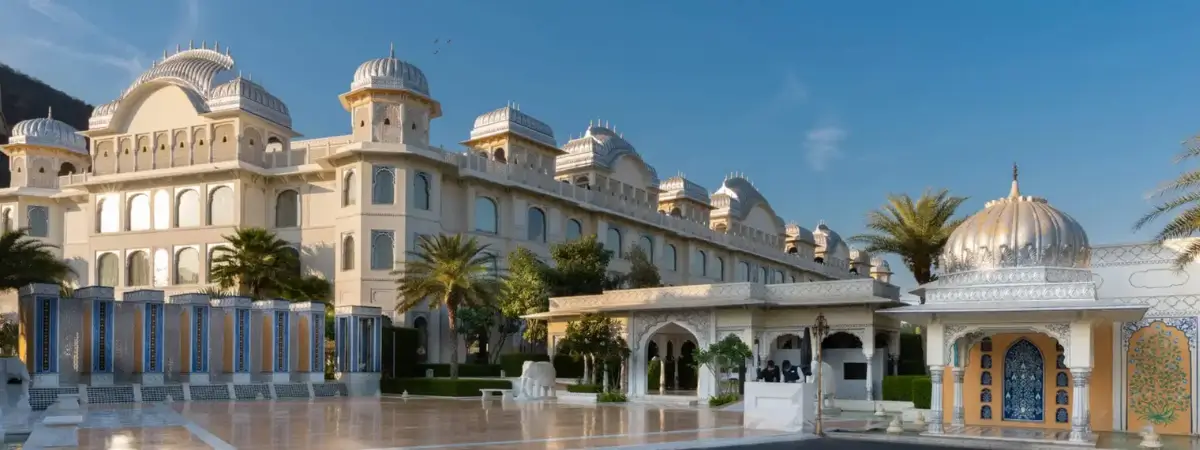
Royal Rajasthan is best understood from the inside of its palaces, and our Rajasthan Palace Hotels Luxury Tour is built around exactly that idea. Over fifteen unhurried days you sleep in former royal residences, courtyard havelis and hilltop forts that still belong to the families who built them, and you travel between them in a private car and driver arranged only for you. The route opens in Delhi, swings west to Jaipur and the red sandstone of Bikaner, crosses the Thar fringe to Jodhpur, then turns south into the green Aravalli hills of Udaipur and the quiet country seat of Deogarh. Days are paced for comfort: late starts after long drives, an afternoon free at every palace, and time to enjoy the pools, terraces and dining rooms you are paying for rather than rushing past them.
Each city brings a different side of princely life. In Jaipur you walk the mirrored halls of Amber and spend a day at the old Samode estate. Bikaner shows off the lacquered rooms of Junagarh Fort and the camel stables that once supplied the Ganga Risala regiment. Jodhpur offers Mehrangarh's armoury and a morning with Bishnoi villagers, while Udaipur adds the Crystal Gallery, sunset on Lake Pichola and the twelfth-century temples at Nagda. Deogarh closes the trip with rural lanes, miniature painting and a slow metre-gauge train through the hills. Local English-speaking guides join every major visit, and the luxury Rajasthan tour ends with a short flight from Udaipur back to Delhi for your connection home.
Tour Highlights
 Package Includes:
 Package Excludes:
Reply within 24hrs
A palace holiday deserves a calm start, so the first day is kept almost entirely for rest. Our representative meets you in the arrivals hall at Indira Gandhi International Airport holding a name board, helps with luggage and introduces you to the chauffeur who will stay with you for most of the trip. The drive into central Delhi takes forty-five minutes to an hour depending on traffic, and the car is stocked with chilled water. At the hotel, check-in is handled for you, and we hand over a printed folder with your day-by-day route, guide names and emergency numbers so nothing needs to be remembered after a long flight.
If your flight lands in the morning, a light lunch and an afternoon nap work wonders after a long-haul journey across several time zones. Later, if you feel like stretching your legs, ask the chauffeur to take you to Lodhi Garden, where fifteenth-century tombs of the Sayyid and Lodi rulers sit among lawns used by Delhi residents for their evening walks and yoga. Dinner could be at the hotel or at one of the restaurants around Khan Market, and your travel specialist will call to confirm timings for tomorrow's sightseeing. Expect a gentle 9:30 start, nothing earlier, because jet lag is real and the trip is long.
Overnight stay in Delhi.
Your guide collects you after breakfast for a full day of Delhi sightseeing, beginning in the old walled city of Shahjahanabad. The Red Fort is closed on Mondays, so on that day we view its Lahori Gate from outside and spend longer elsewhere. Climb the steps of the Jama Masjid, India's largest mosque, where the courtyard holds up to twenty-five thousand worshippers on festival days. Then switch to a cycle-rickshaw for a ride through Chandni Chowk, past the silver shops of Dariba Kalan and the wedding trimmings of Kinari Bazaar. A stop at Paranthe Wali Gali for stuffed parathas, or for hot jalebi, is optional but warmly recommended.
After lunch the car crosses into New Delhi along Kartavya Path, with views of India Gate and the Rashtrapati Bhavan on Raisina Hill, both designed during the British years by Edwin Lutyens and Herbert Baker. The afternoon belongs to Humayun's Tomb, the Mughal garden mausoleum that inspired the Taj Mahal, and to the neighbouring Sunder Nursery with its restored pavilions and lotus ponds. Close the day at Gurudwara Bangla Sahib, where visitors are welcome to see the community kitchen serve free meals to thousands every day. Back at the hotel, there is time to repack and rest before tomorrow's drive to Jaipur.
Overnight stay in Delhi.
After a relaxed breakfast, the chauffeur takes the highway south-west towards Rajasthan. The drive covers about 280 kilometres and usually takes five to six hours with a coffee stop at one of the highway plazas near Behror or Shahpura. The landscape changes slowly from Delhi's suburbs to mustard fields, camel carts and the first rocky ridges of the Aravalli hills. Your chauffeur speaks good English and is happy to explain the roadside villages, the colour of turbans worn by different communities, and the meaning of "Horn OK Please" painted on the back of almost every truck. Ask him to stop whenever a photograph tempts you.
You reach Jaipur by mid-afternoon and check into a former royal residence, the first of the palace stays that define this Rajasthan Palace Hotels Luxury Tour. The rest of the day is free. Many guests take tea on the lawn, swim, or simply wander the corridors looking at old portraits, hunting trophies and silver-inlaid doors. In the evening, the chauffeur can drive you past the lit facade of Hawa Mahal and the water palace of Jal Mahal for a first look at the city after dark. Dinner might be laal maas, the fiery mutton curry of the Rajput kitchens, or a gentler vegetarian thali at the hotel.
Overnight stay in Jaipur.
The morning starts at Amber Fort, eleven kilometres north of the old city, ideally before the coach groups arrive. Your guide leads you through the Ganesh Pol with its painted frescoes, into the Diwan-i-Aam with its double row of columns, and finally to the Sheesh Mahal, where tiny convex mirrors catch a single candle flame and multiply it across the ceiling. The Sukh Niwas next door shows an early cooling system in which water channels ran through the walls. On the way back, stop at Panna Meena ka Kund, a stepwell with crisscross stairways, and photograph Jal Mahal sitting in the middle of Man Sagar Lake.
After lunch the focus shifts to the old pink city. The Jaipur City Palace is still home to the royal family, and its Pritam Niwas Chowk has four painted doorways representing the seasons, the peacock gate being the best known. Next door, Jantar Mantar holds Sawai Jai Singh's giant stone instruments, including the Samrat Yantra sundial, accurate to about two seconds. End with a short walk along Johari Bazaar for gemstones, enamel jewellery and silver, with your guide on hand to point out trusted family shops. Return to your palace for a sundowner and dinner on the terrace, perhaps with live Rajasthani folk music.
Overnight stay in Jaipur.
Today trades the city for a country palace. The village of Samode sits forty-two kilometres north-west of Jaipur, about an hour away by road, below a ridge crowned by an old fort. Samode Palace was built by the Rawals of Samode, nobles of the Jaipur court, and its Durbar Hall is covered in painted floral panels and mirror work that rival anything in the city. Your guide explains how the family turned the residence into a hotel and points out the Sheesh Mahal and the hand-painted Sultan Mahal. Coffee or lunch in the courtyard, with pigeons circling the domes above, is a fine way to spend the late morning.
In the afternoon there is the option to walk through Samode village, where artisans make lac bangles and block-printed fabric in small home workshops, or to drive to the Samode Bagh garden with its old Mughal-style water channels and fountains. Return to Jaipur by late afternoon with time to rest. Guests who enjoy shopping can be dropped at Bapu Bazaar for embroidered leather mojari shoes and printed quilts, while others may prefer a quiet evening and a massage at the hotel spa. Your chauffeur will confirm a 9 am departure for tomorrow's longer drive north-west into the desert country around Bikaner.
Overnight stay in Jaipur.
The road to Bikaner heads north-west through Shekhawati, a region known for painted merchant havelis, and the drive covers about 335 kilometres in roughly six hours. If you would like to break the journey, a short detour to Fatehpur or Mandawa lets you see walls covered in frescoes of trains, gods and British soldiers, painted when Marwari trading families grew rich in Calcutta and Bombay. Lunch can be taken at a heritage hotel along the way. The land grows sandier as you approach Bikaner, and you will see the first khejri trees, wind-shaped dunes and camel herds grazing beside the road.
Bikaner was founded in 1488 by Rao Bika, a son of the Jodhpur ruler Rao Jodha, and the royal family later built one of the grandest red sandstone residences in India. Your palace stay here has wide verandas, billiard rooms and long corridors hung with photographs of shooting parties, polo teams and visiting viceroys. After check-in the evening is free to enjoy the gardens. Try the local snack bhujia, made from moth bean flour and sold in every sweet shop in town, and consider an early night after the long drive. Your guide for tomorrow will meet you in the lobby after breakfast.
Overnight stay in Bikaner.
After breakfast, your guide takes you to Junagarh Fort, one of the few major Rajasthan forts built on flat ground rather than a hilltop. Its interior is the real surprise. Anup Mahal is covered in red and gold lacquer work, Karan Mahal was built to mark a victory over the Mughals, and Phool Mahal is decorated with glass and painted flowers. The fort museum displays a First World War biplane, palanquins and a fine armoury. Later, walk through the old city lanes to see the carved facades of the Rampuria Havelis, built by a merchant family in deep pink sandstone with European touches.
In the afternoon, drive thirty kilometres south to Deshnok and the Karni Mata Temple, famous for the thousands of rats that live within its marble walls and are fed by priests as sacred beings. Shoes are removed at the entrance, so bring a pair of socks. On the return, stop at the camel research farm, which opens to visitors in the afternoon, to watch the herds come in for the evening and taste camel milk ice cream or coffee. Back at the hotel, ask for dinner to be served in the old banquet hall, where the royal family once hosted the Prince of Wales.
Overnight stay in Bikaner.
Leave Bikaner after breakfast for the drive south to Jodhpur, about 250 kilometres taking four and a half to five hours. The road crosses the edge of the Thar Desert, passing villages of round mud huts with thatched roofs and herds of goats sheltering under khejri trees. Your chauffeur can stop at Nagaur, known for its Ahhichatragarh Fort and its winter cattle fair, if you would like to stretch your legs and see the restored palace murals. Watch for the blue houses of Jodhpur's old quarter long before you reach the city, crowned by the cliff-top walls of Mehrangarh glowing in the afternoon light.
Check into your Jodhpur palace stay, where the afternoon is free to settle in. Jodhpur's palace hotels are known for their gardens and peacocks, and tea served on a lawn facing the fort is a pleasant way to recover from the drive. Towards sunset, the chauffeur can take you to the Clock Tower and Sardar Market, where spice sellers, textile merchants and tea stalls crowd around the old Ghanta Ghar. Taste a makhaniya lassi, thick and saffron-scented, at one of the well-known lassi shops nearby, and perhaps a mirchi bada, the local chilli fritter, before heading back for a quiet dinner.
Overnight stay in Jodhpur.
Begin early at Mehrangarh Fort, rising 125 metres above the city on a sheer rock outcrop. Your guide takes you up through its gates, including the Jai Pol and the Loha Pol with its handprints of royal widows. Inside, the museum is one of the best in India: Moti Mahal with its coloured glass windows, Phool Mahal with gold filigree ceilings, and the Daulat Khana galleries of howdahs, miniature paintings and weapons. Leave time for the view from the ramparts across the blue city below. Close by, Jaswant Thada is a white marble cenotaph built in 1899 for Maharaja Jaswant Singh II, beside a small lake.
After lunch, set off on a jeep drive into the Bishnoi villages south of Jodhpur. The Bishnoi community follows twenty-nine principles laid down in the fifteenth century, including protection of trees and wildlife, and you may see blackbuck and chinkara grazing close to the houses. Visit a potter's family in Kakani and the durrie weavers of Salawas, whose flat cotton rugs are sold across the world. A village elder may welcome you with tea and jaggery in a courtyard swept clean with cow dung. Return to Jodhpur by late afternoon for dinner and a final evening among the gardens and peacocks of your palace.
Overnight stay in Jodhpur.
The drive to Udaipur covers about 250 kilometres and climbs gradually into the Aravalli hills. Break the journey at Ranakpur, where the fifteenth-century Jain temple of Adinath stands in a forested valley. The temple is open to non-Jain visitors from noon until 5 pm, and leather items such as belts and wallets must be left outside. Inside, 1,444 carved marble pillars support a series of domes, and no two pillars are said to be alike. Your guide will explain the Jain beliefs behind the design and point out the carving of a many-headed serpent coiled across one ceiling panel. Lunch is at a garden restaurant near the temple.
Continue to Udaipur, arriving in the late afternoon. Udaipur, called the City of Lakes, was founded by Maharana Udai Singh II in 1559 after Chittorgarh came under repeated attack from the Mughal emperor Akbar. Your palace hotel here faces the water, and the evening is best spent on a balcony watching the lights come on across Lake Pichola and the City Palace. Dinner might be dal baati churma, the classic Rajasthani dish of baked wheat balls, lentils and sweet crumble, eaten slowly by candlelight. Your Udaipur guide will call ahead to confirm a 9:30 start for tomorrow's walking tour.
Overnight stay in Udaipur.
After breakfast, your guide meets you for a walking visit to the City Palace complex, the largest palace in Rajasthan, built over nearly four centuries by successive Maharanas. Highlights include the Mor Chowk courtyard with its glass mosaic peacocks, the Badi Mahal garden built on top of a natural hill, and the Zenana Mahal where the royal women lived. A separate ticket admits you to the Crystal Gallery inside Fateh Prakash Palace, which holds chairs, beds and even a fountain made of crystal, ordered from England in 1877 and left unpacked for over a hundred years after the ruler died.
The afternoon is free to rest at the hotel, and then, about an hour before sunset, board a boat for a ride on Lake Pichola. The boat passes the bathing ghats, the island palace of Jag Niwas and the domed pavilions of Jagmandir, where Prince Khurram, later Shah Jahan, is said to have sheltered as a young rebel. If you prefer, a private boat can be arranged for a quieter outing. Later in the evening, catch the Dharohar folk dance performance at Bagore ki Haveli, which features puppetry and a dancer balancing a tower of brass pots on her head.
Overnight stay in Udaipur.
This morning drive twenty-two kilometres north of Udaipur to Eklingji, the temple complex dedicated to the patron deity of the Mewar rulers, who considered themselves regents governing on behalf of Lord Shiva. The main temple has a four-faced image of Shiva in black marble, and photography is not allowed inside, so cameras stay with the chauffeur. A short drive brings you to Nagda, where the tenth-century Sas-Bahu temples stand beside a quiet lake. Their carved ceilings and pillars show dancers, musicians and scenes from Hindu mythology, and you will likely have them almost to yourself on a weekday morning, apart from a few village children and goats.
Return to Udaipur for lunch and a free afternoon at your palace hotel. Before sunset, the chauffeur drives you up to Sajjangarh, better known as the Monsoon Palace, on a hilltop five kilometres west of the city, built in 1884 to watch the rain clouds gather. From its terraces you see the whole of Udaipur laid out below, with the lakes turning gold as the light fades. On the way down, stop at Ahar to see the cenotaphs of the Mewar royal family, a cluster of more than two hundred white domes beside a small river.
Overnight stay in Udaipur.
Leave Udaipur after a leisurely breakfast and drive north for about three hours to Deogarh, a small town in the Aravalli hills that belonged to one of the sixteen senior noble families of Mewar. The road passes through farmland, marble quarries and small temple villages, and you can stop at Rajsamand Lake to see the carved marble pavilions on the embankment called Nauchowki, built in the seventeenth century as a famine relief project. Arrive at Deogarh in time for lunch on the palace terrace overlooking the town, its two lakes and the rolling green hills around it, with a cool drink waiting.
Deogarh is the quietest stop on the route, and many guests say it is their favourite. The palace dates from the seventeenth century, with later additions in the eighteenth, and the family still hosts guests in its frescoed rooms. In the afternoon, take a stroll through the lanes of the old town with a local guide, visiting a silversmith, a family of cloth dyers and the market where villagers come to trade grain, spices and bright cotton prints. Watch the sunset from the palace ramparts, followed by dinner of local dishes such as ker sangri, made from desert beans and berries, and kadhi.
Overnight stay in Deogarh.
Today is devoted to rural Mewar. After breakfast, set off on a jeep drive through the countryside around Deogarh, stopping at farming hamlets where women in bright odhnis draw water from wells and men tend wheat or mustard fields depending on the season. Visit the Anjaneshwar Mahadev cave temple carved into a hill, and look in at a village school if it is in session. Deogarh also had its own school of miniature painting in the eighteenth century, and your guide can show you examples of this Mewar style in the palace collection, with their hunting scenes and courtly gatherings.
In the afternoon, drive to the station at Kamlighat for a ride on the heritage metre-gauge line that winds through the Aravalli hills towards Goram Ghat, crossing old bridges and tunnels as langur monkeys watch from the rocks. Your chauffeur meets you at the other end and drives you back to Deogarh. Train timings depend on the railway schedule and may change, so the ride is confirmed a day ahead. The evening is your final palace dinner of the trip, perhaps served on the rooftop under the stars with a small bonfire in the cooler months.
Overnight stay in Deogarh.
After breakfast, say goodbye to the Deogarh palace staff and drive about three hours south to Maharana Pratap Airport at Udaipur, with the chauffeur timing the departure to suit your flight. The domestic flight to Delhi takes around one hour and fifteen minutes, and your ticket is included in this package. Our representative meets you at the Delhi domestic terminal and helps you move to the international terminal, or to an airport hotel if your onward flight leaves late at night. Luggage handling at both ends is taken care of by our team, so the last day stays as relaxed as the first.
If your international flight leaves after midnight, a day room near the airport can be arranged at extra cost so that you can shower and rest before the long flight home. Our travel specialist will check your flight details in advance and adjust the Deogarh departure time to leave a comfortable margin at both airports. Before you go, your chauffeur will ask for your honest feedback on the hotels, guides and pacing, which helps us keep refining this palace route for future guests. Thank you for travelling with Heritage India Private Tours, and we hope to welcome you back to Rajasthan again soon.
Hear what our happy guests say about their India adventures! From private drivers to guided tours, we make every journey smooth, safe & unforgettable.
 rating score: 5.0 of 5, based on 448 reviews

Complete our inquiry form

Customize your itinerary

Confirm when you're satisfied
1-to-1 Service | Reply within 24hrs | Expert's Advice