Chennai - Mahabalipuram - Pondicherry - Thanjavur - Madurai - Munnar - Kochi - Kumarakom - Alleppey - Marari Beach
Goddesses rule many of the great temples of the south, and women carry much of its everyday culture, from the rice-flour kolam drawn at dawn on every Tamil doorstep to the cooperatives of Kerala. Our South India Women Only Cultural Tour is built around meeting those women in person. Over twenty days you take a Bharatanatyam class in Chennai, learn to draw kolam with a Pondicherry grandmother, cook a Chettinad lunch with a home chef in Madurai, sit with tea pluckers in Munnar and spend an afternoon with a Kerala women's group making coir and banana-fibre crafts. The route runs from the Coromandel Coast through the Chola and Pandya heartlands, over the Western Ghats and down to the backwaters and beaches of Kerala, at a pace that leaves room for rest.
Safety and comfort shape every arrangement. Each traveller, or small group of friends, has a private car and driver chosen from chauffeurs who have worked with us for years and who are briefed specifically for women travellers. We request female guides in every city where good ones are available, choose hotels with a strong record for solo women guests, and keep a 24-hour helpline staffed by our own team. Evenings are relaxed rather than crowded with sightseeing. You also get a night on a private Alleppey houseboat, two nights in a lakeside Kumarakom resort with an Ayurvedic spa staffed by women therapists, and a quiet final night on Marari Beach. Dress-code guidance, saree draping and practical tips on temple etiquette come as part of the welcome briefing in Chennai.
Tour Highlights
 Package Includes:
 Package Excludes:
Reply within 24hrs
Whatever time your flight touches down at Chennai International Airport, a member of our team waits outside the arrivals exit holding a board with your name, and where possible that welcome is given by one of our women coordinators. Your chauffeur, carefully selected for this tour and introduced by name and photograph before you leave home, takes care of the luggage and drives you to the hotel, a trip of thirty to fifty minutes depending on traffic. The hotel has been chosen for its location, its security and its record with women guests, and the room is held from your arrival so that a night landing does not mean a long wait in the lobby.
Rest is the only task today. Once you are settled, the coordinator spends half an hour with you going through the route, the hotel and chauffeur contacts, and the 24-hour helpline number, which you should save on your phone. She also brings a cotton saree on loan for the Bharatanatyam class and temple visits, plus a light dupatta that is useful for covering shoulders, and shows you how to drape both. If you feel like a gentle walk later, the hotel can arrange a short car ride to Besant Nagar beach, where Chennai families stroll at sunset and stalls sell hot bajji and roasted corn.
Overnight stay in Chennai.
Begin the morning in Mylapore with your female guide, starting at the flower stalls outside the Kapaleeshwarar Temple, where women thread jasmine and kanakambaram into long garlands faster than the eye can follow. Your guide explains how women buy these strings to pin in their hair each morning, and helps you choose one. Inside the temple, notice the shrine to Karpagambal, the form of Parvati worshipped here, and the women lighting ghee lamps along the corridor. Then visit the Kalakshetra Foundation in Thiruvanmiyur, founded by the dancer Rukmini Devi Arundale, who revived Bharatanatyam for respectable public performance at a time when it was socially stigmatised.
Kalakshetra's shaded campus, with classrooms open to the trees, is closed on Sundays and during holidays, so the day is arranged around its timetable. After a simple lunch, a professional woman dancer gives you a ninety-minute private introduction to Bharatanatyam: the basic stance called araimandi, a few adavus or footwork patterns, and the hand gestures that tell a story without words. No previous dance training is needed. Later, stop at Nalli or one of the Pondy Bazaar silk shops if you wish to look at Kanchipuram sarees, with your guide on hand to explain weaves and fair prices. Dinner can be at the hotel.
Overnight stay in Chennai.
The drive south follows the East Coast Road, a pleasant run with the sea on one side. Your first stop, at Injambakkam, is the Cholamandal Artists' Village, a cooperative of painters and sculptors founded by artists from the Madras Art Movement, with a gallery showing modern South Indian work. Your guide introduces the women painters whose canvases hang here, and if one of the resident artists is in her studio, you may be invited in to talk about her work. Continue to DakshinaChitra to see the kitchen of a Chettinad house and the loom of a Kanchipuram weaver, where women weave and demonstrate palm-leaf basketry.
You arrive in Mahabalipuram by mid-afternoon and check in to a beachfront hotel with a pool and garden, a calm setting after the city. In the late afternoon, your guide walks you to the Shore Temple, framed by the waves, and tells the story of the Pallava queen Rangapataka, whose name survives in an inscription at a temple she endowed at Kanchipuram, a reminder that royal women here built and paid for monuments. Watch the fishing boats come in on the beach, where fisherwomen sort the catch and haggle with buyers. Dinner of seafood cooked to your taste is at the hotel or a restaurant your guide trusts.
Overnight stay in Mahabalipuram.
Spend the cooler morning hours at the monuments with your guide. At Arjuna's Penance, she asks you to look past the famous heroes to the small figures: a mother elephant guiding her calves, a woman carrying a pot, a female ascetic among the sages. The Varaha Cave and the Mahishasuramardini Mandapa follow, the latter showing the goddess Durga in battle with the buffalo demon, a fierce female image that sets the tone for the temples ahead. End the morning at the Five Rathas, where the smallest shrine, the Draupadi Ratha, is shaped like a thatched village hut and dedicated to Durga.
After lunch, stop at a family stone-carving studio on the edge of town. Stone carving here has long been a male craft, but some families now train their daughters at the Government College of Architecture and Sculpture in town, and your guide arranges a visit to a workshop where a woman sculptor works granite with hammer and chisel. You may try a few strokes yourself on a practice block. The rest of the afternoon is free to rest by the pool or walk along the beach. In the evening, a simple dinner of crab masala, prawn fry or vegetable kurma is easy to find along the main lanes.
Overnight stay in Mahabalipuram.
Continue south along the coast, past salt pans and casuarina groves, to Auroville, the international township founded on the vision of Mirra Alfassa, known to followers as the Mother. Women are among the founders, builders and craftspeople of Auroville, and your visit focuses on that side of the place. After the short film at the visitor centre and a walk to the viewpoint of the golden Matrimandir, visit a women-run unit making handmade paper, incense or naturally dyed textiles. These workshops employ women from surrounding Tamil villages and have given many of them steady income. Lunch is at one of Auroville's café kitchens, using vegetables from its own organic farms.
Drive on to Pondicherry, about 15 km away, and check in to a heritage hotel in the White Town, the quiet grid of streets beside the sea where colonial villas painted mustard and white face each other behind bougainvillea. In the late afternoon your guide walks you along the Promenade, closed to traffic in the evenings, past the statue of Gandhi and the old lighthouse. Visit the Sri Aurobindo Ashram, where flowers are arranged in intricate patterns on the samadhi each day, then end at a French bakery for coffee and an éclair. The neighbourhood feels safe and relaxed after dark, so short walks to dinner are easy.
Overnight stay in Pondicherry.
Rise early, as kolam is drawn before sunrise. In the Tamil Quarter, on the inland side of the old canal, your guide takes you to the home of a grandmother who has drawn a fresh kolam at her front door every morning for decades. She shows you how to hold the rice flour between thumb and forefinger, how to lay a grid of dots and how to loop lines around them without lifting your hand. Many designs carry meanings: protection for the house, welcome for guests, and food for the ants and birds. Breakfast is shared with her family, typically idli, coconut chutney and sambar, with filter coffee.
After a rest at the hotel, take a guided heritage walk through the Tamil Quarter, where the houses have verandas called thinnai with built-in benches for neighbours to sit and talk. Visit the Manakula Vinayagar Temple, where an elephant named Lakshmi once blessed visitors, and the Basilica of the Sacred Heart of Jesus with its stained-glass windows. In the afternoon, a visit to a women's tailoring cooperative or a block-printing studio in town gives you the chance to have a cotton kurta made to measure, ready the following morning. The evening is free for a quiet dinner of Creole-Tamil fish curry at a garden restaurant in White Town.
Overnight stay in Pondicherry.
The road leaves the coast and runs inland through the green paddies of the Kaveri delta, past villages where women dry chillies and grain on the roadside and herd goats along the verges. Stop at Chidambaram to visit the Nataraja Temple, sacred to Shiva in his form as cosmic dancer. For you, as a student of Bharatanatyam since Day 2, the eastern gopuram is the real interest: its inner faces show the 108 karanas, the dance poses described in the Natya Shastra, each carved on a separate panel with an inscription naming it. Your guide helps you match a few of them to the steps you learned.
Continue to Thanjavur, arriving in the mid-afternoon, and check in to a comfortable hotel with a garden. The city was the capital of the Cholas and later of the Maratha rulers, and it remains the centre of Carnatic music and of Bharatanatyam as it was codified by four brothers known as the Thanjavur Quartet. In the early evening, your driver takes you to the main temple to see the floodlit tower against the night sky, when families come to sit on the lawns. If there is a classical music recital at the Tamil University or the palace, we arrange tickets.
Overnight stay in Thanjavur.
In the morning, visit the Brihadeeswarar Temple with your guide, who concentrates on the Chola women connected with it. The inscriptions on the base record the names of the 400 dancers brought by Rajaraja Chola to serve the temple, together with the streets where they lived and the shares of land assigned to each. Rajaraja's elder sister Kundavai, an important patron of temples and hospitals, also appears. Inside, the Chola frescoes in the inner corridor show celestial dancers in graceful poses, and in the corner shrine to the goddess Periyanayaki, women offer flowers and light lamps. Before leaving, your guide shows you the small shrine where Chola queens are believed to have made offerings on festival days.
The afternoon is spent with the women who keep two Thanjavur crafts alive. At a workshop on the outskirts of town, women artisans make the famous bobble-headed Thanjavur dolls, called thalaiyatti bommai, from clay and papier-mâché, then paint them in bright colours. You can paint one to take home. Then visit a family studio where a woman artist works on a Thanjavur painting, applying gold foil and coloured glass to a gesso base on wood. Before dinner, walk through the Saraswathi Mahal Library to see palm-leaf manuscripts, including medical texts with recipes for herbal remedies used by women for generations.
Overnight stay in Thanjavur.
Today's route makes a slight detour through Chettinad, the dry region of merchant mansions between Thanjavur and Madurai. At Kanadukathan, your guide shows you round one of the grand homes built by the Nattukottai Chettiar trading families, with teak pillars from Burma, Italian marble floors and Japanese tiles. Women ran these houses while the men traded across South-East Asia for years at a time, managing staff, finances and the elaborate festival calendar. You also visit a handloom unit where women weave Kandangi cotton sarees in checks and bold borders, and a workshop making Athangudi tiles by hand, poured in layers on glass.
Lunch is at a Chettinad home or heritage hotel, served on a banana leaf with a run of dishes such as kozhi milagu varuval, pepper chicken, paniyaram and kavuni arisi, a sweet made of black rice. Continue to Madurai, arriving by late afternoon, and check in to your hotel. Madurai is one of the oldest continuously inhabited cities in India, and its streets are laid out in concentric squares around the great temple, named for the Tamil months in which festival processions follow them. After a rest, take a walk through the flower market near the temple, which runs into the night.
Overnight stay in Madurai.
Madurai belongs to its goddess. The Meenakshi Amman Temple is unusual in South India because Meenakshi, a warrior princess who married Shiva in the form of Sundareswarar, receives first worship ahead of her husband. Go with your guide in the morning, before the crowds, and walk through the Ashta Shakti Mandapam, a hall of eight goddesses at the entrance, to the Golden Lotus Tank, the thousand-pillar hall and the inner shrines. Cameras and phones are not permitted inside the temple and must be left in the lockers outside. Your guide tells the story of Meenakshi's conquest of the three worlds and her wedding, celebrated each April in the Chithirai festival.
At midday, a Madurai home chef welcomes you into her kitchen to cook a lunch of Madurai and Chettinad dishes: perhaps kara kuzhambu, a tangy tamarind curry, poriyal, rasam and kesari. She explains the use of spices such as kalpasi, the black stone flower lichen. In the afternoon, visit a Sungudi workshop, where women tie tiny knots into cotton before dyeing to make the dotted fabric typical of the city. Return to the temple at around nine in the evening to watch the palli arai ceremony, when Sundareswarar is carried in a silver palanquin to Meenakshi's chamber for the night with music and lamps.
Overnight stay in Madurai.
Leave Madurai after an early breakfast. The road crosses the flat cotton and grape country around Theni and Cumbum, where vineyards are trained on overhead pergolas, then begins the long climb into the Western Ghats via the Bodi Mettu pass, where the border between Tamil Nadu and Kerala lies among cardamom forests. The hairpin bends are taken slowly, and your driver stops at viewpoints so you can enjoy the change in the air as the plains drop away. Lunch is at a simple Kerala restaurant on the way, serving rice with fish curry or vegetable thoran and pappadam, and your driver knows which places keep clean washrooms for guests.
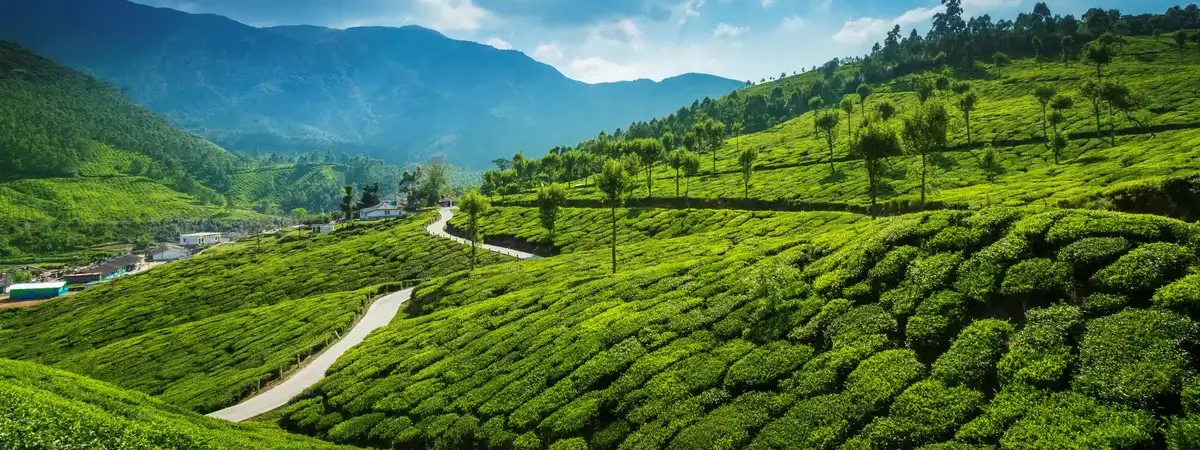
You arrive in Munnar, at about 1,600 metres, in the afternoon. The hillsides around town are covered with tea bushes clipped to waist height, with silver oak trees for shade. Your hotel is a resort or homestay just outside town, with views over the estates, chosen for its quiet setting and friendly staff. The evening is cool enough for a light jacket, so after tea on the veranda, take a gentle walk along the estate road before dinner, or just watch the mist roll up the valley. Munnar's restaurants close early, so dinner is usually at the resort.
Overnight stay in Munnar.
Morning is the best time to see the tea pluckers at work, and almost all of them are women, many from Tamil families brought to these hills by British estate owners more than a century ago. With your guide and an estate supervisor, walk the paths between the bushes and watch as the women snip the two leaves and a bud with shears, then fill the sacks on their backs. During their break, you can sit with a group of pluckers and talk through your guide about their working day, their children's schooling and the changes the estates have seen. Please ask before taking photographs; most are happy to pose, and a printed copy sent later is warmly received.
In the afternoon, visit the Kanan Devan Hills Tea Museum, closed on Mondays, to see how leaf becomes tea, from withering to rolling, fermenting and drying, with old machinery from the early factories on display. The tasting counter offers several grades side by side. Later, drive to a spice garden where a woman farmer shows you cardamom, pepper vines, cinnamon and nutmeg growing together, and explains how her family dries and sells them. In the late afternoon you can visit the Attukad waterfall viewpoint, or return to the resort and enjoy a massage, as the women therapists there are trained in Kerala methods.
Overnight stay in Munnar.
After breakfast, drive about 15 km to Eravikulam National Park, home to the endangered Nilgiri tahr, a wild mountain goat that grazes on the grassy slopes. The park is usually closed from February into early April during the calving season, so we confirm dates in advance. A forest department bus takes visitors up to the Rajamalai section, where a paved walkway climbs past rocky outcrops with views of Anamudi, the highest peak in South India. The tahr are used to people and often graze right next to the path. Every twelve years, the hills here turn blue when the Neelakurinji shrub flowers.
The rest of the day is unscheduled, so you can decide how to spend it. Some guests take a session at a women-run beauty and Ayurveda centre in town, while others prefer to read on the veranda with a pot of estate tea. If you would like to see more, your driver can take you to the Mattupetty Dam and Echo Point, where the reservoir is lined with eucalyptus, or to the Lakshmi estate viewpoint for sunset. In the evening, your hotel can arrange a Kerala dinner of appam with vegetable stew and Malabar parotta with egg curry.
Overnight stay in Munnar.
The descent to the coast is gentler than yesterday's climb. The road winds down through tea, then cardamom and rubber estates, past the Cheeyappara waterfalls, which are full after the monsoon, and into the flat green country around Kothamangalam, with its pineapple farms and church spires and roadside stalls hung with bunches of nendran bananas. Your driver stops at a roadside stall for fresh tender coconut water. By early afternoon you are in Kochi, a city spread across islands and peninsulas around a large natural harbour, and you check in to a heritage hotel in Fort Kochi, the quiet old quarter on the seafront.
In the late afternoon, walk with your guide along the beach promenade to the Chinese fishing nets, the large cantilevered nets lowered and raised by teams of fishermen. Watch the sunset over the Arabian Sea, then visit St Francis Church, the oldest European church in India, where Vasco da Gama was first buried. In the evening, go to the Kerala Kathakali Centre, where the make-up session starts about an hour before the show, then stay for a short Mohiniyattam performance, the slow, swaying classical dance of Kerala performed by women in white and gold. It makes a lovely counterpoint to the Bharatanatyam from Chennai.
Overnight stay in Kochi.
In Mattancherry, start at the Dutch Palace, closed on Fridays. It was built by the Portuguese for the Raja of Kochi and later renovated by the Dutch, and its bedchamber walls are covered with Kerala murals of scenes from the Ramayana. Your guide points out the scenes involving Sita and the women of Krishna's court. Walk on to the Paradesi Synagogue, closed on Fridays, Saturdays and Jewish holidays, with its floor of blue and white Chinese tiles and its Belgian glass chandeliers. In Jew Town, the antique shops and spice warehouses line a single narrow street, where ginger is still dried in courtyards and sorted by hand.
In the afternoon, visit a social enterprise in Fort Kochi where women, including women recovering from difficult circumstances, make quilts, bags and clothing from block-printed cotton. Some of their products are stocked in the shop on site. Before dinner, you have the option of a Kerala cooking class with a woman home cook in Fort Kochi, who teaches dishes such as meen pollichathu, fish wrapped in banana leaf, and avial, mixed vegetables in coconut and yoghurt. You eat what you cook on her veranda. Fort Kochi is a safe and pleasant place for a short evening walk afterwards.
Overnight stay in Kochi.
After a slow breakfast, drive south-east to Kumarakom on the shores of Vembanad Lake, the largest lake in Kerala. Your resort, set among coconut palms on the water, is designed for relaxation, with lakeside cottages, a pool and an Ayurvedic spa where all treatments for women are given by women therapists. Spend the afternoon resting: there is no sightseeing. At around four, a gentle Ayurvedic massage, such as abhyanga, a full-body oil massage, or shirodhara, a stream of warm oil poured over the forehead, eases the travel fatigue of the past two weeks. Your therapist asks about any health conditions beforehand and adjusts the oils to suit.
In the late afternoon, take a short walk along the canal paths with a resort naturalist to see kingfishers, egrets and cormorants at the Kumarakom Bird Sanctuary next door. The sanctuary is best visited early in the morning, so you can return the next day if you are keen. In the evening, the resort can arrange a Kerala sadya dinner, served on a banana leaf with more than a dozen dishes, including olan, erissery, pachadi and payasam. A small performance of Thiruvathirakali, a circle dance traditionally performed by Kerala women at festivals, may be arranged at the resort on request.
Overnight stay in Kumarakom.
The morning starts with a country-boat ride through narrow canals around the lake, where life is lived on the water: women washing clothes on stone steps, children rowing to school and ducks herded in flocks across the paddies. The boatman stops at a village where a Kudumbashree unit, part of the women's self-help network that operates in almost every village in Kerala, welcomes you to their workshop. The women demonstrate coir rope-making from coconut husk on a wooden wheel, and weave mats and baskets from screwpine and banana fibre. You can buy their products directly, and the income goes to the women.
Lunch is at a Kudumbashree restaurant, where a women's collective cooks karimeen, the pearl spot fish of the backwaters, fried with red masala, and kappa, cassava, with fish curry. The afternoon is free at the resort, perhaps for a second spa session, a swim or a nap in a hammock under the palms. If you prefer to stay active, you can take a walk to a toddy tapper's grove to see how sap is collected from the tops of coconut trees, or visit the local church. As the sun sets, sit by the lake with a cup of masala chai.
Overnight stay in Kumarakom.
After breakfast, transfer to the Alleppey jetty, or board directly from Kumarakom if your boat is moored there. Your private Alleppey houseboat is a kettuvallam, a traditional rice barge rebuilt with a bedroom, bathroom, sundeck and open-sided lounge. The crew of three includes a cook, and the boat is reserved for you or your group only. We choose operators with good safety records, life jackets and locking cabins. Cruise south across Vembanad Lake and into the Kuttanad backwaters, an area of paddies below sea level, protected by dykes, where villages stand on narrow strips of land between canals and women paddle canoes loaded with vegetables to their neighbours.
Lunch is cooked on board: rice, fish curry, thoran, and fresh fruit, with the cook happy to adjust spice levels. In the afternoon the boat stops at a village so you can walk along the bank and perhaps visit a small temple or church, then you moor in a quiet backwater before dusk, as houseboat movement stops after sunset. Dinner on deck may include prawns bought from local fishermen, and you fall asleep to the sounds of frogs and the occasional passing canoe. The boat has air conditioning in the bedroom at night, and your driver is reachable by phone at all times.
Overnight stay on the houseboat in Alleppey.
Wake early to watch the backwaters come to life: women washing pots at the edge of the canal, the first ferries and fishermen casting nets from canoes. Breakfast is served on board, perhaps puttu with banana or appam with egg curry, before the boat returns to the jetty around nine. Your driver meets you there for the short drive north to Marari Beach, a long, quiet stretch of sand in the fishing village of Mararikulam. Your beach resort, set in a coconut grove, has cottages a few steps from the sea, a pool and a spa. Women's beach shelters and loungers are set well apart, so you can read in peace.
The day is entirely yours, which is the point. Swim in the pool, as the sea can be rough, especially in the monsoon months, or walk along the beach to watch the fishermen haul in their nets. The resort offers yoga classes and Ayurvedic treatments, again with women therapists. In the late afternoon, you can cycle through the village lanes with a resort guide, past coir-making units and small temples. A farewell dinner at the resort brings the tour to a close, and your coordinator calls to check your departure time and to hear how the past three weeks have gone.
Overnight stay in Marari Beach.
Enjoy a last swim or a walk on the beach before breakfast. Depending on your flight time, your driver collects you from the resort for the transfer to Cochin International Airport at Nedumbassery, about two hours away. The airport has direct flights to the Gulf, Singapore and Kuala Lumpur, and domestic connections to Mumbai, Delhi, Bengaluru and Chennai for onward international flights. If you have a late flight, a day room can be arranged at the resort, or you can stop on the way for shopping at Lulu Mall in Edappally, one of the largest shopping centres in India, which has good bookshops and a spice and tea counter for last-minute gifts.
Your chauffeur, who has driven you since Munnar, accompanies you to the terminal entrance, and our helpline remains active until your flight departs. Over twenty days you will have met dancers, cooks, weavers, tea pluckers and village entrepreneurs, all women who have shared their skills and stories with you. You leave with a kolam pattern in your fingers, a few Bharatanatyam steps, recipes from Madurai and Kochi, and perhaps a tailored kurta and a Thanjavur doll in your suitcase. We hope to welcome you back for a women-only tour of Rajasthan or the Himalayas, and look forward to hearing from you. Safe travels.
Hear what our happy guests say about their India adventures! From private drivers to guided tours, we make every journey smooth, safe & unforgettable.
 rating score: 5.0 of 5, based on 448 reviews

Complete our inquiry form

Customize your itinerary

Confirm when you're satisfied
1-to-1 Service | Reply within 24hrs | Expert's Advice