Delhi - Jaipur - Mandawa - Bikaner - Jaisalmer - Jodhpur - Jawai - Udaipur - Ranthambore - Delhi
Twenty-five days is the length of time Rajasthan actually asks for if you want to see it properly, without the race from fort to fort that shorter trips demand. Our Rajasthan Grand Luxury Private Tour is built around two-, three- and four-night stays, so most mornings begin with a slow breakfast rather than a suitcase. You travel in a private car and driver arrangement with a senior English-speaking chauffeur who stays with you from Delhi to the tiger country of Ranthambore, and each city is opened up by a hand-picked local guide who knows the palaces from the inside. Accommodation is chosen from former royal residences, restored havelis, a luxury desert camp and a leopard lodge on the granite hills of Jawai, giving you the feel of a different Rajasthan in every region.
The route traces a wide loop across the state. After Delhi and the Pink City you head north into Shekhawati, where merchant families once covered entire mansions in fresco, then west through camel country at Bikaner to the honey-coloured fort of Jaisalmer and a night among the Thar dunes. Jodhpur brings Mehrangarh and the blue lanes below it, Jawai brings wild leopards living alongside Rabari herders, and Udaipur gives you boat rides on Lake Pichola and long evenings by the water. The tour closes with jeep safaris in Ranthambore National Park before a comfortable train ride back to Delhi. Magan Singh and our Jaipur team personally oversee every luxury Rajasthan tour, so changes to pace or routing are handled quietly along the way.
Tour Highlights
 Package Includes:
 Package Excludes:
Reply within 24hrs
Your first contact with the tour is a quiet one. As you walk out of the arrivals hall at Indira Gandhi International Airport, our representative will be waiting with a name board, a cold towel and bottled water, and will help with luggage and a local SIM card if you would like one. Your chauffeur, who will drive you for the whole of the coming three and a half weeks, brings the car right to the kerb. The drive into the city takes between forty minutes and an hour depending on the time of day, and your driver will point out the broad tree-lined avenues of Lutyens Delhi as you pass through towards your hotel in the centre of the capital.
Check-in will already be arranged, so there is no waiting at the front desk. If you land early in the day, a late afternoon walk in Lodhi Garden is the best way to stretch your legs after the flight. The park is shaded by old trees and holds the fifteenth-century tombs of the Sayyid and Lodi rulers, including the octagonal tomb of Mohammed Shah, and Delhi families come here to walk and jog in the cool of the evening. Our tour manager will meet you briefly in the lobby to go through the full route, confirm any dietary needs and hand over a printed itinerary with contact numbers. Dinner is at your leisure.
Overnight stay in Delhi.
Old Delhi is best seen early, before the lanes fill with handcarts and delivery scooters. Your guide meets you after breakfast and the car takes you to the Red Fort, where you can see the Lahore Gate and walk inside to the Diwan-i-Aam and the white marble Diwan-i-Khas (please note the Red Fort is closed on Mondays, so we arrange this day around that). From there a cycle rickshaw carries you into Chandni Chowk and through Kinari Bazaar, the lane of wedding trimmings and silver tinsel, before you climb the steps of Jama Masjid, the largest mosque in India, for a view across the old city rooftops. The walk ends among the sacks of chillies, turmeric and dried fruit in Khari Baoli, Asia's largest spice market.
After lunch at a quiet restaurant in Connaught Place, the afternoon moves to the Mughal gardens of the south. Humayun's Tomb, finished in the 1570s, was the first garden tomb on the subcontinent and set the pattern that later led to the Taj Mahal, so it is worth taking time over its red sandstone and the four-part charbagh garden. Next door is Sunder Nursery, a restored heritage park with lotus pools, sixteenth-century pavilions and a microhabitat garden of native plants. In the evening you could attend the sung prayers at the shrine of Hazrat Nizamuddin, held on Thursday evenings with qawwali singing in the courtyard.
Overnight stay in Delhi.
The third day in the capital looks further back in time. Your guide begins at the Qutub Minar, the seventy-three-metre fluted tower started in 1192, and the neighbouring Quwwat-ul-Islam mosque with its iron pillar that has stood for well over a millennium without rusting. Few visitors then walk into the Mehrauli Archaeological Park next door, which is a shame, because its scattered ruins include Jamali Kamali mosque, the tomb of Balban and the Rajon ki Baoli stepwell. Walking through it on a weekday morning, with parakeets in the trees and hardly another visitor in sight, gives a sense of how many cities were built on the site of modern Delhi before New Delhi itself.
After lunch, you visit the National Crafts Museum near Pragati Maidan, a calm complex of village houses, temple carvings and textile galleries that offers a useful introduction to the block prints, bandhani and miniature painting you will see across Rajasthan (the museum is closed on Mondays). Artisans from different states sit in the courtyard on rotation, and buying directly from them supports their work. Later, a drive past India Gate and the President's House along Kartavya Path shows the formal side of the capital laid out by Edwin Lutyens in the 1920s. The evening is free for dinner at one of Delhi's well-known Indian restaurants.
Overnight stay in Delhi.
After breakfast you leave Delhi on the expressway heading south-west towards Rajasthan. The drive takes five to six hours with a comfortable stop for coffee, and your chauffeur will time the departure to avoid the morning rush out of Gurugram. Once you cross into Rajasthan, the landscape changes quickly: mustard fields in winter, low rocky hills of the Aravalli range, and camel carts loaded with fodder on the service roads. Lunch can be taken on the way at a clean highway restaurant or saved for Jaipur. As you come into the city through the old walls, the buildings take on the terracotta pink wash that Maharaja Ram Singh II ordered in 1876 to welcome the Prince of Wales.
Your Jaipur base for the next four nights is a former palace or royal guest house with gardens and a pool, a good place to recover after the drive. Late in the afternoon, a short trip to Nahargarh Fort on the ridge above the city gives you the best sunset view over Jaipur, with the old city laid out below and the lights of Jal Mahal on Man Sagar Lake beyond. Inside the fort, the Madhavendra Bhawan has nine matching suites built for the king's queens, connected by corridors so he could visit each without being seen. Dinner tonight is at your hotel, where many palace properties hold a courtyard performance of Rajasthani folk music.
Overnight stay in Jaipur.
An early start brings you to Amber Fort, eleven kilometres north of the city, just as the gates open. Arriving first means you can see the Sheesh Mahal, with its ceiling of convex mirror work, and the Sukh Niwas with its channel of running water for cooling, before tour groups arrive. Your guide will also take you into the Zenana quarters at the back, where the courtyard of the queens is surrounded by apartments linked by narrow passages. Rather than walking up the ramp, you go up by jeep, as we do not include elephant rides on our tours. On the way back to the city, a stop at the Panna Meena ka Kund stepwell offers a fine photograph of its criss-cross stairs.
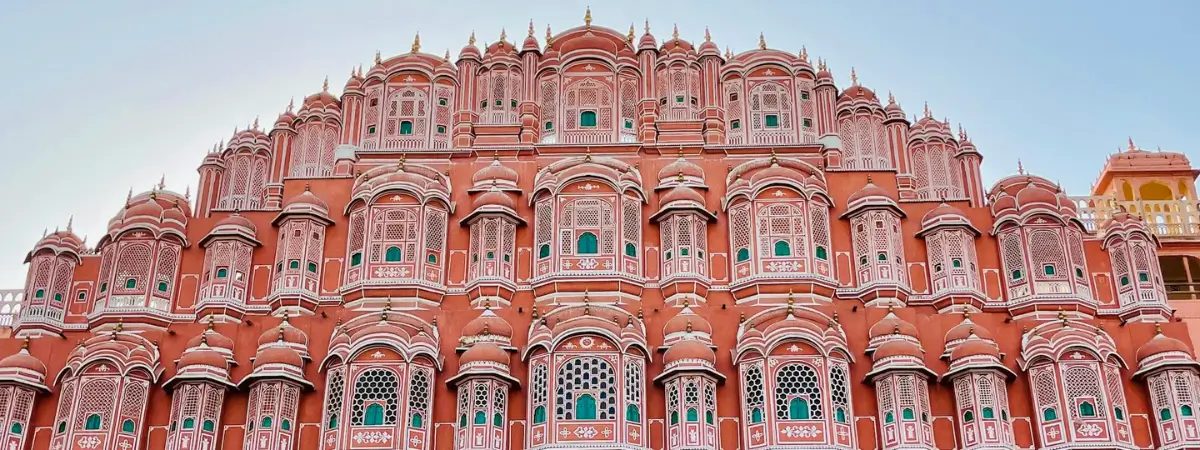
The afternoon is spent at the City Palace in the walled old city, still home to the Jaipur royal family. Your guide can arrange the optional private tour of the Chandra Mahal, which takes you into the royal apartments and the blue Chhavi Niwas, normally closed to general visitors (extra charges payable directly). Across the road is Jantar Mantar, the eighteenth-century observatory of Sawai Jai Singh II, where the giant sundial, the Samrat Yantra, still tells local time within two seconds. As the light softens, a walk past the five-storey façade of Hawa Mahal ends with a cup of chai at a rooftop café facing its 953 small windows.
Overnight stay in Jaipur.
Jaipur has been a city of craftsmen since it was founded in 1727, and today is devoted to them. In the morning your guide takes you to the Anokhi Museum of Hand Printing, housed in a restored haveli in Amber village, where you can watch a block carver and a printer at work and try a print yourself (the museum is closed on Mondays). From there you drive to Bagru, a village of the Chhipa printing community, where cotton is still printed with natural dyes made from indigo, pomegranate rind and iron rust. Lengths of freshly printed fabric dry in the sun along the riverbed, and families are happy to show their courtyards and wooden block collections.
After lunch, you visit a family-run workshop in Sanganer known for its handmade paper and fine block printing, then return to the old city for the jewellery lanes of Johari Bazaar, where Jaipur's gem cutters handle emeralds, garnets and tanzanite. If you would like to commission something, a reputable jeweller recommended by our team can complete pieces before you leave Rajasthan. In the evening, a private dinner can be arranged on a palace terrace or at a heritage haveli inside the walled city, where the kitchen will prepare Rajasthani dishes such as laal maas, ker sangri and bajra roti. Your guide will explain each dish and its origins in desert cooking.
Overnight stay in Jaipur.
Halfway through a long tour, a slower day makes a real difference, so this morning is entirely free. You might spend it at the hotel spa or by the pool, or take a cookery lesson with a local family who will show you how to temper spices and roll out chapatis. Many guests also enjoy a round of golf at the Rambagh Golf Club or a visit to the polo grounds during the winter season, when matches are played on weekends. Your driver remains on call throughout, so if you would like to see something not on the itinerary, a quick message is all it takes to arrange.
In the late afternoon, the car takes you to Galta Ji, a group of temples built into a narrow gorge on the eastern edge of the city, where natural springs feed a series of sacred tanks. The site is home to a large troop of rhesus macaques, and the walk up to the Surya Mandir on the ridge above rewards you with a view back over Jaipur at sunset. On the way back you stop at the Albert Hall Museum, whose Indo-Saracenic building is lit up beautifully after dark; the collection includes an Egyptian mummy, Persian carpets and old arms and armour. A final dinner in Jaipur closes your stay in the Pink City.
Overnight stay in Jaipur.
This morning you leave the Pink City behind and drive north into Shekhawati, a semi-desert region that grew wealthy in the eighteenth and nineteenth centuries on the caravan trade. The road passes through Chomu and Sikar, with fields of millet and groundnut on either side and village wells with stone ramps for bullocks. In about four hours you reach Mandawa, a small town of painted mansions built by Marwari merchant families such as the Goenkas, Chokhanis and Newatias, who later moved to Kolkata and Mumbai and became some of India's great industrialists. Many of the houses they left behind are covered inside and out with murals of gods, trains, horses and European visitors.
Your stay here is in a restored fort or haveli hotel in the heart of town, with painted walls and thick stone rooms that stay cool through the afternoon. After lunch, a local guide walks you through the lanes to the Binsidhar Newatia Haveli, where the frescoes include a Wright brothers aeroplane and a man on a telephone, then the double haveli of the Chokhani family, built as twin homes for two brothers. In the evening you can watch the sun go down from the roof of the fort, with peacocks calling from the surrounding fields. A quiet dinner follows in the courtyard of your hotel.
Overnight stay in Mandawa.
Shekhawati's painted towns are close together, and today your chauffeur drives you to two of the finest. The first is Nawalgarh, twenty-five kilometres south of Mandawa, where the Dr. Ramnath A. Podar Haveli Museum has been carefully restored with its murals in full colour. The rooms inside hold displays of Rajasthani wedding costumes, musical instruments and miniature models of the state's forts. Your guide then leads a short walk to the Morarka Haveli, whose painted ceilings are some of the best preserved in the region, and to the stepwells and chhatris that wealthy families built for the town as public works.
In the afternoon you drive to Fatehpur, where the French artist Nadine Le Prince bought and restored a haveli in 1999; today it serves as a cultural centre and gallery, and its courtyard frescoes have been cleaned to show their original pigments. The streets around it contain many other mansions in various states of repair, and seeing them side by side shows how much has been lost and how much is still being saved. Your guide can explain the shift in painting styles, from scenes of Krishna and Rama to Victorian ladies and steam engines after the British arrived. Return to Mandawa for a relaxed evening and dinner.
Overnight stay in Mandawa.
After breakfast you continue west towards Bikaner, and the land grows drier with every kilometre. Khejri trees become more common, and you will start to see camels used as working animals, pulling carts with tyres on the roads. The drive takes about four hours through Fatehpur and Ratangarh. Bikaner was founded in 1488 by Rao Bika, a son of the founder of Jodhpur, and it became rich on its position along the old caravan routes from Central Asia. Your hotel is a palace built for the Bikaner royal family in the early twentieth century, with red sandstone carvings, wide verandahs and a garden where peacocks wander freely.
After a late lunch, the afternoon is reserved for the National Research Centre on Camel, eight kilometres outside the city. The centre breeds camels of different Indian breeds and opens to visitors in the afternoon, when the herds return from grazing. You can walk among the pens, see newborn calves, and taste camel milk ice cream, coffee and lassi at the parlour. The small museum explains why camels have long been so important to life in the Thar. On the drive back, your chauffeur can stop at one of the famous bhujia shops on Station Road, where the crispy gram-flour snack has been made since the 1870s.
Overnight stay in Bikaner.
Junagarh Fort is unusual among Rajasthan's great forts because it sits on flat ground rather than a hilltop, and it was never captured by force. Your guide brings you here in the morning to see its series of palaces built over four centuries. The Anup Mahal is covered in red and gold lacquer work, the Phool Mahal has mirror and glass inlay, and the Badal Mahal is painted with blue clouds and falling rain, a fantasy for a desert king. The museum section holds a First World War biplane gifted to Maharaja Ganga Singh, along with palanquins and royal howdahs. Afterwards, a short walk in the old city brings you to the Rampuria Havelis, with their red stone façades and fine latticework.
After lunch, the car takes you thirty kilometres south to Deshnok and the Karni Mata Temple, known for the thousands of rats that live within its walls and are fed milk and grain by devotees. The marble gates and silver doors are fine examples of local craftsmanship, and seeing a rare white rat is considered a good omen. Shoes must be removed, so socks are recommended. Returning to Bikaner, stop at the Bhandasar Jain Temple, built in the fifteenth century; legend says forty thousand kilograms of ghee went into its mortar instead of water. Dinner is at your palace hotel.
Overnight stay in Bikaner.
Today is the longest drive of the tour, and the reward is arrival in the golden town of Jaisalmer. You leave Bikaner after an early breakfast, heading south-west across the Thar Desert through Kolayat and Pokaran. The road is good and lightly travelled, and the view is of open scrubland, sand dunes, small villages of round mud huts and herds of goats and camels under the care of shepherds. Your chauffeur knows the stretch well and will stop at a roadside dhaba for tea or at Pokaran for a look at its sandstone fort. Lunch boxes can also be packed by your Bikaner hotel if you would rather not stop for long.
You arrive in Jaisalmer in the afternoon and check in to your hotel, a luxury property built in the local yellow sandstone with views of the fort. In the evening, Gadisar Lake is a calm spot to watch the light fade. The lake was dug in the fourteenth century to supply the town with water, and its banks are lined with small shrines and chhatris. The carved gateway, Tilon ki Pol, is said to have been built by a courtesan, and the king nearly had it torn down until she added a temple to the top. Return to your hotel for a relaxed dinner on the terrace.
Overnight stay in Jaisalmer.
Jaisalmer Fort, known as Sonar Quila, is one of the few living forts left in the world, with about a quarter of the town's people still living within its walls. Your guide meets you early so that you can reach the ramparts as the sun turns the stone gold. You enter through four great gates, including Suraj Pol, and pass the Raj Mahal palace before reaching the group of seven Jain temples carved between the twelfth and sixteenth centuries. The temples open to visitors in the morning, usually until about noon, and their yellow stone carving is as fine as any in western India. Leather items such as belts and wallets must be left outside.
In the afternoon you walk through the lanes below the fort to the merchant mansions that made Jaisalmer famous. Patwon ki Haveli is actually a cluster of five houses built by a family of brocade traders, and one of them now holds a museum of household objects. Salim Singh ki Haveli, built by a powerful prime minister, has a peacock-shaped roofline, while Nathmal ki Haveli was carved by two brothers who each worked on one side, which is why the halves are not quite identical. Before dinner, the cenotaphs of the royal family at Bada Bagh are worth seeing as the sun sets behind them.
Overnight stay in Jaisalmer.
This morning is free to rest, shop for embroidered textiles or visit the Desert Culture Centre near Gadisar Lake, which runs a puppet show in the evening and a collection of local instruments and household items. After lunch, you drive out of the city to Kuldhara, a village abandoned overnight by its Paliwal Brahmin community about two hundred years ago. The houses and temple still stand, roofless, along straight lanes, and local stories about why the people left vary from a greedy minister to a curse on anyone who tries to settle there again. Your guide will share the history as you walk among the ruins.
From Kuldhara you continue to the Sam dunes, forty kilometres west of Jaisalmer, where a camel ride takes you into the sand to watch the sunset away from the busier areas. As the light goes, you move to your luxury tented camp, where each tent has a proper bed, bathroom and private sitting area. Dinner is served under the stars, with Manganiyar musicians singing old desert ballads around a bonfire and Kalbelia dancers performing. Your camp can arrange a telescope for a look at the night sky, which is remarkably clear out here. Your chauffeur will be ready for an early return in the morning.
Overnight stay in Jaisalmer.
Wake early for sunrise over the dunes, a quiet time when you may see desert foxes or gazelles. After breakfast you return to Jaisalmer and set out on the road to Jodhpur. The drive takes about five hours through Pokaran and Shergarh, and the landscape slowly becomes greener as you approach the Marwar region. Your chauffeur can stop at a Bishnoi village near Jodhpur, if you wish, where the community's long tradition of protecting trees and wildlife has helped blackbuck antelopes survive. The Bishnois follow twenty-nine rules set down by Guru Jambheshwar in the fifteenth century, and their beliefs have made them some of India's earliest conservationists.
Arrival in Jodhpur is late afternoon, and your hotel for the next three nights is a heritage palace with views of Mehrangarh Fort. Jodhpur was founded in 1459 by Rao Jodha, and its old city spreads out below the fort in a mass of blue-painted houses. Some say the colour began with Brahmin homes, others that it keeps the houses cool or deters insects. After settling in, you can take a short walk in the evening around Ghanta Ghar, the clock tower, and the Sardar Market, where spice, fruit and textile stalls stay busy until late. Try the famous makhaniya lassi before heading back for dinner.
Overnight stay in Jodhpur.
Mehrangarh rises 122 metres above Jodhpur on a sheer rock, and the climb to its gates is quite something. Your guide begins the morning at the lower gates; you can walk up or take the lift that the fort trust installed for visitors. Along the way, you pass the Lohapol, marked with the handprints of royal widows who committed sati, a sobering reminder of the past. Inside, the museum is one of the best-run in India, with galleries of palanquins, howdahs, turbans and weapons. The Phool Mahal, Sheesh Mahal and Moti Mahal show the luxury of the royal court, and the view from the ramparts over the blue city is wonderful.
After lunch, a short drive brings you to Jaswant Thada, the white marble memorial built in 1899 for Maharaja Jaswant Singh II. The marble is so thin in places that it glows in the afternoon sun, and the small lake and terraced gardens around it are quiet and calm. Next door, the Rao Jodha Desert Rock Park has restored the native plants of the rocky hill below the fort, and a naturalist-led walk here is an easy and rewarding way to see birds and lizards. The evening is free for dinner at a rooftop restaurant facing the illuminated fort.
Overnight stay in Jodhpur.
The morning begins at Umaid Bhawan Palace, one of the last great royal palaces built in India, completed in 1943. Part of it remains home to the Jodhpur royal family, another part is a hotel, and a third houses a museum with clocks, vintage cars and art deco furniture. Your guide will tell you about how the palace was built as a famine relief project, employing thousands of local workers for more than a decade. Next, you visit Mandore Gardens, the old capital of Marwar before Jodhpur, where red sandstone cenotaphs of earlier rulers stand among trees full of langur monkeys.
In the afternoon, a walking tour takes you through the old city's Navchokiya neighbourhood, where blue-washed lanes are lined with carved doorways and small temples. You end at Toorji ka Jhalra, an eighteenth-century stepwell built by a queen and restored a few years ago; it is now a favourite spot for locals to sit in the evening. The cafés around it serve good coffee and snacks such as mirchi vada and kachori. Your guide can also take you to a textile workshop where you can watch tie-dye and bandhani work in progress. Dinner tonight can be arranged on the fort's own terrace if you would like a private meal.
Overnight stay in Jodhpur.
After a leisurely breakfast you drive south from Jodhpur for about three hours towards Jawai, a region of granite hills, small farming villages and a large reservoir. Along the way, if you are interested, your chauffeur can stop at Salawas, a village known for its flat-woven cotton dhurries, where weavers work on simple pit looms in their courtyards. As you get closer to Jawai, the landscape changes dramatically, with huge round boulders rising out of fields of wheat and mustard. This is leopard country, but it is not a national park; the leopards live freely among the villages and herds of the Rabari herders, who have lived alongside them for generations.
Your lodge here is a luxury tented camp or stone cottage property set among the rocks, designed for comfort and privacy. After lunch and a rest, you head out on your first jeep safari in the late afternoon with a seasoned naturalist. Leopards are most active at dawn and dusk, and they are often seen lying on the boulders or walking along the rocky ledges. The guides here know individual animals and their territories well. You may also see striped hyenas, jackals, nilgai and a wide range of birds. Back at the lodge, dinner is served by a campfire under a clear desert sky.
Overnight stay in Jawai.
Leopard sightings depend on early starts, so a hot drink is waiting for you before dawn as you set out on the morning jeep safari. The air is crisp, and the light on the granite is soft and golden. Your naturalist will drive slowly between hills such as Perwa and Bera, scanning the caves and ledges where leopards rest. Even when the cats remain out of sight, the morning has plenty to offer: Rabari herders in red turbans moving their goats to graze, langurs calling from temple steps, and vultures circling on the morning thermals. Return to the lodge for a late breakfast and a rest through the warm hours of midday.
In the afternoon, a visit to Jawai Bandh, the largest dam in western Rajasthan, gives a different perspective on the region. The reservoir attracts thousands of migratory birds in winter, including bar-headed geese, ruddy shelducks and flamingos, and mugger crocodiles can often be seen basking on its banks. You might also call at a Rabari family home, where the women wear heavy silver jewellery and the men are known for their long white turbans and red shawls. Your evening safari follows, giving you a second chance to find leopards in the fading light. Dinner is served on the lodge's open terrace.
Overnight stay in Jawai.
After breakfast you leave the granite hills of Jawai and head south-west into the Aravalli range. Midway, at Ranakpur, you reach one of the most remarkable Jain temples in India, the Chaumukha Temple, built in the fifteenth century from pale marble. It contains 1,444 carved pillars, and no two are said to be alike; light falls between them from openings in the roof, changing throughout the day. Non-Jain visitors may enter from noon until about 5 pm, so the drive is timed to arrive just after midday. Leather items, food and cameras on phones are subject to temple rules, which your guide will explain on arrival.
After lunch at a quiet resort near the temple, the drive continues for about two hours through forested hills and villages before descending into Udaipur. The city was founded in 1559 by Maharana Udai Singh II after Chittorgarh fell to the Mughals, and it is built around a series of artificial lakes. Your hotel for the next three nights is a lakeside palace property, with rooms facing the water and the City Palace. Evening is free to relax, and you might like to take dinner on the hotel terrace as the lights of the palaces and ghats reflect in Lake Pichola.
Overnight stay in Udaipur.
Udaipur's City Palace stretches for nearly a kilometre along the eastern bank of Lake Pichola, and your guide brings you here in the morning while the courtyards are still cool. Built over four hundred years by successive Maharanas, it is a series of palaces joined together. Highlights include Mor Chowk, with its three peacocks made of glass mosaic, the Badi Mahal garden on a natural hilltop, and the Zenana Mahal with its collections of royal paintings. The silver gallery and the crystal gallery, the latter with furniture ordered from Birmingham in 1877, are worth the extra entry fee for anyone interested in royal craftsmanship.
After lunch, you walk to Jagdish Temple, a seventeenth-century temple to Vishnu with a striking carved exterior, and then through the lanes around Hathi Pol, where you can watch miniature painters at work on fine paper. In the late afternoon, a private boat takes you out on Lake Pichola, passing the Lake Palace and stopping at Jag Mandir island, where Prince Khurram, later Shah Jahan, once took refuge. The sun setting behind the hills while the City Palace glows across the water is one of the most beautiful scenes in Rajasthan. After the boat ride, enjoy the evening at leisure.
Overnight stay in Udaipur.
Your last full day in Udaipur is kept light. In the morning, you visit Saheliyon ki Bari, the Garden of the Maidens, laid out in the eighteenth century for royal ladies, with marble elephants, lotus pools and fountains fed by gravity from Fateh Sagar Lake. Next, the Vintage and Classic Car Collection of the Mewar royal family includes Rolls-Royces and a Cadillac once used by Queen Elizabeth II during her visit. If you enjoy cooking, an optional private class with a local family can show you how to make Mewari dishes such as dal baati churma and gatte ki sabzi.
In the afternoon there is time for the spa or simply sitting by the lake. Towards sunset, your chauffeur drives you up the winding road to Sajjangarh, the Monsoon Palace, built in 1884 on a hilltop overlooking the city. On clear evenings, you can see the lakes, the Aravalli hills and the city spread out below. Afterwards, you can attend the Dharohar folk dance show at Bagore ki Haveli on Gangaur Ghat, which begins around 7 pm and features puppetry, the Bhavai pot dance and other Rajasthani traditions. A farewell dinner by the water rounds off your stay in Udaipur.
Overnight stay in Udaipur.
Today's drive is long, so it is divided by a visit to Chittorgarh, the largest fort in India and once the capital of Mewar. You leave Udaipur after an early breakfast and reach Chittorgarh in about two hours. The fort covers almost 700 acres on a plateau, and your guide will show you the Vijay Stambh, a nine-storey tower of victory built in the fifteenth century, the earlier Kirti Stambh dedicated to a Jain saint, and the ruins of Rana Kumbha Palace. The story of Rani Padmini and the three sieges of Chittorgarh are deeply important in Rajput history, and your guide will tell them at the places where they took place.
After lunch near the fort, the drive continues north-east through Bundi district to Sawai Madhopur, the town at the edge of Ranthambore National Park. Your chauffeur will make tea stops on the way, and you should arrive by early evening. Your lodge is a luxury jungle property with spacious cottages or tents, gardens and a pool, set close to the park entrance. After check-in, the evening is for rest; a naturalist will brief you on tomorrow's safaris, the different park zones, and what animals are being seen at the moment. Dinner is served in the lodge's open-air dining area.
Overnight stay in Ranthambore.
An early wake-up call brings you to the park gate for the morning jeep safari, usually from about 6:30 to 10 am depending on the season. Ranthambore covers forests of dhok trees, lakes and old ruins, and its tigers are often seen walking along the tracks or resting near water. The private six-seat gypsy jeep, with a naturalist and a park-appointed guide, is the best way to see the park. Besides tigers, you may see sambar and spotted deer, wild boar, marsh crocodiles in Padam Talao, sloth bears and a remarkable variety of birds, from crested serpent eagles to painted storks. Please note that zones are assigned by the forest department and cannot be chosen.
Return to the lodge for a late breakfast and a rest. Between safaris, if you are interested, your guide can take you up to the tenth-century Ranthambore Fort inside the park, where the Trinetra Ganesh temple receives wedding invitations by post from across India. You can also visit Dastkar, a crafts centre near the park that supports local women's embroidery and block printing. The afternoon safari runs from about 2:30 pm until sunset, giving you another chance to see tigers in the soft evening light. A farewell dinner at the lodge marks the end of your grand tour of Rajasthan.
Overnight stay in Ranthambore.
After breakfast, your chauffeur will take you to Sawai Madhopur railway station for an express train to Delhi. The journey takes about five to six hours in an air-conditioned chair or sleeper class, and it is a comfortable way to cover the distance after a long road tour, and it avoids the busy highway traffic around Jaipur. Our team will help you with your luggage on board and confirm your seats before the train leaves. This is also the moment to say goodbye to the chauffeur who has driven you for over three weeks, and many guests find it a surprisingly emotional parting after so many miles together.
On arrival at Hazrat Nizamuddin or New Delhi station, our Delhi representative will meet you on the platform and transfer you to the airport for your international departure. If your flight is late at night, a day room at a hotel near the airport can be arranged so you can shower and rest before checking in. Throughout the transfer, our Jaipur office remains in contact to make sure everything goes smoothly. We hope that your weeks in Rajasthan have given you a deep sense of its history and people, and that you will come back to see more of India with us.
Hear what our happy guests say about their India adventures! From private drivers to guided tours, we make every journey smooth, safe & unforgettable.
 rating score: 5.0 of 5, based on 448 reviews

Complete our inquiry form

Customize your itinerary

Confirm when you're satisfied
1-to-1 Service | Reply within 24hrs | Expert's Advice