Delhi - Jaipur - Pushkar - Jodhpur - Jaisalmer - Jodhpur - Udaipur - Bundi - Delhi
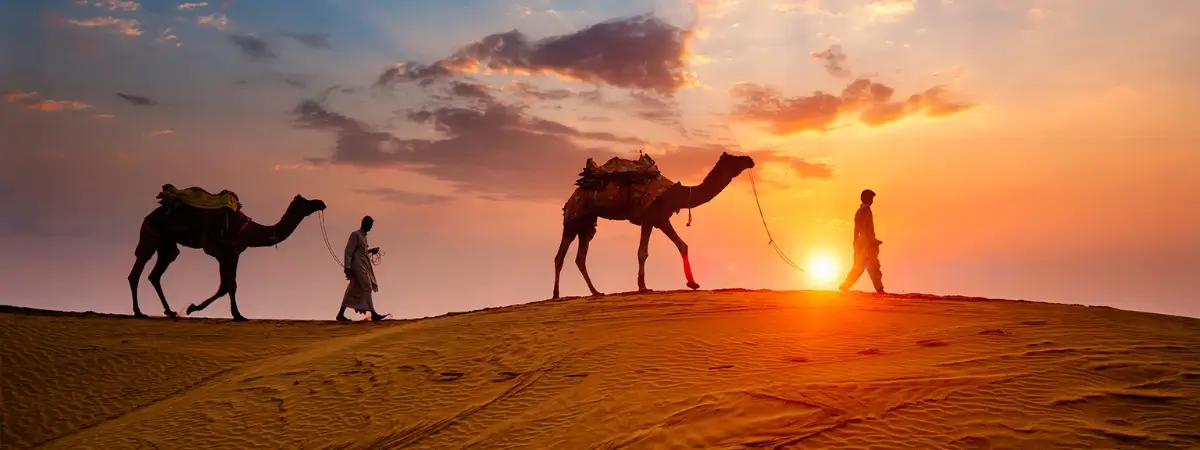
Travelling alone through Rajasthan rewards anyone who enjoys setting their own rhythm, and this Rajasthan private tour for solo travelers is built around exactly that freedom. Over twenty-four days you move from Delhi to Jaipur, Pushkar, Jodhpur, Jaisalmer, Udaipur and finally the quiet stepwell town of Bundi, always with a private car and driver and the same English-speaking chauffeur. Having one familiar face beside you for more than three weeks matters when you are on your own: he knows how you take your coffee by Day 3, waits outside markets while you browse, and handles parking, porters and fuel stops. Hotels are chosen for safe central locations, helpful front desks and comfortable single rooms, so arriving late or eating dinner alone never feels awkward.
The pace leaves real breathing space. Instead of racing through a fort every morning, the itinerary mixes guided sightseeing with unhurried days for a Jaipur cooking class, a sunrise climb above Pushkar Lake, a zipline over the ramparts of Mehrangarh and a night under canvas in the Thar dunes near Khuri. Solo guests often say the hardest part of independent travel in India is the logistics, so we handle SIM cards, train tickets, guides and restaurant bookings while you keep full control over how you spend each afternoon. Women travelling alone are especially well looked after, with female guides arranged in Jaipur and Udaipur on request. The tour ends with a fast AC train from Kota back to Delhi, in good time for evening international flights.
Tour Highlights
 Package Includes:
 Package Excludes:
Reply within 24hrs
Your solo trip begins the moment you clear immigration at Indira Gandhi International Airport, where our representative waits in the arrivals hall with a placard bearing your name. Arriving alone in a city of more than thirty million people can feel daunting after a long-haul flight, so the first hour is kept simple. You are walked to the car, introduced to the chauffeur who will stay with you all the way to Bundi, and handed a welcome folder with emergency numbers, a local SIM card if you requested one, and a short note on tipping and drinking water. The drive to your hotel in central Delhi takes forty-five minutes to an hour, depending on traffic.
Check-in is pre-arranged, so there is no queue at the desk, and your room is ready on arrival wherever hotel policy allows. If you land in daylight and feel restless, Khan Market sits a short drive away and offers bookshops, cafés and a safe, well-lit place to stretch your legs and change money. Many solo guests prefer to sleep off the jet lag, which is completely fine, because tomorrow starts at a relaxed hour. Your tour coordinator calls in the evening to confirm timings, answer questions about dress codes for mosques and temples, and run through the coming three weeks in plain terms.
Overnight stay in Delhi.
After breakfast your local guide meets you at the hotel, and the car drops you both at Jama Masjid, India's largest mosque, built by Shah Jahan in the 1650s. Climb the southern minaret if your knees allow, for a view over the rooftops of Shahjahanabad, then step out into the lanes for a cycle-rickshaw ride along Chandni Chowk. Solo travellers tend to enjoy Old Delhi far more with a guide than without, because the crowds start to make sense once someone explains them. You pass the spice sacks of Khari Baoli, Asia's largest wholesale spice market, and pause at Gurudwara Sis Ganj Sahib, where volunteers serve free langar to anyone who sits down.
Lunch is a tasting stroll through Paranthe Wali Gali, where stuffed breads come fried in ghee with pickles and potato curry, followed by a glass of thick lassi or a plate of jalebi from Old Famous Jalebi Wala at the corner of Dariba Kalan. In the afternoon you visit the Red Fort, walking from Lahori Gate through the covered Chhatta Chowk arcade to the Diwan-i-Aam and the marble Diwan-i-Khas. The fort is closed on Mondays, so if your Day 2 falls on a Monday we simply swap today with tomorrow's programme. You return to the hotel by late afternoon, with time to rest before dinner.
Overnight stay in Delhi.
Today shows the calmer, greener side of the capital. Start at Qutub Minar, the 73-metre fluted sandstone tower begun in 1199, and look closely at the Iron Pillar in the courtyard, which has stood for some sixteen centuries without serious rust. Your guide then rides the Delhi Metro with you for a few stops, a useful lesson in how the city moves and a confidence booster for anyone who wants to wander independently on future visits. The women-only coach at the front of each train is worth knowing about for female solo travellers. Lunch can be at Dilli Haat, where stalls from almost every Indian state serve their regional dishes.
In the afternoon visit Humayun's Tomb, the garden mausoleum that inspired the Taj Mahal, timing it so the red sandstone glows in the late light. Next door, Sunder Nursery has been restored into a landscaped park with heritage tombs, a bonsai house and quiet paths, a lovely place to sit alone with a notebook. Before dusk, drive past India Gate and Rashtrapati Bhavan along Kartavya Path. Lodhi Colony's street murals sit close by if you still have energy, and your chauffeur waits while you photograph them. For dinner, the hotel can book a table at a well-reviewed kebab house where eating alone at the counter is entirely normal.
Overnight stay in Delhi.
Leave Delhi after an early breakfast to beat the morning traffic through Gurugram, then follow NH48 south-west towards Jaipur, a drive of five to six hours. Your chauffeur stops at clean highway rest areas with proper washrooms, an important detail when you are travelling alone and have no companion to watch your bag. Break the journey at Neemrana for a short look at the fifteenth-century hill fort, now a heritage hotel with terraced gardens and a café on the ramparts. The landscape changes slowly as you go, from flat wheat and mustard fields to the rocky Aravalli ridges that announce your arrival in Rajasthan.
You reach the Pink City by mid-afternoon and check in to a hotel inside or close to the old walls, chosen so that evening walks are easy and safe. After a rest, your chauffeur drives you to Birla Mandir, a white marble temple that looks its best when lit at sunset, and then on to Masala Chowk, an open-air food court near Ram Niwas Garden where around twenty of the city's best-known street food stalls cook under one roof. It suits solo diners well: order a pyaz kachori, a plate of dal pakwan and a kulfi, sit at a shared table, and chat with Jaipur families out for the evening.
Overnight stay in Jaipur.
An early start gets you to Amber Fort before the tour buses arrive, when the light on Maota Lake is soft and the ramparts are quiet. Walk up through Suraj Pol into Jaleb Chowk, then on to the Diwan-i-Aam and the painted Ganesh Pol, the gate that leads into the private royal apartments. Inside, the Sheesh Mahal sparkles with thousands of convex mirror pieces, and the guide will show you how a single candle once lit the whole ceiling. Opposite sits Sukh Niwas, where water flowed through channels in the walls to cool the rooms in summer. Elephant rides are not part of our tours; we use a jeep for the climb instead.
Below the fort, Panna Meena ka Kund is a seventeenth-century stepwell whose criss-cross stairs make one of the most photographed patterns in Jaipur, and it rarely draws a crowd before ten in the morning. On the way back to the city, stop at the Jal Mahal viewpoint, where the palace appears to float on Man Sagar Lake. The afternoon is yours: many solo guests take a nap, while others ask the chauffeur to drive them to Nahargarh Fort for sunset over the city from the Padao café terrace. The chauffeur waits at the car park, so you never have to find a taxi down the hill after dark.
Overnight stay in Jaipur.
Spend the morning in the walled city with your guide. The City Palace is still home to the former royal family, and its Pritam Niwas Chowk holds four doorways painted for the seasons, the peacock gate being the favourite of every photographer. The Mubarak Mahal museum displays royal textiles and robes, including the enormous garments of Sawai Madho Singh I. Across the road at Jantar Mantar, the Samrat Yantra sundial tells local time to within two seconds, and your guide will show you how to read its shadow. These masonry instruments have stood since the 1730s and are listed as a UNESCO World Heritage Site.
Then walk to Hawa Mahal, the honeycomb façade with 953 small windows, and climb inside for the street view the palace women once enjoyed. Johari Bazaar for jewellery and Bapu Bazaar for leather mojari shoes and textiles are both close by, and both are easy to manage alone because many shops work on fixed prices. Pause for lassi in a clay cup at Lassiwala on MI Road before returning to the hotel. In the evening, catch a Hindi film at Raj Mandir, a 1970s meringue-shaped cinema where the audience whistles and claps along, a great shared moment even when you arrived on your own.
Overnight stay in Jaipur.
Today is about the people of Jaipur rather than its monuments. Late in the morning you join a home cooking class with a local family, starting with a walk to the neighbourhood vegetable market to buy okra, coriander and green chillies. Back in the kitchen, your host shows you how to temper spices for dal, roll chapati, and make gatte ki sabzi, a Rajasthani curry of gram flour dumplings in spiced yoghurt gravy. Solo travellers often call this the best morning of the trip, because you are welcomed as a guest at the family table rather than seated at a restaurant for one, and the conversation carries on long after the meal.
The afternoon is left open on purpose. Some guests visit the Albert Hall Museum, whose Indo-Saracenic building holds an Egyptian mummy and a fine carpet gallery, while others book a massage or simply read by the hotel pool. If you would like company, your coordinator can arrange a guided evening walk through the lit-up bazaars of the old city, or a table at a rooftop restaurant facing Hawa Mahal. Laundry is worth sending today, since the next stop is a small town where services are simpler. Your chauffeur checks the car and briefs you on tomorrow's short drive west.
Overnight stay in Jaipur.
A short morning drive along the Ajmer highway brings you to Pushkar, the holy lake town where Hindu pilgrims have bathed for centuries. Your chauffeur skirts Ajmer and climbs over Nag Pahar, the snake mountain, before dropping down into the town. Hotels here are small and personal, and we pick ones run by families who keep an eye on solo guests and serve good home-style thalis. Note that Pushkar is strictly vegetarian and alcohol is not served, which many travellers find makes the town feel calm and safe after dark. Check in, settle in, and enjoy a slow lunch of fresh falafel or a thali on a rooftop.
In the late afternoon your local guide walks you down to the lake through the narrow main bazaar, where stalls sell silver rings, rose water and loose cotton trousers. At the ghats, remove your shoes and watch pilgrims offer flowers at Varaha Ghat and Brahma Ghat. Be aware that unofficial priests may press flowers into your hand and later ask for money; your guide will steer you away politely. As the sun drops, the evening aarti at Gau Ghat fills the air with bells and conch shells, and the reflections of temple lamps flicker on the water.
Overnight stay in Pushkar.
Set the alarm early for the climb to Savitri Temple, perched on Ratnagiri hill above the town. The stepped path takes about forty-five minutes at an easy pace, and there is also a ropeway if you prefer to save your legs. At the top, tea vendors brew masala chai while the sun rises over the lake, the desert scrub and the pale dunes beyond. Many solo travellers rate this hour as the most peaceful moment of the whole trip, with only the sound of temple bells drifting up from below. Walk back down for a late breakfast at your hotel, then rest through the hottest part of the day.
After lunch visit the Brahma Temple, one of very few temples in India dedicated to the creator god, with its red spire and a floor studded with silver coins. Photography and leather items are not allowed inside, so leave belts and camera with your guide. Nearby, the south-Indian style Old Rangji Temple shows how far pilgrims have travelled to reach this town. Finish with a stop at Sarweshwar Sweets for malpua, sweet pancakes fried in ghee and soaked in syrup. In the evening, sit on the steps of Jaipur Ghat with a cup of chai and watch children feeding the fish as the lamps come on.
Overnight stay in Pushkar.
Today takes you 15 km over the hill to Ajmer, home to the Dargah of Khwaja Moinuddin Chishti, the Sufi saint whose shrine draws devotees of every faith. Cover your head with a scarf, and your guide will lead you through the Buland Darwaza and past the giant cauldrons, or degs, used to cook food for pilgrims. On Thursday evenings qawwali singers perform in the courtyard, and if your dates line up we can time the visit accordingly. Close by stands the Adhai Din ka Jhonpra, an early mosque built with pillars salvaged from older temples, a short but striking stop before the drive back.
Return to Pushkar for lunch and, in the late afternoon, a private yoga and breathing session with a certified teacher on a rooftop overlooking the lake. The session is tailored to your level, gentle for beginners and more demanding for regular practitioners, and it is a welcome stretch after ten days of sightseeing and car seats. The rest of the day is unstructured. Pushkar has a strong café scene popular with independent travellers, so it is one of the easiest places in Rajasthan to meet people over a bowl of hummus or a game of chess. Pack tonight for tomorrow's longer drive.
Overnight stay in Pushkar.
Drive west after breakfast through Thanwla and Merta City, a route lined with khejri trees and mustard fields. At Merta, stop at the Charbhuja Temple and the small museum devoted to Meera Bai, the sixteenth-century Rajput princess who left palace life to sing devotional songs to Krishna. Her story resonates with many solo travellers, being about a woman who followed her own path despite every expectation placed on her. The road onwards is good, and traffic is light compared with Delhi and Jaipur. Your chauffeur will stop wherever you want a photograph of camel carts or village women in bright odhnis carrying water pots.
Jodhpur appears first as a fortress on a cliff, with Mehrangarh towering 125 metres above the blue-washed old city. Check in at a heritage guesthouse below the fort or a modern hotel nearby, whichever suits your style. In the evening walk with your guide through Sardar Market under the Ghanta Ghar clock tower, where stalls pile up spices, bangles and tie-dye fabric. Do not miss the Omelette Shop at the market gate, a tiny stall that has been frying masala omelettes between slices of bread for decades. From a rooftop restaurant you can then watch the fort lit up against the night sky.
Overnight stay in Jodhpur.
Begin at Mehrangarh Fort when it opens at nine. The audio guide here is among the best in India, and solo visitors often prefer it, since you can linger at your own pace. Pass through Jaya Pol and Loha Pol, where small handprints on the wall mark the sati of royal widows, then enter the palace rooms: Moti Mahal with its glass-inlaid ceiling, the gilded Phool Mahal, and the Takhat Vilas bedchamber painted with hanging baubles and Krishna legends. The galleries of palanquins, howdahs and turbans are excellent. For a dose of adrenaline, the Flying Fox zipline runs six lines over the fort's lakes and battlements.
After lunch at the fort café, walk downhill through the blue lanes of Navchokiya and Brahmpuri with your guide, past doorways painted indigo and small shrines on almost every corner. End at Toorji ka Jhalra, an eighteenth-century stepwell that has been restored and is now ringed by cafés, a pleasant place to sit with a cold drink. Late in the afternoon, drive to Jaswant Thada, the white marble cenotaph beside a small lake, and walk the short trails of Rao Jodha Desert Rock Park below the fort, where native desert flora has been brought back to the volcanic rock. Dinner tonight can be at a café beside the stepwell.
Overnight stay in Jodhpur.
The drive to Jaisalmer crosses the true Thar Desert, the land opening up into wide sandy plains with scattered villages and grazing goats. Your chauffeur stops at Pokaran, where a small sandstone fort stands in the town centre, and at roadside dhabas for chai and a bajra roti if you are hungry. Phone coverage is patchy along parts of this stretch, which is one more reason solo travellers appreciate a reliable driver who knows the road well. Watch for the towering wind turbines and solar farms that now share the horizon with camel herds and the occasional chinkara gazelle. Keep a scarf and sunglasses handy for the dusty stops.
Jaisalmer rises out of the desert in honey-gold sandstone, and its fort, Sonar Quila, catches the late sun as you arrive. After checking in, head to Gadisar Lake, the old reservoir that once supplied the whole town with water. The carved Tilon ki Pol gateway leads down to ghats and small pavilions standing in the water, and at sunset catfish crowd the steps while families feed them bread. Hire a paddle boat if the lake is full, or simply sit and watch the reflections of the chhatris. Dinner is at a rooftop restaurant facing the illuminated fort walls.
Overnight stay in Jaisalmer.
Jaisalmer Fort is one of the few forts in the world where people still live, with around three thousand residents inside its walls. Your guide leads you in through Akhai Pol and up the twisting lanes to the Raj Mahal, the former royal palace, where viewing balconies look out over the town and the desert. The Jain temples inside the fort open to visitors in the morning only, usually until around noon, so we go there first. Their carving in yellow sandstone is extraordinarily fine, especially the ceiling of the Chandraprabhu Temple. Leather items must be left outside, and shoulders and knees should be covered.
Below the fort, the merchant quarter is famous for its havelis. Patwon ki Haveli is actually a cluster of five mansions built by a family of brocade traders, and one of them is a museum furnished as it was in the nineteenth century. Nathmal ki Haveli was carved by two brothers working on opposite halves, which explains why the sides do not quite match, while Salim Singh ki Haveli has a peacock-shaped roof that overhangs the street. Stop for a makhaniya lassi in the market before an afternoon rest. In the evening, the Desert Culture Centre near Gadisar puts on a short puppet show.
Overnight stay in Jaisalmer.
Check out after breakfast with a small overnight bag, leaving your main luggage safely in the car. Drive first to Bada Bagh, a hillside of royal cenotaphs whose domed chhatris stand silhouetted against wind turbines on the ridge, best photographed while the morning light is still low. Continue to Kuldhara, a Paliwal Brahmin village abandoned overnight around 1825, according to local legend, after a dispute with a powerful minister. Walking its roofless lanes is quietly moving. Nearby Khaba Fort has a small fossil museum and a view over another deserted settlement. Lunch is at a simple village restaurant before heading south-west towards Khuri.
Khuri's dunes are quieter than the more commercial Sam Sand Dunes, and the camps here are small and well managed, which suits solo guests far better than a crowded resort. Late in the afternoon you ride a camel out to the crest of the dunes for sunset, then return to camp for tea. Dinner is served by a campfire, with Manganiyar musicians singing folk songs about desert love and war, and a Kalbelia dancer if the troupe is in the area. Away from city lights, the stars are sharp and plentiful. Tents have attached bathrooms and proper beds.
Overnight stay in Khuri desert camp.
Wake before dawn and walk up the nearest dune to watch the sun rise over the Thar, a moment best shared with nobody except the odd beetle tracking across the sand. The camp staff serve tea and a hot breakfast of poha and parathas before you drive back to Jaisalmer. On the way, call in at a village where women build mud houses around circular courtyards and decorate them with lime-washed patterns. Your chauffeur, who stayed nearby overnight, has the car cooled and your main luggage ready, and you check back into your Jaisalmer hotel by late morning to shower and rest.
The afternoon is free, a deliberate pause before the journey east. Many solo guests use it to wander back up into the fort for photographs of the narrow lanes in different light, or to browse the shops near Gandhi Chowk for mirror-work cushion covers, camel-leather journals and Barmer-style embroidery. If you would rather sit, the fort's sunset point and the cafés along its walls are calm places to read. Ask your guide about the Jaisalmer War Museum on the Jodhpur road if you have an interest in military history; we can add a short visit tomorrow morning.
Overnight stay in Jaisalmer.
Leave Jaisalmer at dawn for a slightly longer northern route that breaks up the desert miles with two memorable stops. In the cooler months, roughly September to March, the village of Khichan near Phalodi hosts thousands of demoiselle cranes that fly in from Central Asia. Villagers have fed them grain at a special enclosure each morning for decades, and arriving by about nine gives you the best chance of seeing the birds land in grey waves. Bring binoculars if you have them. Outside the season, Khichan's ornate sandstone havelis, built by Jain merchants, are still worth a short walk with your chauffeur.
Continue to Osian, an ancient trading town 65 km before Jodhpur with a cluster of temples dating from the eighth to the twelfth century. The Sachiya Mata Temple sits on a hill reached by a covered stairway, while the Mahavira Jain Temple holds some of the finest early carving in western India. Osian also has a few low sand dunes on its edge, and some guests like to stretch their legs there before the last stretch. After a late lunch, drive the final hour into Jodhpur and check in to a hotel with a pool to rinse off the dust. Your coordinator calls to confirm Ranakpur timings.
Overnight stay in Jodhpur.
Head south towards the Aravalli hills, where the bare desert gives way to green valleys, mango trees and terraced fields. The road is narrow in places but scenic, passing villages of the Rabari herders, whose men wear white with large red turbans. Your highlight today is Ranakpur, where the fifteenth-century Chaumukha Jain Temple stands in a forested valley. It opens to non-Jain visitors only from around noon until five, so the drive is timed to arrive just after midday, with a vegetarian lunch at the temple's own dining hall or a nearby resort. Carry a scarf, as shoulders and knees must be covered inside.
Inside, 1,444 carved marble pillars hold up the domes, and no two are said to be exactly alike. A free audio guide is available, and the priests sometimes explain the temple's design to visitors who show interest. Look for the carved tangle of serpents near the main shrine and the way daylight shifts across the pale stone through the afternoon. From Ranakpur it is another two and a half hours to Udaipur through Gogunda, and you arrive by early evening. Check in to a lakeside hotel or one in the old city near Lal Ghat, then enjoy a slow dinner with a view of the lit City Palace across Lake Pichola.
Overnight stay in Udaipur.
Start at the City Palace, the largest palace complex in Rajasthan, built over four centuries by the rulers of Mewar. Your guide leads you through Badi Pol and the Tripolia Gate into rooms such as the Mor Chowk, where three glass mosaic peacocks represent the three seasons, and the Manak Mahal with its mirror inlay. The Badi Mahal garden sits on top of a natural hill, so the trees grow at the height of the fourth floor. Before entering the palace, climb the steps of Jagdish Temple, a seventeenth-century Vishnu temple whose carved walls show elephants, dancers and musicians, and where morning prayers ring out with drums and bells.
In the late afternoon take a boat ride on Lake Pichola from the City Palace jetty, gliding past Jag Niwas, now the Taj Lake Palace hotel, to Jag Mandir, the island palace where a young Shah Jahan once took refuge. You can step ashore at Jag Mandir, stroll its gardens and enjoy a drink at the café as the sun dips behind the hills. Back on land, walk along to Ambrai Ghat, where locals gather in the evening and the view of the palace is perhaps the finest in Udaipur. Restaurants along Hanuman Ghat are used to solo diners and happily seat you by the water.
Overnight stay in Udaipur.
An early morning guided cycle ride takes you out of the old city on quiet roads towards the villages around Badi Lake. Bikes and helmets are provided, the pace is gentle, and a support vehicle follows in case you tire. You pass farmers ploughing with bullocks, women carrying fodder on their heads and children waving on their way to school. The ride ends with chai and breakfast by the lake, which supplies the city with drinking water and is often edged with herons and egrets. Solo travellers enjoy cycling with a guide or a small group, as it is an easy, natural way to meet people.
Return to the hotel to freshen up and rest during the warmest hours. Later, visit Fateh Sagar Lake and climb Moti Magri hill to the statue of Maharana Pratap on his horse Chetak, with a small museum telling the story of the battle of Haldighati. Then your chauffeur drives you up the winding road to Sajjangarh, the Monsoon Palace, built in 1884 on a hilltop to watch the rain clouds roll in. Sunset from its terraces sweeps over the lakes, the city and the Aravalli ridges. Dinner tonight could be a generous thali at Natraj Dining Hall, a long-standing local favourite.
Overnight stay in Udaipur.
After a relaxed breakfast, join a two-hour miniature painting lesson with a local artist in the lanes near Hathi Pol. Udaipur's miniature painters still use squirrel-hair brushes and colours ground from minerals, stones and flowers, and your teacher will help you paint a small elephant or a lotus on handmade paper or silk. It is calm, absorbing work, perfect for a solo traveller who enjoys focused, creative time without needing to make conversation, and tea is served halfway through. You take your finished piece home, and the teacher will happily point out which shops sell genuine hand-painted work rather than printed copies.
The afternoon is entirely free, the last unscheduled time before the trip winds down. Udaipur is one of the easiest Indian cities to walk alone, with a compact centre wrapped around the lake. Browse the silver jewellery on Jagdish Chowk, have a tailor stitch a shirt in a single day, or book an Ayurvedic massage at your hotel. If you want an evening out, the sound-and-light show in the City Palace's Manek Chowk tells the story of Mewar against the lit palace walls. Your chauffeur collects you afterwards for the short drive back to the hotel.
Overnight stay in Udaipur.
Leave Udaipur after breakfast for the two-hour drive to Chittorgarh, one of the largest forts in India, spread across a plateau almost six kilometres long. Your local guide shows you the ruins of Rana Kumbha Palace, the site of Rani Padmini's palace beside its lotus pool, and the nine-storey Vijay Stambha, the Tower of Victory, carved inside and out with Hindu deities. Climbing its narrow internal staircase is possible but tight. Chittorgarh endured three famous sieges, and the stories of jauhar told here are powerful and sobering. Lunch is at a hotel near the fort before continuing north-east. Allow about three hours here.
The second half of the drive, around three hours, follows a quiet road through Bijolia, where an old group of Shiva temples makes a good leg-stretch stop. Bundi appears suddenly, a cluster of blue houses at the foot of a steep hill crowned by Taragarh Fort and the Garh Palace. It is a small, friendly town with very few tour groups, and solo travellers often say it reminds them of what Rajasthan must have felt like decades ago. Check in to a haveli guesthouse in the old town. In the evening, walk around Nawal Sagar lake as temple bells ring from the shore.
Overnight stay in Bundi.
Bundi rewards curiosity. Begin at the Garh Palace, entering through Hathi Pol with its stone elephants, then climb to the Chitrashala, a small gallery and courtyard whose walls are painted floor to ceiling with turquoise and blue murals of Krishna, court life and hunting scenes. These are among the finest wall paintings in Rajasthan and are often almost empty of visitors. Above the palace, a steep path leads to Taragarh Fort, overgrown and atmospheric, with monkeys on the ramparts and wide views over the town. Wear sturdy shoes and carry a stick, which your guide can provide for the climb.
In the afternoon visit Raniji ki Baori, a carved seventeenth-century stepwell commissioned by a queen, and the Chaurasi Khambon ki Chhatri, a cenotaph supported by eighty-four pillars. Sukh Mahal on Jait Sagar lake is where Rudyard Kipling stayed and, according to local tradition, began writing Kim; the lake is often carpeted with lotus flowers after the monsoon. Stop for a cup of chai at a small stall on the way back. Finish your trip with a farewell dinner on a rooftop facing the floodlit palace, and thank your chauffeur, who will have shared the road with you for more than three weeks. Pack tonight, since tomorrow starts early for the train to Delhi.
Overnight stay in Bundi.
After an early breakfast, your chauffeur drives you 40 km to Kota Junction for the AC train to Delhi. The fast morning Jan Shatabdi or a Rajdhani service covers the distance in roughly five to six hours, and your reserved seat or berth is booked in advance. Train travel in India is a pleasure in the AC classes, and it gives you a final chance to watch rural Rajasthan slide past the window. Say goodbye to your chauffeur at the station; he will help with your bags and see you to the right platform and coach before he heads back home.
On arrival at Hazrat Nizamuddin or New Delhi station, a representative meets you on the platform and walks you to a waiting car. If your international flight leaves late at night, as many do, we can arrange a day room near the airport or a short final drive past Lodhi Garden before heading to Indira Gandhi International Airport. Your transfer drops you at the departure terminal with plenty of time for check-in. You leave having crossed Rajasthan from Delhi to the desert and back on your own terms, with good company whenever you wanted it and quiet whenever you did not.
Hear what our happy guests say about their India adventures! From private drivers to guided tours, we make every journey smooth, safe & unforgettable.
 rating score: 5.0 of 5, based on 448 reviews

Complete our inquiry form

Customize your itinerary

Confirm when you're satisfied
1-to-1 Service | Reply within 24hrs | Expert's Advice