Delhi - Jaipur - Mandawa - Bikaner - Jaisalmer - Jodhpur - Bundi - Udaipur
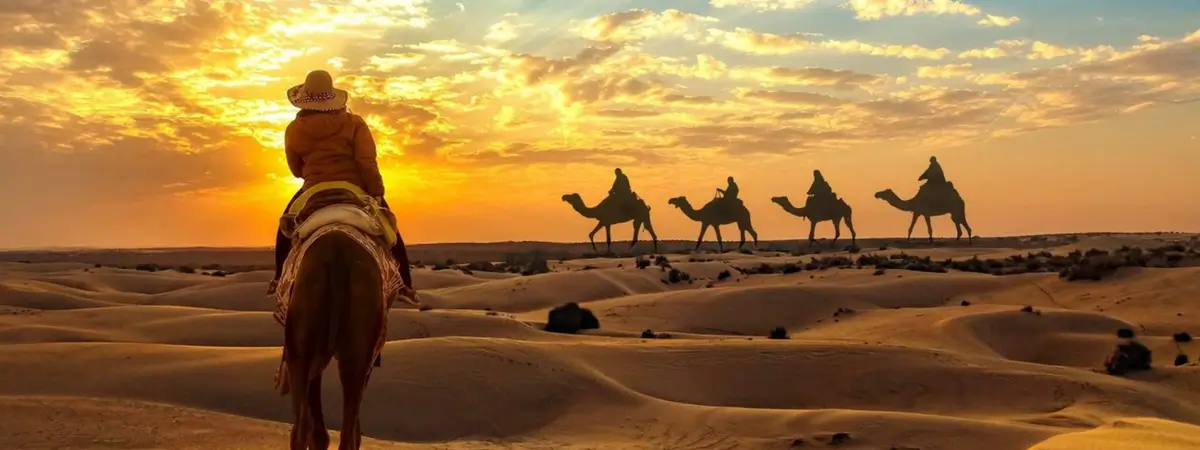
Light is the real subject of any good travel photograph, and Rajasthan has more of it than almost anywhere in India. Our Rajasthan Photography and Cultural Heritage Tour spends twenty-three days chasing it: the blush of dawn on Jaisalmer's sandstone walls, hard noon shadows inside Bikaner's carved courtyards, and the blue hour settling over the painted rooftops of Jodhpur. The schedule is built around golden hours rather than opening hours wherever possible, so you are on a rooftop at sunrise, resting through the flat midday glare and back on the streets when the colour returns. A private car and driver waits at every location with your kit, which means no lugging tripods through crowds and no rushing to rejoin a group. Local guides who understand photographers handle permissions, find the best angles and introduce you to the people behind the portraits.
The route deliberately takes in towns that most first-time visitors skip. Mandawa and Nawalgarh in the Shekhawati region hold hundreds of havelis covered in fading frescoes of trains, gods and British officers. Bikaner offers the red sandstone Junagarh Fort and the strange Karni Mata temple at Deshnoke. Bundi, with its turquoise houses, stepwells and the faded murals of the Chitrashala, is still one of the most photogenic and least crowded towns in the state. Alongside these, the Rajasthan heritage tour covers the essentials: Amber Fort, Mehrangarh, the Jaisalmer fort, the Thar Desert dunes and the lakes of Udaipur. Shooting on a phone or a full-frame camera, you will leave with a portfolio, a better eye and a real feel for the culture of each town.
Tour Highlights
 Package Includes:
 Package Excludes:
Reply within 24hrs
Your photography tour begins the moment you clear immigration at Indira Gandhi International Airport, where a member of our team waits outside with a sign bearing your name. Your chauffeur loads the bags and camera cases into a spacious air-conditioned vehicle, and the drive to your hotel takes around an hour. Before you leave the airport, we share a short briefing note covering photography etiquette in India: always ask before taking close portraits, be careful inside religious sites, and keep drones packed away, as flying them requires government permission that is not easy to obtain. Wi-Fi is available in all our hotels, and your chauffeur can also help you buy a local SIM card the next day.
The rest of the day is free to recover from your flight, charge batteries and clear memory cards. If you land in the afternoon and feel lively, your hotel can arrange a car to Connaught Place, the white colonnaded circle built in the 1930s, where the arches make clean geometric frames as the lights come on in the evening. Otherwise, rest early and keep your camera bag ready, as tomorrow begins before sunrise. Dinner at the hotel can include butter chicken or dal makhani, two Delhi classics that are perfect after a long journey. Ask the restaurant for less chilli if your stomach is still adjusting.
Overnight stay in Delhi.
Old Delhi wakes up early, and this is when it photographs best. Leave the hotel at around six o'clock to reach Jama Masjid as the first worshippers arrive and pigeons wheel over the red sandstone courtyard. Visitors must remove shoes and cover legs, and a small camera fee is charged at the gate. Your guide then leads you down into Chandni Chowk, where porters push carts through narrow lanes, chai sellers boil milk in giant pans and the shutters of silver shops rattle open. The side streets of Kinari Bazaar, filled with tinsel and wedding decorations, offer bold colour against crumbling walls.
The highlight for most photographers is Khari Baoli, the largest spice market in Asia, where men carry sacks of chillies, turmeric and dried fruit on their heads. Climb to the rooftop of Gadodia Market for a wide view over the lanes and the domes of Fatehpuri Masjid, but tie a scarf over your nose, as the chilli dust can be strong. Return to the hotel for a late breakfast and a midday rest. In the afternoon, visit the Red Fort's Lahori Gate and the Diwan-i-Khas, though remember it is closed on Mondays. On a Monday, the Mughal-era lanes of Ballimaran and the stately Fatehpuri Masjid make a fine alternative.
Overnight stay in Delhi.
Today mixes architecture and living culture across the city. In the morning, reach Humayun's Tomb soon after it opens, when low sunlight warms the red sandstone and the reflecting channels are still. Use a wide lens for the symmetry of the main tomb and a longer one to pick out the inlaid star patterns on the facade. Isa Khan's tomb in the same complex is often overlooked but offers octagonal arches that frame the main dome neatly. Your guide also shows you the quiet Arab ki Sarai gateway, which few visitors notice. Late afternoon is also good here, when the western light fills the arches of the main tomb with a warm glow.
After lunch, drive to Agrasen ki Baoli, a fourteenth-century stepwell hidden between office towers near Connaught Place. Its 108 steps lead down between stone walls that create strong leading lines, best photographed from the top step looking down. In the evening, walk through the narrow lanes of Nizamuddin Basti to the shrine of the Sufi saint Hazrat Nizamuddin Auliya. On Thursday evenings especially, qawwali singers perform in the courtyard, with harmonium and hand-clapping filling the air. Photography is allowed in the courtyard, but stay respectful and use no flash. Dinner can be kebabs at one of the old eateries nearby. Arrive before the singing starts to find a place along the wall.
Overnight stay in Delhi.
After breakfast, set off for Jaipur along the Delhi–Jaipur highway. Your chauffeur knows the good stops, and the countryside beyond Gurgaon opens into mustard fields in winter and villages where camel carts still share the road with lorries. Keep a camera on the seat beside you, as roadside scenes of brick kilns, tea stalls and women in bright saris walking along field edges are frequent. A stop at a dhaba for chai and parathas gives you a chance to photograph the cooks at their tandoor ovens. Your chauffeur is used to sudden requests to stop, so simply ask whenever something catches your eye.
You arrive in Jaipur by early afternoon and check in at a heritage hotel. Rest through the middle of the day, then drive up to Nahargarh Fort in the late afternoon. The fort sits on a ridge above the city, and from its western terrace the entire pink city spreads out below with the Aravalli hills on either side. Stay through sunset and into the blue hour, when the city lights appear and the sky turns indigo. A tripod helps here, and the terrace café makes a comfortable base while you wait for the light to change. Return to the hotel for dinner.
Overnight stay in Jaipur.
Hawa Mahal faces east, so the best time to photograph its pink honeycomb facade is just after sunrise, when the first light hits the 953 small windows. Several rooftop cafés across the road open early and allow you to shoot straight on from the same height, without traffic in the way. After coffee, continue to Amber Fort, about 11 km north of the city, and arrive before the crowds fill the main courtyard. Frame the fort from the edge of Maota Lake, where its walls reflect in the water on calm mornings, before heading inside. Arriving by seven o'clock gives you around an hour of soft side light before the sun gets too high.
Within Amber Fort, focus on the colourful Ganesh Pol gateway, the rows of pillars in the Diwan-i-Aam and the Sheesh Mahal, where a phone torch lights the mirrored ceiling like stars. After a late lunch, visit the Panna Meena ka Kund stepwell nearby, whose zigzagging staircases form one of the most graphic compositions in Rajasthan. Note that visitors are no longer allowed to walk down the steps, so shoot from the edge. In the late afternoon, return to the city and stop at Jal Mahal, the water palace in Man Sagar Lake, at golden hour. Ask your chauffeur to park on the eastern side of the lake road, which has the clearest view of the palace.
Overnight stay in Jaipur.
This Jaipur city tour focuses on the colour and life of the old city. Start early at the Phool Mandi, the wholesale flower market near Chandpole, where marigolds, roses and jasmine are piled high in sacks and traders shout prices over the noise. Then move into the old city's grid of bazaars: Tripolia Bazaar for brass and steel utensils, Johari Bazaar for jewellery and gems, and Bapu Bazaar for textiles and leather slippers. Your guide can introduce you to shopkeepers who are happy to be photographed, which makes for natural portraits. Mornings are best for markets, as traders are relaxed and happy to chat before the afternoon rush.
After lunch, visit the City Palace, where the four seasonal gates of Pritam Niwas Chowk are among the most photographed doorways in India; arrive in the late afternoon when the courtyard is softer. Jantar Mantar next door offers strong shapes and shadows, especially from the giant sundial. Before sunset, drive to Patrika Gate at Jawahar Circle, a modern gateway painted inside with scenes from every part of Rajasthan. End at Albert Hall Museum, whose Indo-Saracenic facade is lit up at dusk and looks best in the blue hour, when pigeons gather on the square in front.
Overnight stay in Jaipur.
Leave Jaipur after breakfast and head north into the Shekhawati region, a semi-desert area once home to wealthy merchant families who covered their houses in frescoes. The drive takes about four hours through farmland and small towns, and the landscape becomes sandier the further north you go. On the way, stop at a village well or at one of the many roadside shrines where local families gather; your chauffeur can usually point out good spots that are rarely seen by visitors. Shekhawati's dusty light is soft in winter and gives a warm, slightly hazy look to photographs of the open fields.
You reach Mandawa in the early afternoon and check into a converted fort or haveli hotel, many of which have painted walls of their own. After a rest, take a walking tour of Mandawa with a local guide in the late afternoon, when the light is warm and the streets are quiet. The town holds dozens of havelis, including the Chokhani, Goenka and Ladia havelis, whose walls show scenes of gods, battles, motor cars and early aeroplanes. Some are lived in, others are empty, and your guide arranges permission to enter the courtyards. Return to the hotel for a rooftop sunset and dinner.
Overnight stay in Mandawa.
Shekhawati is often called an open-air art gallery, and today you see why. In the morning, drive 30 km to Nawalgarh, where the Dr. Ramnath A. Podar Haveli Museum has been restored to show the frescoes in their original bright colours. Nearby, the Morarka Haveli Museum has some of the finest painted ceilings and arches in the region. Your guide also takes you to lesser-known havelis that are slowly crumbling, where faded murals of elephants, trains and European visitors make striking compositions with the peeling plaster. Look up as well as around, as many of the best panels are painted under the eaves. A small entry fee is often requested by caretakers of private havelis, and your guide handles these politely.
After lunch in Nawalgarh, continue to Fatehpur, where the Haveli Nadine Le Prince has been restored by a French artist and now serves as a cultural centre. Fatehpur also holds several abandoned havelis whose dusty courtyards are filled with soft, indirect light, ideal for detail shots of carved doors and painted panels. Late in the afternoon, return to Mandawa and walk through the market, where men in white turbans sit outside tea stalls and children play cricket in the lanes. The cooler evening light is perfect for natural street portraits. Dinner is served at the hotel.
Overnight stay in Mandawa.
The road to Bikaner crosses the edge of the Thar Desert, with sand dunes appearing beside the highway and khejri trees dotting the fields. Leave after breakfast, and make a short stop at a roadside village to photograph the round mud huts and painted doorways typical of the region. The light here is very bright by mid-morning, so a polariser filter helps to cut glare and deepen the sky. Your chauffeur usually stops for lunch at a simple restaurant on the highway serving dal, roti and fresh buttermilk. The roads in this stretch are straight and quiet, which makes the drive feel shorter than it is.
You arrive in Bikaner in the early afternoon. After checking in and resting, spend the late afternoon in the old city, a maze of narrow lanes where the red sandstone Rampuria Havelis stand close together. Built by a merchant family in the early twentieth century, their facades are covered in carved balconies, latticed windows and pillars, and they glow deep orange as the sun goes down. Your guide leads you through the lanes to the Bhandasar Jain Temple, whose interior is covered in gold leaf and painted scenes. Shoes must be removed, and leather items are not allowed.
Overnight stay in Bikaner.
Junagarh Fort is one of the few major forts in Rajasthan built on flat ground rather than a hill, and it has never been captured. Arrive when it opens at ten o'clock and spend the morning inside with your guide. The Anup Mahal is covered in gold leaf and red lacquer work, the Badal Mahal has walls painted with blue clouds and rain, and the Phool Mahal is decorated with mirrors and floral designs. A small museum holds a First World War biplane, a rare sight inside a palace. The interiors are fairly dark, so bring a fast lens or raise the ISO.
After lunch, drive 8 km out of town to the National Research Centre on Camel, a government farm where several hundred camels are bred and studied. The camels return from grazing in the late afternoon, between three and five o'clock, creating great scenes of dust, sun and long necks against the sky. You can also try camel milk ice cream at the farm's café. Return to Bikaner for dinner, and try the city's famous bhujia, a spicy fried snack made from gram flour, sold in shops throughout the old market. Rasgulla from the old city sweet shops is another Bikaner favourite worth trying.
Overnight stay in Bikaner.
Today is a long drive, so start early. About 30 km south of Bikaner, stop at the Karni Mata Temple in Deshnoke, where thousands of black rats live in the temple and are treated as sacred. Spotting a rare white rat is considered good luck. Shoes must be removed at the entrance, so bring thick socks. The temple's silver doors and marble facade are also worth photographing, and the scene of worshippers sharing milk with the rats is unlike anything else in India. Photography is allowed, though a camera fee applies. Arrive early in the morning when the temple is calmer and worshippers are making their first offerings.
From Deshnoke, the road runs south-west across empty desert towards Pokaran and then Jaisalmer, a total of about six hours including stops. The landscape becomes increasingly barren, with sand, scrub and occasional herds of goats and camels. Your chauffeur will stop wherever the scenery calls for it. You reach Jaisalmer in the late afternoon, just in time to see the honey-coloured fort glowing in the evening sun. Check into a hotel with a fort view and enjoy dinner on the rooftop, watching the walls fade into darkness as the lights come on. The fort is floodlit at night and makes a fine subject from the rooftop with a tripod.
Overnight stay in Jaisalmer.
Wake before dawn and drive to Vyas Chhatri, a group of sandstone cenotaphs on a small hill west of the old city. As the sun rises behind you, it lights up the full length of the fort's walls and ninety-nine bastions in gold, the classic photo of the Jaisalmer city tour. After breakfast, walk up into the fort itself, one of the very few living forts in the world, where around three thousand people still live inside the walls. Its narrow lanes are filled with houses, shops, cafés and a group of finely carved Jain temples dating from the twelfth to the sixteenth centuries.
After lunch, walk down into the town to visit Patwon ki Haveli, a group of five connected mansions with carved stone facades that look almost like lace. The first haveli has been restored as a museum, and its rooms show how a wealthy merchant family lived. Nearby, Salim Singh ki Haveli has a distinctive peacock-shaped roof, and Nathmal ki Haveli was carved by two brothers who each worked on one side, which is why the two halves are not quite identical. Spend the evening at the rooftop café of your hotel. A long lens picks out details on the upper balconies.
Overnight stay in Jaisalmer.
Gadisar Lake is a man-made reservoir surrounded by small temples, shrines and a carved gateway, and it is at its most photogenic at dawn, when the water is still and catfish gather near the steps. Local women often come to fetch water or worship at the small temples on the bank. After breakfast, drive about 18 km to Kuldhara, a village abandoned by the Paliwal Brahmin community around two hundred years ago. Local legend says they left overnight and cursed the village so that no one could live there again. Today its roofless houses and empty lanes are eerily quiet. Mid-morning light is harsh here, so look for frames through doorways and windows where the shade gives you contrast.
Return to Jaisalmer for lunch and a rest. In the afternoon, visit the Desert Culture Centre, a small museum of local puppets, musical instruments and fossils, before heading to Bada Bagh in the late afternoon. Located about 6 km north of the city, Bada Bagh is a garden of royal cenotaphs with domed roofs and carved pillars, set against a ridge lined with modern wind turbines. The contrast between old and new makes a striking image at sunset, especially if you shoot with the sun setting behind the domes. Return to the hotel for dinner. Arrive at least forty minutes before sunset to scout angles.
Overnight stay in Jaisalmer.
Spend the morning at leisure in Jaisalmer, perhaps revisiting the fort lanes for more street portraits or shopping for mirror-work textiles and leather goods. After lunch, drive about an hour south-west to Khuri, a quieter dune area than the busier Sam dunes. On the way, stop at Khaba Fort, a ruined fort and abandoned village whose courtyard holds a small fossil museum. The road passes small villages of round mud houses with thatched roofs, and the people of the area are generally welcoming to visitors who ask before photographing them. Pack only an overnight bag for the camp, as your main luggage stays safely in the car.
At Khuri, you check into a desert camp of comfortable tents with attached bathrooms. In the late afternoon, take a camel ride out into the dunes, timed so that you are among the ripples and ridges of sand as the sun sets. The low light creates long shadows across the dunes, and camel silhouettes against the orange sky make a classic desert image. Return to the camp for a folk music and dance performance around a campfire, followed by a Rajasthani dinner. After dinner, step away from the camp lights for star photography, as the night skies are very clear.
Overnight stay in Khuri desert camp.
Rise early for sunrise on the dunes, when the sand is cool and smooth and the light is soft and warm. Walk out a few hundred metres from the camp to find untouched sand without footprints, and look for patterns in the ripples left by the night wind. After breakfast at the camp, set off for Jodhpur. The drive takes around five and a half hours, passing through Pokaran and a long stretch of desert scrub where you may spot chinkara gazelles and desert foxes near the road if you are lucky. Your chauffeur will also stop at the war memorial near Jaisalmer if you would like a short break.
You arrive in Jodhpur in the afternoon and check into a hotel close to the old city or with a view of Mehrangarh Fort. After a rest, walk to the Clock Tower and Sardar Market in the late afternoon, where traders sell spices, vegetables, bangles and textiles under the old tower. The scene is busy, colourful and full of photo opportunities. Try the famous makhaniya lassi from one of the shops near the market gate, and the spicy mirchi vada, a fried green chilli stuffed with potato, which is a Jodhpur speciality. The lanes around the Clock Tower are lively until late, so you can return after dark for night shots.
Overnight stay in Jodhpur.
Mehrangarh Fort rises around 120 metres above the city on a sheer rock, and its walls look almost like they were carved from the hill itself. Arrive when it opens at nine o'clock and spend the morning inside, where the palaces are among the finest in Rajasthan. The Moti Mahal, or Pearl Palace, has a ceiling decorated with mirrors and gold, while the Phool Mahal is painted with floral designs and portraits of rulers. The museum's collection of royal palanquins, howdahs and weapons is also impressive. From the ramparts, the blue houses of the old city spread out below. The rooftop terrace near the Daulat Khana gives a wide view that works well with a standard zoom lens.
In the afternoon, take a guided walk through the blue lanes of Navchokiya and the Brahmpuri area below the fort, where many houses are painted in shades of indigo and sky blue. The colour came from a tradition linked to the Brahmin community, though today homes of all kinds use it. Doorways, steps, windows and laundry lines make endless frames, and local residents are usually friendly. End the day at Toorji ka Jhalra, a restored eighteenth-century stepwell close to the Clock Tower, whose geometric steps glow in the late afternoon light. Morning and late afternoon both work well, as the walls take on different tones depending on the angle of the sun.
Overnight stay in Jodhpur.
Start early on a jeep drive to the Bishnoi villages south of Jodhpur. The Bishnoi community is known for its strong commitment to protecting trees and wildlife, and blackbuck antelopes often graze freely near their homes. You visit a potter who throws pots on a hand-turned wheel, a family of dhurrie weavers working at their looms, and a traditional home where you may be offered tea or opium water at a ceremonial welcome, a custom you are free to politely decline. Portraits of elderly Bishnoi men in white turbans and women in red and gold are often the best images of the tour.
Return to Jodhpur for lunch, then visit Jaswant Thada in the late afternoon, a white marble cenotaph built in memory of Maharaja Jaswant Singh II. The thin marble walls glow when the sun shines through them, and the small lake beside the memorial gives you reflections with the fort rising behind. Finish at Mandore Gardens, 9 km north of the city, where the cenotaphs of the former rulers of Marwar are built in red sandstone in the style of temples. Langur monkeys play among the ruins, adding life to your photographs. Bring a polariser for the reflections at Jaswant Thada.
Overnight stay in Jodhpur.
This is the longest drive of the tour, so leave right after an early breakfast. The road heads east through Pali and Beawar, then continues past Bhilwara towards Bundi. Your chauffeur makes several comfortable stops along the way, including lunch at a clean highway restaurant. The landscape gradually changes from the desert plains of Marwar to the greener, hillier country of the Hadoti region, with lakes, farms and small temples appearing more often. This is a good day to back up your files and review your pictures from the desert. Keep snacks and water in the car, as the stops between Beawar and Bhilwara are fewer than on other days.
You reach Bundi in the late afternoon and check into a small heritage haveli in the old town, many of which have rooftop terraces with views of the palace on the hillside above. Bundi is a small town, far quieter than Jodhpur or Jaipur, and its narrow lanes, turquoise houses and old temples feel untouched by mass tourism. Take a short walk in the evening around Nawal Sagar Lake, whose small temple in the middle of the water reflects the palace lights at dusk. Dinner is usually served on the rooftop, with views of the lit-up palace.
Overnight stay in Bundi.
Bundi's Garh Palace climbs the hillside in a series of terraces, and Rudyard Kipling described it as a palace built by goblins rather than by men. Enter in the morning when the light is soft. The palace's main attraction is the Chitrashala, a small courtyard surrounded by rooms whose walls are covered in blue and green murals of Krishna, court scenes and hunting parties. These paintings are some of the finest examples of the Bundi school of miniature painting. The Hathi Pol, or Elephant Gate, with its two stone elephants, is another favourite frame. The murals are fragile, so flash is not allowed, but the courtyard light is usually bright enough for a handheld shot.
In the afternoon, climb higher to Taragarh Fort, the Star Fort, which sits above the palace on the ridge. The path is steep and overgrown in places, and monkeys are common, so a guide is essential and a stick is useful. The fort is largely in ruins, which makes it atmospheric, with crumbling gateways, water tanks and wide views across the town and lakes below. Return to the old town by late afternoon to photograph the blue houses around the palace as the shadows lengthen. Dinner is at a small family-run restaurant in the old town. Bring water and sturdy shoes, as there are no stalls on the hill.
Overnight stay in Bundi.
Bundi is known as the city of stepwells, with more than fifty in and around the town. Start the morning at Raniji ki Baori, a seventeenth-century stepwell whose deep shaft is decorated with carved pillars, arches and elephant figures. It is best photographed from the top in the morning, when light falls into the lower levels. Nearby, the Dabhai Kund is a large geometric stepped tank, similar to Panna Meena in Jaipur but bigger and almost always empty of visitors. Then visit the Chaurasi Khambon ki Chhatri, a cenotaph supported by eighty-four pillars, with carved elephants and deer around its base.
After lunch, visit Sukh Mahal on the banks of Jait Sagar Lake, a small summer palace where Kipling stayed while writing parts of his novel Kim. The lake is lined with lotus plants and visited by herons and kingfishers, so a long lens is useful. In the late afternoon, your guide takes you to a village just outside Bundi where farmers bring their cattle home and women cook on wood fires, with soft dusty light filling the lanes. Ask before photographing people inside their homes, and return to the old town for a final rooftop dinner.
Overnight stay in Bundi.
Leave Bundi after an early breakfast and drive about 160 km to Chittorgarh, home to one of the largest forts in India. The fort spreads over a long plateau and holds palaces, temples, reservoirs and two famous towers. The nine-storey Vijay Stambh, or Victory Tower, is covered in carvings of Hindu gods and was built in the fifteenth century by Rana Kumbha. The smaller Kirti Stambh is a Jain tower dedicated to Adinath. Rani Padmini's Palace, set beside a water tank, is linked to the legend of the queen who chose death over capture. The fort is huge, so your guide and chauffeur move you between sites by car to save time and energy.
After lunch near the fort, continue another 115 km to Udaipur, a drive of around two and a half hours through green hills. You arrive in the late afternoon and check into a hotel close to Lake Pichola. Head straight to Ambrai Ghat at sunset, which offers one of the best views across the water to the long white facade of the City Palace. As the palace lights come on and reflect in the lake, the scene is perfect for a long exposure on a tripod. Dinner at a lakeside restaurant completes a busy day. A city view is also possible from the higher terraces of many lakeside hotels.
Overnight stay in Udaipur.
Your last full day begins at Hanuman Ghat at dawn, as local people bathe, wash clothes and pray on the steps. Fishermen row out in small boats across the still water of Lake Pichola, and the light behind the City Palace creates a gentle glow. Walk through the narrow lanes of the old city as shops open and cows wander between the houses. Stop at Jagdish Temple when morning prayers are taking place, then cross Chandpole Bridge for a different angle on the lake. Morning light here is gentle, so a standard zoom is enough, and a short tripod helps in the dim lanes before sunrise.
After breakfast, visit the City Palace, focusing this time on photographic details: the Surya Gokhada sun window, the inlaid glass of Manak Mahal, and the Crystal Gallery in the Fateh Prakash Palace, which holds furniture made entirely of glass, including a bed. Photography is not allowed in the Crystal Gallery, so enjoy it with your own eyes. In the afternoon, visit the Vintage Car Collection of the former royal family, whose polished Rolls-Royces and Cadillacs make strong detail images. End the tour at sunset on a boat ride around the lake, a fitting finale to a twenty-three-day photography journey.
Overnight stay in Udaipur.
After breakfast, there may be time for one last walk along the ghats depending on your flight schedule. Your chauffeur then drives you about 25 km to Maharana Pratap Airport for your domestic flight to Delhi, which takes about an hour and a quarter. Before you leave, we recommend backing up your images in at least two places, as you will likely have several thousand photographs from the past three weeks. Please check that your camera batteries are packed in your hand luggage, as airlines in India do not allow spare lithium batteries in checked bags. Your chauffeur will also help you pack fragile lenses and tripods in the car for the airport drive.
On arrival in Delhi, our representative meets you and transfers you to the international terminal or to a hotel near the airport if your flight leaves the next day. We would love to see your best images from the tour, and many of our guests share their favourite pictures with us after returning home. Thank you for choosing Heritage India Private Tours for this Rajasthan photography tour. We hope the forts, faces and colours of Rajasthan stay with you for a long time, and that your portfolio reminds you of every sunrise and sunset along the way. Safe travels home.
Hear what our happy guests say about their India adventures! From private drivers to guided tours, we make every journey smooth, safe & unforgettable.
 rating score: 5.0 of 5, based on 448 reviews

Complete our inquiry form

Customize your itinerary

Confirm when you're satisfied
1-to-1 Service | Reply within 24hrs | Expert's Advice