Delhi - Agra - Jaipur - Jawai - Ranakpur - Udaipur - Delhi
Leopards in Jawai do not hide in thick forest. They sleep in caves on bare granite hills, walk past village temples at dusk and sit on rock ledges in full view of the shepherds below, which is why this corner of southern Rajasthan has become one of the most reliable places in India to see the big cat. Our Golden Triangle Tour with Jawai Leopard Safari links that wild landscape to Delhi, Agra and Jaipur, and then winds down in the lake city of Udaipur. You travel by private car and driver throughout, with local guides in every city, and you fly back from Udaipur to Delhi at the end, so there is no long return drive. Over eleven days, the pace moves from busy capital to quiet countryside.
What makes Jawai special is the way people and predators share the land. The Rabari herders, recognisable by the men's white clothes and red turbans, have grazed goats and camels here for generations and treat the leopards as neighbours, and there are very few records of attacks on people. Safaris run in open jeeps at dawn and in the late afternoon, scanning rock faces for spotted coats. Jawai Bandh reservoir adds mugger crocodiles and, from November to March, flamingos and migrant geese. After the hills, you cross the Aravallis to the marble Jain temple of Ranakpur and finish with three nights in Udaipur. This Jawai leopard safari tour suits wildlife lovers, photographers and couples who want a softer finish after the cities.
Tour Highlights
 Package Includes:
 Package Excludes:
Reply within 24hrs
Your eleven-day journey begins as you step out of customs at Indira Gandhi International Airport. Our representative greets you with your name card and introduces your chauffeur, who will drive you from Delhi to Jawai and on to Udaipur over the coming ten days, so you will soon feel at ease with him. The drive to your hotel takes forty minutes or so, longer during the evening rush. Check-in is usually from early afternoon, and if you arrive in the early morning we can book an early check-in on request so you can sleep straight away. Do let us know your flight details in advance so the pick-up is ready.
Take the day to rest. If you would like to go out, a quiet choice is the Gandhi Smriti on Tees January Marg, the former Birla House where Mahatma Gandhi lived for the last 144 days of his life and where he was shot on his way to a prayer meeting. Concrete footprints mark his final steps across the lawn to the spot, now marked by a small memorial, and his simple room has been left as it was. It is closed on Mondays. It gives a moving and calm introduction to modern Indian history. In the evening, enjoy dinner close to your hotel. Overnight stay in Delhi.
Begin your full day of sightseeing in Old Delhi with your guide at the Jama Masjid, Shah Jahan's grand Friday mosque, before walking into the lanes of Chandni Chowk. Look out for the silver traders of Dariba Kalan and the Gauri Shankar Temple, then step inside Gurudwara Sis Ganj Sahib, which marks the place where the ninth Sikh Guru was executed in 1675. Continue to the Red Fort, which is closed on Mondays, to see the Diwan-i-Aam and the marble Rang Mahal. The old city is crowded and loud, so the guide will keep a steady, comfortable pace. Your guide will also point out the old havelis above the shopfronts.
After lunch, drive to New Delhi for Qutub Minar and its Alai Darwaza gate, an early example of true arches in India. Next, pass the government buildings on Raisina Hill and India Gate. Late in the afternoon, drive east across the Yamuna to Swaminarayan Akshardham, a huge modern temple of pink sandstone and white marble, with more than twenty thousand carved figures of gods, sages and animals. Phones and cameras are not allowed inside, and the complex is closed on Mondays, so we arrange the visit around it. If you stay into the evening, the water show by the stepped tank tells a story from the Upanishads. Overnight stay in Delhi.
After breakfast, drive south on the Yamuna Expressway, reaching Agra by about lunchtime. Your guide meets you at the hotel and takes you first to Agra Fort, where you walk up the ramp from the Amar Singh Gate and through courts built by three emperors. Akbar's sandstone Jahangiri Mahal contrasts with Shah Jahan's white marble pavilions, and the guide will show you the Sheesh Mahal, a bathhouse lined with tiny mirrors, and the Anguri Bagh, a geometric garden of grapes and flowers once tended for the women of the court. Notice the jharokha balconies, where the emperor showed himself to his subjects every morning. The views of the river from the upper terraces are wonderful.
In the late afternoon, visit the Taj Mahal, which is closed on Fridays, and stay until the light starts to soften on the marble. Your guide points out how the dome, the four minarets and the platform were all carefully set so that the building looks perfect from the entrance gate, and you will have plenty of time for photographs. Afterward, return to your hotel. For dinner, many guests try a Mughlai meal at a restaurant near the Taj East Gate, with dishes such as murgh musallam and shahi paneer, followed by a scoop of kulfi. Overnight stay in Agra.
Leave Agra after breakfast, heading west on the Agra–Jaipur highway. The drive takes about four and a half hours, passing fields of mustard, millet and wheat depending on the season, and small market towns where camel carts still carry fodder. Your chauffeur will make a comfortable tea stop along the way. You arrive in Jaipur in time for lunch and check in to your hotel. The afternoon is kept free so that you can settle in after three busy days, perhaps with a swim or a short nap. Along the way, look out for women in bright odhnis carrying water pots and herds of goats crossing the road. It is a calm, easy day of travel.
In the late afternoon, take a gentle walk through the walled city. Start at Hawa Mahal and then head into Bapu Bazaar and Nehru Bazaar, where shops sell block-printed cotton, leather mojari shoes and lac bangles at friendly prices. Your chauffeur can also take you to the Birla Mandir, a white marble temple that glows at dusk below the Moti Dungri hill. End with dinner at a restaurant serving Rajasthani thali, which can include dal baati churma, ker sangri, a desert dish of dried beans and berries, and gatte ki sabzi, gram flour dumplings in a yoghurt curry. Overnight stay in Jaipur.
Start early to reach Amber Fort before the tour buses. Your guide walks you through the Sila Devi temple, the Diwan-i-Aam, and the Jai Mandir with its mirrored ceilings, then into the oldest part of the palace built by Raja Man Singh. On the way down, stop at Panna Meena ka Kund, a sixteenth-century stepwell where criss-crossing staircases form a geometric pattern. A short walk away, see the Anokhi Museum of Hand Printing in the restored Chanwar Palkiwalon ki Haveli, where artisans demonstrate block carving and printing on cotton. The museum is closed on Mondays, so our team arranges the day accordingly. Allow about an hour, and do not miss the small shop selling printed scarves and quilts.
After lunch, continue your Jaipur city tour with the City Palace, where you visit the Mubarak Mahal costume gallery and the armoury, and the Jantar Mantar observatory, a UNESCO World Heritage Site with nineteen giant astronomical instruments built by Maharaja Jai Singh II. Your guide explains how the Samrat Yantra sundial measures local time. If you still have energy, walk through the lanes of Johari Bazaar for gemstones and silver, or simply return to the hotel to rest and prepare for tomorrow's journey into the wild south of Rajasthan. Its upper floors give good views across the old city. Overnight stay in Jaipur.
After an early breakfast, drive south-west towards Jawai on the highway via Ajmer and Beawar. As you get closer, the landscape changes: flat farmland gives way to tall, smooth domes of granite rising out of fields, with small temples on many of the summits. Your chauffeur stops for lunch at a roadside restaurant on the way. You arrive at your luxury tented camp or heritage lodge in the Jawai hills in the afternoon, where the staff welcome you with a cool drink and a short safari briefing from the head naturalist. These are the leopards' home hills. Keep your binoculars close, as the trackers sometimes spot movement even from the highway.
In the late afternoon, set off on your first open jeep Jawai leopard safari with an experienced tracker. Leopards here usually come out of their caves as the heat fades, and the trackers scan the rocks carefully for movement or for alarm calls of langurs and peafowl. You may also see striped hyenas, jungle cats, Indian foxes, nilgai and plenty of birds, including the Indian eagle owl and the painted sandgrouse. Return to the camp after dark for a drink by the campfire and dinner under the stars, as the sounds of the night drift up from the valley. Overnight stay in Jawai.
Wake before sunrise for the morning safari, when leopards often lie on warm rock ledges after a night of hunting. The tracker drives you along farm tracks between the hills, stopping to check caves and scanning with binoculars. Sightings vary, but Jawai's open terrain gives good chances, and patient watching sometimes rewards you with a mother and cubs playing on the boulders. Return to camp for a hearty breakfast and some free time; the pool, the shaded verandah and the camp's own bird list will keep you happy through the heat of the day. Bring a long lens if you have one, as the cats are often seen at a distance.
In the afternoon, visit a Rabari settlement with your naturalist. The Rabari are a semi-nomadic herding community, and you will learn how they keep goats and camels in thorn enclosures, why they leave the leopards alone, and how the cats are seen as protected by the local goddess. Tea is often offered in brass cups. Then drive to the edge of Jawai Bandh, the largest reservoir in western Rajasthan, where mugger crocodiles bask on the shore and, in winter, flocks of flamingos, bar-headed geese and ruddy shelducks gather in the shallows. A final evening safari follows, ending with sundowners on a rock. Overnight stay in Jawai.
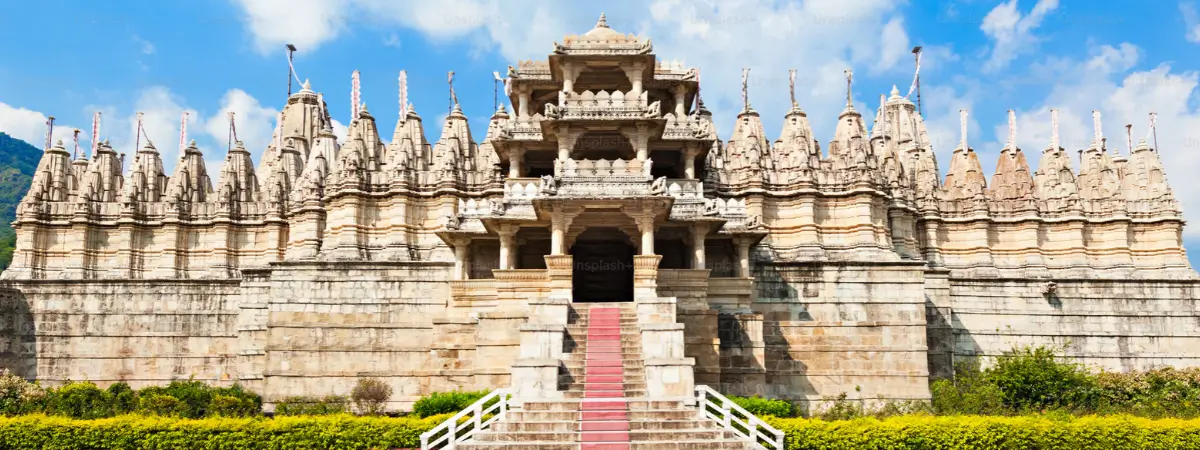
Take one last early safari in the cool of the morning, then return to the camp for breakfast and check out. The drive to Udaipur crosses the forested Aravalli hills and passes through Ranakpur, home to the Chaumukha Jain Temple, a fifteenth-century masterpiece of pale marble. It stands on 1,444 carved pillars, and legend says no two are identical. Your guide shows you the carved Kalpavriksha ceilings and the knotted serpent panel of Parshvanath. Jain rules apply, so leather items are not allowed inside, and the temple opens to non-Jain visitors from around noon. Shoulders and knees must be covered, and visitors should wear modest clothing.
After lunch at a hotel near the temple, continue through hilly country and villages to Udaipur, arriving in the late afternoon. Check in to your lakeside hotel. Udaipur was founded in the sixteenth century by Maharana Udai Singh II of Mewar after Chittorgarh fell, and the old city is built around lakes and ghats. In the evening, head to the rooftop of a restaurant near Gangaur Ghat to watch the sunset over Lake Pichola, with the white walls of the City Palace glowing in the last light and lights coming on in the Lake Palace. Try a glass of cold coffee or a mango lassi as you watch. Overnight stay in Udaipur.
Your guide meets you after breakfast for a Udaipur city tour, starting at the City Palace, the largest palace complex in Rajasthan, built over four centuries by the Mewar rulers. Walk through the Mor Chowk with its peacock mosaics of coloured glass, the Badi Mahal, a garden courtyard built on a natural hill, and the Zenana Mahal, which now houses royal palanquins and paintings. Then visit the nearby Jagdish Temple, a seventeenth-century temple dedicated to Vishnu, with an elaborately carved spire and a bronze Garuda guarding the entrance. The view of Lake Pichola from the upper balconies is the best in the city. Allow at least two hours for the palace alone.
In the afternoon, take a boat ride on Lake Pichola, with a stop on Jag Mandir, an island palace where Prince Khurram, later Shah Jahan, took refuge in his youth. From the water you see bathing ghats, old havelis and the hills beyond. Later, drive to Saheliyon ki Bari, an eighteenth-century garden laid out for the ladies of the royal court, with fountains, lotus pools and marble elephants. In the evening, attend the Dharohar folk dance show at Bagore ki Haveli, where dancers perform the bhavai, balancing a tall stack of clay pots on their heads. Overnight stay in Udaipur.
Spend the morning at your own pace. Many guests enjoy a quiet walk around Fateh Sagar Lake, or a visit to the Vintage Car Museum, which displays the Maharana's Rolls-Royces and Cadillacs. For views, drive up to Sajjangarh, the hilltop Monsoon Palace built in the late nineteenth century, which overlooks the city, its lakes and the surrounding Aravalli hills. In the old city, you can browse miniature painting workshops, where artists use brushes made from squirrel hair to paint detailed scenes of royal hunts and Krishna legends, or shop for silver and textiles near Hathi Pol. Your chauffeur is on hand all day, so you can mix and match these as you please.
In the afternoon, join a Rajasthani cooking class at a family home in the old city. The host teaches you to make a full meal, usually including masala chai, a vegetable curry, a dal and a few kinds of bread such as chapati, paratha and puri, and explains the use of spices like cumin, asafoetida and fenugreek. Afterward, sit down to enjoy what you have cooked with the family. In the evening, take a final walk across the Daiji footbridge to Ambrai Ghat for a farewell view of the City Palace lit up over the water. Overnight stay in Udaipur.
Enjoy a final lakeside breakfast and some time to pack. Depending on your flight time, there may still be a chance for a last stroll along the ghats or some souvenir shopping. Your chauffeur then drives you to Maharana Pratap Airport at Dabok, about twenty-five kilometres from the city, for your domestic flight to Delhi. The flight takes about an hour and twenty minutes, and you can say goodbye to your chauffeur, who has driven you more than a thousand kilometres across North India and Rajasthan. Thank him warmly before you head inside. Keep your boarding pass handy, as security at Udaipur airport checks it twice.
On arrival at Delhi's domestic terminal, our representative meets you and helps you transfer to the international terminal or to an airport hotel if your flight leaves the next day. We book the Udaipur flight with a good margin before your international departure so that you do not feel rushed. As you board your flight home, you will carry with you images of the Taj Mahal, the pink walls of Jaipur, leopards on the granite rocks of Jawai and the lakes of Udaipur. Thank you for travelling with us, and we hope to see you in India again. Have a smooth flight home.
Hear what our happy guests say about their India adventures! From private drivers to guided tours, we make every journey smooth, safe & unforgettable.
 rating score: 5.0 of 5, based on 448 reviews

Complete our inquiry form

Customize your itinerary

Confirm when you're satisfied
1-to-1 Service | Reply within 24hrs | Expert's Advice