Delhi - Agra - Jaipur - Bundi - Udaipur
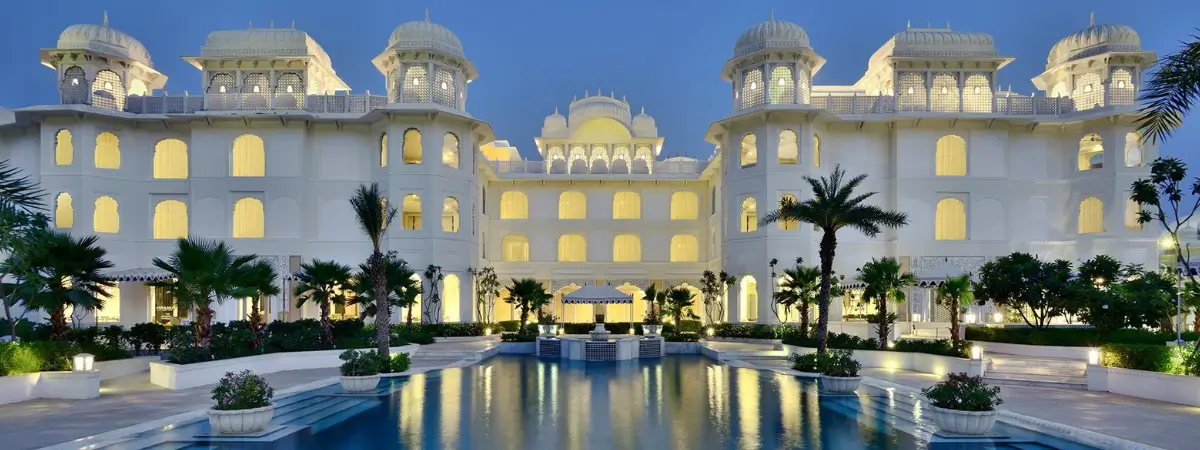
Small hotels tell bigger stories. A restored merchant haveli in Old Delhi, a family-run mansion in the jewellers' quarter of Jaipur, and a seventeenth-century guesthouse below the ramparts of Bundi each carry the history of the street outside their door, and staying in them changes the way you see a city. Our Luxury India Tour with Boutique Hotels and Cultural Experiences strings together thirteen days of these characterful properties, chosen for courtyards, rooftop views and owners who still live on site, rather than for star ratings alone. The route follows a familiar arc from Delhi to Agra and Jaipur, then turns south into the less-travelled Hadoti country of Bundi before ending among the lakes of Udaipur, with a flight back to Delhi at the end.
Culture here means hands-on time with the people who keep traditions alive. You will press carved wooden blocks onto cotton with printers in Bagru, learn to tie a Rajput turban, sit with a Dastangoi storyteller in Delhi, and watch a Mewar folk dance in a lakeside mansion in Udaipur. Each region also brings a home-cooked meal with a local family. Throughout the trip, a private car and driver carries you between cities on good roads, with stops at a medieval stepwell at Abhaneri and the vast fort of Chittorgarh. This boutique hotel tour of India is ideal for curious, well-travelled guests who would rather know the names of their hosts than the number of their room.
Tour Highlights
 Package Includes:
 Package Excludes:
Reply within 24hrs
Our representative greets you in the arrivals hall at Indira Gandhi International Airport and introduces your chauffeur, who will stay with you across Rajasthan until the flight home. The drive to Old Delhi takes about an hour, and the final stretch is done on foot or by cycle rickshaw, because the lanes around Chandni Chowk are too narrow for a car. A porter carries your bags the last few hundred metres, and the change from the airport's glass and steel to a quiet carved doorway tucked away in Gali Guliyan is a fitting start to a trip built around the character of small places.
Our usual choice is Haveli Dharampura, a merchant's mansion built in the nineteenth century and restored over several years with carved sandstone balconies, jharokha windows and a central courtyard open to the sky. Rooms are named after the families who once lived here, and the rooftop restaurant, Lakhori, looks directly across at the domes and minarets of the Jama Masjid. After settling in, watch the evening light fade over the mosque from the terrace as the call to prayer drifts across the rooftops, then enjoy a dinner of slow-cooked Mughlai dishes on the roof, where nihari and mutton korma are served with sheermal bread. Overnight stay in Delhi.
Your local guide meets you in the courtyard after breakfast for a slow walk through the old quarter that begins at Khari Baoli, Asia's largest wholesale spice market, where sacks of red chillies, turmeric and dried fruit line the lanes and porters carry loads that seem twice their size. A narrow staircase in the Gadodia Market building leads to the rooftop for a view of the whole market from above. Next comes Paranthe Wali Gali, where families have been frying stuffed flatbreads since the 1870s, and a stop at the Sisganj Gurudwara, which marks the place where the ninth Sikh guru was martyred.
After lunch, you drive to Gurudwara Bangla Sahib near Connaught Place, where volunteers in the community kitchen prepare langar for thousands of visitors every day, and you are welcome to roll chapatis alongside them. The National Crafts Museum near Pragati Maidan, closed on Mondays, follows, with its tribal shrines, textiles and village houses rebuilt in the grounds. In the evening, a Dastangoi performer recites a tale from the Urdu storytelling tradition in a candle-lit room of the haveli, with an English introduction so the plot is easy to follow, and a cup of kahwa is served at the interval. Overnight stay in Delhi.
You leave Old Delhi after breakfast, with a quick stop on the way out at Humayun's Tomb, if you have not seen it before, before joining the Yamuna Expressway toward Agra. The road is fast and well maintained, and your chauffeur pauses at a highway rest stop for coffee and clean facilities halfway through the drive. Arriving in Agra around lunchtime, you check in to a small boutique property in the Taj Ganj area, our usual choice being a family-run guesthouse with rooftop views of the Taj Mahal dome or a similar property, subject to availability. The owners usually greet guests themselves and are generous with local tips.
In the afternoon, your Agra guide leads you to the Agra Fort, concentrating on the women's quarters and the private apartments overlooking the river rather than the grand halls alone, explaining how the Mughal women lived, prayed and watched the river. In the evening, you attend Mohabbat the Taj, a theatre show at Kalakriti Cultural Centre that tells the story of Shah Jahan and Mumtaz Mahal through dance, music and elaborate costume. A short drive afterwards brings you to a rooftop restaurant for a dinner of Mughlai dishes and the city's famous petha, a sweet made from ash gourd, which comes in more than a dozen flavours. Overnight stay in Agra.
The alarm goes before dawn, but the reward is worth it: the Taj Mahal at sunrise, when the white marble turns soft grey, then rose, then cream as the light changes across the morning. The monument is closed on Fridays, and the itinerary is arranged so that today never falls on one. Your guide uses the quieter hour to show details that crowds tend to miss: the optical trick that makes the minarets appear straight while they actually lean outward, and the perfect symmetry that only breaks at the tomb of Shah Jahan himself, placed beside his wife's as an afterthought by his son Aurangzeb.
After breakfast at the guesthouse, you walk through the lanes of Taj Ganj, the neighbourhood that grew up to house the workers who built the Taj, where descendants of those craftsmen still carve marble and inlay it with stones in small workshops. A visit to one of these family workshops shows the patient method behind the inlay, and there is time to see the delicate tomb of Itmad-ud-Daulah across the river. The afternoon is free for rest, and in the evening your host serves a dinner of home-style Agra dishes on the rooftop, with the dome of the Taj catching the last light just beyond the guesthouse wall. Overnight stay in Agra.
Leaving Agra after breakfast, the road heads west, and after about three hours your chauffeur turns off the highway toward the village of Abhaneri. Here, the Chand Baori stepwell drops thirteen storeys into the earth, its 3,500 narrow steps arranged in a precise zigzag pattern around three sides of a deep square pool. Built in the ninth century to store rainwater through the dry months, the stepwell also served as a cool gathering place for villagers in summer. Next to it stand the ruins of the Harshat Mata temple, its carved panels showing dancers and musicians, and village children often follow visitors around with friendly curiosity.
The final two hours take you into Jaipur, where our usual choice is Alsisar Haveli, a nineteenth-century mansion of a noble family with a pool in its courtyard garden, or Samode Haveli, known for its painted dining room, both subject to availability. The afternoon is spent at leisure in the courtyard, and in the early evening your guide leads a walk through the lanes of the walled city near Tripolia Bazaar, past shops selling brass utensils, kite strings and bangles, as the evening lights come on over the pink facades and the street-food carts start frying mirchi vada. Overnight stay in Jaipur.
This morning, your guide takes you to Amber Fort, where the climb up to the Suraj Pol gate gives a fine view of the Maota Lake and its saffron garden island below. Inside, you spend time in the Zenana quarters, where the twelve suites of the queens are connected by narrow corridors around a central courtyard. Below the fort, the old town of Amber holds quieter treasures, including the Jagat Shiromani temple with its carved marble porch and the restored Anokhi Museum of Hand Printing, closed on Mondays, set in a traditional haveli restored with lime plaster and local stone.
At the museum, a craftsman demonstrates how designs are cut into teak blocks and dyed with natural colours, and you can print your own small scarf to take home. Back in the city, your afternoon includes a turban-tying lesson with a member of a Rajput family, who explains how the colour and style of a turban once showed caste, region and the season. In the evening, the same family invites you into their home in the old city for a dinner of dal baati churma, gatte ki sabzi and bajre ki roti, cooked by the women of the house, followed by conversation over sweet masala chai. Overnight stay in Jaipur.
Bagru village lies thirty kilometres southwest of Jaipur, and its families of Chhipa printers have been printing cotton by hand for over three hundred years. After a short drive, you spend the morning in their workshops, watching the fabric being washed in the river, dyed with indigo, pomegranate rind and iron rust, and laid out in the sun to dry. Then you try your own hand, pressing carved wooden blocks onto a length of cotton under the guidance of a master printer, who shows how the slightest error in pressure blurs the pattern. Your printed cloth is washed and packed so it travels home safely.
In the afternoon, back in Jaipur, your guide leads you through the City Palace museum, with its textile gallery showing royal costumes and shawls woven with gold thread. Next comes a visit to a blue pottery workshop, where artisans shape quartz-based clay and paint it with cobalt and copper oxide designs that came to Jaipur from Persia. In the evening, the Raj Mandir Cinema, built in the 1970s with a meringue-pink Art Deco interior, shows a Hindi film with full audience participation, a memorable cultural outing; your guide sits with you to translate the plot during the songs. Overnight stay in Jaipur.
The drive south from Jaipur leaves the busier tourist route behind, passing through Tonk with its old Nawabi palaces and the open farmland of Hadoti. After about four hours, the road reaches the town of Bundi, cupped among the Aravalli Hills, with the walls of Taragarh Fort running along the ridge above and the palace stacked down the hillside below it. Rudyard Kipling stayed here in the 1880s, and he wrote that Bundi Palace looked as though it had been built by goblins rather than men, which still seems a fair description of the way its towers and balconies seem to grow out of the rock.
Our usual choice in Bundi is Haveli Braj Bhushanjee, a seventeenth-century mansion run by the same family for generations, filled with miniature paintings, old photographs and antique furniture, or Bundi Vilas, a smaller guesthouse just below the palace walls, both subject to availability. After lunch on the rooftop, you take a slow evening walk through the old town, where many houses are painted blue, passing small shrines, sweet shops and the Nawal Sagar lake, with its half-submerged Varuna temple in the middle. Bundi sees a fraction of the visitors of Jaipur, so you will meet more locals than tourists on the way. Overnight stay in Bundi.
Bundi Palace is the reason most travellers come to this town, and your guide leads you up through the Hathi Pol, the elephant gate, to the Chitrashala, a small courtyard where the walls and ceilings are covered with eighteenth-century murals painted in turquoise, green and red. The paintings show Krishna with the gopis, royal processions, hunting scenes and festivals, all in the distinctive Bundi style. Climbing higher, the steep path leads to Taragarh Fort, now partly overgrown and home to troops of langur monkeys, with views across the town and its lakes. Good shoes and a walking stick are wise, as the path is steep and uneven in places.
After lunch, you visit the Raniji ki Baori, a stepwell built in 1699 by a queen, with carved elephants and pillars decorated with lotus motifs, followed by the smaller Dhabhai Kund nearby. The Sukh Mahal, a summer palace on the banks of Jait Sagar lake where Kipling began writing Kim, makes a quiet stop in the late afternoon. In the evening, your host family serves a dinner of Hadoti dishes, such as kachori and kadhi with millet bread, on the haveli rooftop under the illuminated palace, as the evening bells ring out from the temples in the lanes below. Overnight stay in Bundi.
The road southwest from Bundi passes through Menal, where a cluster of eleventh-century Shiva temples stands beside a seasonal waterfall, worth a short stop in the monsoon months. After about two and a half hours you reach Chittorgarh, the largest fort in India, spread across a plateau over a hundred and eighty metres above the plains. Your guide tells the stories of the three sieges and the women who chose jauhar rather than capture, then leads you to the Vijay Stambh, the Tower of Victory, and the Rani Padmini Palace overlooking a lotus pool, where the legend of the queen's reflection in a mirror is still told to every visitor.
After a lunch of simple Rajasthani dishes at a heritage hotel in Chittorgarh, the final two hours of driving bring you to Udaipur. Our usual choice here is Amet Haveli, a seventeenth-century residence on Lake Pichola, or Jagat Niwas Palace, near the Jagdish temple, both subject to availability, and both are run by families with long roots in the city. The haveli rooms look out over the water toward the City Palace, and the evening is free to relax on the terrace, with dinner at the haveli's own lakeside restaurant, where tables are set right on the water's edge and candles float in clay lamps nearby. Overnight stay in Udaipur.
Your Udaipur guide meets you after breakfast for a morning drive to Shilpgram, a rural crafts village on the western edge of the city, where traditional homes from Rajasthan, Gujarat, Goa and Maharashtra have been rebuilt and craftsmen sell their work directly. You see potters, weavers and puppet makers at work, and there may be folk musicians performing in the open courtyard, especially at weekends. On the way back, you stop at Saheliyon ki Bari, laid out in the eighteenth century by Maharana Sangram Singh II, the garden of the maids of honour, with fountains, marble elephants and lotus pools built for the royal ladies.
After lunch, the afternoon is free to rest in the haveli or to visit the City Palace with your guide, focusing on the palace's collection of Mewar miniatures. In the evening, you attend the Dharohar folk dance performance at Bagore ki Haveli, a restored mansion on Gangaur Ghat, where women dance the ghoomar in swirling skirts and an elderly performer balances a tower of clay pots on her head. Afterwards, the ghats are lit by lanterns and the lake reflects the City Palace, a fine setting for a walk back to the haveli along the water. Overnight stay in Udaipur.
This morning brings a cooking class in the home of an Udaipur family, an old courtyard house in the lanes near Lal Ghat, where the host teaches you to make a full Mewari meal from scratch. You learn to temper spices for dal, roll chapatis and prepare a seasonal vegetable curry, with time to ask questions about family life, festivals and the city's traditions. The lesson ends with everyone sitting down together to share the meal, and recipes are written out for you to take home. The host's children often join in, and the warmth of the meal is often the moment guests remember most from the whole trip.
The afternoon is free for shopping in the lanes around Hathi Pol, where miniature painters, silver jewellers and leather workers have small shops, or simply resting at the haveli. In the late afternoon, a boat ride on Lake Pichola takes you past the ghats, the City Palace and the white Lake Palace, with a stop at Jag Mandir island for the sunset. Your final evening is a farewell dinner on the haveli's rooftop, with the City Palace lit up across the water and a group of folk musicians playing softly. Your guide joins you for a final toast and shares a few last stories of the city. Overnight stay in Udaipur.
Breakfast on the terrace marks your last morning in Rajasthan, and there is time for a final walk along the ghats before checkout, when women are washing clothes and the temple bells are ringing. Your chauffeur, who has driven you since Delhi, takes you to Maharana Pratap Airport, about twenty-five kilometres east of the city, for the domestic flight to Delhi, which takes about an hour and a quarter. Saying goodbye to a driver after twelve days is often harder than guests expect, and many of them keep in touch long after the trip has ended, sending greetings at Diwali each year.
On arrival in Delhi, our representative meets you at the domestic terminal and, depending on the time of your international flight, can arrange a day room at an airport hotel near Aerocity for rest and a shower before the long journey home, with your luggage kept safe throughout. Alternatively, if time allows, a short visit to Dilli Haat gives a last chance to buy crafts from every state of India. At the right time, you are transferred to the international terminal for your onward flight, taking home printed cotton from Bagru, recipes from Udaipur and memories of the people who welcomed you into their homes, workshops and kitchens along the way. We hope you return one day to see the other corners of India they told you about.
Hear what our happy guests say about their India adventures! From private drivers to guided tours, we make every journey smooth, safe & unforgettable.
 rating score: 5.0 of 5, based on 448 reviews

Complete our inquiry form

Customize your itinerary

Confirm when you're satisfied
1-to-1 Service | Reply within 24hrs | Expert's Advice