Delhi - Jaipur - Bikaner - Khimsar - Jaisalmer - Osian - Jodhpur - Delhi
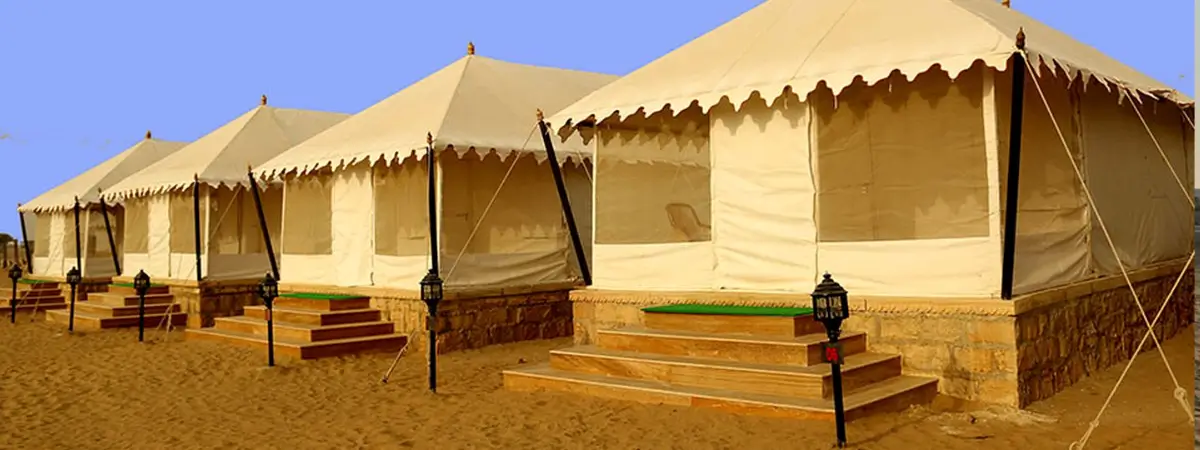
Canvas walls, a proper bed and the silence of the Thar at midnight: that is the promise of this Rajasthan desert glamping and luxury camping tour. Across thirteen days, you move from city palaces to sand country and spend more than half your nights under canvas, in carefully run camps where the tents have en-suite bathrooms, hot showers, wooden floors and rugs, and where dinner is cooked over open fire. The route starts in Delhi and Jaipur, then heads into the desert at Bikaner, Khimsar, Jaisalmer and Osian before finishing in Jodhpur. Each camp has its own character. One sits among the low dunes of Raisar, another beside a desert fort, one in the open sands past Sam and Khuri, and the last on the dunes outside an ancient temple town where caravans once rested.
Long road days through the desert are handled in a private car and driver. Your English-speaking chauffeur knows where to find shade, clean restrooms and the best masala chai along the way. Afternoons are kept light so you reach each camp in time for the dunes at golden hour, and mornings start late enough to enjoy breakfast in the open air. Expect camel rides at sunset, jeep drives across the sand, star-gazing with a telescope at Jaisalmer and folk music around the fire from Manganiyar and Langa musicians. Between camps, local guides take you through Amber Fort, Junagarh, the Jaisalmer Fort and Mehrangarh, so the trip balances desert comfort with Rajasthan's great architecture. A domestic flight from Jodhpur takes you back to Delhi on the final day.
Tour Highlights
 Package Includes:
 Package Excludes:
Reply within 24hrs
The desert is still a few days ahead, but your tour begins the moment you clear customs at Indira Gandhi International Airport. Your chauffeur is waiting with a placard, and he helps you load your bags into a spacious air-conditioned car that has room for the soft duffel bags we suggest for camp nights. The drive to your Delhi hotel takes about an hour. Tonight is a comfortable hotel stay with a good shower and an easy dinner, so you start the trip well rested. At check-in our representative hands over a small packing list for the camps, with notes on desert nights, which can be chilly in winter, and on the fine sand that gets into everything.
If your flight lands in the afternoon, a gentle outing to Qutub Minar is a good way to stretch your legs. The red sandstone tower rises seventy-three metres and was started at the end of the twelfth century by Qutb-ud-din Aibak, the first Sultan of Delhi. In the same compound, the iron pillar has stood for more than sixteen hundred years without rusting. Late afternoon light on the carved bands of calligraphy is lovely for photographs. Dinner can be at a nearby restaurant in Mehrauli, where several places have terraces with views of the Qutub at night. Return to your hotel for an early night.
Overnight stay in Delhi.
Head out of Delhi after breakfast on the expressway toward Jaipur, with a tea stop midway at a highway café. The drive is easy and gives you a first look at the rural landscape of Rajasthan, with camel carts on the service roads and women in bright odhnis working the fields. Instead of a city hotel, your base for the next two nights is a luxury tented camp set on the edge of the Aravalli hills a short drive from Amber. The tents have hand-block-printed linen, writing desks, en-suite bathrooms with rain showers and a private deck looking toward the hills. Arrive in time for a late lunch at the camp.
Spend the afternoon at leisure. Most camps of this type have a pool, a spa tent and paths for short walks into the scrub, where peacocks, partridges and the occasional nilgai appear at dusk. Toward evening, gather at the fire pit for a welcome drink while the camp staff light lanterns along the paths. Dinner is a Rajasthani spread served outdoors, with dishes such as laal maas, gatte ki sabzi and missi roti. A local musician may play the ravanhatta, a bowed string instrument used by wandering bards. Ask the camp manager about the night sounds, from jackals calling in the hills to temple bells in the village below.
Overnight stay in Jaipur.
From your camp, it is only twenty minutes to Amber Fort, so you arrive in the morning before the large tour groups. Your guide leads you up through Suraj Pol and Jaleb Chowk to the Diwan-i-Aam, the Ganesh Pol and the Sheesh Mahal, where the mirror work catches the light of a single candle. Below the fort, Panna Meena ka Kund is a sixteenth-century stepwell with stairs that form a neat geometric pattern on all four sides. A short drive away, the Jal Mahal stands in the middle of Man Sagar Lake, and you can stop for photographs from the promenade on the way into the city.
In the afternoon, visit the City Palace with its Mubarak Mahal and Pritam Niwas Chowk, then cross to Jantar Mantar to see the giant stone sundial and instruments built by Sawai Jai Singh II. Walk past the Hawa Mahal and through the colourful stalls of Johari Bazaar, known for jewellery and gemstones. Toward sunset, your chauffeur drives you up to Nahargarh Fort, on a ridge above the city, where the ramparts give a wide view over the Pink City as the lights come on. Return to your camp for dinner by the fire and a quiet evening under the stars.
Overnight stay in Jaipur.
Today is a long but scenic drive north and west into the desert, so start after an early breakfast at camp. The road passes through Sikar and the Shekhawati region, and your chauffeur can stop for a short look at the painted havelis of Fatehpur along the way. After Fatehpur, the land gets drier and the dunes start to appear by the roadside, with khejri trees, sheep herders and the first camel herds you will see in numbers. Lunch can be at a highway restaurant or a simple dhaba serving dal, roti and fresh buttermilk, a good choice in the heat.
Arrive in the late afternoon at your glamping camp on the Raisar dunes, about twenty kilometres from Bikaner city. The tents here are well spaced across the sand, each with its own small sit-out facing the dunes. After a cup of tea, take a camel cart ride across the sand to a high dune for sunset, as the light turns the sand from gold to deep orange. Back at camp, a folk dance performance by the fire includes the Kalbelia dance, with its swirling black skirts, and the music of the dholak and khartal. Dinner is a barbecue under the stars, with grilled paneer and kebabs.
Overnight stay in Bikaner.
After a slow breakfast in the camp garden, drive into Bikaner with your guide for Junagarh Fort, one of the few major Rajasthani forts built on flat ground. Inside, focus on the Karan Mahal durbar hall with its gilded ceilings, the Ganga Mahal hall where the old armoury is displayed, and the Chandra Mahal with its walls of mirror and inlay. Next, visit the Lalgarh Palace, a red sandstone building of the early twentieth century that combines Rajput, Mughal and European styles, with a small museum of photographs and hunting trophies. Lunch can be at a heritage restaurant in town serving Bikaneri dishes.
In the afternoon, walk through the old city with your guide, past the Rampuria havelis and the Bhandasar Jain temple, and stop at Chhotu Motu Joshi sweet shop for rasgulla and a taste of the famous Bikaneri bhujia. Later, drive thirty kilometres west to Gajner, the old royal hunting lodge set on a lake, where imperial sandgrouse once drew shooting parties from across the world and migratory ducks still gather in winter. Return to your camp in time to watch the sunset from the dunes. Tonight, dinner is served in the open on a dune top, with lanterns, cushions and low tables set on carpets. After dinner, the camp staff can bring blankets for stargazing.
Overnight stay in Bikaner.
After breakfast, drive south from Bikaner through Nagaur district, a sparse stretch of desert where blackbuck and chinkara sometimes appear near the road. Stop briefly in Nagaur to see the outer walls of the Ahhichatragarh Fort, known for its painted palaces and clever water systems. Continue to Khimsar, a small village with a sixteenth-century fort, and drive a short distance past it to the Sand Dunes Village, a cluster of round mud-walled huts and luxury tents set around a small lake among the dunes. The rooms are cool in the day and cosy at night, with thatched roofs and private sit-outs facing the sand.
After lunch and a rest, take an open jeep safari across the dunes in the late afternoon, stopping at a village where Rajput and Meghwal families live in round mud homes with painted walls. The jeep then carries on to a high dune for sunset. Back at the camp, the evening is spent around a bonfire with folk music and a simple Rajasthani dinner served by lantern light. This is one of the quietest places on the whole tour, far from roads and city lights, so the stars here are especially bright. Ask the staff for a cup of hot kesar milk before bed.
Overnight stay in Khimsar.
Leave Khimsar after breakfast and drive west toward Jaisalmer through Phalodi and Pokaran. The landscape turns into true Thar desert, with long open stretches and only small villages with round mud huts and stone walls. At Pokaran, stop to see the old fort, which has a small museum and a quiet courtyard. Lunch can be at a small restaurant in Pokaran or a roadside dhaba with spicy aloo paratha, and your chauffeur will make sure the car is cool and the water bottles topped up before the final stretch. As you reach the outskirts of Jaisalmer, the golden fort rises from the desert ahead of you, one of the most remarkable sights of the tour.
Check in to a heritage hotel built in local yellow sandstone, with views of the fort from the rooftop. After a rest, take an evening stroll to Gadisar Lake, a man-made reservoir built in the fourteenth century to supply water to the city. The lake has carved stone gateways, small temples and ghats, and at sunset it fills with catfish rising to take bread from visitors. Stay to watch the fort turn from gold to bronze as the sun goes down. Dinner is at a rooftop restaurant in the old city, perhaps with ker sangri and a Jaisalmeri chicken curry.
Overnight stay in Jaisalmer.
Jaisalmer Fort is a living fort, with about three thousand people still living within its walls, and your guide leads you through its four great gates into a maze of narrow lanes. Visit the Raj Mahal, the former royal palace, with its carved balconies and rooftop views over the city. Then see the Jain temples inside the fort, a group of seven temples built between the twelfth and sixteenth centuries in yellow sandstone with very fine carving. The Jain temples are open to visitors in the morning only, so this part of the visit comes first, and your guide will ask you to leave leather items at the entrance.
After lunch, walk through the old city to Patwon ki Haveli, a group of five houses built by a wealthy brocade merchant, with stone screens carved as finely as lace. Nearby, Nathmal ki Haveli was carved by two brothers who worked on separate halves, so the two sides are similar but not identical, and Salim Singh ki Haveli has a peacock-shaped roof. Spend the late afternoon browsing the shops in Sadar Bazaar for camel leather, embroidered textiles and silver jewellery. In the evening, enjoy a light dinner at your hotel, as tomorrow you head into the open desert for two nights.
Overnight stay in Jaisalmer.
After a slow breakfast, visit Bada Bagh in the morning, a garden of royal cenotaphs on a low hill north of the city, where carved chhatris stand against the open desert. Then drive west toward the dunes, stopping at Kuldhara, a village abandoned two hundred years ago by its Paliwal Brahmin residents. Local stories say they left in a single night to escape a cruel minister, and the empty houses and temple still stand. Continue to the luxury desert camp in the open sand beyond Sam and Khuri, arriving by lunchtime. The camp is set far from the busy tourist dunes, with only a few tents spread across the sand.
Your Swiss tent has a wooden deck, a proper bed with soft linen, an en-suite bathroom with hot water, and a private sit-out to watch the desert. Spend the afternoon relaxing in the camp lounge or by the plunge pool if your camp has one. In the late afternoon, ride a camel across the dunes to a quiet spot for sunset, where the camp staff will have set up chairs, chai and snacks on the sand. As night falls, return to camp for a candlelit dinner and Manganiyar folk music around the fire. The night sky here is among the darkest in India.
Overnight stay in Jaisalmer.
Wake early for a short dune walk at sunrise, when the sand is cool and covered in the tracks of beetles, desert foxes and birds from the night before. After breakfast, take a jeep drive to Khaba Fort, a small hilltop fortress next to another abandoned Paliwal village. The fort has a small museum with fossils found in the area and a view over the empty village and the desert beyond. On the way back, stop at a village where women make clay toys and men herd goats and camels, and your guide can arrange a cup of tea with a local family.
In the afternoon, take an open jeep safari across the dunes, a fun ride over the sand ridges, ending with a sunset view from a high dune. Back at camp, a short Kalbelia dance and folk music performance takes place by the fire before dinner. Later in the evening, a star-gazing session with a telescope lets you see Saturn's rings, Jupiter's moons and the Milky Way, depending on the season and the moon. The camp's guide will point out constellations and tell local legends about the stars. Go to bed under thick quilts, as nights in the desert are cold in winter.
Overnight stay in Jaisalmer.
Leave the desert camp after breakfast and drive east toward Osian, an ancient temple town in the Thar that was once a major stop on the caravan route. The road passes through Pokaran and Phalodi, and you can stop for a short break at Phalodi to see the old havelis and the flocks of demoiselle cranes that visit the nearby village of Khichan in winter. Arrive at Osian in the early afternoon, with sand drifting across the road in places, and check in to a luxury tented camp on the sand dunes outside town. The tents are spacious, with en-suite bathrooms and private sit-outs looking out over the dunes.
In the late afternoon, visit the temples of Osian with your guide. The Sachiya Mata temple sits on a small hill and is still an active place of worship, while the eighth-century Mahavira Jain temple has fine carving on its pillars and ceilings. Your guide will explain how Osian was a thriving trade and religious centre between the eighth and twelfth centuries. Then return to your camp for a camel safari over the dunes at sunset. Tonight's dinner is a farewell desert meal under the stars, with live music by a local folk group and a final round of hot chai by the fire before bed.
Overnight stay in Osian.
After a final breakfast in the desert, drive to Jodhpur, arriving by late morning. Check in to your hotel, then set out with your guide for Mehrangarh Fort, which rises from a rocky ridge above the blue city. The fort's seven gates lead to palace rooms such as the Moti Mahal, the Phool Mahal and the Sheesh Mahal, and the fort museum holds a fine collection of palanquins, howdahs, arms and miniature paintings. From the ramparts, look down over the blue houses of Brahmpuri and the old city walls, and stop at the small Chamunda Mata temple at the fort's southern end, the family goddess of the Rathore rulers.
In the late afternoon, walk the trails of the Rao Jodha Desert Rock Park, below the fort walls, which has been restored with native desert plants on volcanic rock. The trails are short and easy, and the views of the fort are excellent. For a little adventure, the Flying Fox zipline runs six lines over the fort's lakes and walls, a fine finale for those who enjoy a bit of height. Afterwards, stop at Janta Sweet Home on Nai Sadak for a hot mawa kachori before returning to the hotel. Tonight's farewell dinner can be at a rooftop restaurant with views of the fort lit up at night.
Overnight stay in Jodhpur.
After breakfast, there may be time for a short visit to the Umaid Bhawan Palace museum, which shows vintage cars, clocks and photographs of the royal family, depending on your flight time. Your chauffeur then drives you to Jodhpur airport, about twenty minutes from the city, for your domestic flight to Delhi, timing the drive so there is no rush at security. Before you part, take a moment to thank the driver who has carried you from the Delhi airport through the Thar desert and back. Many guests say goodbye to their chauffeur as a friend, and he will gladly share the photos he took of you on the dunes and at the camps.
When you land in Delhi, someone from our team is there with your name on a card to escort you across to the international terminal for the flight home. If your international flight leaves late at night, a day room near the airport can be arranged on request. We hope the quiet of the dunes, the warmth of the campfire and the clear night skies of the Thar stay with you for a long time. Heritage India Private Tours thanks you for travelling with us and looks forward to welcoming you back to Rajasthan, perhaps for a winter festival or a wildlife safari next time.
Hear what our happy guests say about their India adventures! From private drivers to guided tours, we make every journey smooth, safe & unforgettable.
 rating score: 5.0 of 5, based on 448 reviews

Complete our inquiry form

Customize your itinerary

Confirm when you're satisfied
1-to-1 Service | Reply within 24hrs | Expert's Advice