Jaipur - Sanganer - Bagru - Jaipur - Jodhpur - Barmer - Udaipur
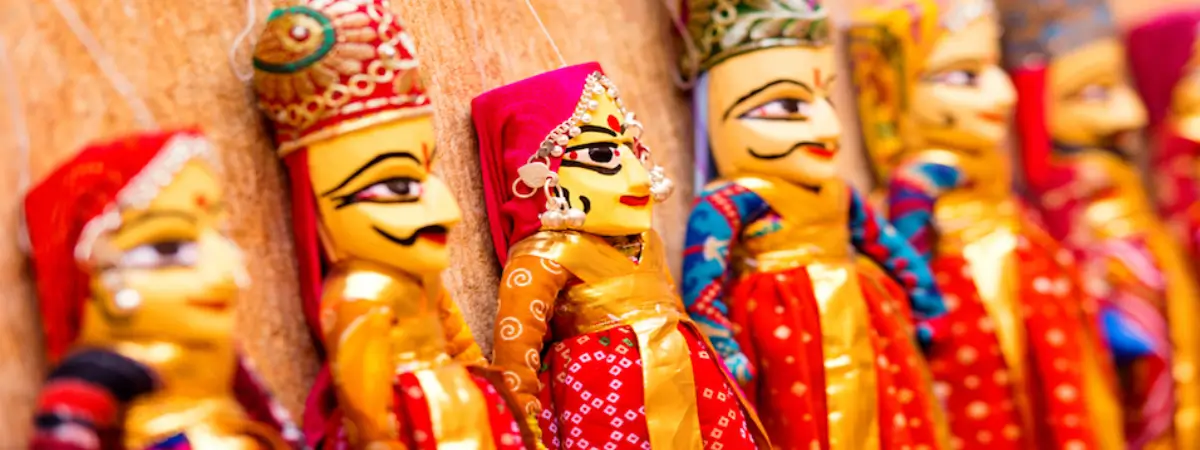
Indigo-stained hands, the thud of a teak block on cotton and the smell of wet clay are what you take home from our Rajasthan Art Textile and Handicraft Tour. Instead of hurrying from fort to fort, this eleven-day route follows the makers. In Jaipur you meet blue pottery artists, lac bangle sellers and gem cutters; in Sanganer you watch handmade paper lifted from vats of pulp; in Bagru you print fabric with the mud-resist method known as dabu. Jodhpur brings tie-dye workshops and the durrie weavers of Salawas, Barmer adds the bold appliqué and mirror embroidery of the desert communities, and Udaipur ends the trip with miniature painting and the terracotta plaques of Molela. Every workshop is a working family business, not a showroom.
Travel is by private car and driver, so you can stop when a dyer's cloth is drying in a field or a potter is firing a kiln by the road. A local English-speaking guide with a background in textiles or crafts joins you in each city, and several days include hands-on sessions: printing your own scarf in Bagru, painting a small miniature in Udaipur, and trying the potter's wheel in Kakani. Museums are chosen for their craft collections, from the Anokhi Museum of Hand Printing at Amber to the textile galleries of Mehrangarh. For designers, collectors and curious travellers, this Rajasthan craft tour offers fair buying straight from artisans, with no commission-driven shopping stops.
Tour Highlights
 Package Includes:
 Package Excludes:
Reply within 24hrs
Your craft tour begins at Jaipur International Airport, or at the railway station if you arrive by train from Delhi. Our representative meets you with a name card and introduces your chauffeur, who drives you to a heritage hotel set in an old haveli inside or close to the walled city. Many of these buildings are themselves a lesson in Rajasthani craft, with carved jharokha windows, fresco borders and floors of polished lime plaster called araish. At check-in we hand you a small folder with the names of the artisans you will meet, the days of the hands-on sessions, and advice on carrying cash for direct purchases.
If you arrive early, use the afternoon to rest and adjust to the time difference. Later, your chauffeur can take you for a short evening walk on MI Road and to the old Rajasthali government emporium, which is useful for getting a sense of fair prices for textiles, pottery and carved wood before you start buying from the makers. Dinner at the hotel might include gatte ki sabzi, gram flour dumplings in a yogurt curry, or ker sangri, a dish of desert beans and berries. Your guide will meet you at nine tomorrow morning. Bring a light shawl, as evenings can be cool between November and February.
Overnight stay in Jaipur.
Start with the drive to Amber, eleven kilometres north of the city, but before climbing to the fort, stop at the Anokhi Museum of Hand Printing in the restored Chanwar Palkiwalon ki Haveli. The museum is closed on Mondays, so the day is arranged around that. Its small galleries explain the history of block printing in Rajasthan, the carving of teak blocks and the natural dyes used before chemical colours arrived. A printer in the courtyard demonstrates the process, and you can try stamping a pattern yourself under his direction. The haveli's restoration won a UNESCO Asia-Pacific heritage award. Its shop sells printed scarves and quilts made with the same techniques.
Walk up through the lanes to Amber Fort, where your guide points out the painted floral motifs of the Ganesh Pol and the inlay of the Sheesh Mahal, many of which inspired later Jaipur textile patterns. After lunch, return to the city for the Jaipur city tour focused on craft. At the City Palace, the textile gallery in the Mubarak Mahal displays royal robes, Kashmiri shawls, Dhaka muslin and gold-thread zari work. End at Maniharon ka Rasta, the lane where families have made lac bangles for generations, heating coloured lac over small charcoal stoves. The lacquer turns soft and glossy before being rolled and set with glass stones.
Overnight stay in Jaipur.
This morning drive sixteen kilometres south to Sanganer, a town of printers and paper makers. Begin at a handmade paper workshop, where cotton rags left over from the garment trade are beaten into pulp, lifted on screens, pressed and dried in the sun. Flower petals and leaves are sometimes added to the sheets for texture. Then visit a printing unit where Sanganeri prints are made, known for fine floral motifs on white or pale backgrounds, using blocks carved with remarkable precision. Your guide explains the difference between the Sanganer and Bagru traditions, which you will see side by side tomorrow. Look closely at the blocks and you will see outlines, fillers and background blocks, each used in turn.
Before leaving Sanganer, stop at the Shri Digamber Jain temple, with carved stone shrines dating back over a thousand years. After lunch in Jaipur, spend the afternoon at a blue pottery studio. Unlike most pottery, Jaipur blue pottery uses no clay at all; it is made from quartz powder, glass, multani mitti and gum, then painted with cobalt and copper oxides. The craft was revived in the twentieth century with the help of the Jaipur royal family and the late artist Kripal Singh Shekhawat. You can try painting a tile to take home. The finished pieces are glazed and fired at low temperature in a small kiln.
Overnight stay in Jaipur.
Today is the heart of the textile side of the tour. Drive thirty-two kilometres west of Jaipur, about forty-five minutes, to Bagru, where the Chhipa community has printed cloth for over three hundred years. Your guide introduces you to a family of printers who still use natural colours: indigo for blue, pomegranate rind and harda for yellow, alizarin for red, and a black made from rusted iron and jaggery called syahi. You see the full cycle from washing the raw cotton to boiling it in dye vats and laying it out to dry on the sandy ground beside the river. Wear clothes you do not mind getting a little stained.
The highlight is dabu printing, a mud-resist method in which a paste of black clay, lime, wheat husk and gum is stamped onto the cloth. Once dried, the fabric is dipped in indigo, and the mud blocks the dye so that the pattern stays pale. After lunch with the printing family, you print your own scarf or tablecloth using their carved blocks, which will be washed, fixed and ready to collect the same evening. Ask your guide to explain how the GI tag now protects the Bagru name. Return to Jaipur in the late afternoon and visit a gem-cutting workshop near Johari Bazaar if you still have energy.
Overnight stay in Jaipur.
Leave Jaipur after breakfast for the drive to Jodhpur, about 340 kilometres and roughly six hours. The route passes Kishangarh, famous for its eighteenth-century school of miniature painting and the image of Bani Thani, a courtly beauty with long almond eyes often called the Mona Lisa of India. If you would like, the chauffeur can stop at the Kishangarh fort area where a few families still paint in this style. Further on, the marble cutting yards along the highway show another side of Rajasthan's craft economy, with huge blocks stacked beside the road. Lunch is taken at a clean roadside restaurant near Beawar, known for its tilpatti, a sesame and jaggery sweet. The chauffeur will also stop for tea whenever you need a break.
You arrive in Jodhpur by late afternoon and check into a heritage hotel near the old city. Before dinner, walk with your guide to the Clock Tower and Sardar Market, where you will find tie-dye bandhej fabric, leather jootis and silver jewellery among the spice stalls. This is a good chance to see how local women shop for odhnis and to learn how to judge a bandhej piece: the finer the dots, the more skilled the work. Finish with a makhaniya lassi or a pyaaz kachori from a famous shop near the market. Most traders are happy to let you look without pressure.
Overnight stay in Jodhpur.
Begin at Mehrangarh Fort, but with an eye for art rather than battles. Your guide takes you to the painting galleries, where Marwar miniatures show the bold colours and court scenes of the Jodhpur school, and to the textile collection with its royal tents, including a Mughal tent of red velvet embroidered with gold. The Phool Mahal ceiling, painted and gilded in the eighteenth century, is a fine example of the gold leaf work called tehnishan. Afterwards, visit a bandhej workshop in the old city, where women tie thousands of tiny knots by hand before the cloth is dyed. The patterns are named after the way the dots are grouped, such as ekdali, chaubundi and leheriya.
After lunch, drive about twenty-five kilometres south to Salawas, a village known for its panja durries, flat-woven rugs made on upright looms using a claw-shaped tool called a panja to pack the weft. The weavers work in cotton, wool and camel hair, and the patterns change with each family. Ask before taking photographs of the women working. Continue to Kakani to meet a potter who works on a wheel turned by a stick, and try shaping a small pot yourself. Bishnoi homesteads nearby keep their yards clean and decorated with painted mud walls. Return to Jodhpur for dinner.
Overnight stay in Jodhpur.
After breakfast, drive west into the Thar Desert towards Barmer, about 200 kilometres and four hours away. On the way, stop at Balotra, a town known for its textile printing units and the Mallinath cattle fair held each spring. The landscape grows drier, with rocky outcrops, thorny shrubs and round huts called jhumpas with painted walls. Barmer lies only a short distance from the Pakistan border, and many families who settled here came from Sindh, bringing the embroidery and printing styles that make the area so important for textile lovers. Your chauffeur knows a few good tea stops along this road. Ask him to point out the communities by their dress as you pass through each village.
Check into a simple but comfortable heritage stay in the afternoon. Barmer has fewer luxury hotels than other cities on the route, but the welcome is warm and the food is excellent. Later, your local guide takes you through the town's market, where you will see appliqué quilts, embroidered bags and wood carved furniture alongside farm tools and camel saddles. Ask about the colourful turbans worn by men here, which tell you something about their community and region. Dinner might be bajra roti with garlic chutney, a staple of desert kitchens. Bring cash, as many smaller shops do not take cards. The night sky here is dark and clear, perfect for stargazing from the hotel roof.
Overnight stay in Barmer.
Today you visit the villages around Barmer where women produce some of the finest embroidery in India. Your guide takes you to a women's cooperative, where artisans from Meghwal and other communities stitch mirror work, fine Sindhi embroidery called pakko, and bold appliqué known as patchwork in English. Each community has its own stitches, colours and motifs, and the women are happy to explain them through your guide. Purchases here go directly to the makers, and prices are usually fixed and fair. You can also commission a piece to be sent to you later. Shipping can be arranged for larger quilts and bedcovers. Lunch is a simple village meal of bajra roti, kadhi and seasonal vegetables.
In the afternoon, visit a family of ajrakh printers, who use a slow resist-printing process with indigo and madder to produce deep blue and red cloth with geometric patterns. The cloth is printed on both sides and may be washed and dyed up to fourteen times. Before sunset, drive about thirty-five kilometres to the Kiradu temples, a group of eleventh-century Hindu temples in a lonely desert valley, with carved ceilings and pillars of dancers, elephants and musicians. The site is quiet, and the late light on the stone is beautiful. Carry water and a hat, as there is little shade at the site. Dinner tonight is back at the hotel.
Overnight stay in Barmer.
This is the longest drive of the trip, about 390 kilometres and seven to eight hours, so we leave soon after breakfast. The road runs south-east through Balotra and Jalore, where the granite hills rise from the plain and the old Jalore fort stands on a ridge. A short stop at a Jalore stone-cutting yard shows how the granite is shaped for temples and homes. As you climb into the Aravalli hills towards Udaipur, the landscape changes completely, with green fields, lakes and forests replacing the desert scrub you have travelled through. Keep a few snacks and a book handy for the slower stretches.
Your chauffeur arranges a lunch stop at a roadside dhaba or heritage property, and there are short breaks every two hours. You arrive in Udaipur in the late afternoon and check into a lakeside heritage hotel in the old city near Lal Ghat. The evening is free to relax, but if you would like, walk along the lanes near the Jagdish Temple, where miniature painting shops line the street. Your guide will explain tomorrow how to tell the hand-painted work from printed copies. Dinner on a rooftop restaurant facing Lake Pichola is a fine end to a long day.
Overnight stay in Udaipur.
After breakfast, drive about forty-five kilometres north to Molela, a village near Nathdwara where potters make terracotta plaques of gods and heroes used in village shrines across Rajasthan and Gujarat. The figures are built up in relief from local clay mixed with donkey dung, then fired and painted. Tribal families travel here each year to buy new plaques of their folk deities such as Dev Narayan. Your guide arranges a visit to a potter's home, where you can watch him work and buy pieces, which are fragile but can be packed for travel. Your guide will translate stories about each deity as the potter works. On the way back, pass the town of Nathdwara, known for pichwai, painted cloth hangings of Lord Krishna.
Return to Udaipur for lunch and an afternoon miniature painting class with a family of artists near the City Palace. You learn how pigments are made from minerals and plants, how brushes are made from squirrel hair, and how the gold leaf is applied and burnished with a stone. Classes usually last two to three hours, and no previous skill is needed. You then paint a simple motif, perhaps an elephant or a flower, which you can take home. In the late afternoon, take a short boat ride on Lake Pichola, or visit the Udaipur City Palace galleries with their Mewar paintings.
Overnight stay in Udaipur.
After a final breakfast with a view of the lake, there is time for any last purchases or for packing the textiles, pottery and paintings you have collected. Your guide or our team can help with packing fragile items or arranging shipping through a trusted courier if your bags are already full. Most artisans you met along the way can also send orders later by post, and we keep their contact details for you. If your flight is in the afternoon, a quick visit to Shilpgram, the rural arts complex three kilometres west of the city, is possible. Your guide will also share a list of trusted stores in case you want to reorder from abroad.
At the time agreed, your chauffeur drives you to Maharana Pratap Airport, about twenty-five kilometres east of the city and forty minutes away. The chauffeur will help with your bags at the terminal. From Udaipur there are direct flights to Delhi and Mumbai for international connections. Our team stays in touch until your flight departs, and we are always happy to help with any follow-up orders. We hope the trip has given you a deeper sense of the craft families of Rajasthan and the skill that lies behind every printed cloth, painted tile and stitched mirror. Thank you for choosing Heritage India Private Tours, and please send us a photograph of your hand-printed Bagru scarf when you wear it at home.
Hear what our happy guests say about their India adventures! From private drivers to guided tours, we make every journey smooth, safe & unforgettable.
 rating score: 5.0 of 5, based on 448 reviews

Complete our inquiry form

Customize your itinerary

Confirm when you're satisfied
1-to-1 Service | Reply within 24hrs | Expert's Advice