Bengaluru - Mysuru - Somanathapura - Hassan - Hampi - Badami - Pattadakal - Aihole - Chennai - Mahabalipuram - Thanjavur
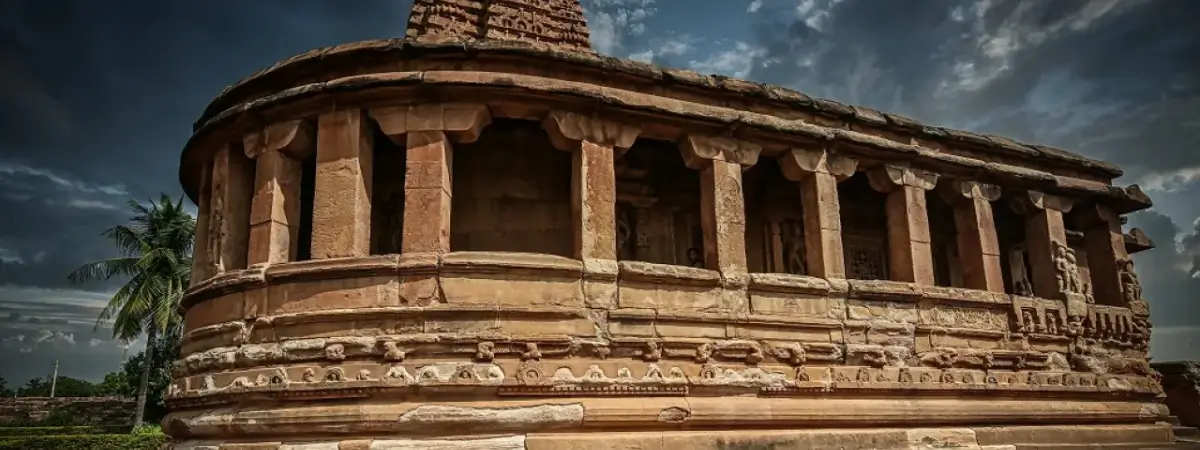
Five dynasties shaped the stone landscape of southern India, and this South India UNESCO Heritage Sites Tour follows them in roughly the order an architecture lover would want: the Hoysala sculptors of Karnataka, the Vijayanagara builders of Hampi, the early Chalukya masons at Badami, Aihole and Pattadakal, the Pallava carvers of Mahabalipuram and finally the Chola temple architects of the Kaveri delta. Over nineteen days you visit five World Heritage properties, along with Badami and Aihole, which sit on India's tentative list and arguably deserve full status. Travel is by private car and driver across Karnataka and Tamil Nadu, with a domestic flight from Hubballi to Chennai replacing the dullest and longest stretch of highway, so your energy goes into temples rather than traffic jams.
The pace is deliberate. Hampi gets three nights because its ruins spread across more than 40 square kilometres of boulder country, and Thanjavur gets three more so you can see the great Chola temples in both morning and evening light. Your local guides are chosen for their knowledge of iconography rather than their patter, so expect to learn how to read a Nataraja bronze, why Hoysala temples stand on star-shaped platforms and how Pattadakal sets northern and southern temple styles side by side. Between the monuments there is ordinary Karnataka and Tamil Nadu life: strong coffee in Mysuru, a coracle ride on the Tungabhadra, bronze casters at Swamimalai and banana-leaf lunches in temple towns. Comfortable heritage and modern hotels with daily breakfast complete the arrangement.
Tour Highlights
 Package Includes:
 Package Excludes:
Reply within 24hrs
Your flight lands at Kempegowda International Airport, roughly 40 km north of central Bengaluru, and our representative meets you outside the arrivals hall with a name board. Your chauffeur, who stays with you for the whole Karnataka section of the tour, loads the bags into an air-conditioned car and drives you into the city, a ride of about an hour depending on traffic along Bellary Road. Most international flights reach Bengaluru late at night or in the small hours, so we request early check-in wherever the hotel allows it. Nothing is scheduled today. Sleep off the flight, adjust to the time difference and let the slightly cooler air of the Deccan plateau, close to 900 metres above sea level, do its work.
If you arrive in daylight and feel restless, take a short walk through Cubbon Park, a green space of almost 300 acres laid out by the British, where the red Attara Kacheri, now the High Court of Karnataka, faces the granite bulk of the Vidhana Soudha across the road. Neither building is a UNESCO site, but both borrow freely from the temple styles you will study over the coming weeks, and the Vidhana Soudha in particular copies Dravidian pillars and gopuram-style roofs on a government scale. In the evening your tour coordinator calls in to hand over vouchers, go through the route day by day and answer questions about dress codes at working temples.
Overnight stay in Bengaluru.
Bengaluru is usually treated as a technology capital, but its older layers make a useful primer for the trip. The morning starts at Tipu Sultan's Summer Palace near the old fort, a two-storey teak structure finished in the late eighteenth century, with carved arches and faded painted panels. A few minutes away, the Kote Venkataramana Temple, built under the Wodeyars, shows Dravidian and Vijayanagara details on a modest scale. Your guide then heads to Basavanagudi to see the Bull Temple, where a monolithic Nandi nearly five metres long sits under a sixteenth-century roof, and the nearby Dodda Ganapathi shrine. A stop at a darshini, one of the city's stand-up eateries, brings crisp masala dosa and a lesson in how locals order fast.
After lunch the drive continues to Lalbagh Botanical Garden, begun by Hyder Ali and extended by his son Tipu. The glasshouse, modelled on London's Crystal Palace, hosts flower shows twice a year, and one of the four watchtowers raised by Kempe Gowda, the city's founder, stands on a rock outcrop inside the garden. That outcrop is Peninsular Gneiss, around three billion years old and protected as a national geological monument, part of the same ancient Deccan bedrock that Vijayanagara masons later quarried at Hampi. The late afternoon is free, or your driver can take you to the Karnataka Chitrakala Parishath gallery to see Mysore-style paintings. Dinner can be a coastal Mangalorean seafood meal or a simple thali.
Overnight stay in Bengaluru.
After breakfast you leave Bengaluru on the Mysuru expressway, and the first proper stop is Srirangapatna, an island town wrapped by two arms of the Kaveri River. This was Tipu Sultan's capital and the place where he died defending it against the British. Your guide walks you through Daria Daulat Bagh, his summer palace, closed on Fridays, whose verandas are covered from floor to ceiling with painted murals of battles, processions and courtiers; much of the paint is original and surprisingly fresh. Nearby lie the spot where Tipu fell, the dungeon where British officers were held and the Ranganathaswamy Temple, a Vishnu shrine far older than the fort walls around it.
Continue to the Gumbaz, the domed mausoleum Tipu built for his father Hyder Ali, where ebony doors inlaid with ivory and tiger-stripe paintwork on the inner walls show his favourite emblem. From there it is a short run into Mysuru, a city of wide avenues and royal buildings that still feels unhurried. Check in, then spend the late afternoon at leisure or visit the Jaganmohan Palace art gallery, which hangs Raja Ravi Varma oils alongside traditional Mysore gesso paintings with their raised gold work. That comparison will prove handy later, when you look at temple murals in Hampi and Thanjavur and start to recognise how the southern painting traditions borrowed from one another.
Overnight stay in Mysuru.
Start early at Chamundi Hill, a granite rise on the edge of the city topped by the Chamundeshwari Temple and its seven-storey gopuram. Halfway up the thousand-step path, which your driver can shortcut by road, sits a Nandi nearly five metres tall carved from a single block of black stone in the seventeenth century and still garlanded daily by devotees. The view from the summit takes in the whole of Mysuru, with the Kaveri country stretching south towards the Nilgiris. On the way down your guide stops at St Philomena's Cathedral, a neo-Gothic church with twin spires and a crypt, built for the city's Catholic community and still crowded at Sunday mass.
The afternoon belongs to the Amba Vilas, better known as Mysuru Palace, an Indo-Saracenic building completed for the Wodeyar kings after the earlier wooden palace burned down. Inside, the Kalyana Mantapa has a stained-glass ceiling made in Glasgow and a floor of peacock-patterned tiles, while the Durbar Hall rises on carved pillars picked out in gold. Walk afterwards to the Devaraja Market for heaps of jasmine, betel leaves, kumkum powder and Mysore pak from Guru Sweets, run by the family credited with creating the sweet. On Sundays and public holidays the palace is lit by close to 100,000 bulbs for about forty-five minutes after seven in the evening, a sight worth timing your dinner around.
Overnight stay in Mysuru.
This is the first true UNESCO day. Drive about 35 km east to Somanathapura, a quiet village where the Keshava Temple, consecrated by a Hoysala general named Somanatha, stands inside a walled courtyard lined with 64 cells. It is a trikuta, three shrines sharing one hall, raised on a star-shaped jagati platform. The temple forms part of the Sacred Ensembles of the Hoysalas, inscribed by UNESCO together with Belur and Halebidu. Your guide points out the signature of the master sculptor Mallitamma on several panels, the horizontal friezes of elephants, horsemen, scrolls and epic scenes, and the lathe-turned pillars inside the hall, polished to an almost metallic sheen.
With the temple seen in soft morning light, the drive continues north-west through sugarcane and coconut country around Mandya to Hassan, the base for the next two Hoysala sites. Lunch is at a roadside eatery serving ragi mudde, the finger-millet ball that is the staple of rural southern Karnataka, with saaru and palya on the side. Hassan itself is a working market town rather than a tourist place, which makes it a calm and practical stop for two nights. Check in during the afternoon, rest, and use the quiet evening to read about Hoysala history and the soft green chloritic schist those sculptors favoured, ahead of a long day among their finest carvings tomorrow.
Overnight stay in Hassan.
Belur lies about 38 km from Hassan, and the Chennakeshava Temple there was begun under King Vishnuvardhana to mark his victories over the Cholas; it took more than a century to finish. The outer walls carry rows of elephants, lions and horses, but the real draw are the madanikas, the bracket figures of dancers, huntresses and a woman admiring herself in a hand mirror, set at an angle beneath the eaves. Inside the dim hall, the Narasimha pillar was once said to rotate on its base. Your guide carries a torch to light the ceiling domes, and you will remove your shoes at the entrance, so bring socks for the hot stone.
A 16 km drive brings you to Halebidu, once the Hoysala capital of Dwarasamudra, sacked by armies from Delhi in the fourteenth century. The Hoysaleswara Temple here is a pair of shrines to Shiva, joined on a common platform and fronted by two huge Nandi pavilions. Its outer walls hold some of the densest sculpture in India, with horizontal bands of animals, foliage and Puranic stories running continuously around the building. Before driving back, stop at the small group of Jain bastis a short walk away, whose polished black stone pillars reflect your face like a mirror. The ASI site museum at Halebidu is closed on Fridays, so we arrange the day accordingly.
Overnight stay in Hassan.
Today is the longest road day of the Karnataka section, so the car leaves soon after breakfast. The route heads north through Arsikere and Hosadurga, with fields of sunflowers, maize and coconut groves giving way to the drier, rock-strewn country of the central Deccan. Around midday you reach Chitradurga, a fort of seven concentric walls climbing a hill of giant boulders, held by the Nayaka chiefs and later by Hyder Ali. A short guided walk covers the Hidimbeshwara Temple, the oil pits, the granaries cut into the rock and the narrow gap in the wall linked to Onake Obavva, a woman who defended the fort single-handed with a wooden pestle.
After lunch at Chitradurga, the final stretch runs past wind turbines and the Tungabhadra canals to Hosapete and on to Hampi, about two and a half hours. Watch the landscape change in the last half hour: piles of orange granite boulders, banana farms and paddy beside irrigation channels that the Vijayanagara kings first cut. Your hotel is either near Kamalapura, close to the royal centre, or in Hosapete, depending on availability. The evening is free. If energy remains, your driver can take you to the foot of Hemakuta Hill, where sunset over the Virupaksha gopuram makes a gentle introduction to the three days that follow.
Overnight stay in Hampi.
Hampi was the capital of the Vijayanagara Empire for about two centuries, and at its height travellers from Portugal and Persia described it as one of the largest cities they had ever seen. Today begins in the royal centre. Your guide starts with the Hazara Rama Temple, the private shrine of the kings, whose outer walls show long processions of horses, elephants, dancers and soldiers, much like a stone record of the Mahanavami festival. Next comes the Mahanavami Dibba, a tiered platform from which the king watched those celebrations, and the stepped tank beside it, excavated only in recent decades and built of finely dressed dark schist blocks.
Inside the Zenana Enclosure, the Lotus Mahal mixes Indo-Islamic arches with a Hindu tiered roof, a reminder that the court absorbed ideas from its Deccan Sultanate rivals. Beyond the wall stand the Elephant Stables, eleven domed chambers in a row, and the guards' quarters. After lunch at a Kamalapura restaurant, visit the Queen's Bath, with its corridor of arched balconies around a sunken pool, and the ASI Archaeological Museum at Kamalapura, closed on Fridays, which holds a scale model of the whole site. End the day at the Underground Shiva Temple, often partly flooded, and the octagonal bath on the road back towards your hotel.
Overnight stay in Hampi.
The sacred centre lies along the south bank of the Tungabhadra. Start at the Virupaksha Temple, in continuous worship since before the empire, with its painted mandapa ceiling showing scenes from the Mahabharata and a pinhole effect that throws an inverted image of the main gopuram onto an inner wall. Climb Hemakuta Hill for its cluster of early, pre-Vijayanagara shrines with stepped pyramid roofs, then walk down past the monolithic Sasivekalu and Kadalekalu Ganesha statues to the Ugra Narasimha, nearly seven metres high and carved from one boulder, with the Badavilinga standing in its water-filled chamber next door, a single lingam about three metres tall that a poor woman is said to have paid for.
In the afternoon your driver takes you round to the Vittala Temple complex, the finest building of the empire and the one printed on India's fifty-rupee note. The stone chariot stands in the courtyard, and in the main mandapa the slender musical pillars once rang with distinct notes when tapped; tapping is now forbidden to protect them. Battery vehicles run from the parking area to the gate. Finish with a coracle ride on the Tungabhadra near the Kodandarama Temple, the round bamboo boat spinning gently past boulders and riverside shrines. Hampi Bazaar, a long colonnade once full of horse and jewel traders, makes a fine walk at dusk.
Overnight stay in Hampi.
Before leaving Hampi there is time for one last morning visit. Our suggestion is Anegundi across the river, the older settlement that predates the Vijayanagara capital, with the hilltop Anjanadri temple, claimed as Hanuman's birthplace, reached by about 570 whitewashed steps. Alternatively, walk the quiet path from the Achyutaraya Temple to the base of Matanga Hill. By late morning the car heads north-west through Gajendragad and the small farming towns of northern Karnataka, where the land turns flat and black-soiled, ideal for cotton and jowar. Lunch can be a plate of jolada rotti, the thin jowar flatbread of the region, with stuffed brinjal curry and spicy groundnut chutney powder.
Badami sits in a horseshoe of red sandstone cliffs around Agastya Lake, and the setting alone justifies the detour. This was Vatapi, capital of the early Chalukyas between the sixth and eighth centuries. Check in, then spend the late afternoon at the four rock-cut cave temples in the southern cliff. Cave 1 holds an eighteen-armed dancing Shiva, Cave 3 is the largest and richest, with a seated Vishnu on the serpent Adishesha, and Cave 4 is Jain, with a fine Parshvanatha. Mind the monkeys, who take food without asking. At sunset, walk along the lake to the Bhutanatha temples on the far shore, reflected in the still water.
Overnight stay in Badami.
Aihole, about 35 km from Badami, is often called the place where Indian temple architecture first tested its ideas, and more than a hundred temples are scattered through the village and surrounding fields. Your guide concentrates on the walled Durga Temple complex, where the Durga Temple has an unusual apsidal layout wrapped by a colonnaded corridor, the Lad Khan Temple, built in the manner of a village assembly hall, and the Ravana Phadi cave with its dancing Shiva and river goddess panels. The small ASI museum beside the Durga complex is closed on Fridays. Bring a hat, because the site has little shade by late morning and the stone holds the heat.
From Aihole drive about 13 km to Pattadakal, the UNESCO-listed coronation site of the Chalukya kings on the bank of the Malaprabha. Here the northern nagara style, with curved towers, and the southern dravida style, with stepped pyramidal towers, stand in the same enclosure. The Virupaksha Temple, built by Queen Lokamahadevi to celebrate her husband's victory over the Pallavas of Kanchipuram, is the largest and still holds active worship; it is said to have inspired the Kailasa at Ellora. The neighbouring Mallikarjuna and Papanatha temples complete the picture. Return to Badami for dinner and an early night before tomorrow's flight.
Overnight stay in Badami.
If you are up early, climb the steps to the North Fort for a last view over the cliffs, the lake and the Upper Shivalaya temple perched on the rock. After breakfast the car leaves for Hubballi Airport, a drive of about two and a half hours through cotton and onion country, where you say goodbye to your Karnataka chauffeur. This is the one hop where flying makes obvious sense: by road, Badami to Chennai is well over 700 km, a two-day slog with little to see. The flight from Hubballi to Chennai, direct or via Bengaluru depending on current schedules, takes between ninety minutes and three hours.
At Chennai Airport a new Tamil Nadu chauffeur and car meet you, and the change of region is immediately obvious: the language shifts from Kannada to Tamil, coffee arrives in a steel tumbler and dabarah, and the air carries the humid weight of the Bay of Bengal. The drive into the city takes forty minutes to an hour. Check in and rest. If you would like to stretch your legs, Marina Beach, one of the longest urban beaches in the world, lies a short drive from most central hotels, and vendors walk the sand in the evening selling sundal, spiced boiled chickpeas served in a paper cone.
Overnight stay in Chennai.
Chennai holds the best single collection for anyone heading into the Chola heartland. The Government Museum in Egmore, closed on Fridays, houses its famous bronze gallery, where Chola Natarajas, Somaskanda family groups and a celebrated Ardhanarishvara show lost-wax casting at its peak. Your guide explains the iconography piece by piece, so that when you later stand in the Thanjavur temples the figures already feel familiar. The same campus holds carved limestone panels from the Amaravati stupa in Andhra Pradesh. Afterwards visit Fort St George, the first British fortress in India, with St Mary's Church, the oldest Anglican church east of Suez, and the Fort Museum, which also closes on Fridays.
After a South Indian lunch on a banana leaf, cross the city to Mylapore, the old Tamil quarter that grounds Chennai in its own past. The Kapaleeshwarar Temple has a towering gopuram covered in painted stucco figures and a large tank where festivals take place. Your guide tells the legend of Parvati worshipping Shiva in the form of a peahen, which gave Mylapore its name. Nearby, the San Thome Basilica is built over the tomb traditionally linked to Thomas the Apostle. Finish with a walk through the Mylapore lanes selling brass lamps, flower garlands and kolam powder, then dinner at your hotel or a local restaurant.
Overnight stay in Chennai.
Leave Chennai on the East Coast Road, which runs south between the sea and a string of lagoons. About halfway, stop at DakshinaChitra, a living museum of South Indian vernacular architecture, closed on Tuesdays. Whole houses have been moved here and rebuilt beam by beam: a Chettinad merchant's mansion, a Kerala Syrian Christian home, a Karnataka weaver's house and an Andhra potter's hut. It is a good counterpoint to the royal monuments, showing how ordinary people lived in the shadow of the temples. Craftspeople work on site, so you may see a potter at the wheel or a basket weaver splitting palm leaf. The canteen serves simple local meals.
Continue to Mahabalipuram, the Pallava port town whose seventh- and eighth-century monuments form one of the earliest groups of Tamil stone architecture. Check in near the beach, then in the late afternoon visit the Shore Temple, two shrines to Shiva and a smaller one to Vishnu built of dressed granite right at the water's edge. Salt spray has softened the carvings over thirteen centuries, giving them a melted look, and the rows of Nandi figures on the compound wall are almost worn smooth. Stay for sunset, when the granite turns pink against the darkening sea, then have grilled fish at one of the restaurants on Othavadai Street.
Overnight stay in Mahabalipuram.
The group of monuments at Mahabalipuram is spread over a low granite ridge, and a guided walk in the cool of the morning covers the heart of it. Arjuna's Penance, a relief nearly thirty metres long carved across two boulders, shows gods, sages, hunters and life-sized elephants gathered around a natural cleft that once carried water to represent the descent of the Ganga. The Krishna Mandapa beside it shows cowherds sheltering under Govardhana Hill. Climb up to the Mahishasuramardini cave, where Durga rides a lion against the buffalo demon, then see the old lighthouse on the ridge and Krishna's Butter Ball, a vast boulder balanced on a slope.
After lunch, drive a short way south to the Five Rathas, monolithic shrines cut from one long outcrop and named after the Pandava brothers and Draupadi. Each copies a different building type in stone, from a thatched hut to a multi-storey vimana, so together they read like an architect's model set for the whole later Dravidian tradition. A life-size stone elephant, lion and Nandi stand among them. In the late afternoon visit the Tiger Cave at Saluvankuppam, 5 km north, an open-air shrine framed by a ring of carved yali heads. Stone carvers in roadside studios throughout town keep the craft alive, shaping granite by hand.
Overnight stay in Mahabalipuram.
A long but rewarding day. The car follows the East Coast Road south, skirts Puducherry and crosses into the Kaveri delta with its paddy fields, palmyra palms and village shrines. By late morning you reach Chidambaram, where the Nataraja Temple has a gold-plated roof over the hall of the dancing Shiva, and the gopurams carry the 108 karanas, the poses of classical dance, carved in sequence. Men must remove their shirts to enter the inner precinct, and the temple closes from around noon until the late afternoon, so timing matters. Your guide will suggest a quick lunch of rice meals served on banana leaves at a nearby vegetarian eatery.
Another hour brings you to Gangaikonda Cholapuram, the capital founded by Rajendra Chola after his armies reached the Ganga. Its temple, part of the UNESCO-listed Great Living Chola Temples, deliberately echoes the Thanjavur shrine built by his father, but with a slightly lower tower and a gently concave profile, as if the son chose grace over size. The site is quiet, with few visitors, and the carved Chandesanugraha panel, showing Shiva garlanding a devotee, is among the finest Chola reliefs anywhere. Continue through Kumbakonam to Thanjavur, arriving by early evening, tired but with a strong sense of how the Chola style evolved.
Overnight stay in Thanjavur.
Rajaraja Chola completed the Brihadeeswarar Temple a little over a thousand years ago, and it still dominates the Thanjavur skyline. Arrive in the morning, when the granite of the 66-metre vimana glows gold, and walk in through the two entrance towers. Inside, a monolithic Nandi weighing around twenty tonnes faces the sanctum, which holds one of the largest lingams in India. Your guide points out the inscriptions running around the base, which record the names of temple dancers, musicians and accountants alongside the gifts of gold and cattle given by the king, and the Chola frescoes in the inner corridor, revealed when later Nayaka paintings were peeled away.
After lunch, visit the Thanjavur Royal Palace, built by the Nayaka and Maratha rulers who followed the Cholas. The art gallery inside displays a superb collection of Chola bronzes and stone sculpture, the Sangeetha Mahal was designed with acoustics for court concerts, and the Saraswathi Mahal Library preserves palm-leaf manuscripts in Tamil, Sanskrit and Marathi. Later, your driver can stop at a workshop making Thanjavur paintings, with gold foil and glass stones on wood, and at a shop selling the bobble-headed Thanjavur dolls. Return to the temple after dark, when the floodlit tower stands out against the night sky and the courtyard is far quieter.
Overnight stay in Thanjavur.
The third of the Chola temples on the UNESCO list sits at Darasuram, about 35 km from Thanjavur, and many visitors find it the most rewarding of all. The Airavatesvara Temple, built under Rajaraja II, is smaller in scale but carved with astonishing detail: the front mandapa is shaped as a chariot with stone wheels drawn by horses, the entrance steps once gave out musical notes, and miniature panels on the base show dancers, acrobats and episodes from the lives of the sixty-three Nayanar saints. Your guide also shows you the small relief of a figure that is an elephant and a bull at once, a classic Chola optical riddle.
Continue a few kilometres to Swamimalai, the village where bronze casters still produce icons by the lost-wax method described in old Sanskrit texts, using fine alluvial clay from the bed of the Kaveri. At a family workshop you watch a wax figure being modelled, coated in clay, fired and filled with molten metal, which closes the circle on the Chola bronzes seen in Chennai. In Kumbakonam, visit the Sarangapani and Adi Kumbeswarar temples and the Mahamaham tank, then try degree coffee, the frothy local brew made with fresh milk and chicory. Return to Thanjavur in the evening for a farewell dinner.
Overnight stay in Thanjavur.
On your final morning, enjoy a slow breakfast before the transfer. Tiruchirappalli International Airport lies about 60 km west of Thanjavur, an hour and a half by car, with flights to Chennai and Bengaluru for international connections as well as some direct services to Singapore, Kuala Lumpur, Colombo and the Gulf. If your departure is in the evening, your driver can stop on the way at the Rock Fort in Tiruchirappalli, climbing more than 400 rock-cut steps past Pallava cave temples to the Ucchi Pillayar shrine on the summit, or at the Ranganathaswamy Temple in Srirangam, the largest functioning temple complex in India.
Travellers who prefer to fly home from Chennai can instead take an express train from Thanjavur or Tiruchirappalli to Chennai Egmore, booked in an air-conditioned class, or a direct road transfer of around seven hours. Whichever option suits your onward flight, your chauffeur sees you to the terminal or platform and our team stays in touch by phone until you depart. Over nineteen days you will have walked through five UNESCO properties and the stories of five dynasties, from Hoysala schist to Chola granite. We hope a later trip brings you back to see the northern temples of Khajuraho, or the painted caves of Ajanta and the rock-cut Kailasa at Ellora.
Hear what our happy guests say about their India adventures! From private drivers to guided tours, we make every journey smooth, safe & unforgettable.
 rating score: 5.0 of 5, based on 448 reviews

Complete our inquiry form

Customize your itinerary

Confirm when you're satisfied
1-to-1 Service | Reply within 24hrs | Expert's Advice