Delhi - Agra - Bharatpur - Jaipur - Pushkar - Ajmer - Delhi
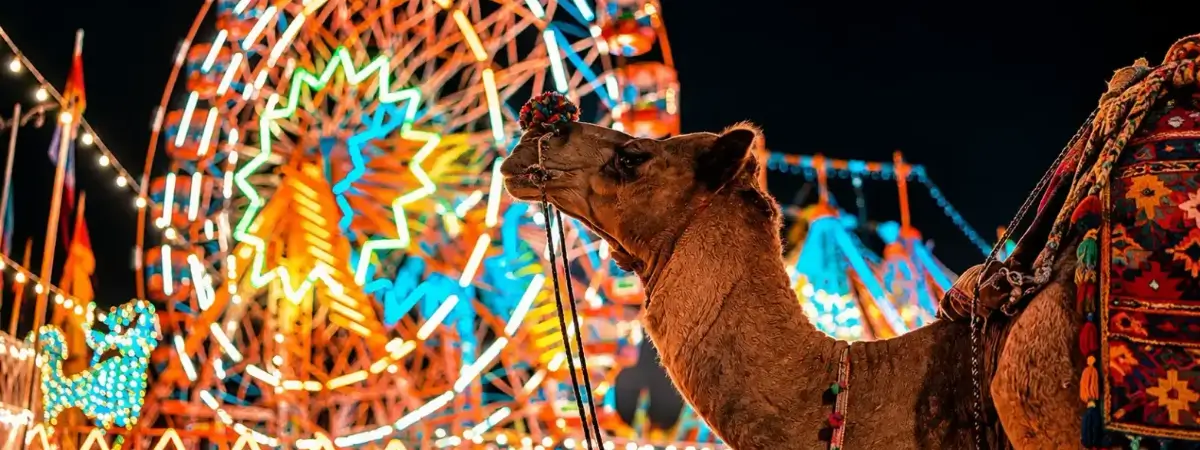
Every autumn, tens of thousands of camels, horses and cattle walk across the Thar Desert to a small holy town on the edge of the Aravalli hills, and for about a week Pushkar becomes the most photographed place in Rajasthan. Our Golden Triangle Tour with Pushkar Camel Fair Experience pairs that spectacle with the three great cities of North India. The fair follows the Hindu lunar month of Kartik and ends on Kartik Purnima, the full moon that falls in October or November, so we set your dates around the moon rather than a fixed calendar day. You travel with a private car and driver from Delhi to Agra, Bharatpur, Jaipur and Pushkar, then return to Delhi by the comfortable Shatabdi Express train from Ajmer.
The fair has two sides, and we time your stay to see both. The early days belong to the herders: Raika and Rabari families in bright turbans haggling over camels on the dunes, smoke from cooking fires, and blacksmiths hammering out bells and anklets for the animals. The final days turn spiritual, as pilgrims bathe in Pushkar Lake and float leaf lamps on its water at dusk. In between, the mela ground hosts camel races, a longest-moustache contest and cheerful tug-of-war matches between locals and visitors. Before reaching Pushkar, the Pushkar fair tour gives you the Taj Mahal, a birding morning in Keoladeo National Park and the forts of Jaipur, and you sleep in a desert tented camp close to the fairground.
Tour Highlights
 Package Includes:
 Package Excludes:
Reply within 24hrs
Our representative meets you at Indira Gandhi International Airport as you come out of customs and introduces you to your chauffeur, who drives you to your hotel in about forty-five minutes. On the drive, you will receive a short printed itinerary and a local SIM card if you have requested one. Because this tour is about the Pushkar fair, we also hand you a light cotton scarf, useful against desert dust and sun on the fairground. The rest of the day belongs to you, and after a long-haul flight the wisest choice is usually a shower, a meal and an early night in a comfortable bed.
If you arrive before mid-afternoon and want to stretch your legs, ask your driver to take you to Hauz Khas Village in south Delhi. The ruins of a fourteenth-century madrasa and the tomb of Feroz Shah Tughlaq stand above a lake where cormorants and herons perch in the trees, and the lanes behind them are full of design boutiques and small cafes. It is a relaxed place to adjust to Indian time and to take your first photographs. As the sun sets, the domes are lit, and the lake path fills with Delhi families out for a walk. Overnight stay in Delhi.
Begin in Old Delhi at Khari Baoli, Asia's largest wholesale spice market, where porters carry sacks of dried chillies, turmeric, cardamom and saffron through narrow lanes, and the air will make you sneeze within minutes. Climb the stairs of the Gadodia Market building to its rooftop for a view over the old city and the domes of the Fatehpuri Masjid. Your guide then walks you through Paranthe Wali Gali, a lane famous since the nineteenth century for stuffed fried flatbreads. These market streets are excellent practice for the photography you will be doing among the crowds and colours at Pushkar.
After lunch, drive to Purana Qila, the old fort that the Mughal emperor Humayun and the Afghan ruler Sher Shah Suri both claimed, and see the Qila-i-Kuhna mosque and the Sher Mandal library tower. Then pass by the Rashtrapati Bhavan and India Gate on Kartavya Path. In the late afternoon, walk into the Nizamuddin basti, a medieval neighbourhood of narrow alleys around the Dargah of Hazrat Nizamuddin Auliya, a fourteenth-century Sufi saint. Most evenings after sunset, qawwali singers perform in the courtyard, with Thursday being the most popular night. Leave your shoes at the entrance and cover your head. Overnight stay in Delhi.
Drive to Agra after breakfast along the Yamuna Expressway. Check in to your hotel, have lunch and then meet your Agra guide for the Taj Mahal in the softer light of the afternoon. The Taj is closed on Fridays, so our itinerary avoids that day. Your guide explains the symmetry of the complex, why the mosque on the west side is mirrored by an identical guest hall on the east, called the jawab, and how the main tomb rests on a high plinth so that nothing behind it breaks the skyline. Walk around the back terrace to look out over the Yamuna, where washermen often lay sheets out to dry.
In the late afternoon, cross to the far bank of the river to Kachhpura, a farming village directly opposite the Taj that most visitors never see. A local guide from a community project walks you through the lanes, past a sixteenth-century Mughal mosque called the Humayun Masjid, into small homes where women make hand-rolled bidis and stitch cloth bags. Children play cricket in the fields, buffaloes cool off in the river, and the white dome of the Taj rises above it all. You return to the city as the sun goes down. Your community guide also explains how the project funds the village school. Overnight stay in Agra.
Leave Agra early after a packed breakfast and drive about an hour to Bharatpur and the Keoladeo National Park, a UNESCO World Heritage wetland once used as the duck shooting reserve of the Bharatpur maharajas. Cars are not permitted inside, so you travel the main track by cycle rickshaw with a rickshaw puller who is also a trained naturalist. Around the time of the Pushkar fair, the first winter migrants are arriving from Central Asia and Siberia. Look for painted storks on their nesting trees, sarus cranes, the tallest flying birds in the world, as well as pelicans, kingfishers, spotted owlets and the occasional golden jackal.
Back at the car by late morning, continue along the highway into Rajasthan. Your chauffeur stops for lunch at a roadside dhaba, where you can try dal, fresh tandoori roti and sweet lassi served in clay cups. You reach Jaipur in the middle of the afternoon and check in to your hotel. The evening is free, and many guests choose to walk through the illuminated Patrika Gate at Jawahar Circle, a colourful gateway with painted panels depicting the history of Rajasthan. Ask your chauffeur to stop at Lassiwala on MI Road for a thick saffron lassi. Overnight stay in Jaipur.
Today's Jaipur city tour starts on the Aravalli ridge. After visiting Amber Fort with its marble Jai Mandir and the latticed screens of the zenana where royal women lived out of public view, take the road up to Jaigarh Fort, the military fort that protected Amber from above. It houses the Jaivana, a massive eighteenth-century cannon on wheels that was test-fired only once, as well as huge water tanks that once stored the fort's monsoon supply. From the ramparts, you can see the old walls running along the hills for miles like a smaller Great Wall. Bring water and a hat, as there is little shade on the upper walls.
After lunch, head into the walled city for the City Palace and the Jantar Mantar observatory. Later in the afternoon, drive to the Galta Ji temple complex in a narrow gorge east of the city. Its seven stepped water tanks are fed by a natural spring, pilgrims bathe in them, and hundreds of macaques chase each other across the temple roofs, which explains its common name, the Monkey Temple. Climb to the small Surya Mandir at the top of the ridge to watch the sun set over Jaipur, a fine warm-up for your desert days at Pushkar. Overnight stay in Jaipur.
Drive to Pushkar after breakfast on the Ajmer highway. In fair season, you will start to see camel carts and herders on the roadside as you near the town. Check in at your tented camp close to the mela ground. The tents are spacious, with proper beds and attached bathrooms, and the camp has a dining tent serving Rajasthani and continental food. In the afternoon, walk with your local guide to Pushkar Lake, a sacred lake ringed by fifty-two ghats where pilgrims bathe. You may be offered flowers to float by self-styled priests; politely decline unless you want to make an offering, and agree on the donation in advance.
Next, visit the Brahma Temple, one of the very few in India dedicated to Brahma, the creator of the universe, with its red spire and a silver turtle set into the floor. Then wander along Sadar Bazaar, the main street, which sells silver jewellery, rose products from local farms, leather bags and embroidered textiles. As evening comes, return to the lake for the maha aarti at Varaha Ghat or Brahma Ghat, with brass lamps, bells and chanting priests reflected in the water. Dinner is served at the camp, often with a folk music and dance performance by a Kalbelia group. Overnight stay in Pushkar.
Set your alarm well before dawn. With your guide, walk out to the trading grounds on the dunes, where herders have been camping for days with their camels, horses and cattle. In the early light, smoke drifts from cooking fires, men in turbans drink chai and smoke hookahs, and buyers inspect teeth and legs before haggling. This is the most rewarding time for photography. Ask before taking close portraits; a smile and a few words usually do the trick. You will see camels decorated with shaved patterns in their fur, beaded necklaces and anklets with brass bells. Your guide can translate, and many herders enjoy seeing their portraits on your camera screen.
Return to camp for breakfast, then head to the mela ground stadium for the day's programme. Events vary from year to year, but often include the camel decoration contest, the longest-moustache competition, the bridal competition, turban tying for foreigners, the matka phod pot race and a lighthearted football or tug-of-war match between villagers and tourists. Fairground stalls sell everything from saddles to sugarcane and toys. In the late afternoon, take a camel cart ride out to the dunes for sunset with a cup of chai. If the organisers are running hot air balloon flights during your visit, our team can try to book one at extra cost. Overnight stay in Pushkar.
As the fair approaches Kartik Purnima, pilgrims stream into Pushkar to bathe in the lake on the most sacred days of the Hindu calendar. Spend a quiet morning on the ghats watching families perform rituals, or take the ropeway up to the Savitri Temple on a hilltop south of town for a wide view of the lake, the town and the fairground. Afterward, visit the Old Rangji Temple, a south Indian style shrine with a tall gopuram gateway, which shows how pilgrims from all over India built their own temples here. The ropeway saves a steep climb of around forty minutes on foot, though some pilgrims still walk.
After lunch, drive fifteen kilometres over Nag Pahar to Ajmer to see the Dargah of Khwaja Moinuddin Chishti, the shrine of a twelfth-century Sufi saint visited by people of all faiths, where devotees offer rose petals and chadars at the tomb. Nearby is the Adhai Din ka Jhonpra, an early mosque with fine carved arches. Return to Pushkar by late afternoon for the evening deepdaan, when thousands of small leaf boats holding lamps and flowers are set afloat on the lake, turning the water into a field of tiny flames. It is a fitting farewell to the fair. Overnight stay in Pushkar.
Spend a slow morning at the camp or go back to the fairground for a last look and any souvenirs. After lunch, check out, and your chauffeur drives you down to Ajmer railway station, about thirty minutes away. Your local representative helps you with luggage and seating on the Ajmer–Delhi Shatabdi Express, a fast train with air-conditioned chair cars, where meals and tea are served at your seat. The journey to New Delhi takes around six and a half hours through the farmland of eastern Rajasthan and Haryana. Pack a light sweater, as the train air conditioning can feel cool. The train usually leaves Ajmer in the afternoon, and seats are allocated in advance.
Your chauffeur, meanwhile, drives the empty car to Delhi, or we arrange a second car to meet you on the platform at New Delhi Railway Station when the train arrives in the evening. From there you are transferred to Indira Gandhi International Airport for your late-night flight home. If your flight departs the following day, we can book an airport hotel so that you can rest before the journey. Most guests leave with memory cards full of camels and sunsets, and a light layer of Pushkar sand in their shoes. We look forward to welcoming you back. Safe travels home.
Hear what our happy guests say about their India adventures! From private drivers to guided tours, we make every journey smooth, safe & unforgettable.
 rating score: 5.0 of 5, based on 448 reviews

Complete our inquiry form

Customize your itinerary

Confirm when you're satisfied
1-to-1 Service | Reply within 24hrs | Expert's Advice