Delhi - Agra - Jaipur - Jodhpur - Udaipur - Delhi
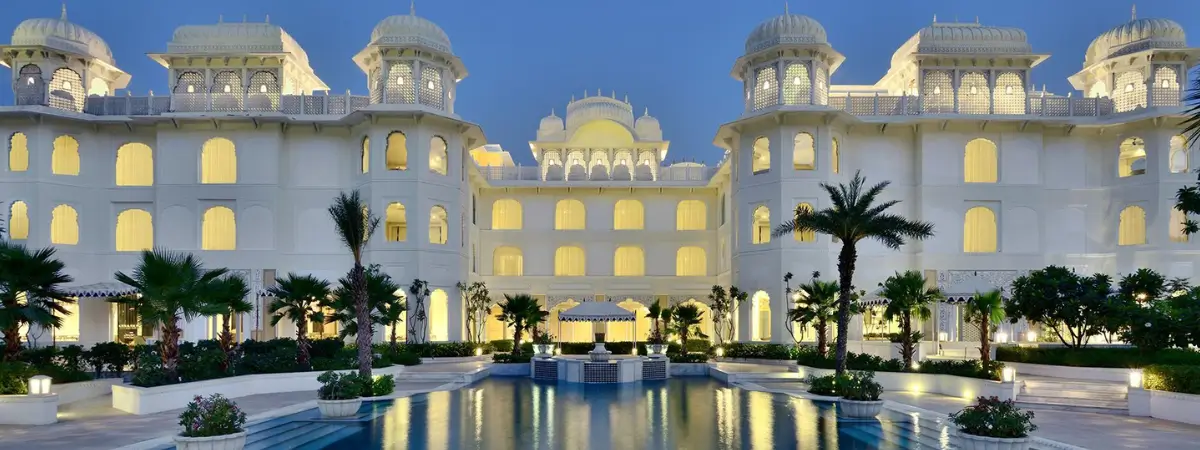
Many of Rajasthan's noble families still live in the homes their ancestors built, and some of them now open those courtyards, painted halls and rooftop terraces to a small number of guests. Our Luxury India Tour with Palace and Heritage Hotels is built around these personal addresses rather than large chain properties. Over twelve days you sleep in a colonial landmark in Delhi, a Mughal-style hotel near the Taj Mahal, a family haveli in Jaipur, a boutique retreat below Mehrangarh in Jodhpur and a wing of the royal palace in Udaipur. Often the owner joins guests for a drink at sunset, and the stories you hear across the dinner table, about polo matches, tiger hunts and royal weddings, become part of the trip itself.
Sightseeing gets the same personal touch. Your private car and driver stay with you the whole way from Delhi to Udaipur, and a short domestic flight brings you back at the end. Beyond the classic Rajasthan heritage tour sights, we add places most itineraries miss: lunch inside the mirrored Durbar Hall of Samode Palace, the miniature painting town of Kishangarh, a jeep ride through the Bishnoi villages near Jodhpur, the thirty-six-kilometre wall of Kumbhalgarh, and the carved temples of Nagda near Udaipur. Three nights in Jaipur and three in Udaipur give real breathing space. It is a route for travellers who value character and conversation over marble lobbies, and who enjoy rooms that feel lived in.
Tour Highlights
 Package Includes:
 Package Excludes:
Reply within 24hrs
Whatever time your plane lands, a Heritage India Private Tours host waits outside the international arrivals area with your names printed on a card. Your chauffeur for the coming ten days lifts the cases into the boot, and you set off for Janpath in the heart of New Delhi. Our usual choice for these two nights is The Imperial, subject to availability, a white Art Deco hotel opened in 1931 just as Lutyens' new capital was being finished. Long verandahs hung with old lithographs of the Raj, teak floors and the tall royal palms along its approach make it feel almost like a country house, despite sitting a few hundred metres from Connaught Place.
Your host hands over a leather folder holding vouchers, guide names and contact numbers, and points out on a map where each heritage property lies. After check-in, rest for as long as you need. If you are awake in the late afternoon, take tea in the hotel's 1911 bar, named for the year King George V announced the move of the capital from Calcutta to Delhi. A short walk around the corner leads to Connaught Place, the circular Georgian-style shopping district with white colonnades, ideal for an easy first stroll. Dinner at the hotel's Spice Route restaurant is a gentle start. Overnight stay in Delhi.
Your Delhi historian joins you at nine to peel back the city's older layers, one dynasty at a time. The first stop is Purana Qila, the Old Fort, raised by Humayun and Sher Shah Suri in the sixteenth century on a site that some believe was Indraprastha of the Mahabharata. Within its gates you find a graceful Afghan mosque of five arches, and Sher Mandal, a two-storey pavilion Humayun used as a library; he slipped on its steep stairs in 1556 and died of his injuries. From here you continue to the National Museum on Janpath, where the Harappan seals, the Chola bronzes and the miniature painting gallery reward even a short visit. The museum is closed on Mondays.
After lunch at a quiet cafe in Khan Market, rest at the hotel until about five. Then, on Thursday evenings, your guide takes you into the medieval lanes of Nizamuddin Basti, past stalls selling rose petals and sheets of embroidered cloth, to the marble shrine of the fourteenth-century Chishti saint. After the call to evening prayer, qawwals sit in the courtyard and sing devotional poems by Amir Khusrau, clapping and building to a powerful climax. On other days we visit the courtyard at dusk and the nearby tomb of the Mughal princess Jahanara instead. Shoes are left outside and heads covered. Overnight stay in Delhi.
Sleep in, then linger over eggs and masala chai on The Imperial's verandah, because the car does not leave until about eleven. Following the Yamuna Expressway past sugarcane and wheat fields, you reach Agra in the early afternoon. Our usual choice here is the Mughal-style ITC Mughal or a smaller Taj-view boutique hotel, subject to availability, and check-in is quick, leaving time for lunch on the lawn. Your Agra guide meets you at three, and the visit to the Taj Mahal is timed for the late afternoon, when the marble takes on warm amber tones and the long shadows of the cypress avenues fall across the water channels.
Because the Taj Mahal closes on Fridays, your route is adjusted so that this visit is never set on a Friday. Inside, your guide shows details most people walk past, such as the four minarets tilted a few degrees outward so that any collapse would spare the dome, and the floral carvings in the dado panels, so fine you can see veins on the leaves. Afterwards, wander with the guide through Kinari Bazaar, the old market lane behind the Jama Masjid of Agra, and try petha, the translucent candied pumpkin sweet the city is famous for. Overnight stay in Agra.
Breakfast is early, and by eight thirty the car is on the road west. In about an hour you reach Fatehpur Sikri, Akbar's short-lived capital, which your guide presents through the lives of the people who lived there. You stand in the large courtyard of Jodha Bai's Palace, the residence of the senior Rajput queen, whose turquoise-glazed roof tiles and carved temple bells show her Hindu faith, and step into Birbal's House, the richly carved home said to have belonged to the emperor's witty minister. Nearby, the Anup Talao is a square pool with a central platform where the great musician Tansen is said to have performed for the court.
The road then crosses into Rajasthan, reaching Jaipur by about three. Your home for three nights is a family haveli in the old quarter of town; our usual choices are Samode Haveli or Alsisar Haveli, subject to availability. Samode Haveli, a two-hundred-year-old townhouse of the Rawals of Samode, has a painted dining room and a courtyard pool shaded by old trees. Spend the rest of the afternoon resting in the garden, and in the evening join the other guests for a drink on the terrace while the staff serve fresh pakoras, before dinner in the frescoed dining hall. Overnight stay in Jaipur.
Today's Jaipur sightseeing stays inside the walls of the Pink City, and most of it is done on foot. First comes the City Palace; its Mubarak Mahal, built in 1900 to receive foreign guests, now displays royal garments, among them the enormous quilted robes made for a ruler who was famously tall and heavy. The Sileh Khana armoury next door holds swords, shields and daggers decorated with gold and precious stones. From here, walk through the Jaleb Chowk to the Govind Dev Ji temple, where the bells and conch shells of the morning prayer draw crowds to see Krishna, the patron deity of the royal family.
After lunch, stroll with your guide down Tripolia Bazaar, where shops sell brass utensils, lac bangles and kites, to the base of Isarlat, a seven-storey tower built in 1749 to mark a military victory. A narrow spiral ramp, rather than stairs, leads to the top, from where the chessboard of streets drawn up by the Bengali architect Vidyadhar Bhattacharya in 1727 suddenly makes sense, nine blocks echoing the nine planets of Hindu astronomy. Return to the haveli for an evening at leisure, or book a special dinner arranged by the owners on the rooftop, with baked baati dumplings, panchmel dal and sweet churma served by lamplight, followed by stories of the family's history from your hosts. Overnight stay in Jaipur.
Amber Fort gets a fresh angle today, with an eight o'clock start to beat the crowds. This time your guide focuses on the old Man Singh palace at the back of the complex, the oldest part of the fort, built around a central pavilion with rooms for the queens and narrow corridors connecting them. From the high walls you look up at the snaking ramparts of Jaigarh and the restored Kesar Kyari saffron garden in the middle of Maota Lake below. Afterwards, pause at the Kanak Vrindavan gardens, a quiet group of eighteenth-century temples at the foot of the Nahargarh hills.
From Amber the car heads north about forty kilometres to Samode, a village tucked into the Aravalli hills. Samode Palace, the ancestral home of the same family who own the haveli in Jaipur, was enlarged in the nineteenth century into one of the most richly decorated buildings in Rajasthan. Lunch is served in the palace, after which you visit the Durbar Hall and the Sheesh Mahal, every surface of which glitters with mirror work, painted flowers and hunting scenes. Enjoy a walk through the village before returning to Jaipur in time for sunset tea on the haveli terrace. Overnight stay in Jaipur.
Today the highway leads west toward Marwar, the old desert kingdom of the Rathores. After about two hours you reach Kishangarh, a former princely state famous for its school of miniature painting, especially the elegant Bani Thani portrait with its long almond eyes and pointed chin. Visit the old Phool Mahal palace beside Gundalao Lake and a small studio where artists still paint with brushes made of squirrel hair and colours ground from minerals. Kishangarh is also India's largest marble trading town, and the road is lined with yards of white and green stone. Lunch is at the Phool Mahal Palace hotel, overlooking the lake, where the dining room still has its original painted ceiling.
The drive continues past Ajmer and across the flat Marwar plain, reaching Jodhpur around five. For two nights we usually book RAAS Jodhpur, subject to availability, a boutique hotel created inside an eighteenth-century nobleman's mansion directly below Mehrangarh Fort, with a pool overlooking the walls. In the evening, walk a few minutes to Toorji ka Jhalra, a red sandstone stepwell built by a queen in the 1740s and recently cleared of rubbish and restored, now surrounded by cafes. Dinner on the hotel's rooftop terrace comes with the floodlit fort above you and peacocks crying somewhere on the rocks. Overnight stay in Jodhpur.
Mehrangarh is just a few minutes away on foot, so you walk up early with your guide before the coach groups arrive. Inside the fort, look for the Takhat Vilas, the private bedroom of Maharaja Takhat Singh, painted with dancers and Krishna scenes and hung with Christmas baubles from Europe, and the Moti Mahal, the pearl palace, whose walls were polished with crushed seashells to make them shine. At the far end of the ramparts the small Chamunda Mata temple honours the goddess of the Rathore family. For something lively, the Flying Fox zipline course runs across the walls and lakes of the fort.
After lunch, an open-top jeep heads into the scrubland south of Jodhpur to visit Bishnoi villages, home to a community that has protected trees and wildlife for five centuries. Blackbuck antelope and chinkara graze near the houses without fear. You meet a potter working at a hand-spun wheel, a family weaving cotton dhurries on a pit loom, and village elders who may perform the amal ceremony, a traditional welcome in which a drink is offered from the palm of the host's hand. Return to the hotel at sunset for a quiet dinner by the pool, perhaps with the local mirchi bada, a large green chilli fritter stuffed with spiced potato. Overnight stay in Jodhpur.
The car leaves Jodhpur after breakfast and drives south through rural Marwar, where scrub gives way to green fields and mango groves as the road rises into the hills. After around four hours you reach Kumbhalgarh, a fortress built by Rana Kumbha on a ridge eleven hundred metres high. Its wall loops for thirty-six kilometres over the ridges, broad enough for eight horsemen abreast, and shelters some three hundred and sixty temples. Climb with your guide to the cloud palace at the very summit, where the view stretches over the hills toward the Thar desert. In good weather you can pick out the line of the wall rolling away for miles.
Lunch is at a heritage lodge near the fort, then a winding descent of about two hours brings you to Udaipur. Our usual choice for the last three nights is Shiv Niwas Palace, subject to availability, a semicircular annexe of the City Palace run by the house of Mewar, with suites decorated in original furniture and views over Lake Pichola. Toward dusk, take a drink at the Paanera bar beside the marble pool. The hotel staff can also arrange for you to watch the royal horses being exercised in the palace stables, or to see the Mewar collection of vintage cars. Overnight stay in Udaipur.
The Udaipur sightseeing programme starts right on your doorstep, inside the palace you are staying in. With a private guide, you walk through the women's apartments, now hung with Mewar court paintings, the Manak Mahal, glittering with glass inlay, and the Amar Vilas, a raised garden with a marble pool and neem trees growing several storeys above the ground. The guide tells the story of the Mewar dynasty, the oldest ruling house in the world, which claims descent from the sun. Lunch is at a cafe on Lal Ghat, near the lakeshore, where the dal and rice come with a view of women washing clothes on the steps.
In the afternoon, drive east to Ashram Ahar, the old royal cremation ground, where some 250 domed cenotaphs of the Mewar rulers stand in neat rows, and visit the small archaeological museum next door with four-thousand-year-old pottery. Later, the car follows the road beside Fateh Sagar Lake, a calm reservoir surrounded by hills. A motorboat takes you to Nehru Garden on its central island, a public garden with fountains and a boat-shaped cafe. Return to Shiv Niwas Palace as the lights of the city reflect on Lake Pichola, and enjoy a quiet evening in the palace courtyard. Overnight stay in Udaipur.
Head north this morning on the Nathdwara road for half an hour to Eklingji, where a walled enclosure of 108 shrines honours Shiva as the true sovereign of Mewar. The main temple, of carved marble and sandstone, houses a black stone image with four faces, and the maharanas regard themselves as regents ruling on behalf of the god. Mobiles must be deposited at the gate, and men may be asked to cover bare legs. A few kilometres on lies Nagda, on the shore of Bagela Lake, where the tenth-century Saas-Bahu temples are covered from base to roof with carvings of musicians, dancers and gods.
Head back into Udaipur for a light lunch and some free time. Around four, a family in a haveli near Jagdish Chowk welcomes you into their home kitchen for a hands-on lesson. The hostess shows you how to grind spices for a Mewari curry, cook dal in a heavy brass pot, and roll out makki ki roti made of maize flour. Afterwards, the dishes you have made are laid out on brass thalis and you share the meal with your hosts. Your guide then drives you back to the palace, where you can spend your last evening by the lake, with a final dinner in the open-air Paanera restaurant. Overnight stay in Udaipur.
On your last morning, take breakfast on the palace terrace as the first boats push off across the lake and temple bells ring from the ghats. The car runs out along the Chittorgarh road to Dabok airport, where you board the seventy-five-minute flight to Delhi. Farewells to a chauffeur who has driven you over twelve hundred kilometres, through desert, hills and city traffic, are rarely brief, and many guests exchange addresses and promise to send photographs. Our representative meets you at Delhi airport and escorts you to Terminal 3, or first to an airport hotel day room if your flight home leaves near midnight.
With an afternoon to spare in Delhi, the representative can arrange a final visit to Sunder Nursery, or a quiet lunch at the Imperial, where your journey began twelve days earlier. Before you board, our Jaipur office will call to make sure everything has gone well and to hear your thoughts about the heritage hotels, the people who run them, and the meals they served. For many guests, this kind of personal, family-style hospitality is the main reason to return to India, perhaps to the forts of Shekhawati, the lakes of Bundi or the tea gardens of Darjeeling on the next visit.
Hear what our happy guests say about their India adventures! From private drivers to guided tours, we make every journey smooth, safe & unforgettable.
 rating score: 5.0 of 5, based on 448 reviews
Complete our inquiry form

Customize your itinerary

Confirm when you're satisfied
1-to-1 Service | Reply within 24hrs | Expert's Advice