Jaipur - Pushkar - Jodhpur - Jaisalmer - Jodhpur - Udaipur - Bundi - Jaipur
Three or four nights in each town changes everything about how Rajasthan feels. Instead of ticking off forts before lunch, you learn which chai stall the shopkeepers of Chandpole prefer, which ghat in Pushkar stays quiet at dawn, and which baker in Jodhpur sells mawa kachori still warm at nine. Our Rajasthan slow travel tour runs for twenty-one days across six places, with a private car and driver who stays with you from the first morning to the last airport drop. Mornings are kept for the big sights, afternoons are often left open, and evenings belong to food, music and conversation. The pace suits travellers who have already seen the highlights of India once, or who simply prefer depth to distance, and who would rather return home knowing a few streets well than a hundred landmarks badly.
The route opens in Jaipur with block printing in Bagru and a cooking lesson in a family kitchen, then moves to the lake town of Pushkar for village walks and rose-field mornings. Jodhpur brings dhurrie weavers in Salawas and the Bishnoi villages, while Jaisalmer gives you three nights inside the sandstone world of havelis, abandoned Paliwal settlements and a night under desert stars. Udaipur slows things further with a miniature painting class and long lake evenings, and Bundi closes the circuit with stepwells and palace murals that few tour groups ever reach. Every day includes local English-speaking guides where they add value, and plenty of unhurried time where they do not. This is a Rajasthan cultural tour shaped around people, crafts and kitchens as much as monuments.
Tour Highlights
 Package Includes:
 Package Excludes:
Reply within 24hrs
Your chauffeur meets you at the Sanganer airport terminal or Jaipur Junction station, holding a name card and a cold bottle of water. The drive into the Pink City takes around thirty minutes, passing Jawahar Circle and the long stretch of Tonk Road before the older walls appear. After check-in, there is no schedule at all for the afternoon. Long trips start better when the body is allowed to adjust, so we suggest a nap, a shower and a slow cup of masala chai on the hotel terrace. Your chauffeur will hand over a printed sheet with phone numbers, the shape of the coming three weeks and a few useful phrases in Hindi that shopkeepers always appreciate hearing from visitors.
Around sunset, if energy allows, your driver can take you to Chandpole for a short first walk through the old city. The lanes near the gate are a working market rather than a tourist strip: copper vessel sellers, flower stalls and men frying hot kachori on iron woks. Stand for a while at the corner of Kishanpole Bazaar and watch the traffic of scooters, cows and cycle rickshaws find its own order. Dinner can be simple tonight, perhaps a thali at a local vegetarian place recommended by your chauffeur. The idea is to arrive gently and let Jaipur introduce itself at its own speed before the longer days begin.
Overnight stay in Jaipur.
The morning begins early at Amber Fort, reaching the gates around eight before the heat and coach groups arrive. Your local guide walks you through the public audience hall, the painted arch of Ganesh Pol, and the mirrored walls of Sheesh Mahal, then down to the women's wing of Man Singh I's palace, set around a central baradari pavilion. Rather than rushing on, take time on the ramparts looking down on Maota Lake and the saffron garden. On the way back, stop briefly at Panna Meena ka Kund, a geometric stepwell behind the fort where the criss-cross stairs make wonderful photographs in the soft morning light.
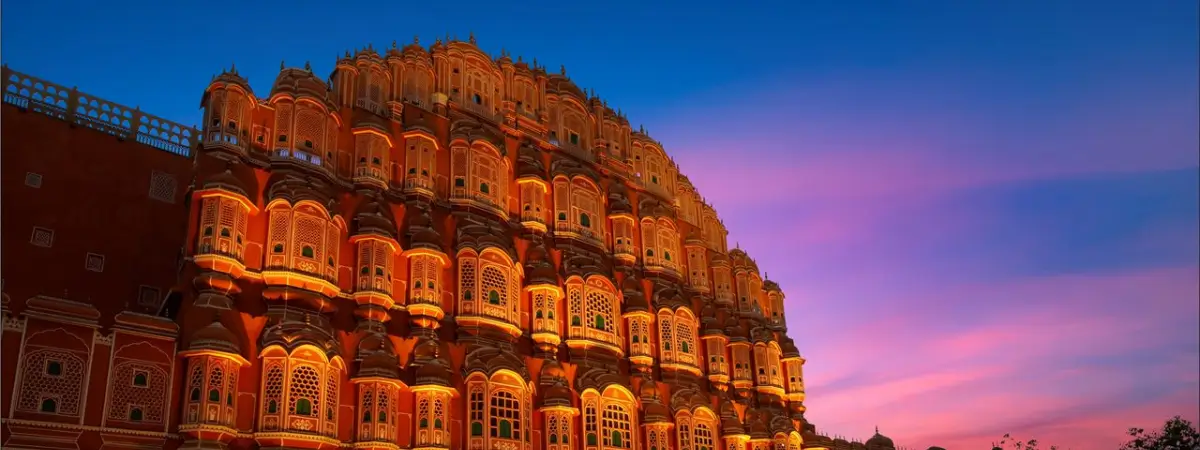
Following lunch and a siesta, the walled city is covered on foot. Start at the City Palace with the Mubarak Mahal textile gallery and the four painted gates of Pritam Niwas Chowk, then cross to Jantar Mantar, where the guide shows how the Samrat Yantra sundial reads time to two seconds. Hawa Mahal is best seen from the cafés opposite, with a lime soda in hand. Finish with a stroll through Johari Bazaar as the shop lights come on, watching gem cutters and silversmiths at work behind narrow counters. Evening is free for dinner near the hotel or a quiet walk.
Overnight stay in Jaipur.
Today leaves the monuments behind for the craft villages south-west of Jaipur. Bagru is about 35 km away, a drive of roughly one hour, and has been home to the Chhipa community of printers for generations. You spend the morning in a family workshop, watching natural dyes being prepared from indigo, pomegranate rind and iron rust, then carving patterns are explained before you print your own scarf or table runner with teak wood blocks. The dabu technique, which uses a mud resist paste, is particular to this village and is fascinating to watch from start to finish. Lunch is home-cooked by the printer's family, usually bajra roti, kadhi and a seasonal vegetable.
In the afternoon your chauffeur drives to Sanganer, closer to the city, where handmade paper is still produced from cotton rag. The process of pulping, pressing and drying sheets in the sun is surprisingly calm and repetitive, and the small shops sell notebooks and gift wrap made on site. On the return, there is time for a pause at the Jain temple of Sanganer, known for its fine stone carving and quiet inner sanctum. Evenings like this one are meant for rest, journaling and a relaxed meal. Ask your chauffeur about rooftop dinners in the old city if you would like a view of the lit walls.
Overnight stay in Jaipur.
Morning starts at a family home in a residential part of Jaipur for a hands-on cooking lesson. The lady of the house begins at the market, choosing vegetables, curd and spices with you, then moves to the kitchen to teach dal baati churma, the classic Marwari combination of lentils, baked wheat rolls and sweet crumble. You also roll phulkas on a flat iron tawa and learn the tempering secrets behind gatte ki sabzi, gram flour dumplings in a yoghurt gravy. Lunch is the meal you cook, eaten together with the family. Conversations often wander to weddings, school, local politics and festivals, which is exactly the point of a day like this.
Late afternoon, your driver takes you east of the city to Galta Ji, the temple complex in a narrow gorge, known locally as the Monkey Temple. Natural springs fill a series of tanks where pilgrims bathe, and the walk uphill to the Surya Mandir gives a sweeping view of Jaipur at sunset. Your guide explains the Ramanandi tradition linked to the site and the role of the sadhus who still live here. The return passes through the Ghat Ki Guni valley with its old garden pavilions. Pack tonight for the morning drive to Pushkar, keeping a light bag for easy days ahead.
Overnight stay in Jaipur.
After breakfast, the drive west towards Pushkar follows the national highway through farmland, mustard fields in winter and small towns with roadside dhabas. Your chauffeur can stop at Kishangarh, famous for its marble market and a distinctive school of miniature painting known for the Bani Thani portrait. If you would like, a short detour leads to the white marble dumping yard, an unusual landscape that looks almost like snow. Pushkar is reached by early afternoon over the Nag Pahar hill road, which gives a first glimpse of the lake held in a bowl of rocky hills, surrounded by temple spires and old guesthouses.
Check-in is followed by a free afternoon. Pushkar is a pilgrimage town, so alcohol and non-vegetarian food are not served inside town, and visitors are asked to remove shoes on the ghats. In the evening, walk with your guide to Gau Ghat for the lamp ceremony, when brass lamps are waved over the water and bells ring across the lake. Afterwards, try malpua from one of the sweet shops on the main bazaar, a fried pancake soaked in syrup that Pushkar is known for across Rajasthan. The town quietens by ten, which makes for deep sleep.
Overnight stay in Pushkar.
Pushkar rewards those who wake early. At first light, the ghats are filled with priests, bathers and the sound of chanting, and the low sun turns the white temple domes pale gold. Your guide leads a slow walk around part of the lake, explaining which ghats carry special significance, including Brahma Ghat and Gandhi Ghat, where some of Mahatma Gandhi's ashes were scattered. A short warning is worth sharing: some self-appointed priests offer flowers and then ask for large donations, so politely decline unless your guide introduces you. Later, visit the Brahma Temple with its red spire, a rare shrine to Brahma, the four-faced creator, who is seldom worshipped elsewhere.
Once lunch has settled, take the ropeway up to Savitri Mata Temple on Ratnagiri hill, dedicated to Brahma's first wife. The ride takes only a few minutes and spares a steep climb of nearly an hour. From the top, the entire town, lake and the sand country beyond spread out below, and the late afternoon light is especially soft here. Back in town, browse the market lanes for leather journals, silver jewellery and cotton clothing at an unhurried pace. Dinner can be at a rooftop café overlooking the lake, where falafel and Israeli dishes sit beside Rajasthani thalis on the menu.
Overnight stay in Pushkar.
This is a quiet countryside day. Ganahera, about 6 km from Pushkar, is surrounded by rose fields grown for the town's temples and for gulkand, the sweet rose petal preserve. In the cooler months, picking happens early in the morning, and farmers are often happy to show how the petals are dried and sorted. Your guide walks you through the village lanes, past mud-plastered homes painted with simple designs, the local school and a small temple where elders gather. A stop at a rose water distillery explains the slow process of steaming petals in copper vessels, and you can taste fresh gulkand on bread.
Back in Pushkar, lunch is followed by a long free afternoon. Some guests take a yoga session with a local teacher, others read by the lake or sit in a chai shop near Sadar Bazaar watching pilgrims pass. In the late afternoon, an optional camel cart ride takes you into the low dunes on the edge of town for sunset, a gentle preview of the bigger desert still to come. Ask your chauffeur to recommend a family-run place for dinner, where a thali of kadhi, ker sangri and bajra roti makes an excellent final Pushkar meal, finished with a small bowl of rabri.
Overnight stay in Pushkar.
After a slow breakfast, the drive to Jodhpur heads west through Merta, a small town with the Meera Bai temple dedicated to the sixteenth-century poet-saint who wrote devotional songs to Krishna. A short stop here gives a feeling for the devotional culture of the Marwar region, and the temple courtyard is usually calm and welcoming. The road then passes through dry farmland, villages with stone fences and herds of goats moving slowly along the verges. Jodhpur appears as a sweep of blue-washed houses below the sheer cliff of Mehrangarh, one of the most dramatic city views in all of India.
After check-in, your guide takes you on an afternoon walk through the old blue city around Navchokiya, where many houses still carry the indigo-washed walls. The lanes are steep, narrow and full of daily life: children returning from school, women filling brass pots, small shrines on every corner. End at Toorji ka Jhalra, a restored eighteenth-century stepwell with carved steps descending to green water, surrounded by small cafés. Dinner tonight is best with a view of the fort, lit golden against the night sky from a rooftop near the clock tower. Try mirchi bada, the stuffed green chilli fritter that Jodhpur claims as its own, before the main course arrives.
Overnight stay in Jodhpur.
Start at Mehrangarh Fort at opening time, entering through Jai Pol and climbing gently past the handprints of royal widows at Loha Pol. The fort museum is one of the best kept in the country, with galleries of royal palanquins, howdahs, turbans and arms, and the painted rooms of Phool Mahal and Takhat Vilas. An audio guide is available, though your local guide adds stories that the recordings leave out. Next, walk into the Rao Jodha Desert Rock Park below the walls, a restored landscape of native plants and volcanic rock, where an easy trail loops around for an hour or so in peaceful silence.
After lunch, drive about 20 km to Salawas, a village known for its flat-woven dhurrie rugs. Weavers work on horizontal looms set into the ground, often whole families together, using cotton, wool or camel hair. The patterns are counted by memory rather than drawn, and watching a design slowly appear is absorbing. On the way back, stop at Jaswant Thada, the white marble cenotaph built in memory of Maharaja Jaswant Singh II, which glows warmly in the late afternoon. Evening is free to wander the Sardar Market around the clock tower, best for spices, tie-dye fabrics and kitchen goods.
Overnight stay in Jodhpur.
Leave Jodhpur early and spend the first part of the morning in the Bishnoi villages south of the city. The Bishnoi community follows twenty-nine principles laid down by Guru Jambheshwar, including a strict protection of trees and wildlife, and it is common to see blackbuck and chinkara grazing close to their homes. You visit a family compound, see the ritual preparation of amal, an opium-water offering made traditionally to guests, and stop at a potter's house in Kakani. Then turn north-west on the long road to Jaisalmer, which crosses open desert with very little traffic. Expect around five and a half hours of driving after the village visits, with your chauffeur pausing whenever you want a photograph.
The drive passes Pokaran, where a short break for tea and a view of the old fort helps break the journey. The landscape changes noticeably after this point, with fewer fields, more scrub and long sandy stretches. Jaisalmer appears on the horizon as a honey-coloured fort rising from the flat plain, a sight that most travellers remember for a long time. Check in and rest. In the evening, walk to Gadisar Lake, an old reservoir lined with small temples and chhatris, where catfish rise to bread thrown from the ghats and the sky turns pink. The carved Tilon ki Pol gateway at the lake's edge is especially pretty at this hour.
Overnight stay in Jaisalmer.
Jaisalmer Fort is one of the very few forts in the world still lived in, with around three thousand residents within its walls. Your guide walks you in through Akhai Pol and Ganesh Pol, past homes, guesthouses and shops, to the Raj Mahal palace museum. Then come the seven Jain temples inside the fort, dating from the twelfth to the sixteenth centuries, each carved in yellow sandstone with dancing figures, elephants and intricate ceiling domes. The temples open to visitors only until around noon, so they are worth seeing in the morning. Climb to the ramparts near the cannon point for a view across the rooftops of the lower town.
After lunch, step down into the old city to the havelis that made Jaisalmer famous. Patwon ki Haveli is a cluster of five houses built by a family of brocade traders, with balconies so finely carved they look like lace. Nathmal ki Haveli was built by two brothers working separately, which explains why the two halves do not quite match. Salim Singh ki Haveli has a peacock-shaped roof and a curious overhanging top floor. The evening is free, perhaps for a puppet show or a quiet dinner of ker sangri and pyaaz kachori on a rooftop facing the lit fort.
Overnight stay in Jaisalmer.
A relaxed morning leads to an afternoon departure into the desert. Your first stop is Bada Bagh, a garden of royal cenotaphs about 6 km north of town, best at the edge of the day when the domes cast long shadows. Then drive about 20 km west to Kuldhara, a Paliwal Brahmin village abandoned in the early nineteenth century. Walking among the roofless houses and temple, your guide shares the local stories about why its people left overnight. Close by, Khaba Fort sits on a small ridge with a museum of fossils and old artefacts found in the area, including ammonite shells from a time when this desert lay under the sea.
Continue to the dunes at Khuri, roughly 45 km south-west of Jaisalmer, which are quieter and less commercial than the busy Sam dunes. A short camel ride takes you onto the sand for sunset, followed by a folk music evening in the camp with Manganiyar singers and a dinner of dal, bajra roti and desert vegetables cooked over wood. Away from city lights, the night sky here is extraordinary, and the camp staff will happily point out the brighter constellations. Tonight your bags stay in Jaisalmer, so pack only a small overnight bag.
Overnight stay in the Khuri desert camp near Jaisalmer.
Wake early for sunrise on the dunes and a cup of chai by the fire before your chauffeur drives you back to Jaisalmer, about one hour. Collect your bags and transfer to the railway station for the late-morning express train to Jodhpur. Your car travels separately by road. The train journey is one of the pleasures of this tour: an air-conditioned chair car or sleeper class, vendors with tea and samosa, and a window onto the Thar that a car never quite matches. Watch for camel carts, village shrines and wide sandy horizons while families share snacks and stories along the carriage.
Your chauffeur will be waiting on the Jodhpur platform for the short drive to your hotel. This overnight in Jodhpur exists to break the long desert crossing, so the evening is kept light and restful. If you feel like stretching your legs, stop at the Umaid Bhawan Palace museum in the late afternoon, which shows royal clocks, vintage cars and art deco furnishings from the 1930s and 1940s. Alternatively, return to a favourite lane from your earlier visit, or try the famous makhaniya lassi at a shop near the clock tower. An early night prepares you for tomorrow's scenic drive.
Overnight stay in Jodhpur.
The road south leaves the desert behind and climbs into the green Aravalli hills. Midway, stop at Ranakpur to visit the Chaumukha Jain Temple, a fifteenth-century masterpiece of white marble with 1,444 carved pillars, no two alike. Your guide points out the carved Parshvanath relief entwined with serpents and the bell that sounds through the halls. Non-Jain visitors are allowed in from noon, and leather items, food and menstruating women are traditionally not permitted inside, which your guide will explain respectfully. Lunch can be taken at a local restaurant nearby among the trees, and the temple grounds themselves are calm enough to sit in quietly for a while after the visit.
The afternoon drive winds through the hills of the Aravalli range, past streams, villages and mango trees, before descending towards the lakes of Udaipur. You arrive in the early evening and check in for four nights, the longest stay of the second half of the tour. There is nothing scheduled tonight. Udaipur is best taken slowly, and the first evening is perfect for a simple walk to a nearby ghat to watch the floodlit City Palace reflect on Lake Pichola. Dinner can be lakeside, with a plate of laal maas or paneer tikka and a cold drink.
Overnight stay in Udaipur.
The City Palace is Rajasthan's largest palace complex, built over four centuries by successive Mewar rulers. With your guide, walk through Mor Chowk with its glass peacock mosaics, the Badi Mahal garden courtyard set on the top of a hill, and the Zenana Mahal, which now displays royal palanquins and paintings. The views across Lake Pichola to Jag Mandir and the Lake Palace are excellent from the upper windows. Afterwards, walk downhill to Jagdish Temple, built by Maharana Jagat Singh in 1651, with carved elephants along its plinth, and watch the morning worship. Sit for a while on the temple steps; the flow of devotees, flower sellers and bell ringers tells you a great deal about daily life in the old city.
In the afternoon, let your guide lead you through the lanes of the old town around Gangaur Ghat and Lal Ghat, where traditional houses lean towards the water. Visit Bagore ki Haveli, a restored mansion with rooms of puppets and turbans, including one claimed to be among the largest in the world. In the evening, return here for the Dharohar folk dance show, a lively hour of Mewari and Rajasthani dance, including the balancing of brass pots on the head. Dinner is free tonight; try dal pakwan or a traditional thali at a family-run place, and ask for the seasonal mango or kesar lassi.
Overnight stay in Udaipur.
The morning is reserved for a painting lesson with a local miniature artist in the old city. Udaipur is a centre of the Mewar school, and the artist demonstrates the use of squirrel-hair brushes, natural pigments ground from stone, and the layering technique that brings out fine detail. You then try painting a simple motif such as an elephant, a peacock or a lotus on paper or silk under patient guidance. Most guests find these two to three hours quieter and more personal than any museum visit. Lunch can be near the studio, followed by a long rest. Your finished piece is yours to keep, and the artist can mount it for travel.
Late afternoon brings a boat ride on Lake Pichola from the jetty near the City Palace. The boatman steers a wide loop around Jag Niwas, home of the Taj Lake Palace, and along the washing steps of Gangaur Ghat before stopping at Jag Mandir island, where you can walk among the carved stone elephants and gardens. Time the ride to end around sunset, when the palace walls turn amber and the lights begin to appear on the ghats. Afterwards, a rooftop dinner at Ambrai Ghat offers one of Udaipur's loveliest night views of the palace across the water. Arrive early to get a table at the railing.
Overnight stay in Udaipur.
A short morning drive of about 22 km north brings you to Eklingji, a fortified complex of 108 temples dedicated to Shiva, the protecting deity of the Mewar rulers. Photography is not allowed inside, and the main shrine has set opening hours, so your guide will time the visit accordingly. Nearby, the eleventh-century Sas-Bahu temples at Nagda sit beside a quiet lake, carved with figures of dancers, musicians and gods in remarkable detail. Very few visitors come here, which gives the site an almost private feel. Bring a hat and water, as there is little shade, and allow about an hour to wander between the two shrines and along the water's edge, where egrets and kingfishers are often seen.
Back in Udaipur by lunchtime, your afternoon is unscheduled. Some guests take a cycle ride around Fateh Sagar Lake, others visit Saheliyon ki Bari, a royal pleasure garden of rain fountains and lotus tanks. Shilpgram craft village on the western edge of town is another gentle option, with traditional huts from across western India. For sunset, head up the winding forest road to Sajjangarh, built in 1884 to watch monsoon clouds gather, for a wide view over the lakes and the surrounding Aravalli hills. Pack tonight for the road east towards Bundi, leaving out a warm layer, as mornings in the Hadoti hills can be cool in winter.
Overnight stay in Udaipur.
Today's drive heads north-east, crossing the farmland of Mewar towards the Hadoti region. A worthwhile stop comes at Menal, about 90 km before Bundi, where a cluster of eleventh-century Shiva temples sits beside a seasonal waterfall and deep gorge. The Mahanaleshwar temple is beautifully carved, and in the monsoon months the waterfall is a dramatic sight. Your chauffeur can also stop at the Bijolia temple group further on if time allows. The road passes small market towns where buffalo carts and tractors share the way with buses. A lunch stop at a simple dhaba near Bijolia offers hot parathas and sweet milky tea, and the chauffeur knows which ones keep clean kitchens.
Bundi appears quite suddenly, a small town clustered beneath a hillside palace and fort. It has a slower rhythm than anywhere else on this route, with blue-washed houses and few tourists. After check-in, wander down to Nawal Sagar, the square lake in the centre of town with a half-submerged temple to Varuna in the middle. In the evening, local cafés serve simple food with views of the floodlit Garh Palace above. This is a fitting final stop for a slow journey through Rajasthan, and the next three days are deliberately loose. Bundi's evenings are hushed, broken only by temple bells and the call of peacocks from the hill.
Overnight stay in Bundi.
Bundi's Garh Palace was praised by Rudyard Kipling as one of the finest buildings he had ever seen. With your guide, climb up through Hathi Pol, the elephant gate, to the palace halls, where paintings of blue and green still cover many walls. The highlight is the Chitrashala, a small courtyard of rooms painted with scenes of Krishna, court life and hunting, among the finest murals in all of Rajasthan. The palace is not heavily restored, which adds to its charm, though some steps can be uneven, so wear sensible shoes and take your time. Carry a small torch for the dim inner rooms.
For those with energy, a steeper path continues up to Taragarh Fort, the Star Fort above the palace, with its huge water tanks and the massive Bhim Burj bastion. Watch for the resident monkeys, and keep food out of sight. After lunch and a long rest, spend the late afternoon at Sukh Mahal, the lakeside summer palace where Kipling is said to have stayed while writing parts of Kim. The adjoining Jait Sagar Lake is lined with lotus in season and is peaceful at dusk. Dinner is relaxed and local tonight, perhaps a homestyle meal of kadhi pakora and missi roti served on a family rooftop.
Overnight stay in Bundi.
Bundi is often called the city of stepwells, and this morning your guide shows you the best of them. Raniji ki Baori, built in 1699 by Rani Nathavati, descends through several levels with carved elephants and gods on its pillars and arches. Nearby, the Dabhai Kund is a vast geometric tank, with stairs on all sides creating a striking pattern of light and shadow. Also visit the Chaurasi Khambon ki Chhatri, the cenotaph of eighty-four pillars, built in the seventeenth century, with carved horses and elephants around its raised platform. Your guide also points out the lesser-known Nagar Sagar Kund twin wells near the market, still used by local women to draw water in the dry months.
The afternoon is completely free, a deliberate final pause before the journey home. Many guests return to their favourite café near Nawal Sagar, buy a few last textiles in the small bazaar near Chogan Gate, or simply sit on the hotel terrace with a book. If you would like something more, ask to be taken to the Kshar Bagh cenotaphs of the Bundi royal family, a quiet garden on the edge of town. In the evening, a farewell dinner on a rooftop with a view of the lit palace is a lovely way to close three weeks of travel.
Overnight stay in Bundi.
After breakfast and a last look at the palace above the rooftops, your chauffeur drives you back to Jaipur along the highway through Deoli and Tonk. The road is good and the journey usually takes four hours, with a tea stop at a roadside dhaba on the way. If your flight is later in the day, there may be time for a final stop in Jaipur for any shopping left unfinished, perhaps blue pottery near the Ajmeri Gate or a quick visit to a textile shop in Bapu Bazaar you saw on the first day. Your chauffeur will keep an eye on the clock so nothing feels rushed at the end.
Your chauffeur will drop you at Jaipur International Airport in good time for your onward flight or connection to Delhi. Before you go, take a moment to note down the names of the people you met along the way: the printer in Bagru, the family who taught you to cook, the weavers of Salawas and the painter in Udaipur. Slow travel builds memories around people and places rather than around photographs, and those faces tend to stay longer. Everyone at Heritage India Private Tours sends you off with thanks for a safe flight home, with the warm hope of welcoming you back to Rajasthan again, perhaps for a festival such as Teej or Diwali next time.
Hear what our happy guests say about their India adventures! From private drivers to guided tours, we make every journey smooth, safe & unforgettable.
 rating score: 5.0 of 5, based on 448 reviews

Complete our inquiry form

Customize your itinerary

Confirm when you're satisfied
1-to-1 Service | Reply within 24hrs | Expert's Advice