Bengaluru - Mysuru - Kabini - Bandipur - Ooty - Wayanad - Coorg - Kochi - Munnar - Thekkady - Kochi
Somewhere along the Kabini River, usually in the last golden hour before the forest gates close, a herd of Asian elephants walks down to drink while a jeep idles quietly on the bank. Moments like that sit at the heart of this South India Wildlife and Nature Tour, a seventeen-day route through the Western Ghats and the Nilgiri Biosphere Reserve, one of the richest stretches of forest in Asia. You start in Bengaluru, cross into the teak and bamboo country of Nagarhole and Bandipur, climb into the blue hills around Ooty, then follow the misty spine of the ghats through Wayanad and Coorg before a train carries you south into Kerala. Every road section runs with a private car and driver, so dawn starts for safaris and sudden stops for a crested serpent eagle on a roadside branch are never a problem.
Sightings can never be promised, but the odds here are better than almost anywhere in India. Kabini is known for leopards, dholes and large elephant gatherings in the dry months; Bandipur and neighbouring Mudumalai hold one of the densest tiger populations in the country; Eravikulam near Munnar protects the endangered Nilgiri tahr, a sure-footed mountain goat found nowhere else on Earth. Between the safaris come gentler days: a ride on the Nilgiri Mountain Railway, a walk through a shade-grown coffee estate in Coorg, a boat on Periyar Lake as the mist lifts. Safari slots, train seats and guides are booked well in advance, because forest department quotas fill quickly, and the pace leaves room to rest between the early mornings. Our Jaipur office stays in touch with you and the chauffeur throughout.
Tour Highlights
 Package Includes:
 Package Excludes:
Reply within 24hrs
Your flight lands at Kempegowda International Airport, about 40 km north of the city centre, and our representative is waiting outside the arrivals hall with a name board. Your chauffeur, who will stay with you through the Karnataka and Tamil Nadu sections of the tour, loads the bags and drives you into Bengaluru, a journey of roughly an hour depending on traffic. The city sits on the Deccan Plateau at about 900 metres, which keeps the air milder than in most Indian cities, and it was once known as the Garden City for good reason. Once you have checked in, sleep off the flight; the coming sixteen days include plenty of early mornings, and starting fresh makes a real difference.
If you arrive by mid-afternoon, a gentle first outing to Lalbagh Botanical Garden is worth the effort. The garden was laid out under Hyder Ali and enlarged by Tipu Sultan, and its glasshouse, modelled on London's Crystal Palace, hosts flower shows twice a year. Look for the exposed sheet of peninsular gneiss at Lalbagh Rock, among the oldest rock formations on Earth, and for the rose-ringed parakeets, black kites and, near the lake, purple herons that live here. Later, our team briefs you on safari timings, park rules and what to pack for the forest days: neutral-coloured clothing, a light fleece for the Nilgiris and a good pair of binoculars. Dinner is at leisure.
Overnight stay in Bengaluru.
Leave Bengaluru after breakfast on the Bengaluru–Mysuru expressway, which has cut the drive to around three hours of actual road time. A short stop at Channapatna shows you the lacquered wooden toys the town has made for two centuries, coloured with vegetable dyes. Before Mysuru you reach Srirangapatna, Tipu Sultan's island capital on the Kaveri, and just beyond it Ranganathittu Bird Sanctuary, a cluster of small river islets that hosts thousands of nesting waterbirds. A boatman rows you slowly between the islands, close enough to watch painted storks feeding their chicks, Asian openbills, spot-billed pelicans and great cormorants, while mugger crocodiles bask on the rocks below the nests.
Nesting is at its peak roughly between December and August, but the islands are rarely quiet in any season. Continue the last 20 km into Mysuru and check in. Later in the day, a Mysuru guide walks you through Mysore Palace, seat of the Wadiyar kings, where the Durbar Hall and the stained-glass Kalyana Mantapa are the rooms to linger in; shoes are left at the counter and photography inside the halls is not allowed. If your visit falls on a Sunday, stay on for the evening illumination, when close to a hundred thousand bulbs light the façade for under an hour. Finish at Devaraja Market among heaps of jasmine, betel leaves and kumkum powder.
Overnight stay in Mysuru.
Start early with a drive up Chamundi Hill, a climb of about a thousand steps for pilgrims but a short road for you. On the way down, stop at the giant Nandi carved from a single block of black granite, garlanded every day by devotees and polished smooth by countless hands. From the hilltop you can trace the direction you will follow towards the forests on the hazy southern horizon. After breakfast the car heads south-west through sugarcane fields, coconut groves and small market towns such as H.D. Kote, where bullock carts still share the road with tractors. The landscape changes noticeably as you near the Kabini reservoir, with dry deciduous forest closing in along the edges of the fields.
Check in at your riverside lodge on the edge of Nagarhole Tiger Reserve; Jungle Lodges' Kabini River Lodge, once a hunting retreat of the Mysore maharajas, is our usual choice, subject to availability. After lunch and a short rest, set off on a boat safari along the Kabini backwaters, where the receding water line in the dry season draws large herds of elephants onto the grassy banks. Watch for gaur grazing beside the water, smooth-coated otters, ospreys and grey-headed fish eagles, and now and then a leopard crossing open ground at dusk. The evening usually includes a short wildlife film or talk by the lodge naturalist, followed by dinner on the lawn.
Overnight stay in Kabini.
The wake-up call comes before six, with coffee and biscuits on the veranda before the first jeep safari in Nagarhole. Morning drives generally run from about 6:00 to 9:00 am, the hours when predators are most active and the light through the bamboo is soft and low. Your vehicle follows forest tracks through teak, rosewood and dense lantana, while the naturalist listens for alarm calls: a sambar's honk or a langur's harsh cough from a treetop often gives away a tiger or leopard close by. Kabini is also known for packs of dholes, the Indian wild dog, and for the black leopard that has made this forest famous among wildlife photographers.
Return to the lodge for a full breakfast and a free late morning. Bird lovers should stay on the lawns and riverbank, where Malabar pied hornbills, white-bellied drongos and Indian paradise flycatchers are regular visitors. After lunch, the afternoon safari runs roughly from 3:00 to 6:00 pm and gives a second chance at the big cats, as well as herds of spotted deer, wild boar and gaur near the waterholes. Back at the lodge, the day's sightings are logged and shared around a campfire. Remember that safari routes are allotted by the forest department, and parks can close at short notice during heavy monsoon rain or for official reasons.
Overnight stay in Kabini.
An optional early walk along the lodge boundary with the resident naturalist is a good way to pick up smaller species such as the jungle owlet, Indian pitta and the bright scarlet minivet. After breakfast the drive to Bandipur is short, passing cotton and maize fields and, between August and October, the sunflower and marigold fields around Gundlupet that turn the countryside yellow and orange. Bandipur Tiger Reserve covers roughly 900 square kilometres and joins Nagarhole, Mudumalai and Wayanad to form one continuous forest, which is why elephants and tigers move freely across state lines here. You check in at your forest lodge in good time for lunch and a rest.
Safaris in Bandipur are run by the Karnataka forest department from the reception centre beside the national highway, using open jeeps and larger canter vehicles. Afternoon trips start at around 3:30 pm and cover dry deciduous scrub, bamboo thickets and the meadows around the waterholes. Bandipur is a good place to see gaur, the largest wild cattle in the world, and tigers are seen with fair regularity in the drier months between March and June. Look too for the shy four-horned antelope. Jungle Lodges' Bandipur Safari Lodge is our usual choice for tonight, subject to availability, and dinner is served there. Note that the highway through the reserve closes to traffic from 9 pm to 6 am to protect wildlife.
Overnight stay in Bandipur.
Cross the state border into Tamil Nadu after breakfast and enter Mudumalai Tiger Reserve, the Nilgiri continuation of the same forest. Stop at the Theppakadu elephant camp on the banks of the Moyar River, one of the oldest in Asia, where working elephants and orphaned calves are cared for by mahouts from the Kattunayakan and Malasar communities. Feeding time, usually around 8:30 am and again in the late afternoon, is when the elephants line up for their portions of ragi balls mixed with jaggery and salt. It is a calm, unhurried scene, and the mahouts are happy to tell you each elephant's name, age and story if you ask.
From Masinagudi the route climbs the Kalhatti ghat, a short but serious ascent of 36 numbered hairpin bends that gains well over a thousand metres in height. Your driver takes it in low gear and pauses at a safe point near Kalhatti Falls for the view back over the Moyar valley. The temperature drops as eucalyptus and pine replace the scrub forest, and by early afternoon you reach Ooty at about 2,240 metres. After check-in, walk through the Government Botanical Garden, laid out on the hillside in the mid-nineteenth century, with its fossilised tree trunk, Italian garden and fern house. Keep a warm layer handy, as evenings are cool in every season.
Overnight stay in Ooty.
Board the Nilgiri Mountain Railway at Udhagamandalam station for the morning run down to Coonoor, a UNESCO World Heritage line that has carried passengers through these hills for more than a century. The little blue-and-cream carriages wind past Lovedale, Ketti and Wellington, through short tunnels and over stone viaducts, with views of tea gardens, terraced vegetable plots and Toda hamlets on the slopes. The trip takes about an hour and seats are reserved in advance, though first-class compartments are small and fill fast in holiday season. Your chauffeur drives ahead with the luggage and meets you at Coonoor station, where the quieter, lower hill town begins.
In Coonoor, spend an hour at Sim's Park, a sloping garden of rare trees from across the world, including camphor, bottlebrush and giant tree ferns, which attract Nilgiri flycatchers and grey-headed canary-flycatchers. Continue to Dolphin's Nose, a rocky outcrop facing Catherine Falls, and to Lamb's Rock, which looks down a sheer drop to the Coimbatore plains. On the way back to Ooty, stop at a small tea factory to watch green leaf being withered, rolled and dried, and taste the brisk, fragrant Nilgiri blends. If clouds allow, the drive up Doddabetta, at 2,637 metres the highest point of the Nilgiris, finishes the day with a wide view.
Overnight stay in Ooty.
Leave Ooty after an early breakfast, heading west past Pykara Lake and Pykara Falls, where the river spills over a series of granite shelves among shola forest and grassland. This upper Nilgiri plateau holds one of the last good examples of the shola–grassland mosaic, a habitat of stunted evergreen woods in the folds of the hills and rolling grass on the ridges, home to Nilgiri pipits and black-and-orange flycatchers. The road then drops through Naduvattam and Gudalur, past tea and cardamom estates, and crosses into Kerala near Nadukani. Every bend brings a change in the forest, from cold, wind-shaped trees to tall, moist evergreen woodland dripping with ferns and orchids.
Wayanad is a highland district of paddy fields, spice gardens and forest reserves, with a large population of Adivasi communities such as the Paniya and Kurichiya. Check in at your resort near Vythiri or Kalpetta, many of which sit among coffee bushes and pepper vines. Spend the late afternoon at Pookode Lake, a natural freshwater lake ringed by evergreen forest, where pedal boats are available and the shoreline path is good for Malabar grey hornbills and the occasional Nilgiri langur. Dinner is often Kerala-style, perhaps kappa (tapioca) with a red fish curry, or a vegetarian thali with avial, thoran and crisp pappadam.
Overnight stay in Wayanad.
After breakfast, drive to Ambukuthi Mala near Sulthan Bathery for the climb to Edakkal Caves, a natural rock shelter formed where a huge boulder split and wedged itself between two others. The walk up from the parking area takes 30 to 45 minutes, partly on steep steps and iron ladders, and the reward is a cave wall covered in carved human figures, animals and symbols that archaeologists date back several thousand years. Your guide points out the figure with a headdress and the carvings some scholars have linked to the Indus script. The caves are closed on Mondays and daily entry numbers are capped, so we time this visit carefully.
In the afternoon, head to Banasura Sagar, often described as the largest earth dam in India, where small islands in the reservoir were once hilltops before the valley flooded. A speedboat ride gives views of the Banasura hills and their fringe of cloud. If you prefer a forest walk, Soochipara Falls is the alternative, a three-tiered waterfall reached by a path through tall trees, though bathing is sometimes stopped after heavy rain. On the way back, a short guided walk through a spice garden shows black pepper, cardamom, vanilla, nutmeg and cinnamon growing side by side, with the farmer explaining harvest seasons and drying methods.
Overnight stay in Wayanad.
Set off before dawn for Tholpetty, the northern range of Wayanad Wildlife Sanctuary, which borders Nagarhole across the Karnataka line. The forest department's jeep safaris begin at around 7:00 am and last about an hour, with a limited number of vehicles allowed in each session, so arriving early matters. Tholpetty is excellent for elephants, gaur and spotted deer, and tigers are sighted more often than many visitors expect. On the approach you pass close to Thirunelli, where an ancient Vishnu temple stands in the forest beneath the Brahmagiri hills; it is worth a short stop if time allows and you are dressed modestly.
Cross into Karnataka at Kutta and stop at Iruppu Falls, where the Lakshmana Tirtha river drops through a forested gorge; the ten-minute walk to the base passes a small Rameshwara temple. The road then winds through Gonikoppal and Virajpet, with coffee shrubs growing under silver oak and native rosewood almost all the way. You reach Madikeri, the hill capital of Kodagu, in the afternoon. Before dinner, catch the sunset at Raja's Seat, a garden terrace where the Kodava kings once watched evening light fade across the valleys. Kodava food differs sharply from the rest of Karnataka; try pandi curry, kadambuttu rice balls and akki roti.
Overnight stay in Coorg.
Begin with an early drive to Dubare Elephant Camp on the Kaveri, about 30 km from Madikeri. A short boat crossing takes you to the camp, where between roughly 8:30 and 10:30 am the elephants are bathed and scrubbed in the river by their mahouts before being fed. Visitors may help with the scrubbing under supervision, and the elephants clearly enjoy the attention. Afterwards, stop at Nisargadhama, a forested river island reached by a hanging bridge, for a walk among bamboo groves where Malabar giant squirrels feed in the canopy. The squirrel's maroon and cream coat is easy to spot once you hear its loud, rattling call.
In the afternoon, walk through a working coffee estate with the owner or manager, learning how robusta and arabica are grown under shade, picked by hand and pulped, and how pepper vines climb the shade trees as a second crop. Many Kodava families have run these estates for generations, and the walk usually ends with fresh filter coffee on a wide veranda. If you have energy left, choose between Abbey Falls, a short descent through spice gardens to a viewing bridge, and the Namdroling Monastery at Bylakuppe, with its gilded statues of the Buddha and Padmasambhava and its large community of Tibetan monks.
Overnight stay in Coorg.
Today you leave the Karnataka hills for the Kerala coast. After breakfast, drive via Virajpet and down the Makkoottam ghat, a road that falls steeply through thick evergreen forest along the edge of Aralam Wildlife Sanctuary, then on through cashew, areca and rubber country to Kannur. Your chauffeur, who has been with you since Bengaluru, says goodbye at Kannur station. Before the train there may be time for a quick look at St Angelo Fort, a laterite fort built by the Portuguese on the seafront, with views over the Mappila Bay fishing harbour and its painted wooden boats pulled up on the sand.
The afternoon train along the Malabar coast to Ernakulam takes around five hours, in reserved air-conditioned seats. It is a pleasant and relaxing ride: coconut palms, backwater inlets, mosque minarets and church spires slide past the window, and vendors sell hot banana fritters (pazham pori) and sweet milky tea at stations such as Kozhikode and Thrissur. A fresh Kerala-based car and chauffeur meets you on the platform at Ernakulam Junction and drives you to your hotel in Ernakulam or Fort Kochi, depending on your preference. With an early start into the mountains tomorrow, a simple dinner at the hotel is the sensible choice.
Overnight stay in Kochi.
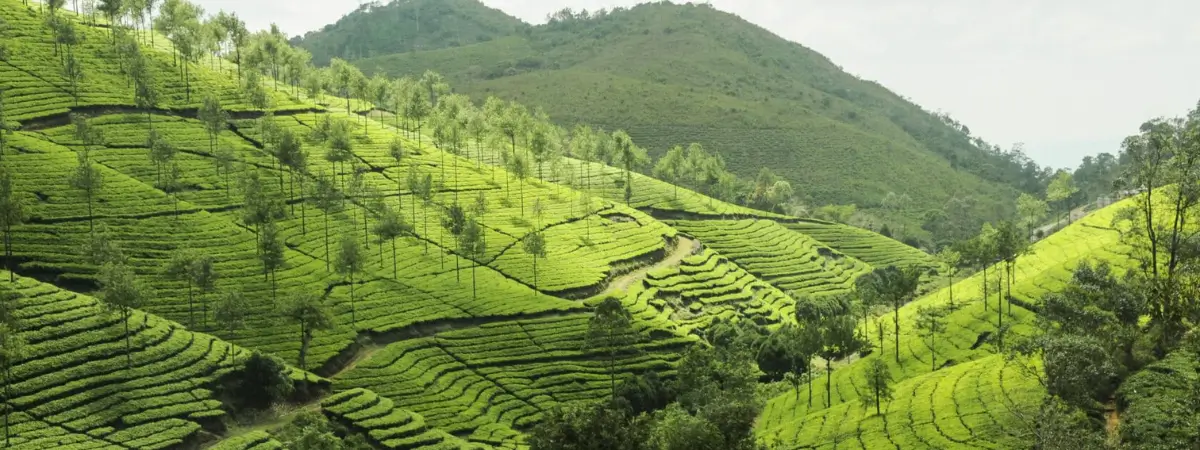
Leave Kochi after breakfast and drive east through Kothamangalam, the last sizeable town before the road climbs into the Western Ghats. The first stops are Cheeyappara and Valara waterfalls, both right beside the highway and at their fullest just after the monsoon. Bonnet macaques often wait on the parapet walls for snacks, so keep food out of sight. The vegetation changes steadily from rubber and cocoa to cardamom forest, then to the neatly clipped tea bushes that cover the hills around Munnar. Your driver will point out the old Kanan Devan estate bungalows and workers' lines on the slopes as you approach the town.
Munnar sits at about 1,600 metres where three mountain streams meet, and the cooler air is a welcome change after the humid coast. After lunch, walk with a local naturalist along a shola forest trail near town, where the Nilgiri wood pigeon, the white-bellied blue flycatcher and the Malabar whistling thrush, known locally as the whistling schoolboy, may be heard well before they are seen. Late afternoon is the best time for the Pothamedu viewpoint, with its sweeping panorama over tea, coffee and cardamom slopes rolling down towards the valley. Evenings in Munnar are short and quiet; a hot plate of appam and vegetable stew at the hotel is the ideal end.
Overnight stay in Munnar.
Morning is reserved for Eravikulam National Park, about 15 km from Munnar, which protects the largest surviving population of the Nilgiri tahr. Forest department buses carry visitors from the Fifth Mile entry point up to the Rajamalai tourist zone, where tahr graze calmly on the rocky grassland just beyond the walking path. Above you rises Anamudi, at 2,695 metres the highest peak in India south of the Himalayas. Tickets are sold in time slots, and the park closes for the calving season, roughly February to March each year, so we confirm your dates with the forest office before the tour begins.
After lunch, drive 32 km east past Mattupetty Dam and Kundala Lake to Top Station on the Kerala–Tamil Nadu border, where the hills fall away almost vertically to the plains of Theni. On clear afternoons the view stretches for miles; when cloud rolls in, the scene changes minute by minute, which has its own appeal for photographers. On the way back, stop at Echo Point, where the lakeshore is popular for pictures, and look for gaur grazing beside the road near Mattupetty at dusk; they are huge but generally unbothered by passing cars. Your naturalist can also show you the Neelakurinji shrubs that flower across these slopes only once every twelve years.
Overnight stay in Munnar.
The road to Thekkady runs south along the Cardamom Hills via Pooppara and Nedumkandam, a stretch where tea gives way to cardamom shrubs grown in the shade of tall forest trees. Stop at a spice garden near Kumily, where a guide shows you black pepper, cardamom pods clustered at the base of the plant, cinnamon bark, clove buds, nutmeg with its scarlet mace, and allspice, along with medicinal herbs used in Ayurveda. Kerala grows most of India's small green cardamom, and much of it comes from these hills. Check in at your hotel by lunchtime and enjoy a short rest before the afternoon on the water.
Later, take the boat cruise on Periyar Lake, a reservoir formed by the Mullaperiyar Dam more than a century ago, whose drowned tree stumps still stand in the water and serve as perches for darters and cormorants. The boats run at fixed times, and the afternoon departure is often the best for elephants, gaur and sambar coming down to drink on the banks of Periyar Tiger Reserve. Otters, wild boar and the occasional dhole pack are also seen from the deck. Back in Kumily town, the main bazaar sells cardamom, tea and handmade spice soaps at fair prices, and the shops stay open well into the evening.
Overnight stay in Thekkady.
Join the Periyar guided nature walk, run by the forest department with trained trackers from the local tribal community, which sets out at around 7:00 am and lasts close to three hours. Walking in a small group lets you notice what vehicles miss: fresh elephant dung, pugmarks in soft mud, Nilgiri langurs crashing through the canopy and the deep, heavy wingbeats of a great hornbill overhead. Leeches can be a nuisance after rain, and leech socks are handed out at the start. It is a fitting last wildlife outing, quiet and unhurried, with the forest at its liveliest in the early light.
After a late breakfast, drive back to Kochi through Vandiperiyar, Kuttikkanam and the rubber country around Kanjirappally, arriving in the late afternoon. Head straight to Fort Kochi for sunset beside the Chinese fishing nets, the huge cantilevered frames lowered and raised by teams of four to six men pulling on ropes weighted with stones. Fishermen sell the catch from small stalls nearby, and several cafes along the waterfront will grill your choice of fish or prawns with garlic and pepper. It is a relaxed final evening after so many early starts, and the sea breeze is pleasant after the hills.
Overnight stay in Kochi.
If your flight leaves after midday, an early visit to Mangalavanam Bird Sanctuary makes a quiet closing note. This small mangrove patch in the heart of Ernakulam, just behind the Kerala High Court, covers only a few hectares, yet it shelters night herons, little cormorants, Asian openbills and a large roost of flying foxes hanging from the branches. Your chauffeur collects you from the hotel around 7:00 am, and an hour among the mangroves is plenty. Return for breakfast and time to pack; most hotels allow a late checkout on request, subject to occupancy and with a small extra charge in some cases.
At the agreed time your chauffeur drives you to Cochin International Airport, about 45 km from Fort Kochi, which takes roughly an hour and a half depending on traffic over the bridges. The airport runs entirely on solar power, an appropriate send-off after two weeks spent in some of India's best-protected forests. Our team checks your flight status before departure and remains on call until you have passed through security. We hope you leave with a full notebook of species, memory cards packed with tigers, tahr and hornbills, and a lasting affection for the hills and forests of the south.
Hear what our happy guests say about their India adventures! From private drivers to guided tours, we make every journey smooth, safe & unforgettable.
 rating score: 5.0 of 5, based on 448 reviews

Complete our inquiry form

Customize your itinerary

Confirm when you're satisfied
1-to-1 Service | Reply within 24hrs | Expert's Advice