Chennai - Kanchipuram - Mahabalipuram - Pondicherry - Thanjavur - Chettinad - Madurai - Munnar - Thekkady - Kumarakom - Alleppey - Kochi
Over a thousand years, three great dynasties of Tamil kings, the Pallavas, the Cholas and the Nayaks, left behind temples that are still in daily worship, and the first two weeks of this South India Heritage and Backwaters Tour follow their trail in the order they were built. You begin in Chennai, see the rock-cut shrines of Mahabalipuram and the silk-weaving temple town of Kanchipuram, linger in the French streets of Pondicherry, then reach the Chola heartland of the Kaveri delta, where the granite tower of Thanjavur's Big Temple has stood for over a thousand years. Further south come the merchant mansions of Chettinad and the towering gateways of Madurai's Meenakshi Temple, before the road climbs into Kerala.
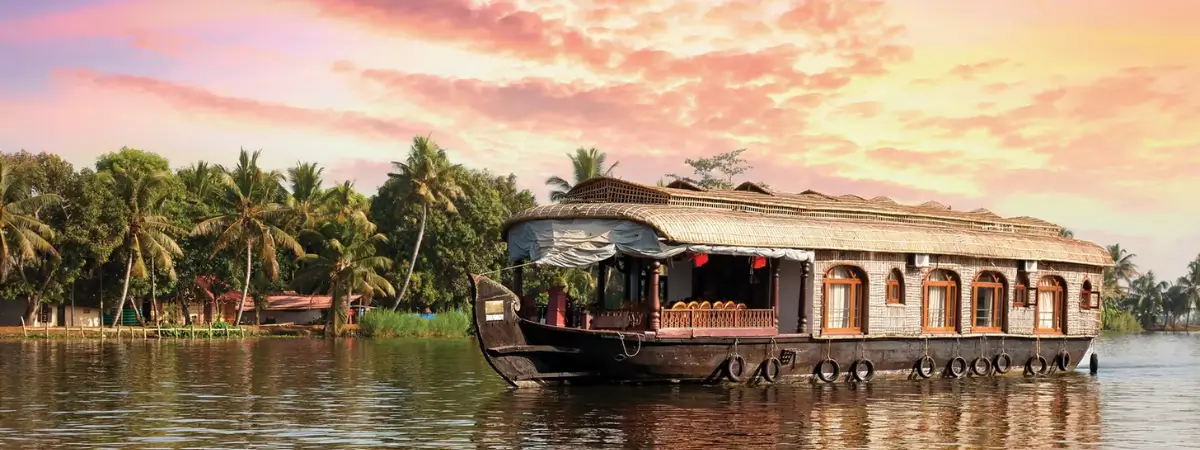
The final days slow everything down. From the tea hills of Munnar and the cardamom country of Thekkady, you descend to the waterways of Kuttanad, where rice grows below sea level and village life moves along canals rather than roads. A night aboard a Kerala houseboat between Kumarakom and Alleppey, with a cook preparing karimeen and red rice on board, gives you time to rest before the closing stop in Fort Kochi, with its Dutch palace, synagogue and Portuguese church. The whole route runs by private car and driver, with no flights needed, and drive times are kept sensible by breaking the longer stretches with temple stops. Local guides in each town bring the stone carvings and the stories behind them to life. Temple dress codes apply throughout, and we brief you on them before the first visit.
Tour Highlights
 Package Includes:
 Package Excludes:
Reply within 24hrs
On arrival at Chennai International Airport in Meenambakkam, our representative meets you outside the terminal and hands you over to the chauffeur who stays with you for the next sixteen days, all the way to Kerala's backwaters. The drive to your hotel takes 30 to 50 minutes depending on the area and the time of day. Chennai, known as Madras until the 1990s, began as a small East India Company trading post in the seventeenth century and grew into the main city of the south, yet it remains deeply Tamil in its music, food and temple traditions. Long-haul flights often land late at night, so nothing is scheduled today beyond getting over the flight.
If you are up for a short outing in the evening, head to Marina Beach, one of the longest urban beaches in the world, when local families come out to walk on the sand and buy sundal (spiced chickpeas) and roasted corn from the stalls. Swimming is not safe here because of strong currents, but the promenade is lively until late. Alternatively, enjoy a quiet first dinner at the hotel; Chennai is famous for its South Indian vegetarian food, and a crisp ghee roast dosa with coconut chutney and sambar is a good introduction. Our team will call to confirm the arrangements for the coming days.
Overnight stay in Chennai.
Begin in Mylapore, the oldest part of the city, with your local guide. The Kapaleeshwarar Temple honours Shiva, and its painted gopuram, crowded with brightly coloured figures from Hindu myth, overlooks a large stepped tank used for the annual float festival. Nearby, San Thome Basilica stands over the tomb traditionally said to be that of St Thomas the Apostle, one of only a few churches in the world built above an apostle's grave. Walk through the Mylapore lanes, where shops sell brass lamps, flower garlands and sheet music for Carnatic recitals, and stop for strong filter coffee served in a steel tumbler and davara.
After lunch, drive to Fort St George, the first British fortress in India, where St Mary's Church holds marriage records and memorial tablets from the Company era; the fort museum is closed on Fridays. Then continue to the Government Museum in Egmore, also closed on Fridays, whose Bronze Gallery holds one of the best collections of Chola bronzes anywhere, including a magnificent Nataraja and graceful figures of Parvati. Seeing them now gives useful context for the temples ahead. End the afternoon at Pondy Bazaar or T. Nagar for silk saris, Kanchipuram cottons and handmade sandals, or simply return to the hotel.
Overnight stay in Chennai.
Leave Chennai after breakfast for Kanchipuram, about 75 km south-west, one of the seven sacred cities of Hinduism and the Pallava capital between the sixth and ninth centuries. Your guide leads you through the Kailasanathar Temple, a compact sandstone shrine built by the Pallava king Rajasimha, with dozens of tiny cells around its courtyard and traces of original painting still visible on the walls. Continue to the Ekambareswarar Temple, whose courtyard holds an ancient mango tree said to bear four kinds of fruit on its branches. Temples in Kanchipuram usually close between about 12:30 and 4:00 pm, so the morning visits are timed to finish before then.
Before leaving the town, visit a weaving family to watch a Kanchipuram silk sari being made on a pit loom, with gold zari threads worked into the border using a separate shuttle. A single sari can take two or three weeks. Drive on to Mahabalipuram, about 65 km to the east, arriving by mid-afternoon. In the late light, see Arjuna's Penance, a huge relief carved across two boulders with life-size elephants, sages, river spirits and a cat mimicking a meditating ascetic, then walk up to Krishna's Butter Ball, a round boulder balanced on a slope that has refused to move for centuries.
Overnight stay in Mahabalipuram.
Rise early to see the Shore Temple at sunrise, the twin-towered granite temple standing at the edge of the Bay of Bengal, when the light turns the weathered stone pinkish-gold and the site is almost empty. The monuments of Mahabalipuram are a UNESCO World Heritage Site and open from sunrise. Walk next to the Five Rathas, a group of shrines each carved from a single rock outcrop, which were never consecrated and seem to show Pallava sculptors testing different roof styles. A stone elephant, lion and Nandi stand among them. If you have time, visit a local stone-carving workshop, where craftsmen still shape granite with hammer and chisel.
After a late breakfast, follow the East Coast Road south past salt pans, casuarina groves and small fishing villages. A short stop at the Tiger Cave, a Pallava rock-cut shrine framed by carved tiger heads, breaks the drive. Pondicherry comes into view soon after midday, and your hotel sits in the old French quarter, many of which occupy restored colonial houses with shuttered windows and courtyards. In the evening, walk along Goubert Avenue, the seafront promenade, which closes to traffic after dark and fills with families, joggers and ice-cream sellers. Dinner can be Franco-Tamil, such as prawn curry with a French touch.
Overnight stay in Pondicherry.
Join a guided heritage walk through the White Town, where streets such as Rue Romain Rolland and Rue Suffren still carry French names on blue enamel plates, and mustard-yellow villas hide behind bougainvillea. Your guide explains the canal that once divided the French quarter from the Tamil quarter, and you then cross into the Tamil side to see its houses with thinnai (raised verandas) and carved wooden doors. Stop at the Église de Notre Dame des Anges, the Sri Aurobindo Ashram, where the Samadhi of Sri Aurobindo and the Mother lies under a frangipani tree, and the Gothic Basilica of the Sacred Heart with its stained glass.
In the afternoon, drive 12 km north to Auroville, the experimental township founded in the late 1960s, where residents from dozens of countries live and work. At the visitor centre, a short film and exhibition explain the idea behind the township, and a garden path leads to the viewing point for the Matrimandir, a golden sphere used for silent concentration; entry to the inner chamber needs advance booking and is not always possible. Browse the Auroville boutiques for handmade paper, incense and organic produce. Back in town, the Pondicherry Museum, closed on Mondays, displays Roman pottery from nearby Arikamedu.
Overnight stay in Pondicherry.
Today brings the longest road day of the itinerary, though two remarkable temples break it neatly in three. After 70 km you reach Chidambaram and the Nataraja Temple, where Shiva is worshipped as the cosmic dancer and the inner sanctum, the Kanaka Sabha, is roofed with gold plates. The eastern gopuram is carved with the 108 classical dance poses described in the Natya Shastra, which Bharatanatyam dancers still study. The temple is run by a hereditary community of priests called the Dikshitars, recognisable by the tuft of hair tied at the front of the head. Your guide explains which areas visitors may enter and when the rituals take place.
Continue 40 km to Gangaikonda Cholapuram, the capital built by Rajendra Chola after his armies marched to the Ganges. Its temple tower is slightly shorter and more gracefully curved than the one at Thanjavur, and the site is usually quiet, with only a few local visitors and a priest. Look for the carved panel of Shiva placing a garland on the devotee Chandesha, one of the finest Chola reliefs. The road then follows the Kaveri delta through rice fields and coconut groves to Thanjavur, arriving by late afternoon. Thanjavur is famous for its dolls that wobble without falling, sold in shops near the old palace.
Overnight stay in Thanjavur.
Spend the morning at the Brihadeeswarar Temple, built by Raja Raja Chola I and known locally as the Big Temple. Its vimana rises about 66 metres, and its capstone, a single block weighing around 80 tonnes, was hauled to the top, according to tradition, along a long earthen ramp. Inside the courtyard sits a huge Nandi carved from one stone, sheltered by a later Nayak pavilion. Your guide shows you the corridor walls where Chola-period frescoes were found beneath later Nayak paintings, and the Tamil inscriptions recording the dancers, musicians and lamps the king endowed. Shoes are left at the entrance, and the granite courtyard gets hot by late morning.
After lunch, visit the Thanjavur Royal Palace, built by the Nayak and Maratha rulers, to see the Art Gallery's collection of Chola bronzes and the Saraswathi Mahal Library, which holds palm-leaf manuscripts in several languages. Then drive 35 km to Darasuram and the Airavatesvara Temple, a smaller Chola temple with exquisite carvings and a set of stone steps said to make musical notes when tapped. On the way back, stop at Swamimalai, where families cast bronze icons using the lost-wax method, shaping each figure first in beeswax and clay; they will happily show you each stage.
Overnight stay in Thanjavur.
Drive south after breakfast through the plains of Pudukkottai, once a small princely state. Stop at Sittanavasal, a Jain cave temple on a rocky hill whose ceiling still carries ninth-century paintings of lotus ponds, fish, elephants and swans in faded ochre and green. A short climb above the cave leads to the Ezhadipattam, rock beds carved for Jain monks, with inscriptions in old Tamil script. A little further along, the hill fort of Thirumayam has ramparts with fine views over the countryside and rock-cut shrines to Shiva and Vishnu at the base. Both stops are quiet, and you may well have them to yourselves.
Continue to Chettinad, a cluster of about seventy villages around Karaikudi, home of the Nattukottai Chettiars, a community of bankers and traders who made fortunes in Burma, Ceylon and Malaya and spent much of it building grand houses back home. Your hotel is likely to be a restored mansion; Chidambara Vilas or the Bangala are our usual choices, subject to availability. In the afternoon, walk around the village with a local guide, admiring the facades with Italian tiles, Burmese teak pillars and Belgian mirrors. Dinner is a Chettinad meal on a banana leaf, rich with black pepper, star anise and kalpasi.
Overnight stay in Chettinad.
Spend the morning in Kanadukathan, where your guide arranges visits inside one or two family mansions that still belong to Chettiar families. Each house is arranged around a series of open courtyards, with long corridors of pillars, a reception hall for male visitors and inner rooms where the women of the family cooked and worked. Many owners now live in Chennai or abroad and return only for weddings and festivals, so the houses are watched over by caretakers. In Karaikudi's antique market, shops sell old brass lamps, wooden doors, enamel tiffin boxes and Burmese lacquer, a vivid picture of what these homes once held.
In the afternoon, visit Athangudi, where the famous hand-made floor tiles are produced from local clay and coloured cement poured into glass moulds and then sun-dried; each tile is made individually. Watch a demonstration and take home a few if you like. Later, join a Chettinad cooking session in the mansion kitchen, learning to prepare kuzhi paniyaram, a peppery chicken or vegetable curry and a dessert of kavuni arisi, black rice cooked with coconut and palm sugar. The cooks are often local women who learned the recipes at home, and the dinner you eat is the one you helped prepare.
Overnight stay in Chettinad.
The drive to Madurai is short, leaving the morning free for a final walk among the Chettinad mansions or a visit to the Kottaiyur cotton weavers, whose checked Kandangi saris are woven in bold reds, mustards and blacks. Arrive in Madurai by lunchtime. Madurai is among the oldest continuously inhabited cities in India, once a capital of the Pandya kings and later of the Nayaks, and its streets are laid out in concentric squares around the great temple, named after the Tamil months in which the festival processions pass through them. Check in at your hotel and rest during the hottest part of the day.
In the late afternoon, visit Thirumalai Nayak Palace, a seventeenth-century building whose courtyard is surrounded by massive pillars and arched corridors, mixing Dravidian and Islamic styles. Only part of the original palace survives, but the scale is still impressive. At about 9:30 pm, return to the Meenakshi Amman Temple for the night ceremony, when Shiva's image is carried in a silver palanquin to Meenakshi's chamber to the sound of drums and nadaswaram pipes; it is a moving ritual and visitors are welcome to watch quietly from the side. Mobile phones and cameras are not allowed inside the temple.
Overnight stay in Madurai.
Return to the Meenakshi Amman Temple in the morning with your guide to see the complex properly in daylight. The temple has fourteen gopurams, the tallest on the southern side, covered with thousands of painted stucco figures. Inside, see the Golden Lotus Tank, where poets of the Tamil Sangam are said to have tested their verses, and the Hall of a Thousand Pillars, whose museum includes carved musicians, warriors and sea creatures. Women still come to the shrine of Meenakshi with jasmine and bangles, and the corridors are hung with ceiling paintings of the city's legends. Dress modestly, covering shoulders and knees.
After lunch, cross the road to Puthu Mandapam, a pillared hall from the Nayak period that now houses tailors and bangle sellers; you can have a shirt or blouse stitched within a few hours. Visit the Gandhi Memorial Museum, housed in a seventeenth-century palace, which displays the bloodstained garment Gandhi was wearing when he was assassinated, and is closed on some public holidays. In the evening, try jigarthanda, Madurai's chilled drink of milk, almond gum, sarsaparilla syrup and ice cream, or a plate of kothu parotta from a street stall, and watch the jasmine sellers stringing garlands at lightning speed.
Overnight stay in Madurai.
Leave Madurai after breakfast and head west across the plains to Theni, a farming district of grape vineyards, banana plantations and coconut groves at the foot of the Western Ghats. Near Theni you can stop at Cumbum, where vineyard owners sometimes let visitors walk among the overhead trellises and buy fresh grapes direct from the farm. At Bodinayakanur, one of the main centres of India's cardamom trade, the Spices Board runs electronic auctions where planters and dealers buy and sell small green cardamom; your guide explains how quality is judged by size, colour and aroma. Lunch here can be a simple vegetarian meal at a local restaurant.
The road then climbs the Bodi ghat to Bodimettu on the Tamil Nadu–Kerala border, with seventeen hairpin bends and wide views back over the plains. Over the top, the land changes completely: cardamom plantations under tall shade trees, and soon the tea estates of Munnar, laid out by Scottish planters in the late nineteenth century. Check in at your hotel in the hills, where evenings are cool enough for a fleece. If you have energy, walk around the old part of town and see CSI Christ Church, built of local stone with stained glass and a cemetery on the hillside.
Overnight stay in Munnar.
Today follows the story of tea in the High Ranges. Begin at the Tata Tea Museum at the Nallathanni estate, closed on Mondays, which preserves the machinery, photographs and planters' artefacts of the Kanan Devan Hills, including a rotorvane used to cut leaves and an old bell from the factory. A short demonstration shows how fresh green leaf is withered, rolled, fermented and dried into the black tea sold worldwide. Afterwards, taste a few grades in the museum café, from the bright orange pekoe to the strong dust grades used in Indian chai. Packets of estate tea make light, practical gifts, and the shop packs them well for travel.
In the afternoon, drive towards Lockhart Gap, where the road runs along a ridge with tea estates on one side and deep forested valleys on the other, and take a guided walk through the estate paths with a planter or field supervisor. Your guide explains how tea pickers, many from families who came from Tamil Nadu several generations ago, work the bushes in rows using shears and baskets slung from their heads. In the evening, the hotel may offer a short demonstration of Kalaripayattu, Kerala's ancient martial art, or you can simply enjoy the quiet over a cup of masala chai on the veranda.
Overnight stay in Munnar.
Descend through the Cardamom Hills via Pooppara and Nedumkandam, passing small spice towns, churches and roadside stalls selling pineapples and jackfruit in season. In Thekkady, check in at your hotel near Kumily, then visit a family cardamom estate with the owner, who walks you through the rows of plants under shade trees and shows you the pods that grow on runners close to the ground. You will see how the harvested pods are cured in wood-fired or electric dryers to keep their green colour. Pepper, coffee, cocoa and vanilla often grow on the same estates, and you can taste a few of them fresh.
In the late afternoon, attend a performance of Kalaripayattu at one of the established centres in Kumily, where trained fighters demonstrate kicks, leaps, staff fighting and sword-and-shield combat in a sunken pit. It is fast and athletic, and the performers start young. Then watch the make-up being applied for a Kathakali show, followed by an hour of dance drama in which a single episode from the Mahabharata is told through hand gestures, eye movements and drum rhythms. Kumily's bazaar is good for buying spices, tea and handmade Ayurvedic oils. Dinner can be a light Kerala meal of appam and stew.
Overnight stay in Thekkady.
The road from Thekkady drops through Vandiperiyar, Peermade and Kuttikkanam, where tea estates give way to rubber and then to the flat green rice country of Kottayam district. Kottayam was an early centre of printing and education in Kerala, and its old Syrian Christian churches, such as the Valiyapally with its Persian cross, reflect a Christian community that traces its origins to the first centuries after Christ. A short stop there adds another layer to the story of the region. You reach Kumarakom, on the eastern shore of Vembanad Lake, after lunch and settle into a lakeside resort with its own jetty on the water.
Late in the afternoon, take a country boat along the narrow canals that link the village to the lake. You will see families washing clothes on the steps, ducks being herded along the water, and toddy tappers climbing palm trees to collect sap. The Kumarakom Bird Sanctuary, set within an old rubber plantation once owned by an English family, is home to herons, darters, kingfishers and migrant birds in winter. In the evening, try karimeen pollichathu, pearl spot fish wrapped in banana leaf with spices and cooked over a flame, at a toddy shop or at your resort.
Overnight stay in Kumarakom.
Board your Kerala houseboat at around noon. These kettuvallams were once used to carry rice and spices along the backwaters, built from jackfruit wood planks stitched together with coir rope rather than nails. Today the boats are fitted with bedrooms, bathrooms and an open sitting deck, and come with a crew of three, a pilot, a cook and a helper. As you cruise across Vembanad Lake and into the canals of Kuttanad, the cook prepares a Kerala lunch on board, perhaps fish fried with red masala, thoran, sambar and red rice, along with fruit and coconut-based sweets. Tell the cook in advance if you prefer vegetarian dishes or milder spicing.
The afternoon passes slowly as you drift past paddy fields, small churches and temples and villages that can only be reached by water. Kuttanad is one of the few places in the world where rice is farmed below sea level, protected by dykes and pumps, and your crew will explain how the fields are drained before planting. Under local regulations, houseboats must moor before sunset, so you will stop for the night in a quiet spot near Alleppey with tea and snacks on deck. Dinner is prepared on board, and the sounds of frogs and the occasional church bell drift across the water.
Overnight stay on the houseboat in Alleppey.
Wake early to watch the backwaters come alive as fishermen cast their nets and children set off for school in small boats. After breakfast on board, disembark at Alleppey at around 9:00 am and drive north along the coast to Kochi, a port that traded with Arabs, Chinese, Jews, Portuguese, Dutch and British merchants over the centuries. Begin in Mattancherry with the Mattancherry Palace, also known as the Dutch Palace, closed on Fridays, which holds some of the finest Kerala murals, with scenes from the Ramayana covering whole walls in deep reds, ochres and greens. Upstairs, the coronation hall displays palanquins, royal robes and portraits of the Kochi rajas.
Just around the corner is the Paradesi Synagogue, closed on Fridays, Saturdays and Jewish holidays, with its floor of blue-and-white hand-painted Chinese tiles and Belgian glass chandeliers. Walk through Jew Town, where antique shops and spice warehouses line the lane, then continue to St Francis Church, the oldest European church in India, where Vasco da Gama was first buried before his remains were taken back to Portugal. In the evening, attend a Kathakali performance at a theatre near Fort Kochi; if you arrive early you can watch the actors spend over an hour on their elaborate make-up.
Overnight stay in Kochi.
Your final morning is free to enjoy at your own pace. Take an early walk along the waterfront at Fort Kochi to watch the Chinese fishing nets being lowered into the water, or visit Santa Cruz Basilica, with its pastel interior and painted ceilings. If you would like to shop, the stores around Princess Street sell handloom cotton, spices, coffee and handmade jewellery. Some guests use the morning for an Ayurvedic massage at their hotel, a pleasant way to rest before a long flight. Your chauffeur will be on hand to take you wherever you wish to go within Fort Kochi.
When it is time to leave, the car heads north across the Venduruthy and Goshree bridges to the airport at Nedumbassery, a drive of about 90 minutes. If you are connecting to a domestic flight, we recommend allowing at least two hours for check-in. Our team will keep track of your flight details and remain on call until you are safely through security. We hope that the journey from the temple towns of Tamil Nadu to the waterways of Kerala leaves you with lasting memories of South India's culture, history and hospitality, and that you return one day to see more of it.
Hear what our happy guests say about their India adventures! From private drivers to guided tours, we make every journey smooth, safe & unforgettable.
 rating score: 5.0 of 5, based on 448 reviews

Complete our inquiry form

Customize your itinerary

Confirm when you're satisfied
1-to-1 Service | Reply within 24hrs | Expert's Advice