Delhi - Agra - Bharatpur - Jaipur - Delhi
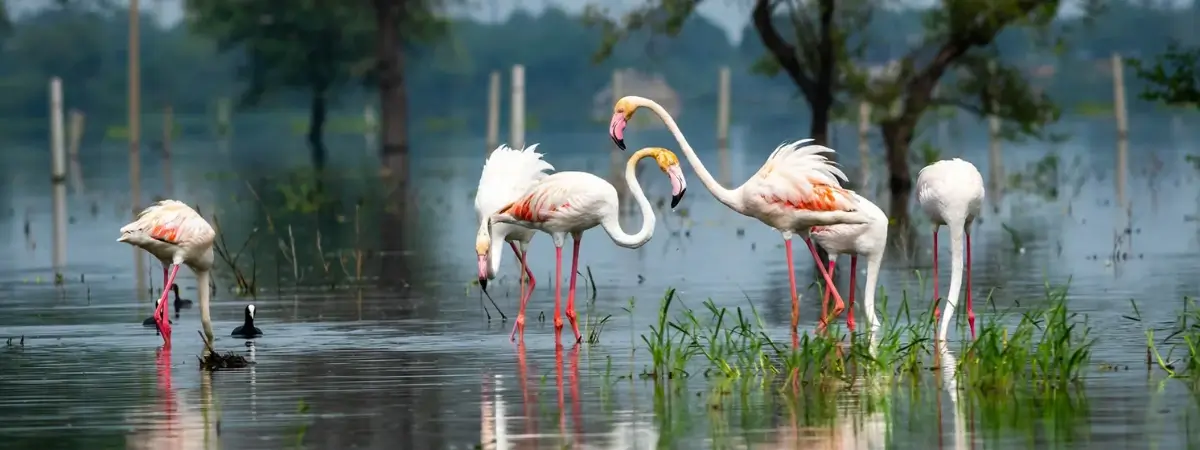
Painted storks nesting on acacia trees, sarus cranes trumpeting over flooded grassland and a Mughal tomb glowing at dawn can all fit into a single week. This Golden Triangle Tour with Bharatpur Bird Sanctuary was shaped for travellers who carry binoculars as readily as a camera. Between Agra and Jaipur lies Keoladeo National Park, a UNESCO World Heritage wetland that was once the duck-shooting reserve of the Maharajas of Bharatpur and is now one of the finest birding sites in Asia. More than 370 species have been recorded here, and in the winter months huge flocks of geese, ducks and waders arrive from Central Asia, Siberia and the Tibetan plateau. The rest of the route covers the great monuments of Delhi, Agra and Jaipur at a photographer's pace.
The whole journey runs on a private car and driver basis, which matters for a birding trip because it lets you start before sunrise, stop when a raptor sits on a roadside wire and linger when the light is good. Inside Keoladeo, motor vehicles are not permitted beyond the main checkpoint, so you travel the raised dykes by cycle-rickshaw with a licensed naturalist who knows each nesting colony and roosting tree. We include two sessions in the park, one in the afternoon and one at dawn, as the birds behave very differently at each hour. Good light also guides the city days: an early look at Hawa Mahal, a sunset view from Nahargarh Fort and a quiet morning at the Taj Mahal before the crowds arrive.
Tour Highlights
 Package Includes:
 Package Excludes:
Reply within 24hrs
Welcome to India. As you walk out of the arrival hall at Delhi airport, a representative from Heritage India Private Tours greets you by name, helps with your bags and leads you to the air-conditioned car and the chauffeur who will drive you across three states this week. The ride to the hotel takes about an hour. Our representative uses the time to brief you on the days ahead, including the early starts that birding and good photography demand, and hands you a printed route with hotel numbers and our office contacts. Keep a pair of binoculars in your hand luggage, because the first interesting birds may appear before you even leave the airport roads.
Once checked in, rest for a few hours. If the day is still light, a short drive to Lodhi Garden makes a pleasant introduction to the city and its bird life. The fifteenth-century tombs of the Sayyid and Lodi rulers stand among old trees where you may see rose-ringed parakeets, Indian grey hornbills, coppersmith barbets and black kites circling overhead. Local families jog the paths in the evening, and the light on the domes of Bara Gumbad is gentle and warm. Return to the hotel for dinner, perhaps a mild butter chicken or paneer tikka with garlic naan, and an early night. Tomorrow the Delhi sightseeing begins after breakfast. Overnight stay in Delhi.
Your guide meets you after breakfast for a Delhi city tour that balances landmarks and green space. Begin at the Red Fort, which is closed on Mondays; on those days we photograph the massive Lahori Gate from the outside and add time at other sites. Then visit Raj Ghat, where a simple black marble platform honours Mahatma Gandhi. Purana Qila, the Old Fort of Sher Shah Suri and Humayun, comes next, with its Qila-i-Kuhna Mosque and the octagonal Sher Mandal, where Humayun is said to have slipped on the stairs and died. Its moat now holds a small boating lake. Pause at India Gate, the war memorial arch, for a photograph down the long avenue of Kartavya Path.
The afternoon belongs to Humayun's Tomb and the adjoining Sunder Nursery, a Mughal-era garden restored with native trees, ponds and small heritage buildings. Birders often find it one of the best spots in central Delhi, with Indian peafowl, white-throated kingfishers, purple sunbirds and spotted owlets in the old masonry. The tomb itself, of red sandstone trimmed with white marble, introduced the double dome and the grand garden setting that the Taj Mahal later perfected. Stay until the late light warms the facade. On the way back, your driver can stop at Khan Market for a coffee and a browse in the bookshops for a field guide to Indian birds. Overnight stay in Delhi.
Leave Delhi after breakfast and drive south on the Yamuna Expressway, an easy road with clean rest stops. Keep a lookout over the flat fields for black-shouldered kites and Indian rollers on the electric lines; your chauffeur will slow down where it is safe if you want a photograph. Before entering Agra, stop at Sikandra to visit the tomb of Emperor Akbar. The grand southern gate carries bold inlay of white marble and coloured stone, and the four minarets above it predate those at the Taj Mahal. The surrounding lawns hold small herds of blackbuck and spotted deer, and langur monkeys sit in the trees, so it suits nature lovers very well.
After check-in and lunch, your Agra guide takes you to Agra Fort, a red-sandstone citadel stretching more than two kilometres along the Yamuna. Walk up the ramp of the Amar Singh Gate, then through the courtyards of the Jahangiri Mahal and the white marble Khas Mahal. From the Musamman Burj the Taj Mahal floats in the distance, and kites and vultures sometimes circle above the river. Late afternoon is a good time for a slow walk through Kinari Bazaar in the old city, or a rest by the hotel pool before an early dinner, because tomorrow begins before dawn. Your guide will brief you on what you may carry inside the Taj Mahal. Overnight stay in Agra.
Rise early for the Taj Mahal sunrise visit, the best time of day for photographs. The monument opens about thirty minutes before sunrise and closes on Fridays, which we always account for in the timetable. Tripods are not allowed past the main gate, so bring a steady hand or a compact beanbag. Walk past the central reflecting pool to the plinth and notice how the marble shifts from blue-grey to cream as the sun lifts. Your guide points out the optical tricks of its design, including the slight outward lean of the four minarets, which protects the main tomb if they ever fall. Return for breakfast and check-out.
The drive west to Bharatpur is short, just over an hour and a half. Check in at a lodge close to the park entrance, where many guests see their first birds in the hotel garden. After lunch, meet your licensed naturalist and board a cycle-rickshaw for the first session in Keoladeo National Park. The rickshaw pullers here are trained by the forest department and many can name birds by call alone. Ride along the main road through the woodland to the open water near Keoladeo Temple, watching for painted storks, Asian openbills, Oriental darters drying their wings and sambar deer at the water's edge. Stay until sunset, when flocks fly overhead to roost. Overnight stay in Bharatpur.
Return to the park gates at sunrise for the second session, when the wetland is at its most active. Morning mist lies over the jheels, and you will hear sarus cranes calling, the tallest flying birds in the world. Between October and March the water fills with bar-headed geese, northern pintails, ruddy shelducks and many other migratory ducks, while greater spotted eagles and marsh harriers hunt above them. Ask your naturalist to show you Python Point, where Indian rock pythons bask outside their burrows on cool winter mornings, and the heronry, where cormorants and egrets nest in noisy crowded colonies. Return to the lodge for a late breakfast.
Before leaving Bharatpur, visit Lohagarh Fort, the Iron Fort of the Jat ruler Maharaja Suraj Mal. Its thick earthen walls, surrounded by a moat, withstood repeated British siege in the early nineteenth century. Inside, the small Government Museum keeps sculptures and old weapons. Then drive west to Jaipur on the national highway through Mahua and Dausa, a straightforward road of about four hours. After check-in, walk out for an evening in the old city, where your chauffeur can drop you near Johari Bazaar for a glass of saffron lassi and a plate of pyaaz kachori, two local favourites. The pink walls glow softly under the street lights. Overnight stay in Jaipur.
Start early for photographs of Hawa Mahal while the morning sun strikes its pink facade and the street outside is still empty. Then drive north to Amber Fort with your local guide. Walk or take a jeep up the ramp and spend time in Diwan-i-Aam, the Ganesh Pol and the mirrored Sheesh Mahal, then climb the hill road to Jaigarh Fort, which protected Amber from above. Its foundry cast the Jaivana, one of the largest wheeled cannons in the world, and its ramparts look down over Amber and Maota Lake, where cormorants, egrets and sometimes a pied kingfisher hunt the shallows below the palace walls.
After lunch, the Jaipur city tour continues at the City Palace, with its royal textiles, armoury and the Peacock Gate, and Jantar Mantar, whose huge sundial and star instruments make a fine subject for graphic photographs. Stop at Patrika Gate on the edge of Jawahar Circle, a painted entrance arch whose ceilings and pillars are covered in bright murals of Rajasthan's history. As the afternoon fades, the car winds up the ridge to Nahargarh Fort for a sunset view over the whole Pink City, with kites wheeling below the battlements. Have a farewell dinner at a rooftop restaurant on the fort or in town. Overnight stay in Jaipur.
After a relaxed breakfast and check-out, your chauffeur drives you back to Delhi. If your flight leaves in the evening, a short morning stop at the Albert Hall Museum, the Indo-Saracenic building in Ram Niwas Garden, is possible before setting off. The road runs north through Shahpura and Behror, and your driver will stop at a clean highway restaurant for lunch, where a simple thali or a plate of aloo paratha with curd makes an easy meal. The journey takes around five hours, and our team times the departure from Jaipur carefully so that you reach Delhi with a comfortable gap before your international flight.
Your chauffeur drops you at the airport terminal or, for a late-night departure, at a hotel near the airport where a day-use room can be arranged on request. Take a few minutes before the flight to sort through your photographs: the painted storks of Keoladeo, the sunrise over the Taj Mahal and the pink city from Nahargarh will likely stand out. Many birders begin a list on this trip and return in a later season to see species they missed, such as the winter cranes or the monsoon breeding colonies. Our team will be glad to help when you are ready to return, and we will email after your trip to hear your thoughts.
Hear what our happy guests say about their India adventures! From private drivers to guided tours, we make every journey smooth, safe & unforgettable.
 rating score: 5.0 of 5, based on 448 reviews
Complete our inquiry form

Customize your itinerary

Confirm when you're satisfied
1-to-1 Service | Reply within 24hrs | Expert's Advice