Delhi - Agra - Jaipur - Ranthambore - Udaipur - Delhi
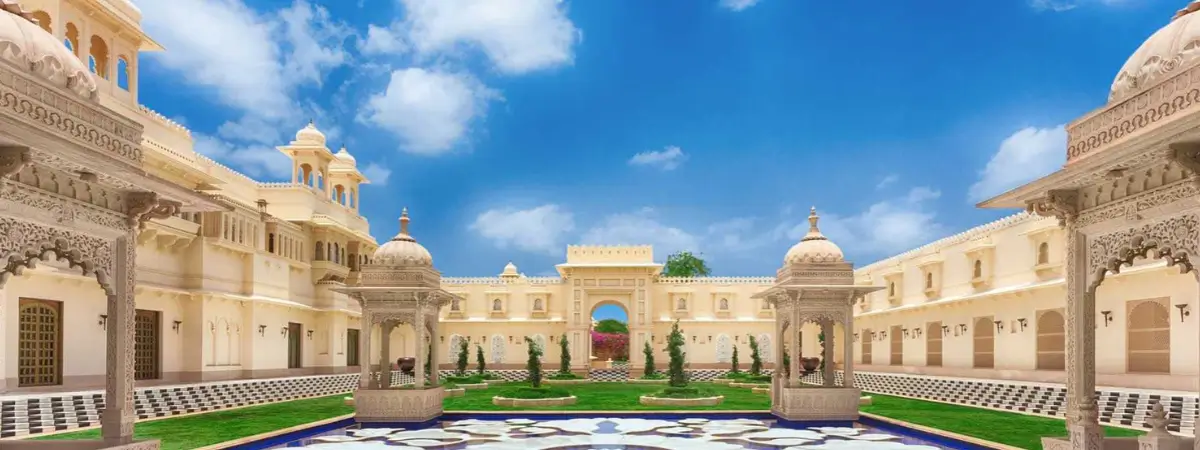
Oberoi service has a quiet reputation among frequent travellers: names remembered after one meeting, a butler who unpacks your case, and rooms where every window is placed for a view. Our Luxury India Tour with Oberoi Hotels strings five of the group's finest addresses into one eleven-day route. In Agra you wake at Amarvilas, where every room looks toward the Taj Mahal, six hundred metres away. In Jaipur, Rajvilas spreads over thirty-two acres of orchards and fountains with a restored Shiva temple at its centre. At Ranthambore, Vanyavilas puts you in a luxury tent a few minutes from the park gate, and in Udaipur the domes of Udaivilas reflect in Lake Pichola. Each hotel is booked for two nights, so you never pack and unpack on consecutive mornings.
The middle of the trip adds what most palace tours lack: wildlife. Two days at Ranthambore include three jeep safaris in search of the Bengal tiger, along with leopards, sloth bears and huge sambar deer, and the drive from Agra to Jaipur passes through Keoladeo bird sanctuary at Bharatpur. Every road leg is handled by private car and driver, while a short flight from Udaipur to Delhi replaces what would be a twelve-hour drive home. Expert guides lead each Agra city tour, Jaipur and Udaipur visit, and Oberoi naturalists brief you before each safari. This route is ideal for couples and families with older children who want a calm pace, outstanding food and something truly wild between the forts.
Tour Highlights
 Package Includes:
 Package Excludes:
Reply within 24hrs
Flights from Europe and America often land in Delhi late at night, so we keep the first day deliberately light. Our representative stands at the arrivals exit holding a card printed with your surname, and the chauffeur drives you to The Oberoi, New Delhi, which we book when rooms allow. Overlooking the greens of the Delhi Golf Club, it has views toward Humayun's Tomb from the upper floors, and a guest relations manager escorts you directly to your room, where the paperwork is completed in private. Instead of a briefing at one in the morning, our representative will run through the full route over a pot of Darjeeling tea after breakfast, when your head is clearer and the questions come more easily.
Guests landing in the morning can rest until lunch and then spend a gentle afternoon at Gandhi Smriti, the colonial bungalow on Tees January Marg where Mahatma Gandhi lived his last 144 days. Stone footprints set into the grass mark the path he took to the evening prayer meeting on 30 January 1948, and simple rooms keep his spectacles, spinning wheel and sandals. The memorial shuts on Mondays, so on that day the chauffeur shows you the Lutyens bungalow zone and Khan Market instead. Back at the hotel, dinner at Baoli brings North Indian dishes from a tandoor, or room service and an early night may suit you better. Overnight stay in Delhi.
This Delhi city tour takes a less common line through the capital. After breakfast and your route briefing, the guide collects you at ten and heads first to Mehrauli Archaeological Park, two hundred wooded acres scattered with more than a hundred monuments that the coach tours drive straight past. Paths lead past the tomb of Balban, the earliest true arch in India, the step well called Rajon ki Baoli, and the delicate Jamali Kamali mosque, where a poet and his companion lie side by side under a painted ceiling. Walking out of the park's southern edge, you enter the Qutub complex, where the guide shows how the earliest mosque of the Delhi Sultanate reused carved pillars taken from twenty-seven Hindu and Jain temples.
Lunch is at a cafe overlooking the medieval reservoir of Hauz Khas, after which you walk through the ruined madrasa of Firoz Shah on its edge. Toward four, the car crosses to the east bank for Swaminarayan Akshardham, a vast modern temple of pink stone and white marble opened in 2005, with 234 carved pillars and some twenty thousand statues. Phones and cameras must be left at the cloakroom, and the temple is closed on Mondays. Stay for the evening water and light show on the stepped tank before heading back across the river for a light supper in your room or the lobby lounge. Overnight stay in Delhi.
A mid-morning departure gets you onto the Yamuna Expressway once the city traffic has eased, and the four-hour drive passes fields of mustard and potatoes. Just before the city limits, the car pulls in at Sikandra, the resting place of Akbar, a red sandstone mausoleum topped by an open marble terrace, set in a park where blackbuck antelope and peacocks graze between the trees. The emperor himself chose the site and began the design, and his son Jahangir finished it in 1613. Its south gate, inlaid with white marble patterns and four slender minarets, is often said to have inspired those of the Taj Mahal. Below lies the plain grave in a dim vaulted chamber, where one call from the attendant echoes for several seconds.
By early afternoon you check in at The Oberoi Amarvilas, reserved for you where rooms allow. Terraced pools lead down from the lobby, and every room faces the monument. Spend the afternoon by the pool, then take tea on the terrace as the monument changes colour. Toward sunset, a short stroll leads to the Taj Nature Walk, a forested park south of the monument with viewpoints framed by trees. Dinner at Esphahan, the Amarvilas Indian restaurant, is accompanied by a live santoor player, and the kitchen's slow-cooked dum pukht biryani is reason enough to book a table. Overnight stay in Agra.
Our Agra city tour begins before dawn, when a hotel buggy takes you to the East Gate, only a few minutes away. The first view through the great red sandstone gateway is the classic one, the white tomb framed in the archway, but your guide also takes you to quieter corners: the mosque of red stone on the west side, the matching guest hall on the east, and the riverside terrace behind the tomb. Inside, the guide explains the double dome, the octagonal marble screen and the false cenotaphs above the real graves below. Since the mausoleum stays closed each Friday for the weekly prayer, your Agra days are always fixed elsewhere in the week.
After a late breakfast and some rest, the afternoon takes you to Agra Fort, built under Akbar in the 1560s and later reshaped by his grandson in white marble. Highlights include the Jahangiri Mahal, a palace of carved sandstone brackets built for Rajput queens, the tiny Mina Masjid used privately by the emperor, and the vine garden where the ladies of the court once strolled. The afternoon ends in a pietra dura studio, where artisans shape slivers of malachite, lapis and mother of pearl on a bow-driven wheel before setting them into marble with natural glue, exactly as their predecessors did. Back at Amarvilas, enjoy a spa treatment or a quiet cocktail at the Bar on the terrace. Overnight stay in Agra.
Pull out of Amarvilas at seven for the hour's run to Bharatpur, home of Keoladeo, a World Heritage wetland created by a maharaja as a duck shooting reserve and now protected for birds. In winter it hosts painted storks, pelicans, cranes and hundreds of migrant ducks from Siberia and Central Asia. You travel through the park by cycle rickshaw with a trained rickshaw-puller who knows the nesting sites, and a park naturalist joins you with binoculars. Even in the hotter months you may see spotted deer, nilgai, kingfishers and the occasional python sunning itself near the water channels. Two to three hours inside is plenty, and the rickshaw keeps the pace quiet enough for the birds to stay put.
After a picnic lunch packed by Amarvilas, continue into Rajasthan, pulling into Jaipur around five. Rajvilas, booked where rooms allow, is a low cluster of pink-walled buildings and luxury tents set among orange trees, fountains and lily ponds about twenty minutes from the centre. Some villas come with their own private pool, and breakfast can be served on your verandah. At dusk the lamps are lit around the old temple in the grounds, and a priest still performs the evening prayer. Dine at Surya Mahal by the pool, where Rajasthani dishes such as gatte ki sabzi are served beside Mediterranean choices. Overnight stay in Jaipur.
Amber Fort opens the Jaipur city tour early, while its honey-coloured walls still catch the soft morning light. Once through the gates, you reach the Diwan-i-Khas, the hall of mirrors whose walls are set with convex glass, and the Zenana, the women's quarters, arranged round a courtyard with rooms for each of the twelve queens. In Amber town, just below the fort, a restored haveli now houses the Anokhi Museum of Hand Printing, with displays of printing blocks and a block printer working in the courtyard. Note that this small museum is closed on Mondays, and in that case we visit the village of Bagru instead.
The afternoon brings you back to the city for the Albert Hall, a domed Indo-Saracenic museum opened in 1887 that holds Egyptian mummies, carpets and arms from the royal collection. From there the car drives through Johari Bazaar, the jewellers' street, and out to the newer south of the city, where the arcades of Patrika Gate are covered in murals showing the forts, festivals and crafts of each district of Rajasthan, a cheerful last stop before the drive back to Rajvilas. Return to Rajvilas for a dip in the pool and a treatment at the spa, which offers a separate ayurvedic menu, including the warm herbal oil therapy called shirodhara. Overnight stay in Jaipur.
A three-and-a-half-hour drive south-east, through mustard fields and the first rocky outcrops of the Aravalli and Vindhya ranges, brings you to Sawai Madhopur, the railway town beside the tiger reserve. Halfway, the chauffeur stops at a roadside dhaba where he knows the cook, for a glass of strong tea and a hot kachori, and you can stretch your legs among the parked trucks painted with flowers and slogans. Lunch is ready when you reach The Oberoi Vanyavilas, booked where tents allow. Accommodation is in spacious air-conditioned tents with teak floors, claw-footed bathtubs and private walled gardens, and the grounds are planted with native trees that attract langurs, peacocks and the odd nilgai.
At about two thirty, the resort's naturalist briefs you on the park and the tigers seen most often in recent weeks, then a private jeep takes you through the park gate for your first safari. Safari slots follow the forest department calendar: in winter they run roughly from seven to half past ten in the morning and from two until half past five, while in summer they start earlier and finish later to match the light. Each vehicle has a fixed route, called a zone, given by the forest department. Expect to see sambar deer, wild boar, crocodiles and many birds, and with some luck a tiger resting in long grass near a lake. Overnight stay in Ranthambore.
Tea and biscuits arrive at your tent around half past five, and the second safari begins at sunrise when animals are most active. Tigers often patrol along the forest roads early in the day, and a good guide listens for the alarm calls of spotted deer and langur monkeys warning of a predator nearby. Ranthambore is also known for its old ruins hidden in the forest, including lakeside pavilions and watchtowers built by the old rulers. Back at Vanyavilas, brunch is served in the garden and the hours until noon are for resting. Please note that the park is closed from 1 July to 30 September, during the monsoon season.
Around midday, a short drive and a climb of several hundred steps bring you to Ranthambore Fort, a tenth-century hilltop stronghold now enclosed by the reserve. Inside its walls stands the Trinetra Ganesh temple, where local people send wedding invitations to the elephant-headed god by post. The fort ramparts give a broad view over the lakes and forests of the park. Your third safari follows in the afternoon, normally in another zone with fresh terrain to search. Later, the Vanyavilas naturalist gives a short talk about the tiger project, and dinner is set under the stars in the garden, with a crackling log fire on cold nights. Overnight stay in Ranthambore.
This is a long road day, so the car leaves after an early breakfast and takes the highway south-west through Bundi district toward Chittorgarh. Some four and a half hours later the walls of Chittorgarh appear, ringing a mesa about three hundred and twenty hectares in area, a citadel big enough to hold whole villages. A local guide walks you to the Vijay Stambh, raised by the Mewar ruler Kumbha after his victory over the Malwa sultan and carved with Hindu deities on every storey, Rani Padmini's palace beside its pool, and the Kirti Stambh, a smaller tower dedicated to a Jain saint. The guide also tells the tragic stories of the three sieges of Chittor, when the women chose death rather than capture.
After lunch at a small restaurant in town, the final two hours bring you into Udaipur around five. Udaivilas, booked where rooms allow, stands on the shore of Lake Pichola facing the City Palace, with domes, courtyards and long reflecting pools. Some rooms have a semi-private pool that flows to the edge of the water. Arriving by road, you might not guess how much water surrounds the property until you open your door. The hotel boat can take you out for the last of the light, and Suryamahal, the hotel's all-day restaurant, serves an evening menu of Indian and continental dishes. Overnight stay in Udaipur.
Begin the Udaipur city tour inside the City Palace, a sprawl of eleven palaces added by successive maharanas over four centuries. After the courtyards of the main museum, the guide takes you upstairs in the Fateh Prakash wing to the Crystal Gallery, where Osler of Birmingham furniture, sent from England in 1877, includes crystal chairs, beds and even a fountain, yet Maharana Sajjan Singh died before it arrived and the boxes stayed unopened for a century. A short walk away, the Vintage and Classic Car Collection, housed in the old palace garage, displays Rolls-Royces, a Cadillac convertible and the cars once used by the royal family. Lunch is at Ambrai, a waterside terrace in the Hanuman Ghat neighbourhood, across from the palace.
After a rest at Udaivilas, the car takes you up the steep road to Sajjangarh, also called the Monsoon Palace, perched on a hilltop to the west. Maharana Sajjan Singh began it in 1884 as an observatory for the coming monsoon, and today it offers the widest view of the lakes and the Aravalli hills at sunset. The road passes through a small wildlife sanctuary where leopards are occasionally seen. Back at Udaivilas, set off on an evening cruise on Lake Pichola in the hotel's own boat, followed by a farewell dinner by the pool, perhaps with lal maas or a delicate Mewari fish curry. Overnight stay in Udaipur.
Take a last swim and a slow breakfast facing the City Palace before checkout. The chauffeur who collected you in Delhi ten days ago makes his final drive, the twenty-five minutes out to Dabok airport, and helps with bags at the terminal door. Farewells here tend to involve photographs and the exchange of phone numbers. The flight north lands in Delhi after roughly seventy-five minutes, and a colleague from our Delhi team is waiting outside baggage claim. If your long-haul departure is close to midnight, we can reserve a room near the airport for a shower and a rest in the meantime.
With a few spare hours, a quick final outing is easy to arrange: the stalls at Dilli Haat near INA sell crafts from every state and plates of momos from the north-east or dosa from the south. After that, your representative escorts you to Terminal 3 about three hours before departure. Our Jaipur office calls to confirm all is well and to hear which tiger, temple or Oberoi breakfast stays with you longest. Should India call again, Bandhavgarh's tigers, the Kerala backwaters or the monasteries of Ladakh would make an excellent next chapter, and our team would happily shape that trip with the same care.
Hear what our happy guests say about their India adventures! From private drivers to guided tours, we make every journey smooth, safe & unforgettable.
 rating score: 5.0 of 5, based on 448 reviews
Complete our inquiry form

Customize your itinerary

Confirm when you're satisfied
1-to-1 Service | Reply within 24hrs | Expert's Advice