Delhi - Agra - Fatehpur Sikri - Jaipur - Delhi
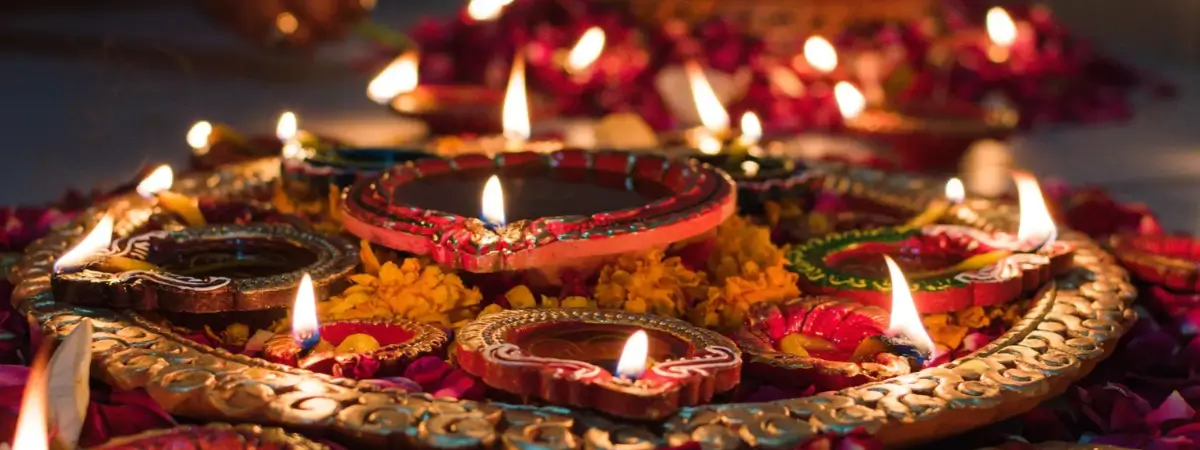
Once a year, the streets of North India glow with millions of clay lamps, and our Golden Triangle Diwali Festival Tour is timed so that you are standing in Jaipur when it happens. Diwali follows the Hindu lunar calendar, so it moves between October and November each year, and we build your dates around the festival night rather than asking you to guess. The route covers Delhi, Agra and Jaipur over eight relaxed days with a private car and driver, local guides in every city and enough free time to shop for sweets, lanterns and rangoli powder alongside Indian families doing exactly the same thing. You see the classic monuments, of course, but you also see a country getting ready for its biggest night of the year.
The festive build-up starts in Old Delhi, where Kinari Bazaar is draped in tinsel and every halwai counter is stacked with kaju katli and motichoor ladoo. In Agra, potters sell freshly fired diyas outside the city gates while you watch sunrise colour the Taj Mahal. Jaipur then gives you the main event: Johari Bazaar and MI Road lit up by trader associations who compete over the brightest street, an evening Lakshmi puja with a Jaipur family, and fireworks over the old walled city seen from a rooftop. This Diwali tour of Delhi, Agra and Jaipur suits first-time visitors, couples and families with older children. Our team adjusts monument days for the Friday closure of the Taj Mahal and the Monday closure of the Red Fort.
Tour Highlights
 Package Includes:
 Package Excludes:
Reply within 24hrs
Your festive holiday begins at Indira Gandhi International Airport, where our representative and your chauffeur meet you just outside the arrivals hall holding a sign with your name. After a short welcome and a box of Diwali sweets for the road, you are driven to your hotel in central Delhi. The drive takes around forty minutes, depending on traffic, which tends to be heavier in the weeks before the festival because the whole city is out shopping. Your chauffeur speaks English and will stay with you through the entire tour, so this is a good moment to ask about the route, the days ahead and anything you need, from local SIM cards to currency exchange.
The rest of the day is free to recover from the flight. If you feel energetic in the evening, ask your driver to take you to Connaught Place or Khan Market, both of which hang strings of lights and lanterns across their arcades during the festive season. Shops sell decorative torans, brass lamps and gift hampers of dry fruit, and it is a gentle first look at how seriously Delhi takes Diwali. Guests with sensitive lungs should note that air quality in North India can dip around the festival, so packing a few good masks is sensible advice. Dinner is at your leisure, and our team can suggest restaurants close to the hotel. Overnight stay in Delhi.
After breakfast, your guide takes you into Old Delhi, the walled city built by Shah Jahan, starting at Jama Masjid, India's largest mosque, where the courtyard holds thousands of worshippers. From there, a cycle rickshaw carries you through Chandni Chowk and into Kinari Bazaar, a narrow lane that sells nothing but tinsel, ribbons, garlands and glittering trims, and in the Diwali season it shimmers from end to end. Next door, Dariba Kalan has sold silver jewellery for centuries. Your guide will stop at a halwai shop for fresh kaju katli and motichoor ladoo, and at the Old Famous Jalebi Wala on the corner for crisp jalebi straight out of the hot oil.
The Red Fort, closed on Mondays, is next, with the Lahori Gate and the Diwan-i-Aam where Mughal emperors heard petitions. In the afternoon, the tour moves to New Delhi for Humayun's Tomb, the garden tomb that later inspired the Taj Mahal, followed by a drive along Rajpath past India Gate and the Rashtrapati Bhavan. As light fades, you visit Gurudwara Bangla Sahib, the city's best-known Sikh shrine. Around Diwali, Sikhs mark Bandi Chhor Divas, so the shrine and its sarovar pool are lined with lamps, and the community kitchen serves free langar to anyone who sits down. It is a calm, moving close to a busy day. Overnight stay in Delhi.
Leave Delhi after breakfast on the Yamuna Expressway, a smooth six-lane road that brings you to Agra in about four hours with a coffee stop on the way. Check in to your hotel and rest a little before meeting your Agra guide. The afternoon is reserved for Agra Fort, the red sandstone citadel where three generations of Mughal emperors ruled. Enter through the Amar Singh Gate and walk past the Jahangiri Mahal to the Khas Mahal, the private palace with its gilded pavilions. Your guide will point out the Musamman Burj, the octagonal tower where Shah Jahan spent his final years under house arrest, gazing across the river at the tomb he built for his wife.
Later, cross the Yamuna to Itimad-ud-Daulah, often called the Baby Taj, a jewel box of white marble covered in inlaid stone flowers and wine-cup motifs. It was finished before the Taj Mahal and shows the first full use of pietra dura in Mughal building. In the evening, your driver takes you through Sadar Bazaar, where Agra families stock up on lamps, lanterns and dry fruit for the festival. Try Agra's own sweet, petha, made from ash gourd and flavoured with saffron or rose; a shop such as Panchhi Petha sells boxes that travel well. The pace is easy, and you have time for a quiet dinner before tomorrow's early start. Overnight stay in Agra.
Wake before dawn to reach the Taj Mahal as the gates open, about thirty minutes before sunrise. The Taj is closed every Friday, so we always arrange this visit on another day. Your guide walks you through the Darwaza-i-Rauza, the great red gateway, where the white dome appears framed in the arch. Inside the garden, learn how the Quranic calligraphy on the main arch grows larger towards the top so that it reads evenly from the ground, and how the four minarets lean slightly outward. The early light turns the marble from grey to soft pink and then gold, and the crowds are thinner than at any other time of day.
Return to the hotel for breakfast and a rest. In the afternoon, visit a marble inlay workshop run by families who claim descent from the craftsmen of the Taj, and watch them cut tiny pieces of lapis, malachite and carnelian by hand. Your driver can then stop at a potters' lane on the edge of town, where diyas for the festival are thrown on spinning wheels and stacked in their thousands to dry. Before sunset, drive to Mehtab Bagh, the Mughal garden on the far bank of the Yamuna, for a peaceful view of the Taj glowing across the water without the crowds. Overnight stay in Agra.
After breakfast, drive west for about an hour to Fatehpur Sikri, the abandoned capital that Emperor Akbar built in red sandstone and then left after barely fifteen years, probably because of a water shortage. Your guide shows you the Buland Darwaza, the towering victory gate, and the courtyard of the Jama Masjid, where the white marble tomb of the Sufi saint Salim Chishti sits behind carved stone screens. Visitors tie red threads to the screens while making a wish, a custom still followed by people of every faith. You also see the Panch Mahal, the five-storey open pavilion, and the Diwan-i-Khas with its single carved central pillar.
Continue into Rajasthan, reaching Jaipur by mid-afternoon. Check in to your hotel and freshen up. As darkness falls, your chauffeur takes you on a festive drive through the walled city. In the days before Diwali, the trader associations of Johari Bazaar, Bapu Bazaar and MI Road compete to decorate their streets, so whole avenues are wrapped in lights and themed arches. The pink facades of the old city look completely different at night. Stop for a cup of masala chai and a plate of pyaaz kachori, a Jaipur favourite, at one of the street stalls before heading back to rest. Overnight stay in Jaipur.
Morning is the best time for Amber Fort, eleven kilometres north of the city. Climb up the ramparts or take a jeep to the main courtyard, then follow your guide through the Diwan-i-Aam, the Ganesh Pol gateway and into the Sheesh Mahal, the mirror palace where a single candle once lit up the whole ceiling. It is a fitting stop on a festival of lights tour. Nearby is the Panna Meena ka Kund, a stepwell with criss-cross stairways that photographers love. On the way back, pause at the roadside viewpoint for Jal Mahal, the water palace sitting in the middle of Man Sagar Lake.
After lunch, continue to the City Palace, still home to the former royal family, and admire the four painted gates of Pritam Niwas Chowk, each representing a season. Next door is Jantar Mantar, an eighteenth-century observatory whose giant sundial tells the time to within two seconds. Finish with a photo stop at Hawa Mahal, the honeycomb facade of 953 small windows. In the evening, your driver takes you to Tripolia Bazaar and Chandpole, where you can buy rangoli powder, clay diyas, and torans for the front door, much as a Jaipur household would on these days. Overnight stay in Jaipur.
The festival day begins slowly. In the morning, visit the Birla Mandir, also known as the Lakshmi Narayan Temple, built in white marble at the foot of Moti Dungri hill. Lakshmi is the goddess of wealth, and on Diwali she is the centre of every prayer, so the temple is decorated with flowers and full of families. Because Diwali follows the lunar calendar, we fix this festival day on your exact Jaipur date when we confirm your booking. Return to the hotel for rest, or spend an hour browsing the textile shops of Bapu Bazaar for block-printed quilts and mojari shoes.
In the afternoon, you join a local Jaipur family at their home. The women of the house will show you how to make a rangoli design at the front door, and you will help paint and fill clay diyas with oil and cotton wicks. At dusk, the family performs the Lakshmi puja, and you are welcome to sit with them and receive the blessings and sweets. A home-cooked dinner follows, usually puri, sabzi, dal and kheer. Then everyone climbs to the rooftop, where the whole walled city glows with lamps and fireworks burst across the sky until late in the night. Overnight stay in Jaipur.
On the morning after Diwali, many Jaipur temples celebrate Govardhan Puja with Annakut, a huge offering of cooked dishes for Lord Krishna. If your departure timing allows, your guide can take you to Govind Dev Ji Temple inside the City Palace complex, where devotees gather early for the morning aarti and the temple looks particularly festive. Afterward, return to the hotel for a relaxed breakfast, finish your packing and check out. Your chauffeur will load your luggage, including any boxes of sweets and lanterns you have collected along the way, and set off for Delhi on the national highway. Pack a small bag of the leftover sweets for the flight; Indian customs officers rarely object to a box of ladoo.
The drive takes five to six hours, with a lunch stop at a clean highway restaurant around the halfway point near Behror or Neemrana. Holiday traffic after Diwali can be heavy, so we advise booking international flights that depart in the evening or late at night, and your driver will leave Jaipur with extra time in hand. On arrival in Delhi, you are dropped at Indira Gandhi International Airport for your onward flight. If your flight is the next day, we can arrange an extra night in Delhi or a hotel near the airport. We hope you leave with festive memories and a suitcase full of sweets.
Hear what our happy guests say about their India adventures! From private drivers to guided tours, we make every journey smooth, safe & unforgettable.
 rating score: 5.0 of 5, based on 448 reviews

Complete our inquiry form

Customize your itinerary

Confirm when you're satisfied
1-to-1 Service | Reply within 24hrs | Expert's Advice